Entrepreneurship and Professional PracticeUnit 314 min read
Business Plan: Structure, Content & Real-World Application
Unit 3 of Entrepreneurship and Professional Practice covers the purpose, components, and preparation of a business plan, including financial projections, marketing strategies, and risk analysis. Learn how to structure a plan for startups (e.g., Daraz, Pathao) and government-backed ventures (e.g., NTC projects), with te
TAKEAWAYS:
- A business plan is a living document that outlines goals, strategies, and financial needs—critical for securing funding (e.g., bank loans, investor pitches).
- The 10 key sections (executive summary, market analysis, operations plan, etc.) must align with Nepal’s business environment (e.g., labor laws, tax policies).
- Financial projections (cash flow, break-even analysis) use real-world data (e.g., Daraz’s revenue growth, Nabil Bank’s loan interest rates).
- SWOT analysis and Porter’s Five Forces help assess competitive threats (e.g., Pathao vs. Yeti in ride-hailing).
- Government schemes (e.g., Nepal Investment Board incentives) can reduce risks for tech startups.
- Exam focus: Expect case studies (e.g., "How would you write a plan for a solar energy startup in Pokhara?") and short-answer questions on plan components.
1. What Is a Business Plan?
A business plan is a strategic roadmap that defines:
- Business idea (product/service, mission, vision).
- Target market (customers, competitors, trends).
- Operations (supply chain, technology, team).
- Financial needs (startup costs, revenue model, profitability).
- Risk management (contingency plans).
Why it matters:
- Investors (e.g., Nabil Bank, F1Soft) demand it before funding.
- Government approvals (e.g., Company Registration Office) require a plan for licenses.
- Internal clarity: Guides decision-making (e.g., Pathao’s expansion from Kathmandu to Pokhara).
1.1 Types of Business Plans
| Type | Purpose | Example (Nepal) | Length |
|---|---|---|---|
| Startup Plan | Secure funding (investors, loans) | Daraz’s initial pitch to investors | 20–40 pages |
| Internal Plan | Guide company operations | NTC’s project plan for fiber expansion | 10–15 pages |
| Strategic Plan | Long-term growth (5+ years) | Himalayan Java’s expansion to Europe | 30–50 pages |
| One-Page Plan | Quick overview (e.g., elevator pitch) | Khalti’s initial concept for digital wallets | 1 page |
2. The 10 Key Sections of a Business Plan
Use this structured outline for full marks in exams. Each section must be data-driven (e.g., cite Nepal Rastra Bank reports for financial trends).
2.1 Executive Summary
- Purpose: A 1-page snapshot of the entire plan (written last).
- Key elements:
- Business name, location (e.g., Pokhara vs. Kathmandu).
- Mission statement (e.g., "To provide affordable solar solutions to rural Nepal").
- Financial highlights (startup cost: ₹5M, projected revenue: ₹20M/year).
- Unique Selling Proposition (USP) (e.g., Daraz’s same-day delivery in Kathmandu).
Worked Example: A tech startup in Bhaktapur wants to build an app for local farmers to sell produce directly to hotels. Executive Summary:
"AgriLink Nepal aims to connect 5,000 farmers in Bhaktapur to 200 hotels within 2 years, reducing middlemen costs by 30%. Startup cost: ₹3M (₹1M for app development, ₹2M for farmer onboarding). Projected revenue: ₹15M/year from commission fees (5% per transaction)."
2.2 Company Description
- Legal structure: Sole proprietorship, partnership, or private limited company (e.g., Daraz Nepal Pvt. Ltd.).
- Industry: Classify using NACE codes (e.g., 47.91 for retail e-commerce like Daraz).
- History/milestones: If existing, list growth stages (e.g., Pathao’s pilot in 2016, 100K users in 2019).
Mermaid Diagram: Company Structures in Nepal
mindmap
  root((Company Structures in Nepal))
    Sole Proprietorship
      "Single owner\nNo legal separation\nUnlimited liability"
    Partnership
      "2–20 partners\nShared profits/liabilities"
      Types["General vs. Limited"]
    Private Ltd. Company
      "₹1M+ capital\nMin. 2 directors\nLimited liability"
      "Example: Daraz Nepal Pvt. Ltd."
    Public Ltd. Company
      "₹5M+ capital\nShares traded on NEPSE"
      "Example: Nabil Bank Ltd."
2.3 Market Analysis
A. Industry Overview
- Use Porter’s Five Forces to analyze competition (e.g., ride-hailing: Pathao vs. Yeti vs. Uber).
- Nepal-specific data:
- E-commerce growth: 30% CAGR (2020–2025) per Nepal Investment Board.
- Mobile penetration: 150% (2023), driving apps like Khalti.
B. Target Market
- Demographics: Age, income, location (e.g., Khalti users: 70% under 35, 60% in Kathmandu).
- Customer needs: Solve a specific pain point (e.g., NTC’s slow internet → Starlink Nepal’s satellite solution).
C. Competitive Analysis
| Tool | Application | Example (Nepal) |
|---|---|---|
| SWOT Analysis | Internal/External factors | Daraz’s SWOT: Strengths (brand trust), Weaknesses (high logistics cost). |
| Porter’s 5 Forces | Industry attractiveness | Banking: High rivalry (Nabil vs. Global IME), low threat of substitutes. |
| PESTEL | Macro-environmental factors | Political: Nepal’s new Digital Transaction Act (2023) boosts fintech. |
2.4 Organization and Management
- Organizational structure: Show hierarchy (e.g., flat structure for startups vs. hierarchical for NTC).
- Key team members: Names, roles, and expertise (e.g., "CEO: 10 years at Ncell, handles partnerships").
Mermaid Diagram: Flat vs. Hierarchical Structure
graph TD
    subgraph Flat Structure["Startup (e.g., AgriLink Nepal)"]
        A["Founder/CEO"] --> B["Marketing"]
        A --> C["Operations"]
        A --> D["Finance"]
    end

    subgraph Hierarchical Structure["Established Firm (e.g., NTC)"]
        A["CEO"] --> B["COO"]
        A --> C["CFO"]
        B --> D["Regional Managers"]
        B --> E["Project Teams"]
    end
2.5 Products and Services
- Detailed description: Features, pricing, and USP (e.g., Khalti’s QR code payments vs. traditional banking).
- Product lifecycle: Use the BCG Matrix for positioning.
Mermaid Diagram: BCG Matrix for Nepali Tech Startups
2.6 Marketing and Sales Strategy
A. Marketing Mix (4Ps)
| Element | Nepal Example | Exam Tip |
|---|---|---|
| Product | Daraz’s "Same-Day Delivery" | Highlight USP (e.g., faster than local shops). |
| Price | Khalti’s 1% transaction fee | Compare with competitors (e.g., eSewa’s 2.5%). |
| Place | Pathao’s app-only vs. street vendors | Discuss distribution channels (online vs. offline). |
| Promotion | NTC’s "Internet for All" ads | Mention digital marketing (social media, SEO). |
B. Sales Forecast
- Use historical data (e.g., Daraz’s 2022 sales: ₹8B).
- Assumptions: Growth rate (e.g., 15% YoY for solar startups).
2.7 Operations Plan
- Location: Why Kathmandu vs. Pokhara? (e.g., lower rent in Pokhara for a startup).
- Supply chain: For AgriLink Nepal, include:
- Farmer partnerships.
- Hotel contracts.
- Tech stack (e.g., Firebase for app backend).
- Equipment: List costs (e.g., ₹500K for servers).
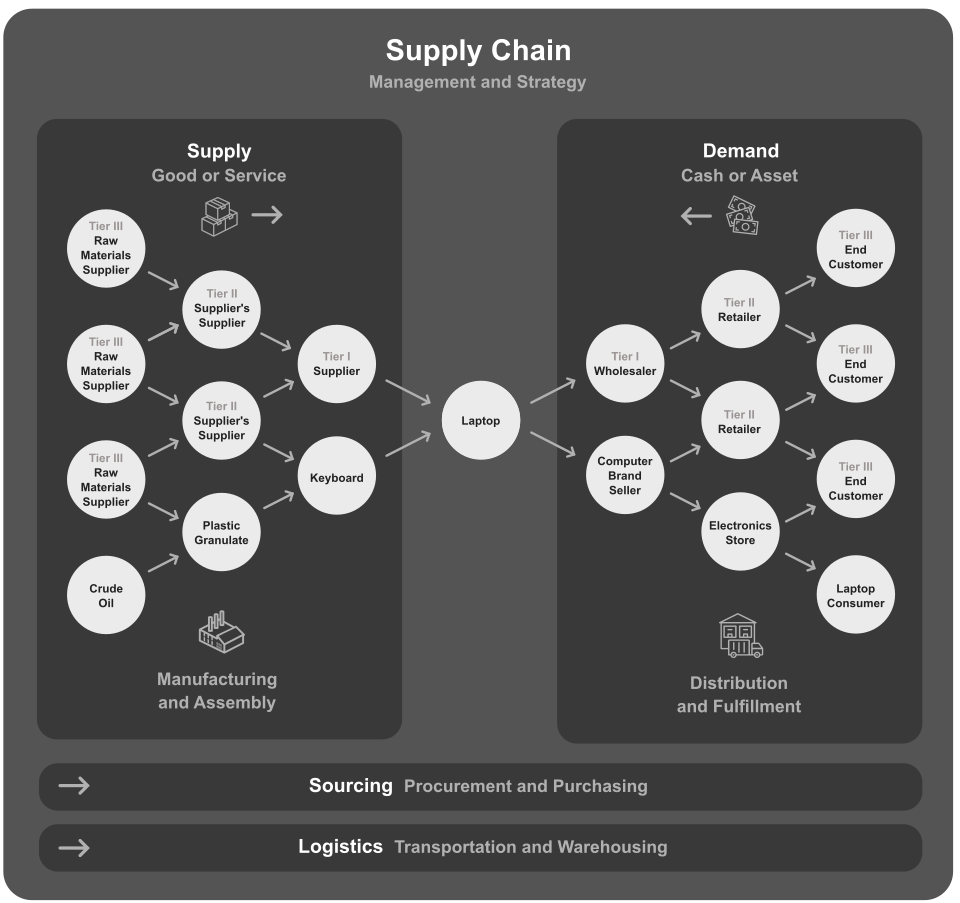 Supply chain for a Nepali e-commerce startup (Daraz-like). (Image: Miguel Garcia Gonzalez, CC BY-SA 4.0, via Wikimedia Commons)
2.8 Financial Plan
A. Startup Costs
| Expense | Example Cost (₹) | Notes |
|---|---|---|
| Legal registration | 50,000 | Company Registration Office fee. |
| Website/app development | 1,500,000 | Freelancers in Nepal: ₹500–₹1,000/hr. |
| Inventory (if applicable) | 2,000,000 | Daraz’s initial stock. |
| Marketing | 800,000 | Facebook/Google ads. |
B. Revenue Projections Use 3-year forecast (conservative, moderate, optimistic). Example for AgriLink Nepal:
| Year | Transactions | Revenue (5% commission) | Profit Margin |
|---|---|---|---|
| 1 | 50,000 | ₹2,500,000 | 20% |
| 2 | 100,000 | ₹5,000,000 | 25% |
| 3 | 200,000 | ₹10,000,000 | 30% |
C. Break-Even Analysis
- Formula:
- Example: AgriLink Nepal has fixed costs of ₹3M/year and charges ₹500/commission. If variable cost per transaction is ₹50:
2.9 Risk Analysis
- Identify risks: Political instability, cash flow issues, competition.
- Mitigation strategies:
- Diversify suppliers (e.g., AgriLink partners with 3 logistics firms).
- Government grants: Apply for Nepal Investment Board incentives.
Mermaid Diagram: Risk Management for Startups
flowchart TD
    A["Identify Risks"] --> B["Assess Likelihood/Impact"]
    B --> C["Mitigate"]
    C --> D["Monitor"]
    D -->|"Feedback"| A
2.10 Appendix
- Supporting documents:
- Resumes of key team members.
- Market research data (e.g., Nepal Rastra Bank reports).
- Legal permits (e.g., CIB registration for fintech).
In the Real World
Daraz Nepal
- Idea Used: Business plan for scaling e-commerce.
- How: Their 2016 plan included:
- Market analysis: Nepal’s urban population growth (22% in Kathmandu).
- Operations: Partnerships with local couriers (now Daraz Logistics).
- Financials: Secured ₹100M from Alibaba for expansion.
- Exam Link: "How would you structure a plan for a Daraz competitor in Pokhara?"
Khalti
- Idea Used: Financial projections for fintech.
- How: Their 2019 plan projected:
- 1M users in Year 1 (achieved 2M).
- Revenue from merchant fees (1–2%) and forex transactions.
- Real-World Tie: "Calculate Khalti’s break-even if they charge 1.5% on ₹500 transactions."
NTC’s Fiber Expansion
- Idea Used: Government-backed business plan.
- How: Their 2020–2025 plan included:
- SWOT: Strength (monopoly), Weakness (slow rollout).
- Financials: ₹50B budget from government + loans.
- Risk: Political delays → mitigation: Fast-track permits.
Case Study: Himalayan Java’s Business Plan
Scenario: A Pokhara-based coffee startup wants to export to Europe. Plan Highlights:
- Executive Summary:
- "Himalayan Java exports organic coffee from Pokhara to EU markets, targeting ₹20M revenue in Year 3."
- Market Analysis:
- Target: EU organic coffee market (worth €1.2B).
- Competitors: Nepal’s other exporters (e.g., Green Hills Coffee).
- Operations:
- Supply chain: Farmers → Processing unit (Pokhara) → Port (Kathmandu).
- Certifications: EU Organic Standard (cost: ₹500K).
- Financials:
- Startup cost: ₹8M (₹3M for certification, ₹5M for marketing).
- Break-even: 15,000 kg/year at ₹1,000/kg.
- Risks:
- Political: EU tariffs → Solution: Lobby via Nepal Embassy in Brussels.
Mermaid Diagram: Himalayan Java’s Export Process
flowchart LR
    A["Farmers (Pokhara)"] --> B["Processing Unit"]
    B --> C["Quality Check"]
    C --> D["Port (Kathmandu)"]
    D --> E["EU Importer"]
    E --> F["Retailers (e.g., Starbucks Europe)"]
Exam Tip
How to Score Full Marks
- Structure: Follow the 10-section outline strictly. Examiners deduct marks for missing sections (e.g., no financials = 20% loss).
- Data: Use real Nepal stats (e.g., Nepal Rastra Bank, CIB, NIB).
- Example: "Nepal’s startup ecosystem grew 40% in 2023 (NIB report)."
- Case Studies: Expect short-answer questions like:
- "Write a 1-page plan for a solar panel startup in Dhankuta."
- "Analyze Pathao’s competitive advantage using Porter’s 5 Forces."
- Financials: Always show calculations (e.g., break-even, ROI).
- Formula to remember:
- Diagrams: Draw 1–2 diagrams per answer (e.g., SWOT, BCG Matrix).
- Local Relevance: Tie answers to Nepal’s context (e.g., labor laws, tax incentives).
Common Mistakes to Avoid:
- ❌ Generic plans (e.g., "We will sell products" → Vague).
- ✅ Specific: "We will sell organic coffee to EU via 5 certified importers."
- ❌ Ignoring risks (e.g., no mention of political instability).
- ✅ Mitigation: "Apply for NIB grants to offset currency risks."
Practice Question (Exam-Style)
Question: "A student in Pokhara wants to start a drone-based delivery service for medicines. Write a 1-page business plan outline focusing on the market analysis and financial projections sections."
Model Answer Structure:
Market Analysis:
- Industry: Drone delivery in Nepal (growing at 50% YoY).
- Target: Hospitals in Pokhara (50+), rural clinics.
- Competitors: NTC’s traditional delivery, Pathao’s pilot drone project.
- SWOT:
Strength Weakness Fast delivery (30 mins) High initial cost (₹10M) Opportunity Threat Government grants CAAN regulations
Financial Projections:
- Startup cost: ₹10M (₹5M drones, ₹3M permits, ₹2M marketing).
- Revenue: ₹8M/year (₹200 per delivery × 40,000 deliveries).
- Break-even: 25,000 deliveries (₹5M revenue needed to cover costs).
Visual:
Based on the PU BE Computer (PU) syllabus for Entrepreneurship and Professional Practice (MGT332), unit 3.
Discussion
Loading…