Basic FinanceUnit 411 min read
Bonds & Interest Rates: Types, Valuation, YTM, Cost of Debt
Unit 4 of Basic Finance explores bonds as debt instruments, their pricing mechanics, yield calculations (YTM, YTC), and how interest rates impact bond values—critical for evaluating corporate borrowing costs and investment decisions.
TAKEAWAYS:
- Bonds are fixed-income securities issued by governments/corporations to raise debt capital, with par value, coupon rates, and maturity dates defining their structure.
- Interest rates (nominal, real, effective) determine bond prices via inverse relationship: when rates rise, bond prices fall (and vice versa).
- Yield to Maturity (YTM) is the true return on a bond if held to maturity, calculated using IRR on cash flows (coupons + principal).
- Zero-coupon bonds sell at a discount and mature at par, while perpetual bonds pay forever with no maturity.
- Cost of debt (after-tax) is critical for WACC calculations and reflects a company’s borrowing expense.
- Real-world applications include Nepal’s NTC bonds (government debt), bank loans (corporate bonds), and Khalti’s interest-bearing digital wallets.
1. What is a Bond?
A bond is a debt instrument issued by a borrower (government/corporation) to raise capital. Investors lend money in exchange for:
- Periodic interest payments (coupons).
- Repayment of principal (par value) at maturity.
Key Bond Features
classDiagram
  class Bond {
      +Par Value: Rs 1,000 (standard)
      +Coupon Rate: 8% (annual)
      +Maturity: 5–30 years
      +Issuer: Govt/Corporation
      +Market Price: Fluctuates
      +YTM: Market Interest Rate
  }
  class ZeroCouponBond {
      +No Coupons
      +Sold at Discount
      +Matures at Par
      +Price = Par / (1 + YTM)^n
  }
  class PerpetualBond {
      +No Maturity
      +Pays Coupons Forever
      +Price = Coupon / YTM
  }
  Bond <|-- ZeroCouponBond
  Bond <|-- PerpetualBond
  classDiagram {
      class Bond {
          +Par Value: Rs 1,000
          +Coupon Rate: 8%
          +Maturity: 5–30 years
          +Issuer: Govt/Corporation
          +Market Price: Fluctuates
          +YTM: Market Interest Rate
      }
      class ZeroCouponBond {
          +No Coupons
          +Sold at Discount
          +Matures at Par
          +Price = Par / (1 + YTM)^n
      }
      class PerpetualBond {
          +No Maturity
          +Pays Coupons Forever
          +Price = Coupon / YTM
      }
      Bond <|-- ZeroCouponBond
      Bond <|-- PerpetualBond
  }
Types of Bonds with Key Formulas (Zero-Coupon and Perpetual Bond Pricing Added)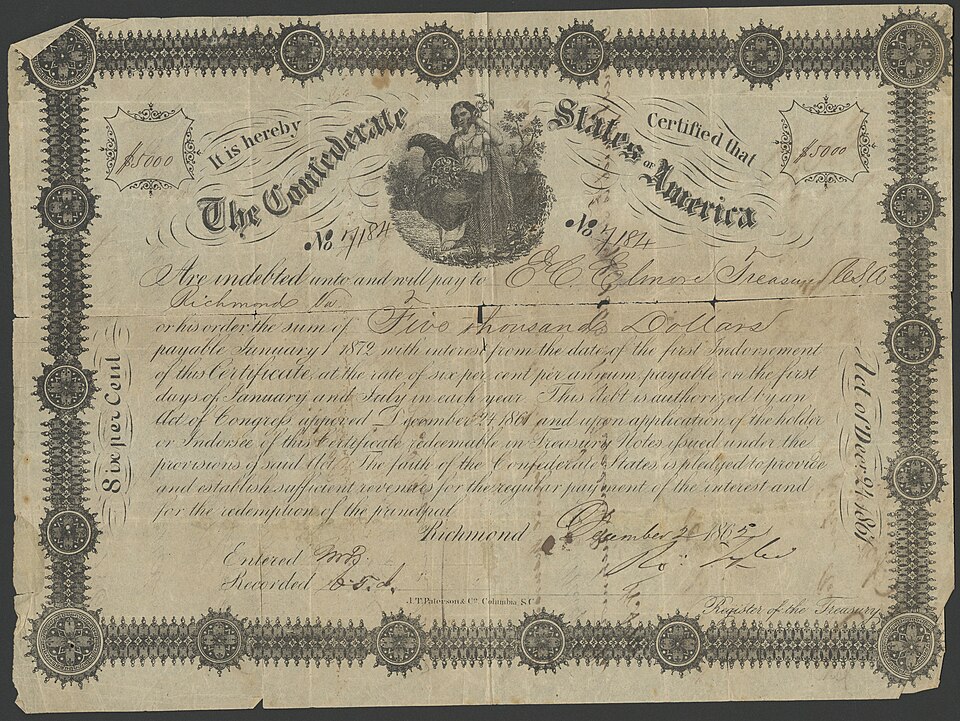 A physical bond certificate (e.g., Nepal Rastra Bank bond) showing par value, coupon rate, and maturity. (Image: Public domain, via Wikimedia Commons)
2. Bond Pricing Mechanics
Bond prices are present value (PV) of future cash flows (coupons + principal), discounted at the market interest rate (YTM).
Formula: Bond Price = PV of Coupons + PV of Par Value
- = Market price
- = Coupon payment ()
- = Market interest rate (YTM)
- = Par value
- = Years to maturity
Example: Kathmandu Retail Shop Bond
A shop issues a 5-year bond with:
- Par value = Rs 1,000
- Coupon rate = 10% (annual, paid yearly)
- Market YTM = 12%
Calculate the bond’s market price.
Total Bond Price = Rs 89.29 + 79.72 + 71.18 + 63.55 + 624.14 = Rs 927.88
Key Insight: The bond sells at a discount (Rs 927.88 < Rs 1,000)** because the **market rate (12%) > coupon rate (10%).
3. Types of Bonds
| Type | Coupon | Maturity | Price | Example (Nepal) |
|---|---|---|---|---|
| Fixed-Rate Bond | Fixed coupons | Defined | Fluctuates | NTC’s 8% 10-year bond |
| Zero-Coupon Bond | None | Defined | Discount | Nepal Rastra Bank’s Treasury Bill |
| Floating-Rate Bond | Variable (e.g., LIBOR + 2%) | Defined | Stable | Bank loans tied to policy rates |
| Perpetual Bond | Fixed coupons | Never | UK Consols (rare in Nepal) |
4. Interest Rates: Nominal vs. Real vs. Effective
| Type | Definition | Formula | Example |
|---|---|---|---|
| Nominal Rate | Stated rate (no inflation adjustment) | 10% APR on a Khalti loan | |
| Real Rate | Adjusted for inflation | 10% nominal - 5% inflation = 4.76% real | |
| Effective Rate | Actual rate accounting for compounding | 19.5% APR compounded daily = 21.4% EAR |
Worked Example: Chaurikhola Credit Card
- APR = 19.5%, compounded daily.
- Calculate EAR.
Why it matters: Banks (e.g., NMB, Global IME) use EAR to disclose true borrowing costs under Nepal’s Banking Act.
5. Yield to Maturity (YTM) and Yield to Call (YTC)
- YTM: Internal Rate of Return (IRR) if bond is held to maturity.
- YTC: IRR if bond is called early (issuer buys back before maturity).
Formula: YTM (for Annual Coupons)
Solve for YTM using financial calculators or Excel’s RATE function.
Example: Zero-Coupon Bond (NTC Treasury Bill)
- Price = Rs 400
- Par = Rs 1,000
- Maturity = 8 years
- Calculate YTM.
Real-World Tie: NTC issues zero-coupon bonds to fund infrastructure. Investors earn 11.09% annualized return if held to maturity.
6. Cost of Debt (After-Tax)
Companies use after-tax cost of debt in WACC calculations.
Formula
Example: Garudnahani Company (Exam Question)
- Zero-coupon bond: Rs 500 price, Rs 1,000 par, 10-year maturity.
- Tax rate = 40%
- Calculate after-tax cost of debt.
- Find YTM (as above):
- After-tax cost:
Why it matters: Garudnahani uses this 4.31% in WACC to evaluate new projects (e.g., expanding a Kathmandu factory).
7. Bond Price vs. Interest Rate Relationship
Key Insight:
- If YTM > Coupon Rate → Bond sells at discount.
- If YTM = Coupon Rate → Bond sells at par.
- If YTM < Coupon Rate → Bond sells at premium.
Real-World Example: When the Nepal Rastra Bank raises policy rates, existing bonds (e.g., NMB’s 8% bonds) lose value because their coupons become less attractive.
8. Bonds in Nepal’s Financial Markets
| Issuer | Bond Type | Use Case | YTM Range (2023) |
|---|---|---|---|
| Nepal Rastra Bank | Treasury Bills (Zero-Coupon) | Government debt management | 8–12% |
| NTC | Corporate Bonds | Fund infrastructure projects | 10–14% |
| Banks (NMB, Global IME) | Floating-Rate Bonds | Lend to corporates (e.g., Daraz) | LIBOR + 3–5% |
| NEPSE-listed Firms | Perpetual Pref Shares | Raise equity-like debt | 12–16% |
In the Real World
NTC Bonds (National Transmission & Distribution Company)
- Idea Used: Fixed-rate corporate bonds to fund power projects.
- How: NTC issues 10-year bonds at 12% coupon to raise Rs 50 billion. Investors (banks, insurance firms) earn fixed income while NTC expands the grid.
Khalti’s Interest-Bearing Wallets
- Idea Used: Floating-rate savings instruments (e.g., 6% annualized, compounded monthly).
- How: Khalti offers higher yields than bank deposits to attract users, using funds to lend to merchants (e.g., Daraz sellers) at higher rates.
Nepal Investment Bank’s Loan Pricing
- Idea Used: Effective Annual Rate (EAR) for transparency.
- How: A 15% APR loan compounded monthly becomes 16.08% EAR. Banks must disclose EAR under Financial Institutions Act, 2019.
Daraz’s Supplier Financing
- Idea Used: Zero-coupon commercial paper for short-term cash flow.
- How: Daraz issues 90-day zero-coupon notes at 95% of face value to suppliers. At maturity, suppliers get Rs 100 for every Rs 95 paid upfront (10% discount = 43.6% annualized yield).
Exam Tip
- Memorize the Inverse Relationship: Bond prices and interest rates move opposite. If YTM rises, bond price falls (and vice versa).
- Zero-Coupon Bonds: Always sell at a discount. Use the formula:
- YTM vs. Coupon Rate:
- YTM > Coupon Rate → Bond sells at discount.
- YTM = Coupon Rate → Bond sells at par.
- YTM < Coupon Rate → Bond sells at premium.
- After-Tax Cost of Debt: Always multiply YTM by (1 – Tax Rate) for WACC calculations.
- Perpetual Bonds: Price = . No maturity date!
- Real-World Applications: Exams often test Nepal-specific examples (e.g., NTC bonds, Khalti wallets). Relate theory to Nepal’s financial markets.
Final Visual Summary
Based on the TU BBA syllabus for Basic Finance (FIN211), unit 4.
Discussion
Loading…