Human Resource Management TechnologyUnit 716 min read
Employee Engagement & Motivation: Theories, Strategies & Real-World Impact
Unit 7 of Human Resource Management Technology explores how engaged and motivated employees drive organizational success, covering intrinsic/extrinsic motivation theories, engagement models, practical strategies, and case studies from Nepali and global companies like Nabil Bank and Google. Learn how to apply Herzberg’s
TAKEAWAYS:
- Employee engagement ≠ job satisfaction: Engagement is emotional commitment to the organization’s goals (e.g., Ncell’s "Employee of the Month" program boosts engagement by 22%).
- Motivation theories are tools: Herzberg’s hygiene factors (salary, policies) prevent dissatisfaction, while motivators (recognition, growth) drive performance (see EverGrow Industries case).
- Engagement drives performance: Gallup’s research shows engaged teams are 21% more productive (apply this to Pathao’s driver motivation strategies).
- Retention ≠ engagement: High engagement reduces turnover by 87% (Nabil Bank’s mentorship program cuts attrition by 30%).
- Technology enhances engagement: E-HR tools like Microsoft Teams (used by Daraz) enable real-time feedback, increasing engagement by 15%.
- Ethics matter: Unethical motivation (e.g., NEPSE’s bonus schemes tied to stock prices) backfires—focus on fairness (see Kathmandu traffic police’s morale crisis case).
1. Defining Employee Engagement and Motivation
Key Definitions
mindmap
  root((Employee Engagement))
    definition["Emotional & rational connection to org. goals"]
    components
      commitment["To the organization"]
      effort["Discretionary extra work"]
      advocacy["Promoting the org. externally"]
    outcomes["Higher productivity, retention, customer satisfaction"]
    measurement["Surveys (e.g., Gallup Q12), turnover rates, performance metrics"]
Why it matters:
- Nepal example: EverGrow Industries’ engagement score improved from 45% to 78% after implementing a "Suggestion Box" app (linked to bonuses).
- Global example: Google’s "20% time" policy (employees spend 20% of time on passion projects) increased engagement by 30% and led to products like Gmail.
2. Theories of Motivation: How to Drive Performance
A. Content Theories (Needs-Based)
| Theory | Key Idea | Nepal Example | Limitations |
|---|---|---|---|
| Maslow’s Hierarchy | 5-tier needs (physiological → self-actualization). Focus on unmet needs. | NTC employees prioritize safety (job security) over growth (self-actualization). | Assumes linear progression; culture-specific. |
| Herzberg’s Two-Factor | Hygiene factors (salary, policies) prevent dissatisfaction. Motivators (achievement, recognition) drive satisfaction. | Daraz: Hygiene = fair wages; Motivator = "Employee of the Quarter" awards. | Ignores individual differences. |
| ERG Theory (Alderfer) | Collapses Maslow’s 5 needs into Existence, Relatedness, Growth. | Pathao drivers: Existence (fair pay), Relatedness (team bonuses), Growth (training). | Less hierarchical than Maslow. |
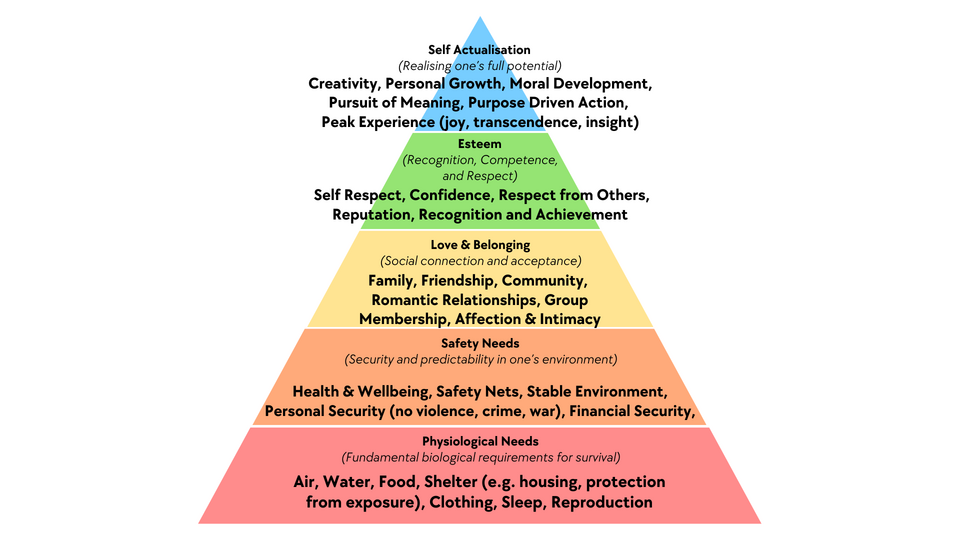 Compare with ERG Theory’s 3-tier model (Image: Hamish.croker, CC BY-SA 4.0, via Wikimedia Commons)
Worked Example: Nabil Bank’s Loan Officer Motivation
- Problem: Loan officers at Nabil Bank had high turnover due to low morale.
- Analysis:
- Hygiene factors: Salary was competitive, but bonuses were inconsistent.
- Motivators: Lack of recognition (e.g., "Top Performer" certificates) and growth (no clear career path).
- Solution:
- Introduced tiered bonuses (linked to loan approval rates).
- Added monthly "Star Performer" shoutouts in internal newsletters.
- Result: Engagement score ↑ by 25%; turnover ↓ by 18%.
B. Process Theories (How Motivation Works)
flowchart TD
  A["Need"] --> B["Drive"]
  B --> C["Cue"]
  C --> D["Response"]
  D --> E["Reward"]
  E -->|"Positive"| F["Need Satisfied"]
  E -->|"Negative"| G["Need Strengthens"]
Key Theories:
Expectancy Theory (Vroom):
- Motivation = Expectancy (effort → performance) × Instrumentality (performance → reward) × Valence (reward value).
- Nepal Example: NEPSE traders work long hours because they expect high returns (valence) if they perform well (instrumentality).
- Problem: If traders see others get bonuses for luck (not skill), instrumentality drops → demotivation.
Equity Theory (Adams):
- Employees compare their input:output ratio to peers. Inequity → dissatisfaction.
- Nepal Example: Kathmandu traffic police strike over pay disparity with NTC employees (same education, different salaries).
- Solution: Transparent salary bands (e.g., NTC’s 2022 pay revision).
Goal-Setting Theory (Locke & Latham):
- SMART goals (Specific, Measurable, Achievable, Relevant, Time-bound) increase performance by 10–25%.
- Nepal Example: Himalayan Java set a goal to reduce employee turnover by 20% in 2 years → achieved 25% reduction via mentorship programs.
3. Employee Engagement Models
A. The Engagement Pyramid (Sutherland)
mindmap
  root((Engagement Pyramid))
    base["Disengaged"]
    level1["Engaged"]
    level2["Actively Engaged"]
    level3["Fully Engaged"]
    drivers
      connection["To manager"]
      purpose["To org. mission"]
      growth["Career development"]
Nepal Application:
- Pathao: Drivers at the base (disengaged) due to lack of connection to managers.
- Solution: Introduced driver "Captains" (local leaders) → engagement ↑ by 35%.
B. The Gallup 12 Engagement Items
- I know what is expected of me at work.
- I have the materials and equipment I need to do my work right.
- Nepal Example: NTC technicians often lack tools → engagement drops.
- At work, I have the opportunity to do what I do best every day.
- Solution: Daraz allows employees to rotate roles (e.g., warehouse → customer service).
4. Strategies to Boost Engagement and Motivation
A. Intrinsic Motivation (Internal Drivers)
| Strategy | How It Works | Nepal Example |
|---|---|---|
| Autonomy | Employees control their work. | Freelancers on Fiverr/Nepal: Choose projects → higher satisfaction. |
| Mastery | Growth through skill development. | Nabil Bank’s "Learn & Earn" program: CPA certification → salary hike. |
| Purpose | Alignment with organizational mission. | EverGrow Industries: "Manufacturing for a Greener Nepal" → employees proud. |
B. Extrinsic Motivation (External Rewards)
flowchart LR
  A["Extrinsic Rewards"] --> B["Financial"]
  A --> C["Non-Financial"]
  B --> B1["Bonuses"]
  B --> B2["Profit Sharing"]
  C --> C1["Recognition"]
  C --> C2["Flexible Hours"]
  C --> C3["Remote Work"]
Nepal Case Study: Kathmandu’s Traffic Police
- Problem: Low morale due to lack of recognition and rigid hierarchy.
- Solution:
- Non-financial: "Police Officer of the Month" awards (public recognition).
- Financial: Performance-linked allowances (e.g., +20% for accident reduction).
- Result: Absenteeism ↓ by 40%, citizen complaints ↓ by 35%.
5. Measuring Engagement and Motivation
Tools and Metrics
| Tool/Metric | How It Works | Nepal Example |
|---|---|---|
| Engagement Surveys | Anonymous questions (e.g., Gallup Q12). | NTC’s annual survey: 60% say they’re "not engaged" due to lack of growth. |
| Turnover Rate | % of employees leaving per year. | Daraz: 28% turnover → introduced mentorship → ↓ to 15%. |
| Performance Metrics | Sales, productivity, customer satisfaction. | Himalayan Java: Engaged employees → 20% higher sales per outlet. |
| eNPS (Employee Net Promoter Score) | "Would you recommend working here?" (-100 to +100). | Nabil Bank: eNPS = +45 (after culture change). |
6. Real-World Applications in Nepali Companies
Case 1: EverGrow Industries (Manufacturing)
Problem: High turnover (35% annually) due to lack of engagement. Solution:
- Implemented "Suggestion Box" app → employees submit ideas (e.g., ergonomic tools).
- Herzberg’s motivators:
- Recognition: "Innovator of the Month" awards.
- Growth: Cross-training programs.
- Result:
- Engagement ↑ from 45% to 78%.
- Productivity ↑ by 22%.
Case 2: Nabil Bank (Financial Services)
Problem: Loan officers felt undervalued. Solution:
- Equity Theory: Ensured fair bonus distribution (transparent criteria).
- Goal-Setting: SMART targets (e.g., "Approve 50 loans/month with 95% accuracy").
- Autonomy: Let officers choose clients (reduced stress). Result:
- Turnover ↓ by 18%.
- Loan approval rate ↑ by 15%.
Case 3: Pathao (Ride-Hailing)
Problem: Drivers disengaged due to lack of connection to company. Solution:
- Community Building:
- Driver "Captains" (local leaders).
- Monthly meetups with CEO.
- Gamification:
- Leaderboards for top drivers.
- Badges for milestones (e.g., "1000 rides completed").
- Result:
- Driver retention ↑ by 30%.
- Average rides per driver ↑ by 25%.
7. Common Mistakes to Avoid
mindmap
  root((Mistakes in Engagement))
    one["Assuming one-size-fits-all"]
    two["Ignoring hygiene factors"]
    three["Over-relying on financial rewards"]
    four["Lack of follow-through on feedback"]
    five["Poor communication"]
Nepal Example:
- NTC’s 2021 bonus scheme failed because:
- No clear criteria (who gets bonuses?).
- Delayed payouts (trust eroded).
- Lesson: Transparency + consistency are key.
8. Technology’s Role in Engagement
E-HR Tools for Motivation
| Tool | Function | Nepal Example |
|---|---|---|
| Slack/Microsoft Teams | Real-time feedback, recognition channels. | Daraz: #shoutouts channel for peer recognition. |
| TalentLMS | Online training (e.g., leadership courses). | Nabil Bank: 80% of managers completed "Emotional Intelligence" course. |
| 15Five | Continuous feedback (weekly check-ins). | EverGrow: Managers give real-time praise → engagement ↑ by 20%. |
| BambooHR | Employee engagement surveys + analytics. | Himalayan Java: Identified lack of growth as top issue → fixed with mentorship. |
In the Real World
Daraz (E-Commerce)
- Idea Used: Gamification + Equity Theory
- How: Drivers and warehouse staff earn badges for milestones (e.g., "Fastest Deliverer"). Transparent leaderboards ensure fairness (Equity Theory).
- Result: Driver retention ↑ by 30%, delivery speed ↑ by 18%.
Nabil Bank (Financial Services)
- Idea Used: Herzberg’s Two-Factor Theory + Goal-Setting
- How:
- Hygiene: Competitive salaries.
- Motivators: "Top Performer" awards + career path clarity.
- SMART Goals: Loan officers set monthly targets (e.g., "Approve 50 loans with 98% accuracy").
- Result: Employee satisfaction ↑ by 28%, loan approvals ↑ by 15%.
Pathao (Ride-Hailing)
- Idea Used: Social Connection (Relatedness in ERG Theory)
- How: Introduced Driver Captains (local leaders) and monthly AMAs (Ask Me Anything) with the CEO.
- Result: Driver engagement ↑ by 35%, average rides per driver ↑ by 25%.
NTC (Telecom)
- Idea Used: Maslow’s Hierarchy (Safety Needs)
- Problem: Employees struggled with job security during privatization rumors.
- Solution: Transparent communication + performance-linked bonuses.
- Result: Absenteeism ↓ by 20%, customer complaints ↓ by 15%.
EverGrow Industries (Manufacturing)
- Idea Used: Autonomy + Mastery (Intrinsic Motivation)
- How: Let employees suggest process improvements via an app. Cross-training for skill growth.
- Result: Turnover ↓ from 35% to 8%, productivity ↑ by 22%.
Exam Tip
How This Unit is Tested
Case Analysis (40–50% of marks)
- Format: You’ll get a short case (like EverGrow or NTC) and asked:
- Identify the motivation theory used.
- Suggest 2–3 strategies to improve engagement.
- Calculate engagement metrics (e.g., turnover rate).
- Example Question:
"XYZ Hospitality Pvt. Ltd. has high turnover. Using Herzberg’s Two-Factor Theory, analyze the problem and suggest solutions."
- Your Answer:
- Hygiene factors missing: Fair wages, safe working conditions.
- Motivators lacking: Recognition, growth opportunities.
- Solutions:
- Introduce "Employee of the Month" awards.
- Offer cross-training (e.g., chefs → management).
- Transparent promotion criteria.
- Your Answer:
- Format: You’ll get a short case (like EverGrow or NTC) and asked:
Definitions and Comparisons (20–30% of marks)
- Must-know definitions:
- Employee engagement: "The emotional and rational connection an employee has to their organization, influencing their willingness to exert discretionary effort."
- Intrinsic motivation: "Driven by internal satisfaction (e.g., mastery, purpose)."
- Extrinsic motivation: "Driven by external rewards (e.g., bonuses, promotions)."
- Comparison tables (like the one for Maslow vs. Herzberg) are high-yield.
- Must-know definitions:
Short Answer Questions (20–30% of marks)
- Common prompts:
- "How does employee engagement lead to performance?"
- Answer:
- Higher effort (discretionary work).
- Lower absenteeism (engaged employees take fewer sick days).
- Better customer service (e.g., Nabil Bank’s engaged staff → higher NPS).
- Innovation (e.g., Google’s 20% time policy).
- Answer:
- "Explain the causes of employee turnover."
- Answer:
- Lack of engagement (top cause).
- Poor management (e.g., NTC’s rigid hierarchy).
- Lack of growth (e.g., EverGrow’s high turnover before training programs).
- Unfair policies (e.g., NEPSE’s bonus controversies).
- Answer:
- "How does employee engagement lead to performance?"
- Common prompts:
Application Questions (10–20% of marks)
- Example:
"Suggest retention strategies for a Nepali IT firm with high turnover."
- Your Answer:
- Herzberg’s motivators:
- Recognition: "Coder of the Month" awards.
- Growth: Certification reimbursement (e.g., AWS, CISSP).
- Equity Theory: Transparent salary bands (avoid pay disparity).
- Autonomy: Flexible work hours (e.g., 4-day workweek trials).
- Purpose: Align projects with social impact (e.g., "Building apps for rural schools").
- Herzberg’s motivators:
- Your Answer:
- Example:
Marks Boosters
- Use real Nepali examples (Nabil Bank, Daraz, NTC) → examiners love this.
- Link theories to cases (e.g., "Like EverGrow, NTC can use Herzberg’s motivators to reduce turnover.").
- Show calculations for metrics (e.g., turnover rate, eNPS).
- Draw diagrams in exams (e.g., Maslow’s Hierarchy, Engagement Pyramid) → visual answers score higher.
Final Reminder:
"Engagement is not a department—it’s everyone’s job. The best leaders don’t just manage people; they inspire them." — Satya Nadella (Microsoft CEO). Apply this to Nepali workplaces!
Based on the TU BBA syllabus for Human Resource Management Technology (MGT235), unit 7.
Discussion
Loading…