PsychologyUnit 513 min read
Cognition & Perception: How We Think & See the World
Unit 5 of Psychology: Explores how humans process sensory information, interpret the world, and make sense of thoughts, memories, and judgments—key to understanding behavior, decision-making, and biases in real life.
TAKEAWAYS:
- Cognition is the mental process of acquiring, storing, and using knowledge (e.g., thinking, problem-solving, language), while perception is how we interpret sensory input (e.g., seeing colors, hearing sounds).
- Sensation is the raw detection of stimuli (e.g., light hitting your retina), but perception adds meaning (e.g., recognizing a face).
- Perceptual biases (like the halo effect or stereotyping) distort how we judge others, affecting workplace decisions and social interactions.
- Cognitive processes (e.g., attention, memory, decision-making) explain why people make irrational choices (e.g., impulse buys, misjudging risks).
- Real-world applications include AI (pattern recognition), marketing (advertising tricks), and psychology (therapy for misperceptions).
- Exam focus: Compare sensation vs. perception, explain biases, and link theories to real-life examples (e.g., eSewa’s fraud detection, Pathao’s driver routing).
1. Definitions: Cognition vs. Perception
Cognition refers to all mental processes involved in acquiring, storing, and using knowledge. It includes:
- Thinking
- Problem-solving
- Memory
- Language
- Decision-making
Perception, on the other hand, is the interpretation of sensory information to give it meaning. It’s how we organize and make sense of what we see, hear, touch, etc.
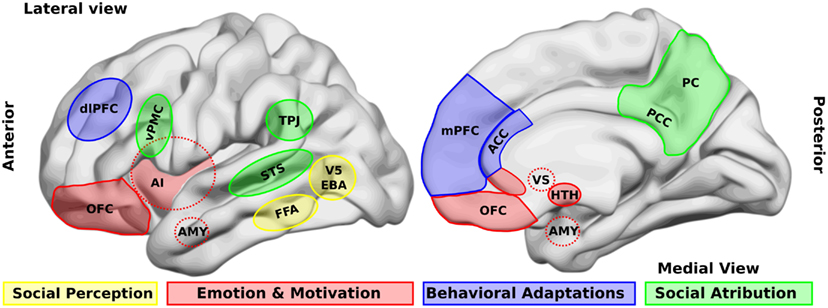 Regions like the prefrontal cortex (thinking) and occipital lobe (visual processing) work together for cognition and perception. (Image: Billeke P and Aboitiz F, CC BY 3.0, via Wikimedia Commons)
Key Difference: Sensation vs. Perception
| Aspect | Sensation | Perception |
|---|---|---|
| Definition | Detection of raw stimuli (e.g., light, sound) | Interpretation of stimuli (e.g., recognizing a friend’s face) |
| Example | Your eyes detect light waves. | Your brain interprets those waves as a red traffic light. |
| Process | Bottom-up (stimulus → sensory receptors) | Top-down (brain adds context, past experience) |
| Bias Influence | Minimal (just physical detection) | High (distorted by expectations, culture, emotions) |
Mermaid Diagram: Sensation → Perception Process
2. How Perception Works: The Gestalt Principles
Our brains organize sensory input into coherent patterns using Gestalt laws. These explain why we "see the whole" even if parts are missing.
Key Principles:
- Proximity: Objects close together are perceived as a group.
- Example: In a crowded market (like Patan Durbar Square), you group nearby stalls as one shop rather than individual vendors.
- Similarity: Similar objects are grouped together.
- Example: Daraz’s product grid uses color-coding (e.g., red for discounts) to group items.
- Closure: We fill in gaps to see complete shapes.
- Example: Recognizing a partially obscured logo (e.g., Ncell’s "N" in a crowd).
- Figure-Ground: We distinguish objects (figure) from their background.
- Example: Spotting a Pathao driver’s red cap in a Kathmandu traffic jam.
3. Perceptual Biases: Why We Misjudge
Our brains use shortcuts (heuristics), but they often lead to errors. Two major biases:
A. Halo Effect
- Definition: When one positive trait (e.g., attractiveness) influences our overall impression of a person.
- Example:
- In job interviews, candidates who dress well (halo effect) are often rated higher, even if their skills are similar.
- Real-world link: eSewa’s customer service reps with friendly voices (halo effect) may get higher trust ratings, even if their response times are average.
B. Stereotyping
- Definition: Overgeneralizing a group based on limited information.
- Example:
- Assuming all NTC employees are "slow" because of a past bad experience with one colleague.
- Real-world link: Banks may stereotype loan applicants from certain neighborhoods as "high-risk," even if data shows otherwise.
Comparison Table: Halo Effect vs. Stereotyping
| Aspect | Halo Effect | Stereotyping |
|---|---|---|
| Basis | Single positive trait (e.g., charm) | Group characteristics (e.g., "all Nepalis are friendly") |
| Impact | Overestimates positive traits | Ignores individual differences |
| Example | "She’s pretty, so she must be smart." | "All Ncell users are unreliable." |
| Real-world Cost | Unfair promotions in jobs | Discrimination in hiring/loans |
4. Cognition in Decision-Making: Heuristics and Biases
Our brains use mental shortcuts (heuristics) to make quick decisions, but they often lead to errors.
A. Availability Heuristic
- Definition: Judging probability based on how easily examples come to mind.
- Example:
- After seeing news about plane crashes, people overestimate flying risks (even though car accidents are deadlier).
- Real-world link: NEPSE investors panic-sell stocks after a market crash (availability heuristic distorts risk perception).
B. Anchoring Effect
- Definition: Relying too heavily on the first piece of information (the "anchor") when making decisions.
- Example:
- A Daraz seller lists a product at ₹500 first, then discounts it to ₹300—customers perceive ₹300 as a great deal because ₹500 was the anchor.
- Real-world link: Banks use high initial loan interest rates to "anchor" customers into accepting higher rates.
Mermaid Diagram: Heuristic Decision-Making
flowchart TD
    A["Decision Context: Loan Offer"]
    B["Initial Anchor: ₹500 listed price"]
    C["Discounted Price: ₹300"]
    D["Customer's Perceived Value"]
    E["Bank's Strategy: High initial rate"]
    A --> B
    B --> C
    C --> D
    B --> E
Anchoring effect in pricing: how initial values distort perceived value5. Attention: The Gatekeeper of Cognition
Our brains can’t process all stimuli at once—attention filters what we focus on.
A. Selective Attention
- Definition: Focusing on relevant stimuli while ignoring others.
- Example:
- In a busy Kathmandu street, a Pathao driver ignores honking cars but focuses on GPS directions.
- Real-world link: WhatsApp’s "seen" feature uses selective attention—you notice who read your message but ignore others.
B. Divided Attention
- Definition: Splitting focus between tasks (often leads to errors).
- Example:
- Texting while driving (common in Nepal) reduces reaction time by ~50% (NTC data).
6. Memory: How We Store and Retrieve Information
Memory involves encoding, storage, and retrieval. Three key types:
A. Sensory Memory
- Duration: <1 second (iconic for vision, echoic for sound).
- Example: When you glance at a billboard, you briefly "see" it even after looking away.
B. Short-Term Memory (STM)
- Capacity: ~7±2 items (Miller’s Law).
- Example: Remembering a 7-digit phone number (e.g., Ncell’s customer service hotline) until you dial it.
C. Long-Term Memory (LTM)
- Duration: Years/lifetime.
- Example: Remembering how to ride a bike (procedural memory) or your first job at a bank.
Mermaid Diagram: Memory Flow
graph TD
    A["Sensory Input (e.g., sight, sound)"] --> B["Sensory Memory (<1s)"]
    B --> C["Attention Filter"]
    C --> D["Short-Term Memory (7±2 items)"]
    D --> E["Rehearsal (e.g., repeating a number)"]
    E --> F["Long-Term Memory (stored permanently)"]
    F --> G["Retrieval (e.g., recalling a loan term)"]
7. Real-World Applications of Cognition & Perception
A. eSewa: Fraud Detection via Perception & Cognition
- How it uses this unit:
- Perception: eSewa’s AI detects unusual transaction patterns (e.g., a sudden large transfer from a low-balance account).
- Cognition: Users must recognize phishing emails (perception) and remember secure passwords (memory).
B. Pathao: Driver Routing & Cognitive Load
- How it uses this unit:
- Attention: Drivers focus on GPS (selective attention) while ignoring distractions.
- Heuristics: They use "availability" to avoid congested routes (based on past experiences).
C. NEPSE: Investor Biases in Stock Markets
- How it uses this unit:
- Anchoring: Investors fixate on a stock’s past price (e.g., ₹500) and resist selling even if it drops to ₹300.
- Stereotyping: Some traders assume "foreign investors always win," leading to risky bets.
8. Exam Tip: How to Score Full Marks
Compare and contrast:
- Always link sensation vs. perception, halo effect vs. stereotyping, or STM vs. LTM with real examples (e.g., eSewa fraud, Pathao drivers).
- Example answer starter:
"Unlike sensation, which is the raw detection of stimuli (e.g., your eyes registering light), perception involves interpreting that input (e.g., seeing a red traffic light). In a real-world scenario, a Pathao driver’s eyes detect a pedestrian (sensation), but their brain perceives them as a potential hazard (perception)."
Apply theories to Nepalese contexts:
- Use Daraz’s pricing strategies (anchoring), Ncell’s customer service (halo effect), or NEPSE’s investor behavior (availability heuristic).
- Example:
"The anchoring effect explains why Daraz’s 'limited-time offer' discounts (e.g., ₹100 off from ₹500) make customers perceive ₹400 as a bargain, even if the actual value is lower."
Discuss biases critically:
- For questions like "Are halo effect and stereotyping the same?", argue similarities (both distort judgments) and differences (halo is trait-based; stereotyping is group-based).
- Example structure:
- Define both.
- Compare: "Both rely on incomplete information."
- Contrast: "Halo effect is individual; stereotyping is generalized."
- Real-world impact: "Stereotyping harms loan approvals at banks; halo effect can lead to unfair promotions."
Use diagrams for perception processes:
- Draw a flowchart of sensation → perception (like the Mermaid example above) to explain how stimuli become meaningful.
- For Gestalt principles, sketch a grouping example (e.g., dots forming a square due to proximity).
Link to organizational psychology:
- Explain how cognitive biases (e.g., confirmation bias) affect workplace decisions (e.g., hiring, promotions).
- Example:
"Managers may favor candidates who remind them of themselves (similarity bias), leading to a homogeneous team at a startup like Daraz."
9. Worked Example: Analyzing a Bank Loan Decision
Scenario: A bank rejects a loan application from a young entrepreneur in Kathmandu because the applicant "looks unprofessional" (halo effect) and "all young people are risky" (stereotype).
Analysis:
Halo Effect:
- The banker’s negative impression of the applicant’s appearance (e.g., casual clothes) influences their judgment of competence.
- Real-world fix: Banks like Global IME use structured interviews to reduce halo effects.
Stereotyping:
- The assumption that "young = risky" ignores individual financial records.
- Real-world fix: NMB Bank uses credit scoring models to reduce bias.
Cognitive Bias Cost:
- The entrepreneur misses funding, hurting their business (e.g., a small café that could’ve grown like a successful Daraz vendor).
Solution:
- Train bankers to separate appearance from skills (reduce halo effect).
- Use data-driven decisions (reduce stereotyping).
10. Common Exam Mistakes to Avoid
- Vague definitions: Don’t say "perception is how we see things." Instead, explain it’s the interpretation of sensory input with examples.
- Ignoring real-world links: Always tie theories to Nepalese apps (eSewa, Pathao) or global examples (Google’s search algorithms).
- Overgeneralizing: Don’t say "all biases are bad." Discuss trade-offs (e.g., heuristics save time but can be inaccurate).
- Skipping comparisons: For questions like "sensation vs. perception," always include a table or flowchart.
Based on the TU BBA syllabus for Psychology (PSY202), unit 5.
Discussion
Loading…