PsychologyUnit 48 min read
Learning & Memory: Processes, Types & Dysfunctions
Unit 4 of Psychology explores how humans acquire, store, and retrieve information (learning and memory), including their biological bases, dysfunctions, and real-world applications like eSewa’s transaction recall and Daraz’s order processing.
TAKEAWAYS:
- Learning is a permanent change in behavior due to experience, involving classical conditioning, operant conditioning, and observational learning.
- Memory has three stages: encoding (converting info to neural code), storage (retention over time), and retrieval (recovering stored info).
- Long-term memory is divided into explicit (declarative) and implicit (procedural) types, with hippocampus and cerebellum playing key roles.
- Memory dysfunctions like amnesia and Alzheimer’s disrupt encoding, storage, or retrieval, often due to brain damage or aging.
- Shaping (reinforcing successive approximations) is a key operant conditioning technique used in training animals and even digital habit formation (e.g., app notifications).
- Real-world examples: eSewa’s memory of transactions (storage), Pathao’s driver route learning (procedural memory), and banks’ loan repayment conditioning (operant conditioning).
1. Introduction to Learning
Learning is the adaptive change in behavior or knowledge resulting from experience. Unlike instinct or maturation, learning is permanent (though sometimes forgotten) and specific (e.g., a student learning algebra, not just "studying").
Key Features of Learning
mindmap
  root((Learning))
    - Permanent Change
    - Experience-Dependent
    - Specific (Not General)
    - Can Be Observed
      - Behavior Change
      - Knowledge Acquisition
    - Not Due to Maturation or Instinct
Types of Learning
| Type | Definition | Example | Real-World Use |
|---|---|---|---|
| Classical Conditioning | Associating two stimuli (e.g., bell → food → salivation). | Pavlov’s dogs. | eSewa’s transaction alerts (sound + notification). |
| Operant Conditioning | Behavior reinforced/punished to increase/decrease frequency. | Skinner’s rat pressing lever for food. | Pathao drivers learning optimal routes (rewarded by tips). |
| Observational Learning | Learning by watching others (Bandura’s Bobo doll). | Child copying parent’s behavior. | Khalti’s fraud detection (employees learn from past cases). |
Worked Example: Bank Loan Repayment A bank offers a discount on interest if a borrower repays on time (positive reinforcement). If repayment is delayed, a penalty fee is applied (negative reinforcement). This operant conditioning ensures consistent repayment behavior.
2. Memory: The Three-Stage Process
Memory is the storage and retrieval of information. It involves:
- Encoding (converting sensory input into neural code).
- Storage (retaining encoded info over time).
- Retrieval (recovering stored info when needed).
flowchart TD
    A["Sensory Input"] -->|"Encoding"| B["Short-Term Memory"]
    B -->|"Rehearsal"| C["Long-Term Memory"]
    C -->|"Retrieval"| D["Behavior/Response"]
    B -->|"Forgetting"| E["Lost"]
Encoding: How Information Gets In
Encoding is the first step where sensory data is processed into a usable format. Types:
- Visual Encoding (pictures, shapes).
- Acoustic Encoding (sounds, rhythms).
- Semantic Encoding (meaning, context).
Example: eSewa Transaction Memory When you pay via eSewa, the app visually encodes the transaction ID, acoustically encodes the confirmation tone, and semantically encodes the meaning ("Payment to ABC Shop").
3. Types of Memory
Memory is classified based on duration and content.
A. Duration-Based Memory
| Type | Duration | Capacity | Example |
|---|---|---|---|
| Sensory Memory | <1 second | High (millions) | Seeing a flash of light. |
| Short-Term Memory (STM) | 20-30 sec | Limited (~7 items) | Remembering a phone number. |
| Long-Term Memory (LTM) | Years to lifetime | Unlimited | Remembering your first day of school. |
Visual: STM vs. LTM
flowchart TD
    A["Sensory Input"] --> B["Sensory Memory"]
    B -->|"Attention"| C["Short-Term Memory"]
    C -->|"Rehearsal"| D["Long-Term Memory"]
    C -->|"Forgetting"| E["Lost"]
B. Content-Based Memory (Long-Term Memory)
Long-term memory is divided into:
- Explicit (Declarative) Memory (conscious recall).
- Episodic (personal events, e.g., your graduation).
- Semantic (facts, e.g., "Nepal’s capital is Kathmandu").
- Implicit (Procedural) Memory (unconscious skills).
- Motor Skills (riding a bike).
- Classical Conditioning (fear of dogs after a bite).
(The hippocampus stores explicit memories, while the cerebellum handles procedural skills like riding a bike.)
Worked Example: Daraz Order Processing
- Explicit Memory: Remembering a customer’s past order history (semantic).
- Implicit Memory: Automatically recalling how to pack an order (procedural).
4. Memory Dysfunctions
Memory problems arise from brain damage, aging, or psychological disorders.
| Dysfunction | Cause | Effect | Example |
|---|---|---|---|
| Amnesia | Brain injury (e.g., accident) | Loss of memory (retrograde or anterograde). | Patient HM (hippocampus removed) lost ability to form new memories. |
| Alzheimer’s Disease | Neurodegeneration | Progressive memory loss, confusion. | Elderly forgetting names of family. |
| Dissociative Amnesia | Psychological trauma | Blocking traumatic memories. | Soldier forgetting war experiences. |
5. Shaping and Its Impact on Learning
Shaping is a technique in operant conditioning where successive approximations of a desired behavior are reinforced.
Example: Training a Dog to Fetch
- Reward for looking at the ball.
- Reward for touching the ball.
- Reward for picking up the ball.
- Reward for bringing it back.
Real-World Use: App Habit Formation
- WhatsApp: Reinforces daily opens with notifications (shaping users to check frequently).
- YouTube: Rewards watch time with suggested videos (shaping addiction to content).
6. Biological Bases of Learning and Memory
Memory relies on neurochemical and structural changes in the brain:
- Synaptic Plasticity: Strengthening of neural connections (e.g., Hebb’s rule: "Neurons that fire together, wire together").
- Long-Term Potentiation (LTP): Permanent increase in synaptic strength after learning.
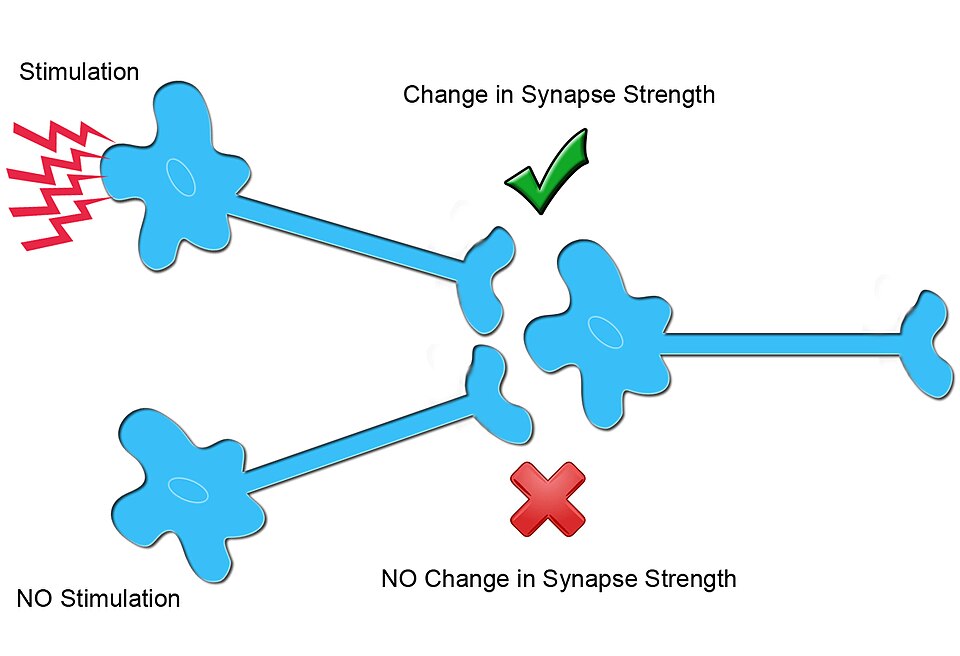 Showing pre- and post-synaptic neurons with neurotransmitters. (Image: HnWilliamson, CC BY-SA 3.0, via Wikimedia Commons)
(Source: "Synaptic plasticity labelled diagram")
Showing pre- and post-synaptic neurons with neurotransmitters. (Image: HnWilliamson, CC BY-SA 3.0, via Wikimedia Commons)
(Source: "Synaptic plasticity labelled diagram")
In the Real World
eSewa’s Transaction Memory
- Uses explicit memory to store transaction details (semantic encoding) and implicit memory for autofill (procedural).
- Example: When you pay, the app retrieves past merchants from long-term memory.
Pathao’s Driver Training
- Shaping is used to train drivers:
- First reward for correct route selection.
- Later for efficient navigation (reducing fuel use).
- Shaping is used to train drivers:
Ncell’s Customer Service
- Classical conditioning: Customers associate Ncell’s jingle with service (bell → food analogy).
- Operant conditioning: Loyalty points (rewards) increase repeat usage.
Exam Tip
- For definitions: Always link learning to permanent behavior change and memory to encoding-storage-retrieval.
- For memory types: Use the duration table (STM vs. LTM) and content table (explicit vs. implicit) to score full marks.
- For dysfunctions: Compare amnesia vs. Alzheimer’s with causes and effects.
- For shaping: Explain in steps (e.g., "First reinforce X, then Y") and tie to real apps (WhatsApp, YouTube).
- For biological bases: Mention synaptic plasticity and LTP—examiners love these terms!
Common Pitfall: Don’t confuse memory with learning. Memory is storage, while learning is acquisition. Always clarify!
Based on the TU BBA syllabus for Psychology (PSY202), unit 4.
Discussion
Loading…