PsychologyUnit 611 min read
Personality Theories, Traits & Assessment: Tools & Applications
Unit 6 of Psychology explores the scientific study of personality—its major theories (Freudian, humanistic, trait-based), assessment methods (objective tests, projective techniques), and real-world applications in workplaces, therapy, and daily life. Learn how to analyze case studies like John’s fluctuating performance
TAKEAWAYS:
- Personality is the unique, stable pattern of thoughts, feelings, and behaviors that distinguishes individuals, shaped by biological, psychological, and social factors.
- Theories (Freud’s psychoanalytic, Maslow’s humanistic, Allport’s trait theory, Big Five) explain personality from unconscious drives to learned traits—each has strengths and limitations.
- Assessment tools range from objective tests (MMPI, 16PF) to projective tests (Rorschach, TAT), with trade-offs in reliability, validity, and cultural bias.
- Workplace applications include team-building (e.g., Daraz’s hiring based on Big Five traits), leadership training (e.g., NTC’s conflict resolution), and customer service (e.g., eSewa’s empathy training).
- Case analysis requires linking traits (e.g., neuroticism → John’s performance swings) to theoretical frameworks and practical solutions.
- Ethics matter: Personality assessments must avoid stereotyping, cultural bias, and misuse (e.g., discriminatory hiring).
1. What Is Personality?
Personality is the dynamic organization of psychological systems that creates a person’s unique adaptations to the environment. It includes:
- Traits: Stable patterns (e.g., extroversion, conscientiousness).
- States: Temporary moods or reactions (e.g., anxiety before an exam).
- Character: Moral and ethical dimensions (e.g., honesty, altruism).
Why study personality?
- Predicts behavior (e.g., job performance, mental health).
- Guides therapy (e.g., CBT for neuroticism).
- Improves workplace dynamics (e.g., team compatibility).
Visual: The "Iceberg" of Personality
2. Major Personality Theories
A. Psychoanalytic Theory (Freud)
- Core idea: Personality is shaped by unconscious conflicts, especially childhood experiences (id, ego, superego).
- Key concepts:
- Id: Primitive drives (pleasure principle).
- Ego: Mediates reality (reality principle).
- Superego: Moral conscience.
- Defense mechanisms: Unconscious strategies to cope (e.g., repression, projection).
- Criticism: Hard to test scientifically; overemphasizes childhood.
B. Humanistic Theory (Maslow, Rogers)
- Core idea: Personality grows through self-actualization (fulfilling potential).
- Key concepts:
- Hierarchy of needs: Physiological → Safety → Love → Esteem → Self-actualization.
- Unconditional positive regard: Rogers’ therapy technique to foster growth.
- Strengths: Focuses on positive human potential.
- Weaknesses: Too optimistic; ignores dark traits (e.g., narcissism).
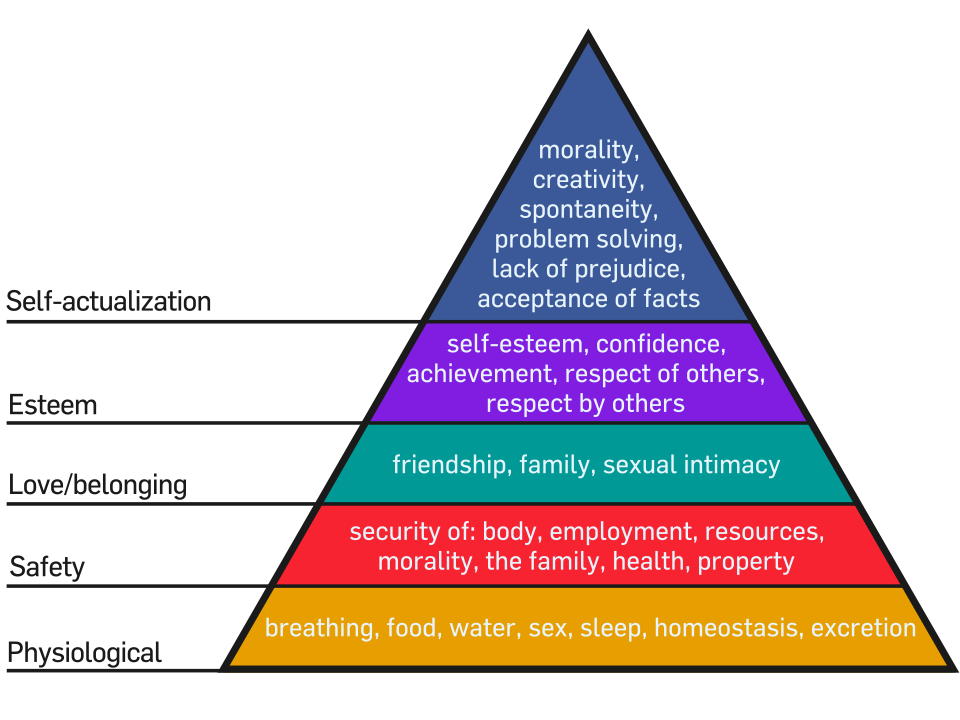 Maslow’s pyramid shows how personality develops as needs are met. (Image: User:Factoryjoe, CC BY-SA 3.0, via Wikimedia Commons)
C. Trait Theory (Allport, Eysenck, Big Five)
- Core idea: Personality is a combination of stable traits.
- Key models:
- Allport’s Trait Theory: Cardinal (dominant), central (common), secondary (situational) traits.
- Eysenck’s PEN Model: Psychoticism, Extraversion, Neuroticism.
- Big Five (OCEAN): Openness, Conscientiousness, Extraversion, Agreeableness, Neuroticism.
- Why Big Five? Most researched, cross-culturally valid, and practical for assessments.
TABLE: Comparing Trait Theories
| Theory | Key Traits | Strengths | Weaknesses |
|---|---|---|---|
| Allport | Cardinal, central, secondary | Descriptive, flexible | Too broad, hard to measure |
| Eysenck (PEN) | Psychoticism, Extraversion, Neuroticism | Biological basis (brain activity) | Limited to 3 traits |
| Big Five | OCEAN | Comprehensive, widely used | Ignores cultural differences |
D. Social-Cognitive Theory (Bandura)
- Core idea: Personality is shaped by interaction between thoughts, behavior, and environment.
- Key concepts:
- Reciprocal determinism: Behavior → Environment → Person (bidirectional influence).
- Self-efficacy: Belief in one’s ability to succeed (e.g., a programmer’s confidence in coding).
- Application: Used in therapy (e.g., CBT) and workplace training (e.g., leadership skills).
3. Assessing Personality
A. Objective Tests (Self-Report)
Measures explicit traits via structured questions. Examples:
- Minnesota Multiphasic Personality Inventory (MMPI-2)
- Purpose: Detects psychopathology (e.g., depression, schizophrenia).
- Format: 567 true/false questions.
- Strengths: High reliability, clinical use.
- Weaknesses: Social desirability bias (people lie to look good).
- 16 Personality Factor (16PF)
- Purpose: Measures 16 basic traits (e.g., warmth, reasoning).
- Use: Hiring, team-building, career counseling.
- Example: A high "C" (Conscientiousness) score predicts job performance (e.g., NTC engineers).
B. Projective Tests (Unconscious)
Measures implicit, hidden motives via ambiguous stimuli. Examples:
Rorschach Inkblot Test
- How it works: Patient describes what they see in inkblots.
- Interpretation: Reveals unconscious conflicts (e.g., seeing aggression in blots → hostility).
- Strengths: Accesses hidden emotions.
- Weaknesses: Low reliability, subjective scoring.
Thematic Apperception Test (TAT)
- How it works: Patient tells a story about ambiguous pictures.
- Example: A story about a lonely figure may reveal attachment issues.
- Use: Therapy, clinical diagnosis.
C. Behavioral Assessment
- How it works: Observes real-world behavior (e.g., in a job interview or classroom).
- Example: A quiet employee (low extraversion) may thrive in analytical roles (e.g., Ncell data analysis).
- Strengths: Objective, ecologically valid.
- Weaknesses: Time-consuming, situational bias.
4. Personality in the Real World
A. Workplace Applications
eSewa (Customer Service)
- Trait used: Agreeableness (friendly, empathetic staff).
- How: Employees with high agreeableness handle complaints better (e.g., "I’m sorry for the inconvenience").
Ncell (Employee Motivation)
- Trait used: Extraversion (teamwork) vs. Introversion (independent tasks).
- How: Managers assign extraverts to sales teams and introverts to technical roles.
Daraz (Hiring & Team Building)
- Trait used: Big Five (e.g., Conscientiousness for logistics workers).
- How: Uses personality tests to match candidates to jobs (e.g., high neuroticism → avoid high-stress roles).
CASE STUDY: John the Software Developer
- Problem: Fluctuating performance due to neuroticism (anxiety) and low conscientiousness (procrastination).
- Solution:
- Trait-based feedback: "John, your creativity (Openness) is high, but let’s structure your tasks (Conscientiousness)."
- Therapy: CBT to manage anxiety (Neuroticism).
- Work adjustments: Flexible deadlines for high-stress tasks.
B. Everyday Life Examples
Khalti (Fraud Detection)
- Trait used: Psychopathy (low empathy in scammers).
- How: Khalti monitors unusual transaction patterns (e.g., rapid transfers) linked to high psychoticism.
NEPSE (Investor Psychology)
- Trait used: Risk tolerance (Openness to experience).
- How: Investors with high openness take riskier stocks; conscientious investors prefer stable bonds.
Pathao (Driver Behavior)
- Trait used: Agreeableness (patient drivers) vs. Anger (aggressive drivers).
- How: Pathao uses behavioral ratings to reward calm drivers and retrain aggressive ones.
5. Strengths and Limitations of Approaches
| Approach | Strengths | Limitations |
|---|---|---|
| Psychoanalytic | Explains deep-seated issues (e.g., trauma) | Hard to test, overemphasizes childhood |
| Humanistic | Focuses on growth, positive psychology | Ignores dark traits (e.g., narcissism) |
| Trait Theory | Practical, measurable (Big Five) | Ignores situational factors |
| Social-Cognitive | Explains behavior change (e.g., therapy) | Complex, requires training |
| Projective Tests | Reveals unconscious motives | Low reliability, subjective scoring |
6. Ethical Considerations
- Bias: Tests must be culturally valid (e.g., Western traits may not fit Nepali contexts).
- Misuse: Avoid discrimination (e.g., rejecting introverts for sales jobs).
- Privacy: Informed consent for personality data (e.g., eSewa employee surveys).
Exam Tip
How to Score Full Marks
Case Studies (e.g., John’s performance)
- Step 1: Identify key traits (e.g., neuroticism, conscientiousness).
- Step 2: Link to theory (e.g., "Freud would say his superego is weak").
- Step 3: Suggest practical solutions (e.g., "Use CBT to reduce anxiety").
- Example Answer:
*"John’s fluctuating performance aligns with high neuroticism (Big Five) and weak ego control (Freud). His procrastination reflects low conscientiousness. Solutions include CBT for anxiety and structured tasks to boost conscientiousness."
Comparing Theories/Tests
- Use a table (like above) to contrast strengths/weaknesses.
- Example: "While MMPI is reliable, Rorschach is subjective—choose based on the goal (clinical vs. research)."
Real-World Applications
- Always tie to Nepali examples (e.g., "Ncell could use Big Five to hire extraverted sales staff").
- Avoid vague answers: Specify which trait and how it applies.
Projective Tests
- Explain how they work (e.g., "Inkblots trigger unconscious associations").
- Critique: "Rorschach lacks reliability because scorers interpret differently."
Common Mistakes to Avoid
- ❌ Mixing theories without explanation (e.g., "Freud and Maslow both say...").
- ❌ Ignoring cultural context (e.g., assuming Western traits fit Nepali workers).
- ❌ Overgeneralizing (e.g., "All introverts are shy"—specify trait nuances).
- ❌ Forgetting ethics (e.g., "Use personality tests to fire employees" → unethical).
Final Checklist for Revision
✅ Can you define personality and name 3 theories? ✅ Can you compare MMPI and Rorschach in a table? ✅ Can you analyze a case (e.g., John) using traits + theory? ✅ Can you link personality to Nepali workplaces (e.g., eSewa, Ncell)? ✅ Do you know the ethical risks of personality testing?
Based on the TU BBA syllabus for Psychology (PSY202), unit 6.
Discussion
Loading…