PsychologyUnit 711 min read
Social Psychology: Attitudes, Conformity & Obedience
Unit 7 of Psychology explores how individuals' thoughts, behaviors, and emotions are shaped by social influences, covering attitudes (formation, functions, and change), conformity (types, factors, and real-world examples), and obedience (Milgram’s experiment, situational factors, and ethical implications). This note in
Key Concepts and Definitions
Attitudes
Definition: Attitudes are evaluations—positive or negative—toward a person, object, or idea. They shape our thoughts, feelings, and behaviors, acting as mental filters that influence how we perceive and react to the world.
Functions of Attitudes
Attitudes serve three primary functions:
- Knowledge Function: Help us organize and simplify our understanding of the world.
- Utilitarian Function: Guide us toward rewards and away from punishments (e.g., liking a brand because it’s practical).
- Ego-Defensive Function: Protect our self-esteem (e.g., justifying a poor decision to avoid feeling incompetent).
Formation of Attitudes
Attitudes are formed through:
- Direct Experience: Personal encounters (e.g., disliking a food after trying it).
- Social Learning: Observing others (e.g., adopting parents’ political views).
- Conditioning: Associating stimuli with rewards/punishments (e.g., fear of dogs after a bite).
- Cognitive Dissonance: Reducing discomfort when attitudes and behaviors clash (e.g., smoking despite knowing its harms).
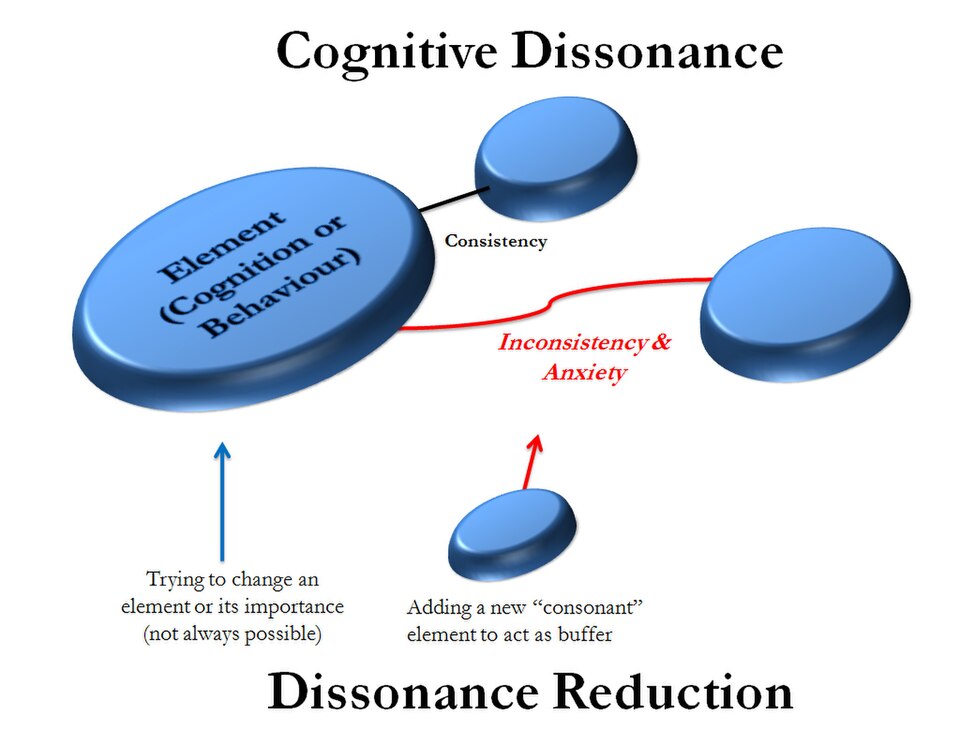 A visual representation of how conflicting beliefs (e.g., I smoke vs. Smoking is harmful) create mental discomfort, driving attitude change. (Image: Tesseract2, CC BY-SA 3.0, via Wikimedia Commons)
Changing Attitudes
Techniques to modify attitudes include:
- Persuasion: Using logical arguments or emotional appeals (e.g., ads showing happy families using a product).
- Foot-in-the-Door Technique: Starting with small requests to gain compliance for larger ones (e.g., asking for a signature on a petition before a donation).
- Door-in-the-Face Technique: Making an extreme initial request, then retreating to a smaller one (e.g., asking for ₹10,000 before settling for ₹1,000).
Conformity: Why Do We Follow the Crowd?
Definition
Conformity is the tendency to adjust one’s behavior or beliefs to align with a group’s norms or expectations, even if it contradicts personal judgment.
Types of Conformity
- Compliance: Publicly going along with a group’s request while privately disagreeing (e.g., laughing at a joke you don’t find funny).
- Identification: Conforming to gain approval or fit in (e.g., dressing like peers to be accepted).
- Internalization: Deeply accepting group norms as your own (e.g., adopting a friend’s political views).
Factors Influencing Conformity
| Factor | Explanation | Example |
|---|---|---|
| Group Size | Larger groups increase conformity (up to a point). | More people in a room, the more likely you’ll agree with a wrong answer. |
| Unanimity | Conformity drops if even one person dissents. | In Asch’s experiment, a single dissenting participant reduced conformity. |
| Cohesion | Stronger group bonds lead to higher conformity. | Fraternity/sorority members conforming to traditions. |
| Status of the Group | Higher-status groups have more influence. | Following fashion trends set by celebrities. |
| Culture | Collectivist cultures (e.g., Nepal) show higher conformity than individualist ones. | Nepali students conforming to teacher expectations. |
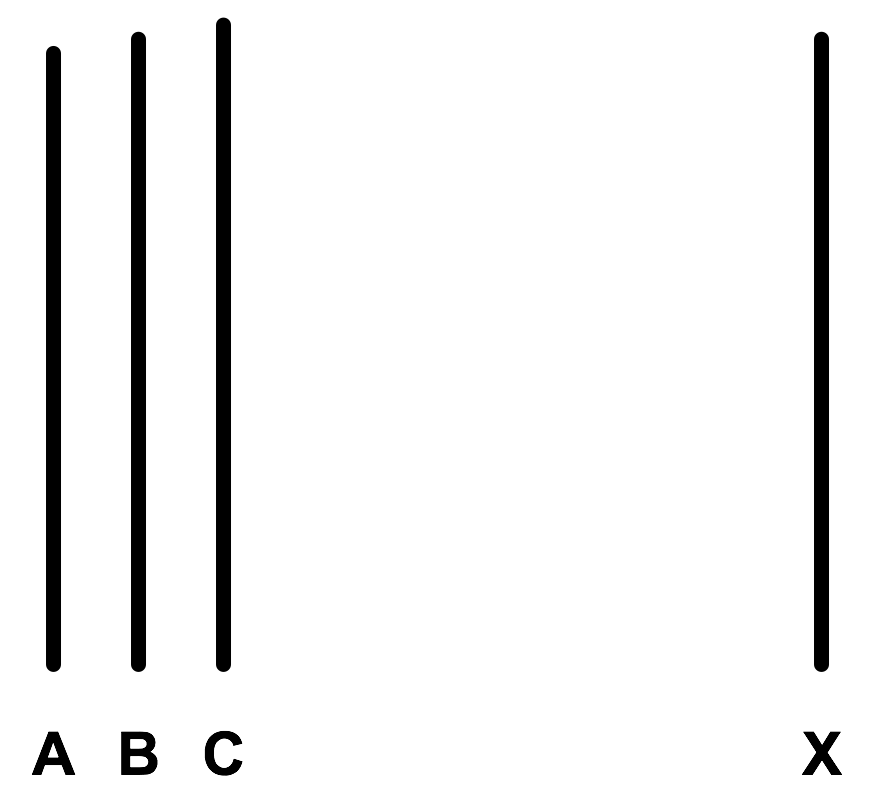 A visual of the line-judgment task where participants conformed to incorrect group answers. (Image: Daniel Göhler, CC BY-SA 3.0, via Wikimedia Commons)
Real-World Example: Pathao’s Ride-Sharing Algorithm
Pathao’s app uses social conformity to influence driver behavior:
- Group Norms: Drivers are shown how many other drivers are accepting rides in a given area, encouraging them to do the same (reducing idle time).
- Peer Pressure: Ratings and reviews create a "norm" for service quality, pushing drivers to conform to high standards.
Obedience: When Authority Demands Compliance
Definition
Obedience is compliance with commands from an authority figure, often regardless of personal ethics. Unlike conformity, obedience involves a clear hierarchy (e.g., boss, teacher, or government).
Milgram’s Obedience Experiment (1963)
Stanley Milgram’s controversial study explored how far people would go in obeying an authority figure, even if it involved harming another person.
Key Findings
- 65% of Participants: Administered what they believed were lethal electric shocks (up to 450 volts) to a "learner" (actor) when ordered by an authority figure.
- Situational Factors: Obedience increased when:
- The authority figure was nearby.
- The victim was depersonalized (e.g., in another room).
- There was no model of defiance (no one else refused).
- Ethical Implications: Raised questions about the dangers of blind obedience (e.g., Nazi Germany, Abu Ghraib).
Modern Applications: Nepal Police and Traffic Obedience
- Authority Influence: Traffic police in Kathmandu use obedience principles to enforce rules (e.g., stopping vehicles for seatbelt violations).
- Situational Factors: Drivers are more likely to obey when:
- The police officer is visible and authoritative (uniform, stern demeanor).
- Peer behavior shows compliance (other drivers stopping).
- The rule is clearly communicated (e.g., "No U-turn" signs).
Social Psychology in Action: Real-World Applications
1. eSewa and Attitude Change
- Persuasion Technique: eSewa uses emotional appeals (e.g., "Pay your bill on time to avoid penalties") to change users’ attitudes toward timely payments.
- Cognitive Dissonance: Users who procrastinate feel guilt (dissonance), motivating them to pay to reduce discomfort.
2. Khalti’s Social Proof
- Conformity: Khalti highlights "Most popular payment methods" to encourage users to adopt trending options (e.g., mobile top-ups).
- Bandwagon Effect: "Join 5 million users" leverages the desire to fit in.
3. NTC’s Obedience to Regulations
- Authority Compliance: NTC enforces traffic rules (e.g., speed limits) by positioning officers at high-visibility locations, increasing obedience due to perceived authority.
4. Daraz’s Social Learning
- Modeling: Daraz’s influencer marketing (e.g., "Top 10 Sellers") uses social learning to show customers how to shop effectively, shaping their attitudes toward the platform.
Exam Tip: How to Score Full Marks
- Define Clearly: Start every answer with precise definitions (e.g., "Conformity is..."). Use the exact language from the syllabus.
- Use Examples: Link theories to real-world Nepalese contexts (e.g., Pathao, eSewa, traffic rules). Examiners love relevance!
- Compare and Contrast:
- Conformity vs. Obedience: Conformity is peer-driven; obedience is authority-driven.
- Compliance vs. Internalization: Compliance is superficial; internalization is deep-seated.
- Diagrams > Text: Always include labelled diagrams (e.g., Asch’s experiment, Milgram’s setup) to visually reinforce answers.
- Ethical Awareness: For obedience/conformity, discuss ethical dilemmas (e.g., Milgram’s criticism, modern applications like workplace bullying).
- Case Study Analysis: If given a scenario (e.g., Dipak’s high school expectations), analyze it using:
- Attitude Formation: "Dipak’s expectations were shaped by social learning (parents/peers)."
- Conformity: "He may conform to peer pressure to fit in."
- Obedience: "If teachers demand compliance, he may obey despite personal preferences."
Summary Table: Attitudes, Conformity, and Obedience
| Concept | Key Feature | Example | Psychological Theory |
|---|---|---|---|
| Attitude | Evaluation of an object/person/idea | Liking Daraz because it’s convenient. | Cognitive Dissonance, Persuasion |
| Conformity | Adjusting to group norms | Wearing school uniforms to fit in. | Asch’s Experiment, Normative Influence |
| Obedience | Following authority figures | Stopping at a red light because of a police officer. | Milgram’s Experiment, Legitimacy |
| Compliance | Publicly agreeing privately disagreeing | Smiling at a boring lecture to avoid conflict. | Foot-in-the-Door Technique |
| Internalization | Deep acceptance of group norms | Adopting a friend’s environmental activism as your own. | Social Identity Theory |
Worked Example: Analyzing Dipak’s Case
Scenario: Dipak imagined high school would be fun but faced teasing and scolding. Analyze his attitudes and conformity.
Attitude Formation:
- Initial Attitude: Positive expectations (fun, excitement) formed through social learning (media, peers).
- Shift in Attitude: Negative experiences (teasing) led to cognitive dissonance ("I expected fun, but it’s stressful"). He may adjust his attitude to justify the reality.
Conformity Pressures:
- Peer Teasing: Dipak may conform to avoid further rejection (e.g., changing behavior to fit in with popular students).
- Teacher Authority: If teachers scold him, he might obey their demands (e.g., completing homework) to avoid punishment.
Real-World Parallel:
- Nepali School System: Many students conform to teacher expectations (e.g., memorizing answers) to avoid failure, even if it contradicts their natural curiosity.
Visual Trace:
flowchart TD
    A["Dipak's Initial Attitude: Fun & Excitement"] -->|"Social Learning"| B["Expectations from Media/Peers"]
    B --> C["Negative Experiences: Teasing/Scolding"]
    C --> D["Cognitive Dissonance: Conflict"]
    D --> E["Adjusted Attitude: Less Optimistic"]
    C --> F["Conformity to Peers"]
    C --> G["Obedience to Teachers"]
    F & G --> H["Behavioral Change: Avoiding Conflict"]
Common Pitfalls in Exams
- Vague Definitions: Avoid saying "conformity is when people follow others." Instead, specify types (compliance, identification, internalization).
- Ignoring Culture: Nepal’s collectivist culture is key! Mention how conformity is higher here than in individualist societies (e.g., USA).
- Overlooking Ethics: For Milgram, discuss why the experiment was unethical (e.g., psychological harm to participants).
- Mixing Terms: Don’t confuse attitudes (evaluations) with behaviors (actions). Attitudes predict behavior but aren’t the same.
Final Checklist for Revision
- Can you list the 3 functions of attitudes and give a Nepalese example for each?
- Draw and label Asch’s conformity experiment and explain why unanimity matters.
- Describe Milgram’s obedience study and link it to NTC traffic enforcement.
- Explain how eSewa uses persuasion to change user attitudes toward payments.
- Compare conformity and obedience in a table with real-world examples.
- Analyze a case study (like Dipak’s) using attitudes, conformity, and obedience frameworks.
Based on the TU BBA syllabus for Psychology (PSY202), unit 7.
Discussion
Loading…