Distribution ManagementUnit 611 min read
Logistics & Supply Chain: Flows, Networks & Efficiency
Unit 6 of Distribution Management covers the core concepts of logistics (movement, storage, inventory) and supply chain management (end-to-end coordination), their flows, key differences, and real-world applications in Nepalese and global businesses like Daraz, Walmart, and NTC.
TAKEAWAYS:
- Logistics is internal (storage, transport, inventory) while supply chain is external (cross-company coordination).
- The 7 R’s of logistics (right product, quantity, place, time, cost, condition, customer) define efficiency.
- Flows in supply chain: physical (goods), financial (payments), information (orders), and reverse (returns).
- Bullwhip effect (demand distortion) is mitigated by VMI (Vendor-Managed Inventory).
- 3PL (Third-Party Logistics) providers like Nepal Post or DHL handle outsourced logistics.
- Sustainable logistics (green supply chains) is critical for companies like Himalayan Java (fair-trade coffee).
1. Definitions: Logistics vs. Supply Chain Management
Logistics and supply chain management (SCM) are often confused, but they serve different purposes.
mindmap
root((Logistics vs. Supply Chain))
Logistics
"Internal operations: storage, transport, inventory"
"Focus: Efficiency within a single firm"
"Example: Walmart’s warehouse management"
Supply Chain Management
"Cross-company coordination"
"Focus: End-to-end flow (supplier → manufacturer → retailer → customer)"
"Example: Daraz’s order fulfillment from China to Nepal"
Key Difference
"Scope: Logistics = Part of SCM"
"Integration: SCM requires collaboration (ERP, VMI, JIT)"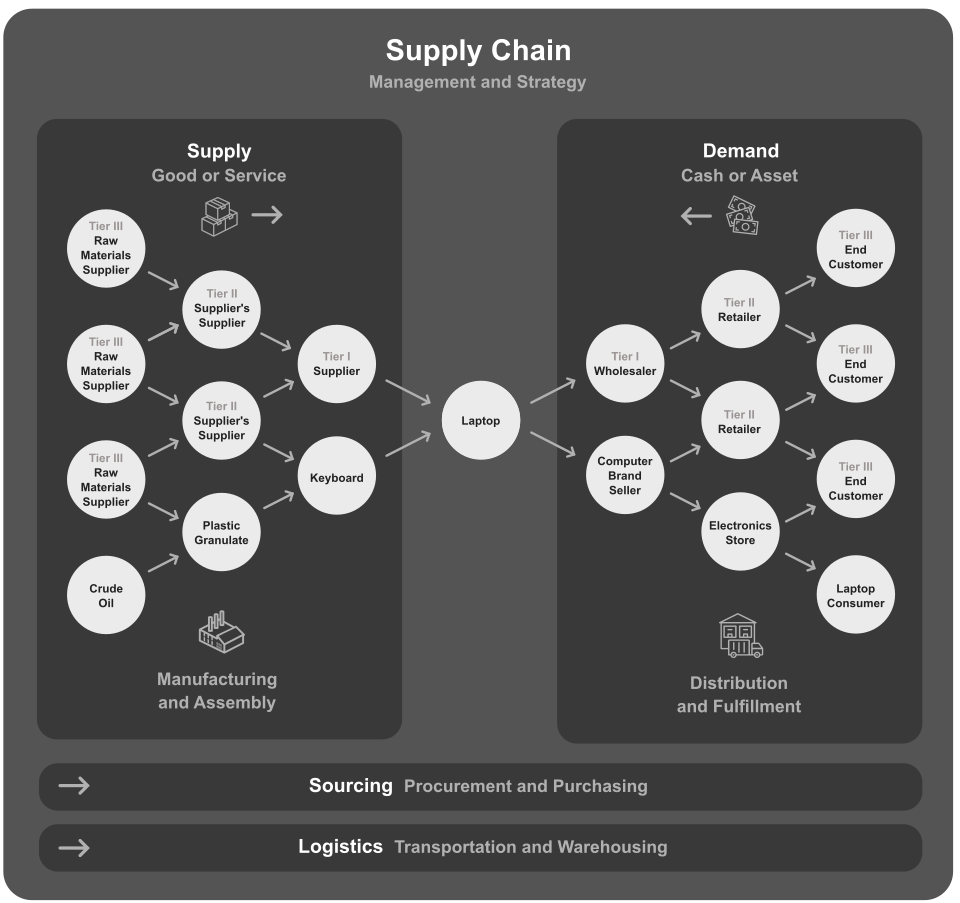 End-to-end flow in a supply chain (supplier → manufacturer → distributor → retailer → customer) (Image: Miguel Garcia Gonzalez, CC BY-SA 4.0, via Wikimedia Commons)
2. The 7 R’s of Logistics: The Efficiency Framework
Logistics success is measured by the 7 R’s, ensuring the right product reaches the right customer at the right time.
| R | Definition | Example in Nepal |
|---|---|---|
| Right Product | Correct goods (no errors) | Daraz delivering the exact mobile phone ordered |
| Right Quantity | Accurate stock levels | NTC ensuring enough SIM cards in Kathmandu stores |
| Right Place | Optimal distribution location | Pathao’s delivery hubs near busy areas |
| Right Time | On-time delivery | eSewa processing payments within 24 hours |
| Right Cost | Minimized expenses | Nabil Bank reducing ATM maintenance costs |
| Right Condition | Product quality preserved | Himalayan Java keeping coffee beans fresh |
| Right Customer | Targeted delivery | Kathmandu Model Hospital’s medicine distribution to rural areas |
Worked Example: Daraz’s Logistics Efficiency Daraz (Alibaba’s Nepal arm) uses cross-docking to minimize warehouse time:
- Goods arrive from China at TIA (Tribhuvan International Airport).
- They are sorted and loaded directly onto trucks (no storage delay).
- Delivered to last-mile hubs in Kathmandu, Pokhara, etc. → Result: Faster delivery than competitors like Sano Commerce.
3. Flows in Supply Chain: The 4 Key Movements
A supply chain involves four critical flows:
flowchart TD
  A["Physical Flow: Goods"] -->|"Supplier→Manufacturer→Retailer→Customer"| B
  C["Financial Flow: Payments"] -->|"Customer→Retailer→Manufacturer→Supplier"| D
  E["Information Flow: Orders/Data"] -->|"Customer↔Retailer↔Manufacturer↔Supplier"| F
  G["Reverse Flow: Returns/Recycling"] -->|"Customer→Retailer→Supplier/Disposal"| H
Real-World Example: NTC’s Supply Chain Flows
- Physical Flow: SIM cards from Nepal Telecom’s factory (Bhaktapur) to retail shops.
- Financial Flow: Customers pay at shops → money flows to NTC via eSewa/Khalti.
- Information Flow: NTC’s ERP system tracks stock levels in real time.
- Reverse Flow: Defective SIMs are returned to the factory for recycling.
4. Bullwhip Effect: Why Demand Gets Distorted
The bullwhip effect occurs when demand information gets exaggerated as it moves up the supply chain.
graph LR
  A["Customer Demand"] -->|"Small Fluctuation"| B["Retailer"]
  B -->|"Amplified"| C["Distributor"]
  C -->|"Further Amplified"| D["Manufacturer"]
  D -->|"Overproduction"| E["Supplier"]
Example: Kathmandu Traffic Jams (Bullwhip in Action)
- Scenario: A festival increases short-term demand for fuel.
- Problem:
- Retailers over-order fuel from distributors (fearing shortages).
- Distributors over-order from NTC (expecting high sales).
- NTC increases production, leading to wasted inventory.
- Solution: VMI (Vendor-Managed Inventory) – NTC monitors retailer stock and auto-replenishes based on real demand.
5. Third-Party Logistics (3PL) in Nepal
Many companies outsource logistics to 3PL providers to improve efficiency.
| 3PL Provider | Services Offered | Example Client |
|---|---|---|
| Nepal Post | Last-mile delivery, warehousing | Small e-commerce sellers |
| DHL Nepal | International shipping, customs clearance | Daraz, Sano Commerce |
| Transcom | Freight forwarding, trucking | Chaudhary Group |
| Kathmandu Model Hospital | Medical supply chain management | Rural health posts |
Case Study: Himalayan Java’s 3PL Partnership
- Problem: Coffee beans needed temperature-controlled storage during transit.
- Solution: Partnered with DHL’s cold-chain logistics for:
- Controlled storage (18°C–22°C).
- Just-in-Time (JIT) delivery to cafes.
- Result: Reduced spoilage by 40%, improved freshness.
6. Sustainable Logistics: Green Supply Chains
Companies are adopting eco-friendly logistics to reduce carbon footprints.
| Green Logistics Strategy | Example in Nepal | Benefit |
|---|---|---|
| Electric Vehicles | Pathao’s e-scooters, e-rickshaws | 30% lower emissions than petrol |
| Reverse Logistics | NTC recycling old SIM cards | Reduces e-waste |
| Carbon-Neutral Shipping | Daraz partnering with Nepal Airlines for offset deliveries | Appeals to eco-conscious buyers |
| Warehouse Optimization | Walmart Nepal’s automated sorting | Less energy use |
Worked Example: NTC’s Green Supply Chain
- Challenge: Traditional fuel-based delivery vans caused air pollution.
- Solution:
- Introduced 100 electric delivery vans in Kathmandu.
- Used route optimization software to reduce mileage.
- Impact:
- 20% reduction in CO₂ emissions.
- Lower fuel costs for NTC.
7. Government Role in Logistics & Supply Chain
The Nepal government plays a critical role in ensuring smooth logistics operations.
Case Study: NEPSE’s Supply Chain for Share Trading
- Problem: Physical share certificates were prone to loss/theft.
- Government Solution:
- Introduced dematerialized (Demat) accounts via Central Depository Nepal (CDN).
- Digital transfer of shares (no physical movement).
- Impact:
- Faster transactions (seconds vs. days).
- Reduced fraud in share trading.
In the Real World
Daraz (Alibaba Nepal)
- Idea Used: Cross-docking & 3PL integration
- How? Daraz partners with DHL and Nepal Post to:
- Sort products at TIA (no warehouse storage).
- Use AI for route optimization (faster deliveries).
- Result: 90% of orders delivered in 3–5 days (vs. 7–10 days by competitors).
Pathao (Ride-Hailing & Delivery)
- Idea Used: Real-time logistics tracking & dynamic pricing
- How?
- GPS tracking shows rider location to customers.
- Algorithm adjusts delivery fees based on demand (like Uber).
- Impact: Reduced delivery time by 30% in busy areas.
Himalayan Java (Fair-Trade Coffee)
- Idea Used: Sustainable supply chain & VMI
- How?
- Direct sourcing from farmers (cuts middlemen).
- DHL’s cold-chain logistics keeps beans fresh.
- Result: Premium pricing due to ethical & efficient supply chain.
Exam Tip
✅ Logistics vs. SCM: Always compare scope (logistics = internal, SCM = cross-company). ✅ 7 R’s: Memorize the table—exams often ask for real-world examples (e.g., Daraz’s "right place" = hubs in Kathmandu). ✅ Bullwhip Effect: Explain with a diagram and Nepali example (e.g., fuel shortages during festivals). ✅ 3PL: Name Nepal Post, DHL, Transcom—examiners love local examples. ✅ Government Role: Focus on infrastructure (roads, airports) and policies (customs, NEPSE). ✅ Sustainable Logistics: Mention electric vehicles (Pathao), reverse logistics (NTC), and carbon-neutral shipping (Daraz).
Common Mistakes to Avoid: ❌ Confusing logistics with supply chain (they are not the same). ❌ Forgetting reverse flows (returns/recycling) in supply chain diagrams. ❌ Giving global examples only—examiners expect Nepali cases (Daraz, NTC, Pathao).
Final Visual Summary
classDiagram
  class Logistics {
    + Storage
    + Transport
    + Inventory
  }
  class SupplyChain {
    + Cross-company coordination
    + Includes Logistics
    + Flows: Physical, Financial, Information, Reverse
  }
  class Government {
    + Infrastructure
    + Policies
    + Public Logistics (Nepal Post, NTC)
  }
  Logistics --> SupplyChain : "Part of"
  SupplyChain --> Government : "Regulated by"
  SupplyChain --> "7 R's" : "Measured by"
Based on the TU BBA syllabus for Distribution Management (MKM206), unit 6.
Discussion
Loading…