Distribution ManagementUnit 712 min read
Transportation & Distribution Coverage: Modes, Coverage, Challenges
Unit 7 of Distribution Management explores how goods move from producers to consumers—covering transportation modes (road, rail, air, water), distribution coverage strategies (intensive, selective, exclusive), and real-world challenges like Nepal’s infrastructure gaps. Includes case studies of Daraz, NTC, and global lo
TAKEAWAYS:
- Transportation modes differ in cost, speed, and suitability (e.g., road for perishables, air for emergencies).
- Distribution coverage (intensive/selective/exclusive) aligns with product type and market reach.
- Nepal’s challenges include poor road networks, monsoon disruptions, and high logistics costs.
- E-commerce (Daraz, Pathao) relies on last-mile delivery solutions like hub-and-spoke models.
- Government role includes regulating transport (NTC, Ncell) and infrastructure development.
- Cost vs. speed trade-offs are critical in supply chain decisions (e.g., Kathmandu’s traffic delays).
1. Transportation in Distribution Management
Transportation is the physical movement of goods from production points to consumption points. It bridges the gap between supply and demand, ensuring timely delivery while balancing cost and efficiency.
Key Functions of Transportation
mindmap
  root((Transportation Functions))
    Cost Reduction["Lowers per-unit cost via economies of scale"]
    Time Savings["Reduces lead time (e.g., Daraz’s 24-hour delivery)"]
    Place Utility["Makes goods available where needed (e.g., remote villages)"]
    Quantity Utility["Enables bulk transport and breaking bulk"]
    Risk Management["Minimizes damage/theft (e.g., cold chain for Himalayan Java)"]
Modes of Transportation: A Comparison
| Mode | Speed | Cost | Capacity | Best For | Example in Nepal |
|---|---|---|---|---|---|
| Road | Medium | Medium-High | Low-Medium | Last-mile delivery, perishables | Daraz, Pathao delivery trucks |
| Rail | Slow | Low | High | Bulk goods (cement, grains) | NTC’s rail freight (limited use) |
| Air | Very Fast | Very High | Low | Emergencies, high-value goods | Nepal Airlines (pharma exports) |
| Water | Slow | Very Low | Very High | Containerized goods (global trade) | NTC’s river barges (rare) |
| Pipeline | Medium | Low | High | Liquids/gases (not used in Nepal) | N/A |
| Digital | Instant | Low | Unlimited | Data/software (e.g., eSewa transfers) | Ncell’s mobile banking |
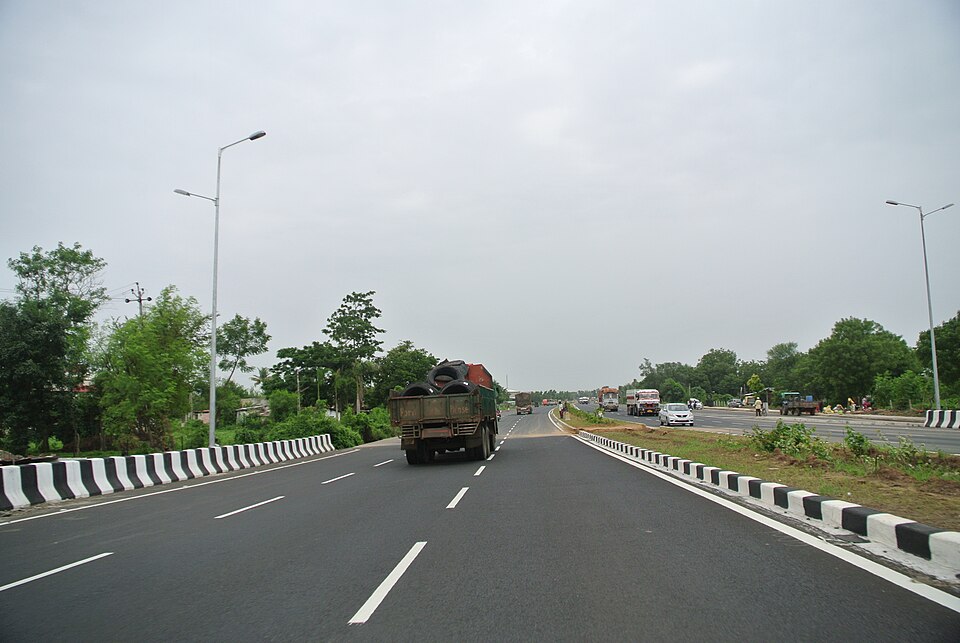 A typical road transport vehicle used by Daraz for last-mile delivery in Nepal. (Image: Soulful sunshine, CC BY-SA 4.0, via Wikimedia Commons)
Worked Example: Daraz’s Transportation Strategy
Daraz, Nepal’s largest e-commerce platform, uses a hub-and-spoke model for distribution:
- Central Warehouses: Located in Kathmandu and Pokhara to minimize transit time.
- Regional Hubs: Smaller depots in major cities (e.g., Biratnagar, Dharan) to reduce last-mile costs.
- Last-Mile Delivery: Partnered with Pathao and local couriers for doorstep delivery.
- Road Dominance: 95% of deliveries rely on trucks due to Nepal’s poor rail/air infrastructure.
Why?
- Cost: Road transport is cheaper than air for most goods.
- Speed: Hubs ensure 24–48 hour delivery in urban areas.
- Flexibility: Can adapt to traffic delays (e.g., Kathmandu’s congestion).
2. Distribution Coverage Strategies
Distribution coverage determines how widely a product is made available to consumers. The choice depends on the product’s nature, target market, and company resources.
Types of Distribution Coverage
mindmap
  root((Distribution Coverage))
    Intensive["Maximize reach (e.g., Frooti, chips)"]
      Pros["High sales volume, brand visibility"]
      Cons["Low profit per unit, high channel costs"]
    Selective["Limited outlets (e.g., Himalayan Java, Apple)"]
      Pros["Higher profit, controlled quality"]
      Cons["Limited market reach"]
    Exclusive["Single outlet (e.g., luxury cars, Rolex)"]
      Pros["Premium pricing, brand exclusivity"]
      Cons["Very limited market penetration"]
When to Use Which Strategy?
| Strategy | Product Type | Market Example (Nepal) | Channel Example |
|---|---|---|---|
| Intensive | Staples, FMCG | Frooti, Maggi, Unilever products | Supermarkets (Big Mart, Mega Mart) |
| Selective | Mid-range electronics, apparel | Himalayan Java, Oppo phones | Authorized dealers (e.g., Nabil Bank ATMs) |
| Exclusive | Luxury, high-end | Mercedes-Benz, Rolex | Single showrooms (e.g., Toyota showrooms) |
Worked Example: Himalayan Java’s Selective Distribution Himalayan Java, a premium coffee brand, uses selective distribution:
- Sold only in high-end supermarkets (e.g., Big Mart, Mega Mart) and specialty cafes (e.g., Java House).
- Why?
- Maintains brand image (premium positioning).
- Controls quality (avoids counterfeits).
- Higher profit margins per unit.
3. Challenges in Transportation and Distribution in Nepal
Nepal’s geography, infrastructure, and policies create unique challenges:
Major Challenges
mindmap
  root((Nepal’s Distribution Challenges))
    Infrastructure["Poor road networks, limited rail/air"]
      Example["Monsoon landslides block highways (e.g., Kathmandu–Pokhara route)"]
    Regulatory["Complex customs, multiple checkpoints"]
      Example["NTC’s slow clearance for imports (avg. 7–10 days)"]
    Cost["High logistics costs (15–25% of product value)"]
      Example["Daraz’s delivery costs: ₹50–₹150 per order"]
    Security["Theft, damage during transit"]
      Example["Unsecured warehouses: 10–15% loss reported"]
    Seasonal["Monsoon disrupts transport"]
      Example["June–September: 30–50% delay in goods movement"]
    Technology["Limited digital infrastructure"]
      Example["Only 40% of SMEs use real-time tracking"]
Real-World Impact: NTC’s Freight Delays
- Problem: Nepal’s rail freight is underutilized due to:
- Slow speeds (average 20 km/h vs. road’s 40 km/h).
- Limited routes (only 57 km of broad-gauge track).
- Impact on Businesses:
- Chaudhary Group (e.g., Prime Cement) relies on trucks despite higher costs.
- Daraz avoids rail for most deliveries due to unreliability.
4. Government Role in Transportation and Distribution
The government regulates and supports distribution through:
- Infrastructure Development:
- NTC (Nepal Transportation Company): Manages rail and road transport.
- DPR (Department of Roads): Maintains highways (e.g., Prithvi Highway).
- Policies and Regulations:
- Customs duties on imported goods (affects e-commerce like Daraz).
- Freight regulations (e.g., weight limits on trucks).
- Public-Private Partnerships (PPPs):
- Example: NTC’s collaboration with Chaudhary Group for freight services.
Worked Example: NTC’s Role in Cement Distribution
- Challenge: Cement is bulky and heavy, making transport costly.
- NTC’s Solution:
- Rail freight for bulk movement from India (Bihar) to Nepal.
- Road transport for last-mile delivery to construction sites.
- Impact:
- Reduces cost by 15–20% compared to full road transport.
- Ensures steady supply for Chaudhary Group’s cement plants.
5. E-Marketing and Direct Marketing’s Role in Distribution
While not the focus of this unit, digital distribution is increasingly important:
- Daraz/Khalti: Use real-time tracking (like FedEx) to manage customer expectations.
- Pathao: Partners with local couriers for last-mile delivery via GPS.
- Ncell: Offers mobile-based logistics tracking for businesses.
How It Works:
flowchart TD
  A["Customer Order on Daraz"] --> B["Order routed to nearest hub"]
  B --> C["Hub assigns to delivery partner (Pathao/Daraz driver)"]
  C --> D["GPS tracking updates customer"]
  D --> E["Delivery confirmation via SMS/app"]
## In the Real World
Daraz’s Hub-and-Spoke Model
- Idea Used: Selective distribution coverage + road transportation dominance.
- How? Daraz uses central warehouses (intensive coverage for fast-moving goods) but selective hubs in cities like Pokhara to reduce costs. Their last-mile delivery relies on road transport due to Nepal’s lack of rail/air infrastructure for most goods.
NTC’s Rail Freight for Bulk Goods
- Idea Used: Transportation mode selection (rail vs. road).
- How? NTC’s rail network is used for cement, grains, and containers from India, but only 5% of Nepal’s freight uses rail because of slow speeds and limited routes. Companies like Chaudhary Group still prefer it for bulk goods to cut costs.
Himalayan Java’s Selective Distribution
- Idea Used: Exclusive/selective coverage to maintain brand premium.
- How? Sold only in high-end supermarkets and cafes, not in every corner shop. This keeps prices high (Rs. 400–600 per pack) and avoids dilution of the brand.
Pathao’s Last-Mile Delivery
- Idea Used: Intensive distribution coverage for urban areas.
- How? Pathao partners with local couriers to deliver orders within 1–2 hours in Kathmandu, using real-time GPS tracking to manage routes efficiently.
Ncell’s Mobile Logistics Tracking
- Idea Used: Digital integration in distribution.
- How? Businesses use Ncell’s SMS/USSD services to track shipments, reducing losses from theft/damage. For example, a flower exporter in Pokhara can monitor a truck’s location en route to India.
## Exam Tip
This unit is conceptual but heavily applied—expect:
Case Studies (30–40%):
- Analyze Daraz, NTC, or a local business (e.g., Himalayan Java) and explain their transportation mode choice or distribution coverage strategy.
- Example Question:
"How does Daraz’s use of road transport align with Nepal’s infrastructure challenges?" Answer Focus:
- Mention road dominance (95% of deliveries).
- Link to challenges: traffic, monsoon delays, lack of rail/air.
- Discuss solutions: hub-and-spoke model, partnerships with Pathao.
Definitions and Comparisons (20–30%):
- Must-know terms:
- Distribution coverage (intensive/selective/exclusive).
- Transportation modes (road/rail/air/water).
- Comparison tables (like the one above) are highly scorable.
- Must-know terms:
Problem-Solving (20–30%):
- Example Question:
"A coffee exporter in Pokhara wants to ship to Kathmandu. Advise on the best transportation mode." Answer Structure:
- Options: Road (truck) vs. Air (limited) vs. Rail (not feasible).
- Recommendation: Road transport (fastest and most reliable for 150 km).
- Justification:
- Cost: Trucks are cheaper than air for bulk goods.
- Speed: Air is faster but not cost-effective for coffee.
- Infrastructure: Roads are better maintained than rail for this route.
- Example Question:
Nepal-Specific Challenges (10–20%):
- Always mention:
- Monsoon disruptions.
- Poor rail/air infrastructure.
- High logistics costs (20–30% of product value).
- Example Answer Snippet:
"Nepal’s distribution system faces challenges like limited rail networks (only 57 km broad-gauge) and monsoon-induced roadblocks, forcing businesses like Daraz to rely on road transport despite higher costs."
- Always mention:
Pro Tip:
- Draw diagrams in exams (e.g., hub-and-spoke model for Daraz).
- Use real examples (NTC, Daraz, Himalayan Java) to illustrate theories.
- Compare modes in tables—examiners love structured answers!
Based on the TU BBA syllabus for Distribution Management (MKM206), unit 7.
Discussion
Loading…