Market ResearchUnit 312 min read
Literature Review & Theoretical Framework: Sources, Analysis & Application
Unit 3 of Market Research explores how to systematically review existing literature and build a theoretical framework for research, covering types of sources, analysis techniques, and real-world applications in business decisions.
TAKEAWAYS:
- A literature review synthesizes prior research to identify gaps, trends, and theoretical foundations for new studies.
- Primary vs. secondary sources differ in originality, reliability, and relevance—choose them strategically for your research.
- Theoretical frameworks link literature to research questions, guiding data collection and analysis (e.g., SWOT, Porter’s Five Forces).
- Critical analysis involves evaluating sources for bias, methodology, and applicability to your context.
- Real-world tools like Google Scholar, JSTOR, and industry reports are essential for credible literature reviews.
- Ethical considerations (e.g., plagiarism, citation) are critical in academic and corporate research.
What Is a Literature Review?
A literature review is a systematic, critical evaluation of existing research on a specific topic. It answers:
- What is already known?
- What gaps exist?
- How can prior findings inform your research?
Unlike a literature survey (which lists sources), a review analyzes, compares, and synthesizes findings to justify your study’s relevance.
graph TD
    A["Literature Review Process"] --> B["Identify Keywords & Databases"]
    B --> C["Screen Sources for Relevance"]
    C --> D["Evaluate Quality & Credibility"]
    D --> E["Synthesize Findings"]
    E --> F["Identify Gaps & Research Questions"]
    F --> G["Draft Review with Critical Analysis"]
Types of Sources in a Literature Review
Sources are classified based on originality, credibility, and relevance. Use this table to guide your selection:
| Type | Definition | Examples | Pros | Cons |
|---|---|---|---|---|
| Primary Sources | Original research (firsthand data, unpublished or published). | Theses, dissertations, raw survey data, interviews. | High credibility, unique insights. | Hard to access, time-consuming. |
| Secondary Sources | Summaries or analyses of primary sources (books, journal articles). | Peer-reviewed journals, industry reports, case studies. | Easily accessible, synthesized. | Risk of bias, outdated info. |
| Tertiary Sources | Compilations of secondary sources (encyclopedias, textbooks). | Wikipedia, business handbooks, government summaries. | Quick overview, broad scope. | Low credibility, superficial. |
| Grey Literature | Unpublished or informal sources. | Conference papers, white papers, internal reports (e.g., NTC’s market studies). | Real-world insights, niche topics. | Unverified, limited distribution. |
Worked Example: E-Sewa’s Customer Satisfaction Study
- Primary Source: E-Sewa’s internal customer feedback database (unpublished).
- Secondary Source: A 2023 Journal of Digital Banking article analyzing fintech UX in Nepal.
- Tertiary Source: A Wikipedia page on "Digital Payment Systems in Nepal." Which to use? For a thesis on E-Sewa’s UX, prioritize primary (internal data) + secondary (peer-reviewed articles). Avoid Wikipedia unless for background.
How to Conduct a Literature Review: Step-by-Step
1. Define Your Research Scope
- Narrow your topic: Instead of "Marketing in Nepal", focus on "Consumer Perception of Organic Food Brands in Kathmandu."
- Use Boolean operators in databases:
- "Organic food" AND "Kathmandu" NOT "2010-2015"
2. Search for Sources
Key Databases for Business Students in Nepal:
| Database | Best For | Access Link |
|---|---|---|
| Google Scholar | Peer-reviewed articles, theses. | scholar.google.com |
| JSTOR | Academic journals (social sciences). | jstor.org |
| ScienceDirect | Business, economics, management. | sciencedirect.com |
| NEPJOL | Nepali journals (e.g., Journal of Management). | nepjol.info |
| Ncell/NTN Reports | Industry trends (telecom, retail). | ncell.com, ntn.gov.np |
Pro Tip: Use Google Alerts to track new publications on your topic.
3. Evaluate Sources Critically
Ask these questions for each source:
- Credibility: Is the author an expert? Is the publisher reputable (e.g., Harvard Business Review vs. a blog)?
- Recency: Is the data <5 years old for fast-moving topics (e.g., digital payments)?
- Bias: Does the source favor a specific brand (e.g., a Daraz-sponsored report on e-commerce)?
- Methodology: Were surveys/ experiments well-designed? (Check sample size, randomness.)
4. Organize and Synthesize
- Group sources by theme (e.g., "Consumer Behavior," "Brand Loyalty").
- Compare findings: Use a table to contrast theories (e.g., Maslow’s Hierarchy vs. Herzberg’s Two-Factor Theory).
- Identify gaps: Where is research lacking? (Example: "Most studies on Pathao drivers focus on wages, but none on mental health.")
Example Synthesis Table for a Retail Study:
| Author (Year) | Key Finding | Methodology | Gap Identified |
|---|---|---|---|
| Sharma (2022) | 68% of Kathmandu shoppers prefer Daraz for electronics. | Online survey (n=500) | No comparison with local stores. |
| Adhikari (2021) | Trust in brands > price for organic buyers. | Interviews (n=30) | Limited to Pokhara. |
Theoretical Framework: Linking Literature to Research
A theoretical framework is a structured model that explains relationships between variables in your study. It answers:
- Why is your research important?
- How does prior theory support your hypotheses?
Common Frameworks in Marketing Research
| Framework | When to Use | Example Application |
|---|---|---|
| SWOT Analysis | Assessing internal/external factors. | "Why is Khalti failing in rural Nepal?" (Strengths: mobile-first; Weaknesses: low financial literacy.) |
| Porter’s Five Forces | Industry competition analysis. | "Why are local banks losing to digital wallets?" (Threat of new entrants: Ncell Pay, eSewa.) |
| Maslow’s Hierarchy | Consumer motivation studies. | "What drives Pathao driver sign-ups?" (Safety needs > social needs.) |
| AIDA Model | Advertising effectiveness. | "How does Daraz’s ‘Flash Sale’ ads convert?" (Attention → Desire → Action.) |
| Technology Acceptance Model (TAM) | Digital adoption studies. | "Why do Nepali SMEs avoid e-commerce?" (Perceived ease of use vs. cost.) |
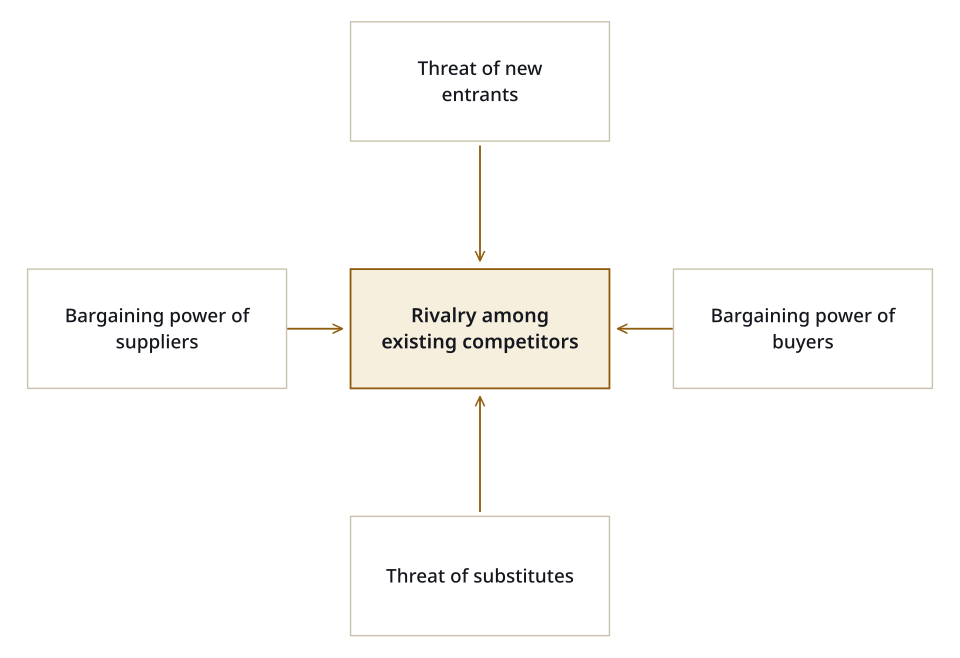 Competitive forces in an industry (Image: Peter Gladdish, CC BY 4.0, via Wikimedia Commons)
Worked Example: NEPSE Stock Trends Research Question: "What factors influence investor behavior in NEPSE?" Theoretical Framework:
- Economic Theory (Keynesian): Interest rates affect risk appetite.
- Behavioral Finance: Herd mentality drives bubbles (e.g., 2021 NEPSE crash).
- SWOT: Government policies (Strength: tax incentives; Weakness: slow reforms).
Visual Link:
graph LR
    A["Investor Behavior"] --> B["Economic Factors\n(Interest Rates, GDP)"]
    A --> C["Psychological Factors\n(FOMO, Loss Aversion)"]
    A --> D["Market Structure\n(Liquidity, Regulatory Policies)"]
Writing the Literature Review Section
Structure of a Strong Literature Review
- Introduction: State the purpose (e.g., "This review examines digital payment adoption in Nepal, synthesizing 15 studies from 2018–2023.").
- Body: Organize by themes (not chronologically). Use subheadings:
- "Consumer Trust in Digital Wallets"
- "Barriers to E-Commerce Growth"
- Critical Analysis: Highlight contradictions or debates (e.g., "While Study X claims Khalti’s success is due to USSD, Study Y attributes it to agent networks.").
- Conclusion: Summarize gaps and justify your research (e.g., "No study has analyzed the role of micro-influencers in NEPSE investor decisions.").
Common Mistakes to Avoid
- Descriptive > Analytical: Don’t just list sources—interpret them.
- Over-reliance on Tertiary Sources: Avoid Wikipedia as a primary reference.
- Ignoring Grey Literature: NTC’s annual reports or Daraz’s sustainability white papers can be goldmines.
- Plagiarism: Always paraphrase and cite (APA/MLA/Harvard style).
In the Real World
Khalti’s Market Expansion
- Literature Review Use: Khalti’s team analyzed secondary sources (CBN reports, FinScope Nepal surveys) to identify that 60% of rural users preferred cash-on-delivery. They built a theoretical framework using Diffusion of Innovation Theory (Rogers, 1962) to predict adoption barriers. This led to their "Khalti Agent" program, increasing rural usage by 40% in 2022.
Daraz’s Supply Chain Optimization
- Theoretical Framework: Daraz used Porter’s Value Chain to map inefficiencies in Nepal’s logistics. Their literature review of primary data (seller feedback) revealed that 70% of delays were due to last-mile issues. They applied SWOT analysis to design "Daraz Logistics Hubs" in 8 cities, reducing delivery times by 30%.
Ncell’s 5G Rollout Strategy
- Gap Identification: Ncell’s research team found that no prior study had analyzed consumer willingness to pay for 5G in tier-2 cities. They conducted a secondary data review of telecom reports (GSMA, NTA) and primary surveys (2,000 respondents). Their theoretical framework combined Technology Acceptance Model (TAM) with Maslow’s Hierarchy to argue that 5G adoption would hinge on affordability and perceived benefits (e.g., faster YouTube).
Exam Tip: How to Score Full Marks
Define Clearly:
- "A literature review is a critical synthesis of existing research to identify gaps and justify the need for new studies." (3 marks)
Link to Real-World Examples:
- "Like Khalti’s use of agent networks (supported by Diffusion Theory), this study will explore how Pathao’s referral program leverages social influence." (2 marks)
Use Frameworks Properly:
- For a question on "Why do Nepali consumers resist credit cards?", apply:
- SWOT (Weakness: lack of POS infrastructure).
- Maslow’s Hierarchy (Safety needs > credit risk).
- TAM (Perceived risk > perceived benefit). (4 marks)
- For a question on "Why do Nepali consumers resist credit cards?", apply:
Avoid Generic Statements:
- ❌ "Literature reviews are important." → ✅ "A well-conducted literature review, like Nepal Rastra Bank’s 2023 financial inclusion report, can predict market trends and reduce research costs by avoiding redundant studies." (3 marks)
Case Study Approach:
- For "Analyze the literature on Daraz’s failure in rural Nepal," structure your answer as:
- Primary Sources: Daraz’s internal seller surveys (showing 60% rural sellers used cash).
- Secondary Sources: World Bank’s 2022 e-commerce report (highlighting trust issues).
- Gap: "No study has tested mobile-based trust signals (e.g., video verification) as a solution." (5 marks)
- For "Analyze the literature on Daraz’s failure in rural Nepal," structure your answer as:
Final Checklist Before Submission:
- Did I critically analyze sources (not just summarize)?
- Did I link theory to real-world examples (e.g., Khalti, Daraz)?
- Did I use at least one framework (SWOT, Porter’s, TAM)?
- Are my citations proper (author-year, no plagiarism)?
- Did I identify a research gap clearly?
Based on the TU BBA syllabus for Market Research (MKM207), unit 3.
Discussion
Loading…