Introductory MicroeconomicsUnit 810 min read
Game Theory Basics, Strategies & Market Applications
Unit 8 of Introductory Microeconomics explores strategic decision-making in economics through game theory, analyzing prisoner’s dilemmas, Nash equilibria, and real-world applications in oligopolies, auctions, and public policy—with Nepalese and global examples.
TAKEAWAYS:
- Game theory models strategic interactions where players’ payoffs depend on others’ choices (e.g., firms setting prices, governments regulating markets).
- A Nash equilibrium occurs when no player can benefit by unilaterally changing their strategy (e.g., Pathao vs. Yeti’s ride-hailing prices).
- Dominant strategies (always best regardless of others’ moves) and mixed strategies (randomized choices) solve classic dilemmas like the Prisoner’s Problem.
- Applications include oligopolies (Ncell vs. NTC), auctions (NEPSE share trading), and climate agreements (global carbon emission pledges).
- Extensive-form games (sequential moves) vs. normal-form games (simultaneous moves) change outcomes (e.g., Daraz’s discount wars vs. Kathmandu traffic routes).
- Market failures (e.g., overfishing in lakes) can be fixed using game-theoretic tools like repeated games or enforcement mechanisms.
1. What is Game Theory?
Game theory studies how rational decision-makers interact strategically, where the outcome for one depends on others’ choices. Unlike traditional economics (which assumes fixed prices or quantities), game theory analyzes interdependent decisions—critical for markets with few players (oligopolies), auctions, or policy design.
Key Definitions
| Term | Definition | Example |
|---|---|---|
| Player | A decision-maker (e.g., firms, governments, individuals). | Ncell and NTC competing on data prices. |
| Strategy | A complete plan of action (e.g., "Set price at Rs. 500" or "Collude"). | Pathao offering discounts to attract riders. |
| Payoff | The benefit/cost a player receives from an outcome. | Higher profits if competitors raise prices (but risk losing customers). |
| Game | A structured interaction with rules, strategies, and payoffs. | Kathmandu traffic: drivers choose routes to minimize time. |
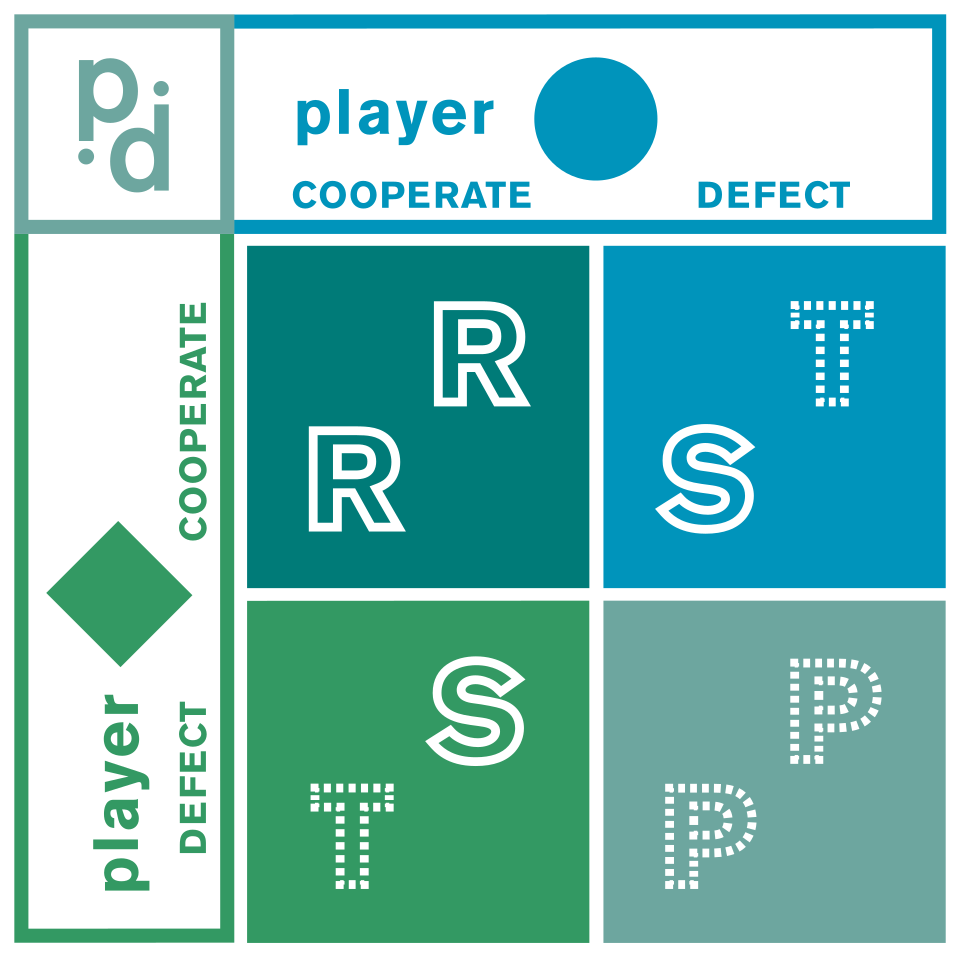 prisoner's dilemma payoff matrix (Image: Christopher X Jon Jensen (CXJJensen) & Greg Riestenberg, CC BY-SA 3.0, via Wikimedia Commons)
A classic example showing why cooperation fails even when it’s mutually beneficial.
prisoner's dilemma payoff matrix (Image: Christopher X Jon Jensen (CXJJensen) & Greg Riestenberg, CC BY-SA 3.0, via Wikimedia Commons)
A classic example showing why cooperation fails even when it’s mutually beneficial.
2. Types of Games
A. Normal-Form (Simultaneous-Move) Games
Players choose strategies at the same time, without knowing others’ moves. Represented in a payoff matrix.
Example: The Prisoner’s Dilemma Two tea smugglers (A and B) are arrested. The police offer:
- If both cooperate (silence), they get 1 year each.
- If one betrays and the other cooperates, the betrayer goes free; the cooperator gets 10 years.
- If both betray, they get 5 years each.
Outcome: Both betray (Nash equilibrium), even though cooperating is better for both. Real-world tie-in: Nepal’s tea farmers face this when deciding whether to undercut prices. If all collude (cooperate), prices stay high; if one cheats, the market collapses.
B. Extensive-Form (Sequential-Move) Games
Players move one after another, with information sets (what each knows). Drawn as game trees.
Example: Stackelberg Duopoly (Ncell vs. NTC)
- Ncell (leader) sets price first.
- NTC (follower) observes and sets its price. Outcome: Ncell earns higher profits by committing to a price first.
graph TD
    A["Ncell: Set High Price (Rs. 1000)"] --> B["NTC: Set Low Price (Rs. 800)"]
    A --> C["NTC: Set High Price (Rs. 1000)"]
    B --> D["Payoffs: Ncell=50, NTC=40"]
    C --> E["Payoffs: Ncell=30, NTC=30"]
Real-world tie-in: Daraz vs. Amazon Nepal—the first to announce discounts forces others to follow.
3. Nash Equilibrium: The Core Concept
A Nash equilibrium occurs when no player can improve their payoff by unilaterally changing strategy.
How to find it?
- For each player, circle their best response to every possible strategy of others.
- The equilibrium is where all players’ circled strategies match.
Example: Battle of the Sexes (Couple Choosing a Movie)
- John prefers football; Jane prefers concerts.
- They get higher payoffs if they agree, but disagree if they choose separately.
Nash equilibria: (Football, Football) or (Concert, Concert). Real-world tie-in: Khalti vs. eSewa—both could collude to set high transaction fees, but fear of losing users to the other prevents cooperation.
4. Dominant and Dominated Strategies
- Dominant strategy: Always best, regardless of others’ choices. Example: In the Prisoner’s Dilemma, betray is dominant for both.
- Dominated strategy: Never best; can be eliminated. Example: In a price war, raising prices is dominated if competitors cut prices.
A payoff matrix where one strategy is always worse.
5. Mixed Strategies and Randomization
When no pure strategy is best, players randomize choices (e.g., flip a coin).
Example: Matching Pennies
- Player 1 chooses Heads (H) or Tails (T).
- Player 2 wins if they match (but Player 1 loses).
- Nash equilibrium: Both choose H or T with 50% probability.
Real-world tie-in: NEPSE share auctions—bidders randomize bids to avoid predictable patterns.
6. Applications in Real Markets
A. Oligopolies: Ncell vs. NTC
- Game: Price competition.
- Strategy: Avoid price wars (like the Prisoner’s Dilemma).
- Outcome: Tacit collusion (unspoken agreements to keep prices high).
- Evidence: Nepal’s mobile data prices are ~30% higher than in competitive markets like India.
pie
    title Ncell Market Share (2023)
    "60%" : "Ncell"
    "30%" : "NTC"
    "10%" : "Others"
B. Auctions: NEPSE Share Trading
- Game: Sealed-bid auction (bidders submit prices simultaneously).
- Strategy: Bid slightly above the second-highest bid (like the Auctioneer’s Problem).
- Outcome: Winners pay more than the item’s value (winner’s curse).
A comparison of auction formats.
C. Climate Agreements: Global Carbon Emissions
- Game: Repeated Prisoner’s Dilemma (countries choose to emit or reduce CO₂).
- Strategy: Tit-for-tat (punish cheaters, reward cooperators).
- Outcome: Paris Agreement uses this logic to incentivize reductions.
7. Market Failures and Game Theory Solutions
| Failure | Game-Theoretic Fix | Example |
|---|---|---|
| Overfishing | Repeated games (fines for cheating). | Nepal’s lakes: fishermen collude to limit catch. |
| Traffic congestion | Congestion pricing (game of route choice). | Kathmandu’s ring road tolls. |
| Free-rider problem | Enforcement mechanisms (e.g., taxes). | NTC/Ncell sharing network infrastructure. |
8. Advanced: Zero-Sum vs. Non-Zero-Sum Games
- Zero-sum: One player’s gain = another’s loss (e.g., poker).
- Non-zero-sum: Both can win or lose (e.g., trade, climate policy).
A side-by-side comparison.
In the Real World
- Pathao vs. Yeti: Ride-hailing apps use price wars (like the Prisoner’s Dilemma) to attract drivers. If both slash fares, profits drop—but neither can resist.
- NEPSE Share Auctions: Investors use mixed strategies to avoid predictable bidding patterns, leading to higher prices for winners.
- Ncell/NTC Data Wars: Telecom firms engage in sequential pricing (Stackelberg model), where the first to cut prices forces others to follow, benefiting consumers but hurting profits.
- Khalti/eSewa Fees: Digital wallets face a Battle of the Sexes—users prefer the cheaper option, but both fear losing market share if they raise fees.
- Nepal’s Tea Farmers: Smallholders collude to limit supply (like an oligopoly), keeping prices high, but risk cheating if one undercuts.
Exam Tip
- Always define terms clearly:
- "A Nash equilibrium is a set of strategies where no player can benefit by deviating unilaterally."
- Draw payoff matrices for Prisoner’s Dilemma, Battle of the Sexes, or Chicken Game.
- Compare normal-form vs. extensive-form games:
- Normal-form: Simultaneous moves (matrix).
- Extensive-form: Sequential moves (tree diagram).
- Link to Nepalese examples:
- Oligopolies → Ncell/NTC.
- Auctions → NEPSE.
- Public goods → Traffic management in Kathmandu.
- Watch for "dominant strategy" questions:
- "If Player A’s strategy is always better, what is the equilibrium?"
- Memorize key outcomes:
- Prisoner’s Dilemma → Both betray.
- Chicken Game → One swerves.
- Stag Hunt → Can have multiple equilibria.
Final Worked Example: Kathmandu Traffic Routes Problem: Drivers choose between Ring Road (fast but congested) or Inner Roads (slow but less crowded). Payoffs:
- If both take Ring Road: Both lose 30 mins (congestion).
- If one takes Inner Roads: Fast driver gains 10 mins; slow driver loses 5 mins.
- If both take Inner Roads: Both lose 5 mins.
Solution:
- Nash equilibrium: Both take Ring Road (even though both would be better off on Inner Roads).
- Real-world fix: Congestion pricing (charge tolls on Ring Road) to incentivize Inner Road use.
Key Takeaway for Exams: Game theory is about strategic thinking. Always ask:
- Who are the players?
- What are their strategies?
- What are the payoffs?
- Is there a Nash equilibrium?
- How does this apply to Nepal’s markets?
Based on the TU BBM syllabus for Introductory Microeconomics (ECO211), unit 8.
Discussion
Loading…