PsychologyUnit 213 min read
Cognitive Processes: Thinking, Memory & Problem-Solving
Unit 2 of Psychology: Explores how humans process information, store memories, solve problems, and think creatively—key for understanding human behavior in workplaces, marketing, and daily decision-making.
TAKEAWAYS:
- Memory is a 3-stage process (encoding → storage → retrieval) with long-term memory divided into episodic, semantic, and procedural modules.
- Thinking uses tools like metacognition, heuristics, and algorithms—but biases (e.g., confirmation bias) often distort reasoning.
- Problem-solving follows structured methods (e.g., Gestalt’s insight, trial-and-error) but is hindered by functional fixedness and mental sets.
- Creativity is a cognitive skill that can be trained through divergent thinking and incubation.
- Real-world applications include Ncell’s customer service (memory recall), Daraz’s inventory systems (problem-solving), and eSewa’s fraud detection (heuristic thinking).
- Research methods (e.g., case studies, experiments) validate these processes—critical for TU/PU exams.
1. Cognitive Processes: The Mind’s Workflow
Cognitive processes are the mental activities that allow us to perceive, think, remember, and solve problems. They bridge biology (brain function) and behavior (how we act). Below is a flowchart of core cognitive processes:
flowchart TD
    A["Perception"] --> B["Attention"]
    B --> C["Memory"]
    C --> D["Thinking"]
    D --> E["Problem-Solving"]
    E --> F["Decision-Making"]
    F --> G["Language"]
Why it matters:
- eSewa’s fraud detection uses pattern recognition (a cognitive process) to flag unusual transactions.
- Pathao drivers rely on spatial memory (a cognitive process) to navigate routes efficiently.
2. Memory: How the Brain Stores Information
Memory is the ability to encode, store, and retrieve information. It operates in three stages:
A. Stages of Memory
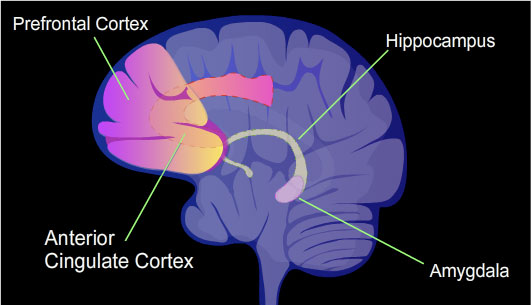 Hippocampus (encoding), amygdala (emotion), prefrontal cortex (retrieval). (Image: This work has been identified as being free of known restric, Public domain, via Wikimedia Commons)
The figure above shows key brain regions involved in memory. Encoding (converting sensory input to memory) happens in the hippocampus, while retrieval (recovering stored info) relies on the prefrontal cortex.
Hippocampus (encoding), amygdala (emotion), prefrontal cortex (retrieval). (Image: This work has been identified as being free of known restric, Public domain, via Wikimedia Commons)
The figure above shows key brain regions involved in memory. Encoding (converting sensory input to memory) happens in the hippocampus, while retrieval (recovering stored info) relies on the prefrontal cortex.
| Stage | Definition | Example |
|---|---|---|
| Encoding | Converting sensory input into a usable memory code. | Studying for an exam (converting textbook info into long-term memory). |
| Storage | Holding encoded information over time. | Remembering your first job interview years later. |
| Retrieval | Accessing stored information when needed. | Recalling a phone number to call a friend. |
Worked Example: Daraz’s Inventory System Daraz uses semantic memory (facts about products) to categorize items and episodic memory (past orders) to predict customer demand. When a user searches for "laptops," Daraz’s system retrieves stored data on stock levels and pricing—just like how your brain retrieves a memory.
B. Types of Long-Term Memory
Long-term memory (LTM) is permanent and divided into three modules:
mindmap
  root((Long-Term Memory))
    Episodic("Episodic Memory")
      - Personal events (e.g., your graduation day)
      - Time-stamped (past, present, future)
    Semantic("Semantic Memory")
      - Factual knowledge (e.g., "Nepal’s capital is Kathmandu")
      - Not tied to personal experience
    Procedural("Procedural Memory")
      - Skills and habits (e.g., riding a bike, typing)
      - Unconscious recall
Real-world tie:
- Ncell’s customer service relies on semantic memory (knowing standard troubleshooting steps) and procedural memory (how to reset a SIM card).
- NEPSE traders use episodic memory (remembering past market crashes) to make decisions.
Exam Tip: For TU/PU exams, always link memory types to real-life examples (e.g., "A doctor uses semantic memory to recall medical facts but procedural memory to perform surgery").
C. Encoding: The Gateway to Memory
Encoding is how information enters memory. The three main encoding types are:
| Type | Definition | Example |
|---|---|---|
| Acoustic | Encoding based on sound (e.g., rhymes, songs). | Singing the alphabet song to remember letters. |
| Visual | Encoding based on images or spatial layout. | Remembering a friend’s face. |
| Semantic | Encoding based on meaning (deepest level). | Understanding that "cat" is an animal, not just a word. |
Worked Example: Learning a New Language When learning Nepali, visual encoding helps remember script shapes, while semantic encoding helps grasp word meanings (e.g., "घर" = house). Acoustic encoding aids pronunciation.
Why semantic encoding is most effective:
- NTC’s training programs use semantic encoding (explaining concepts clearly) to teach employees new protocols.
- Google’s search algorithm encodes user queries semantically to return relevant results.
3. Thinking: Tools and Biases
Thinking is the mental process of manipulating information. It uses tools but is prone to biases.
A. Tools of Thinking
The prefrontal cortex (highlighted) is critical for rational thinking, while the amygdala influences emotional decision-making.
| Tool | Definition | Example |
|---|---|---|
| Metacognition | "Thinking about thinking" (self-awareness of cognitive processes). | A student reviewing notes before an exam. |
| Heuristics | Mental shortcuts for quick decisions (often flawed). | Assuming "expensive = high quality" when buying a phone. |
| Algorithms | Step-by-step problem-solving methods (guaranteed correct). | Following a recipe to bake a cake. |
Worked Example: WhatsApp’s Message Prioritization WhatsApp uses heuristics (e.g., "unread messages = urgent") to sort notifications. However, this can lead to confirmation bias (ignoring less important but relevant messages).
B. Common Biases and Errors
Cognitive biases are systematic errors in thinking. Here are the most exam-relevant ones:
mindmap
  root((Common Cognitive Biases))
    Confirmation("Confirmation Bias")
      - Favoring info that confirms preexisting beliefs.
      - Example: Believing "Ncell has better service" because you only read positive reviews.
    Anchoring("Anchoring Bias")
      - Relying too heavily on the first piece of information.
      - Example: A shop selling a phone for ₹10,000 after listing it at ₹20,000.
    Availability("Availability Heuristic")
      - Judging probability based on recall ease.
      - Example: Fear of plane crashes (highly publicized) over car accidents (common but less reported).
    FunctionalFixedness("Functional Fixedness")
      - Seeing objects only in their typical use.
      - Example: Using a spoon only to eat, not as a makeshift lever.
Real-world impact:
- Banks use heuristics to approve loans quickly but may miss risks due to anchoring bias (fixating on credit scores).
- YouTube’s recommendation algorithm exploits confirmation bias by suggesting videos matching your viewing history.
Exam Tip: For PU/TU exams, always compare biases with real-life scenarios (e.g., "How does anchoring bias affect Daraz’s pricing strategies?").
4. Problem-Solving: Methods and Pitfalls
Problem-solving is the process of finding solutions to challenges. It follows structured methods but is often hindered by mental blocks.
A. Approaches to Problem-Solving
| Approach | Definition | Example |
|---|---|---|
| Algorithm | Step-by-step, guaranteed solution. | Following a math formula to solve an equation. |
| Heuristic | Quick, but may be incorrect. | Guessing a password based on common patterns. |
| Trial-and-Error | Testing solutions until one works. | Adjusting a TV remote until the correct channel appears. |
| Insight | Sudden realization (Gestalt psychology). | Seeing how to rearrange furniture to maximize space. |
Worked Example: Kathmandu Traffic Routes Drivers use heuristics (e.g., "take the left turn") but may get stuck in functional fixedness (only using familiar routes). Algorithms (GPS directions) help avoid this.
B. Common Errors in Problem-Solving
mindmap
  root((Common Problem-Solving Errors))
    MentalSet("Mental Set")
      - Relying on past solutions.
      - Example: Always solving math problems the same way, missing a simpler approach.
    FunctionalFixedness("Functional Fixedness")
      - Seeing objects only in their typical use.
      - Example: Using a hammer only to hit nails, not as a doorstop.
    Overconfidence("Overconfidence Bias")
      - Overestimating one’s abilities.
      - Example: A student skipping revision because "I always pass."
Real-world tie:
- Pathao drivers suffer from mental set if they always take the same route, missing shortcuts.
- NEPSE traders fall into overconfidence bias during bull markets, leading to reckless investments.
5. Creativity: The Art of Divergent Thinking
Creativity is generating novel and useful ideas. It involves divergent thinking (exploring many possibilities) and convergent thinking (narrowing to one solution).
A. Stages of Creativity
- Preparation – Gathering information.
- Incubation – Unconscious processing (e.g., "sleeping on a problem").
- Illumination – Sudden insight (e.g., "Eureka!" moment).
- Verification – Testing the idea.
Worked Example: Daraz’s "Buy Now, Pay Later" Daraz’s marketing team used divergent thinking to brainstorm payment options, leading to this popular feature.
B. Can Creativity Be Learned?
Yes! Techniques to boost creativity:
- Brainstorming (group idea generation).
- Mind mapping (visualizing connections).
- Divergent thinking exercises (e.g., "How many uses can you find for a brick?").
Exam Tip: For TU/PU exams, link creativity to real businesses: "How did WhatsApp’s end-to-end encryption (a creative solution) solve privacy concerns?"
6. Research Methods in Cognitive Psychology
Psychologists study cognitive processes using:
- Case studies (e.g., HM’s memory loss study).
- Experiments (e.g., testing memory recall under stress).
- Neuroimaging (e.g., fMRI scans of the brain during problem-solving).
Example: A study on Ncell’s customer service might use observational research to see how agents recall solutions under pressure.
In the Real World
eSewa’s Fraud Detection
- Idea: Uses heuristics (pattern recognition) to flag unusual transactions.
- How: If a user suddenly makes a large payment, eSewa’s system triggers a confirmation bias check (asking for verification).
Daraz’s Inventory Management
- Idea: Relies on episodic memory (past sales data) and semantic memory (product categories) to predict demand.
- How: If "laptops" sell well in winter, Daraz retrieves this from LTM and stocks more.
Pathao’s Route Optimization
- Idea: Combats functional fixedness by using GPS algorithms (not just driver intuition).
- How: Drivers avoid traffic jams by following structured problem-solving (not just past routes).
Exam Tip: How to Score Full Marks
Link theory to real life.
- Example: "Semantic memory helps NEPSE traders recall stock trends, while episodic memory helps them avoid past mistakes."
- PU/TU love this!
Use diagrams and examples.
- Draw a mind map of long-term memory or a flowchart of problem-solving steps.
- Example: "A student using heuristics to study (skipping hard topics) may fail due to confirmation bias."
Compare approaches.
- Example: "Algorithms guarantee correct solutions, but heuristics are faster—like using GPS (algorithm) vs. asking a local (heuristic) for directions."
Address biases critically.
- Example: "Banks use anchoring bias in loan approvals, which can lead to unfair rejections."
For case studies:
- Dipesh vs. Suresh (supermarket scenario):
- Dipesh uses heuristics (quick decisions), while Suresh uses algorithms (planned budgeting).
- Answer: "Dipesh’s heuristic approach may lead to overconfidence bias, while Suresh’s algorithmic planning ensures better financial control."
- Dipesh vs. Suresh (supermarket scenario):
Final Note: This unit is highly practical. Always connect theory to apps, banks, or daily life—examiners reward real-world relevance!
Based on the TU BBM syllabus for Psychology (PSY201), unit 2.
Discussion
Loading…