PsychologyUnit 48 min read
Motivation & Memory: Theories, Processes & Real-World Impact
Unit 4 of Psychology: Explores the psychological mechanisms of motivation (drives, needs, theories) and memory (encoding, storage, retrieval) with real-world applications in workplaces, education, and daily life.
TAKEAWAYS:
- Motivation is driven by biological needs (Maslow’s hierarchy) and psychological factors (Herzberg’s two-factor theory), shaping workplace performance and personal goals.
- Memory operates in three stages (sensory, short-term, long-term) with encoding (visual, acoustic, semantic) as the critical bridge to retention.
- Real-world examples like Ncell’s loyalty programs (motivation) and Daraz’s order tracking (memory processes) illustrate these concepts in action.
- Forgetting occurs due to decay, interference, or retrieval failure, but techniques like spaced repetition (used in apps like Anki) combat it.
- Managers leverage motivation theories to boost productivity (e.g., bonuses, recognition), while memory principles improve training and decision-making.
- Case studies (e.g., Dipesh vs. Suresh in the supermarket scenario) reveal how motivation and memory interact in real-life scenarios.
Motivation: Theories and Applications
1. Defining Motivation
Motivation is the internal force that drives behavior toward a goal. It can be:
- Intrinsic: Driven by personal satisfaction (e.g., learning for knowledge).
- Extrinsic: Driven by external rewards (e.g., bonuses, promotions).
2. Key Theories of Motivation
A. Maslow’s Hierarchy of Needs
Abraham Maslow proposed that human needs form a hierarchy, from basic survival to self-fulfillment:
- Physiological: Food, water, sleep.
- Safety: Security, stability.
- Love/Belonging: Relationships, social acceptance.
- Esteem: Respect, achievement.
- Self-Actualization: Personal growth, fulfillment.
Example: A Ncell employee may prioritize esteem needs (recognition) before self-actualization (innovation) if their basic needs are met.
B. Herzberg’s Two-Factor Theory
Frederick Herzberg distinguished between hygiene factors (dissatisfiers) and motivators (satisfiers):
| Hygiene Factors (Prevent dissatisfaction) | Motivators (Drive satisfaction) |
|---|---|
| Salary, job security, company policy | Achievement, recognition, growth |
Example: At eSewa, a low salary (hygiene factor) may demotivate employees, but promotions (motivator) can boost morale.
C. Drive Theory
Motivation arises from unmet biological needs (drives) that create tension until satisfied:
- Example: Hunger (drive) → Eating (goal) → Reduction of tension.
D. Expectancy Theory (Vroom)
Motivation depends on:
- Expectancy: Belief that effort leads to performance.
- Instrumentality: Belief that performance leads to rewards.
- Valence: Desire for the reward.
Example: A Pathao driver may be motivated if they believe:
- Hard work (effort) → Good ratings (performance) → Higher earnings (reward).
3. Motivation in the Workplace
Managers use motivation theories to:
- Increase productivity (e.g., bonuses at NTC for meeting targets).
- Reduce turnover (e.g., Khalti offering flexible work policies).
- Enhance creativity (e.g., Daraz encouraging innovation contests).
Worked Example: A manager at a bank notices employees are demotivated. Using Herzberg’s theory, they introduce:
- Hygiene fix: Better pay (addresses dissatisfaction).
- Motivator: Public recognition for top performers (boosts satisfaction).
Memory: Processes and Mechanisms
1. The Memory Process
Memory involves three stages:
- Sensory Memory: Brief (0.5–2 sec) storage of sensory input (e.g., seeing a license plate).
- Short-Term Memory (STM): Holds ~7±2 items for ~20–30 sec (e.g., remembering a phone number).
- Long-Term Memory (LTM): Permanent storage (unlimited capacity).
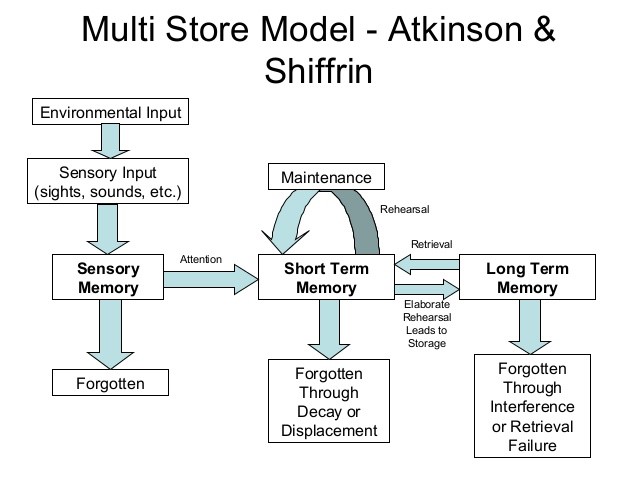 Sensory → Short-Term → Long-Term Memory flow (Atkinson & Shiffrin, 1968) (Image: Dkahng, CC BY-SA 4.0, via Wikimedia Commons)
2. Encoding: How Information Enters Memory
Encoding converts sensory input into a usable format:
- Visual: Images (e.g., remembering a NEPSE stock chart).
- Acoustic: Sounds (e.g., remembering a song lyric).
- Semantic: Meaning (e.g., understanding a bank loan term).
Example: Studying for exams using flashcards (visual + semantic encoding) improves retention.
3. Long-Term Memory Modules
LTM is divided into:
- Explicit (Declarative): Facts and events (e.g., remembering a Daraz order history).
- Semantic: General knowledge (e.g., "Ncell’s CEO is Mr. X").
- Episodic: Personal experiences (e.g., "My first job interview at a bank").
- Implicit (Non-Declarative): Skills and habits (e.g., riding a bike, typing).
4. Forgetting: Why We Lose Memories
Forgetting occurs due to:
- Decay: Memory fades over time (e.g., forgetting a phone number after 20 mins).
- Interference: New info disrupts old (e.g., confusing two similar Ncell plans).
- Retrieval Failure: Info is stored but hard to access (e.g., "tip of the tongue" phenomenon).
Example: A student may forget a NEPSE stock price after a week (decay) or confuse it with another stock (interference).
5. Improving Memory
Techniques to enhance retention:
- Chunking: Grouping info (e.g., phone number as 984-123-4567).
- Spaced Repetition: Reviewing material over time (used in Anki app).
- Mnemonics: Memory aids (e.g., "ROYGBIV" for rainbow colors).
Example: A Pathao rider uses chunking to remember multiple customer addresses by grouping them by neighborhood.
In the Real World
Ncell’s Loyalty Program
- Motivation Idea: Uses extrinsic rewards (discounts, free data) to motivate customers to stay loyal (Herzberg’s motivators).
- Memory Idea: Customers remember past rewards (explicit memory) to justify continued use.
Daraz’s Order Tracking System
- Memory Idea: Uses episodic memory (tracking order history) to build trust and reduce anxiety for shoppers.
Bank Loan Interest Calculations
- Motivation Idea: Banks use expectancy theory—customers are motivated if they believe loans will help them achieve goals (e.g., buying a house).
Kathmandu Traffic Routes
- Memory Idea: Drivers use spatial memory (LTM) to navigate familiar routes, reducing stress during rush hour.
Exam Tip
For Motivation:
- Always relate theories to real-world scenarios (e.g., workplace, education).
- Compare Maslow vs. Herzberg in a table for clarity.
- Use case studies (e.g., Dipesh vs. Suresh) to show how motivation drives behavior.
For Memory:
- Explain encoding types with examples (visual, acoustic, semantic).
- Differentiate explicit vs. implicit memory with clear examples.
- For forgetting, mention all three causes (decay, interference, retrieval failure) and how they apply to daily life.
Common Pitfalls:
- Forgetting to link theories to real examples (e.g., Ncell, Daraz).
- Overlooking memory stages—always include sensory, STM, LTM.
- Not explaining why a theory works (e.g., "Herzberg’s motivators reduce turnover because employees feel valued").
Sample Answer Structure for Exam:
- Define the topic (e.g., "Motivation is...").
- Explain a theory (e.g., Maslow’s hierarchy) with a real-world example.
- Compare two theories in a table.
- Apply to a scenario (e.g., "How would a manager use Herzberg’s theory at NTC?").
Final Note: This unit is highly practical. Always tie theories to apps, companies, or daily life (e.g., Khalti’s rewards, Pathao’s routes). Use examples to show how motivation and memory work together—just like how Dipesh and Suresh in the supermarket case rely on both to make decisions!
Based on the TU BBM syllabus for Psychology (PSY201), unit 4.
Discussion
Loading…