Project managementUnit 212 min read
Project Constraints & Environmental Analysis: Scope, Time, Cost, Risks & External Factors
Unit 2 of Project Management explores the triple constraints (scope, time, cost) and environmental factors that shape project success, using real-world examples from Nepal (e.g., Khimti-I hydropower BOOT model) and global firms (e.g., Daraz’s supply chain delays). Learn how constraints interact, how to analyze project
TAKEAWAYS:
- Triple constraints (scope, time, cost) are interdependent: changing one affects the others (e.g., adding features to a Daraz app delays launch and increases budget).
- Environmental analysis (PESTEL, SWOT) reveals risks like Nepal’s political instability (affecting NEPSE stock projects) or global supply chain disruptions (e.g., COVID-19 halting Ncell’s 5G rollout).
- Fast-track projects (overlapping phases) cut time but increase risk—used in Khimti-I hydropower to meet deadlines under BOOT agreements.
- Bilateral projects (e.g., ADB-funded roads) require alignment with donor constraints, unlike unilateral projects (e.g., NTC’s fiber-optic expansion).
- Project control systems (e.g., Nabil Bank’s loan approval workflows) use feedback loops (monitoring vs. controlling) to adjust scope/time/cost mid-project.
- Nepal’s delays stem from weak stakeholder coordination, legal bottlenecks (land acquisition for hydropower), and resource shortages—solvable with matrix organizations (e.g., Daraz’s cross-functional teams).
1. The Triple Constraints: Scope, Time, and Cost
Projects exist at the intersection of three core constraints, often called the "Project Management Triangle" or "Iron Triangle". These constraints are interdependent: altering one requires trade-offs in the others.
pie
    title Project Management Triangle
    "Scope" : 33
    "Time" : 33
    "Cost" : 33
    label "Trade-offs required!"
How They Interact
- Scope: The features, deliverables, and quality standards of the project. Example: Adding a Khalti payment integration to an eSewa-like app increases scope.
- Time: The deadline to complete the project. Example: NTC’s fiber-optic expansion must finish by 2025 to meet government targets.
- Cost: The budget allocated to the project. Example: Pathao’s electric scooter fleet expansion requires ₹500M but delays if cost-cutting measures fail.
Worked Example: Daraz’s Order Fulfillment Delay Daraz promised same-day delivery in Kathmandu but faced:
- Scope creep: Adding cash-on-delivery for rural areas (increased scope).
- Time crunch: Monsoon rains damaged delivery routes (extended time).
- Cost overrun: Hiring temporary staff for peak season (increased cost). Solution: Daraz reduced scope (limited COD zones) to meet deadlines.
Fast-Track Projects: Overlapping Phases
To meet tight deadlines, projects may overlap phases (e.g., starting construction before finalizing designs). This is called fast-tracking or crashing.
- Used in: Khimti-I hydropower (BOOT model required early revenue).
- Risks:
- Higher rework costs (e.g., redesigning Ncell’s 5G towers mid-construction).
- Increased coordination complexity (e.g., NTC’s fiber-optic teams working simultaneously on trenches and nodes).
Comparison Table: Traditional vs. Fast-Track Projects
| Factor | Traditional Project | Fast-Track Project |
|---|---|---|
| Phase Order | Sequential (Design → Build → Test) | Overlapping (e.g., Build while Testing) |
| Time | Longer | Shorter |
| Cost | Lower (planned) | Higher (unexpected rework) |
| Risk | Lower | Higher (e.g., NTC’s fiber cuts) |
| Example in Nepal | Chaudhary Group’s warehouse expansion | Khimti-I hydropower (BOOT) |
2. Environmental Analysis: PESTEL and SWOT
Projects don’t exist in a vacuum—they’re influenced by external environments. Analyzing these helps identify opportunities and threats.
PESTEL Analysis: Macro-Environmental Factors
PESTEL stands for Political, Economic, Social, Technological, Environmental, and Legal factors. Let’s apply it to a Nepali hydropower project (e.g., West Seti):
mindmap
  root((PESTEL Analysis for West Seti Hydropower))
    Political
      "Government policies (e.g., 20% FDI cap)"
      "Political instability delays approvals"
    Economic
      "High initial cost (₹20B)"
      "ADB loan terms (5% interest)"
    Social
      "Local protests (land acquisition)"
      "Job creation for 500+ workers"
    Technological
      "Use of drones for site surveys"
      "AI for demand forecasting"
    Environmental
      "Flood risk in monsoon"
      "Biodiversity impact (e.g., fish migration)"
    Legal
      "Environmental Impact Assessment (EIA) requirements"
      "Labor laws (minimum wage for workers)"
SWOT Analysis: Internal vs. External Factors
SWOT helps assess a project’s Strengths, Weaknesses, Opportunities, and Threats. Example: Ncell’s 5G Rollout
| Internal | External |
|---|---|
| Strengths | Strong brand (Ncell) |
| Existing 4G infrastructure | |
| Weaknesses | High capital expenditure |
| Limited rural coverage |
Real-World Tie-In: NEPSE’s Stock Market Projects
- Opportunity: Government push for digital IPOs (e.g., NMB Bank’s 2023 listing).
- Threat: Low investor confidence due to past scandals (e.g., 2015 market crash).
- Solution: NEPSE used SWOT analysis to prioritize transparency and tech upgrades (blockchain for trading).
3. Project Control Systems: Monitoring vs. Controlling
Projects use feedback loops to stay on track. Two key processes:
- Monitoring: Tracking progress (e.g., Daraz’s daily sales reports).
- Controlling: Taking corrective action (e.g., Pathao adjusting driver incentives).
flowchart TD
    A["Project Execution"] --> B{"Monitoring"}
    B -->|"On Track?"| C["Continue"]
    B -->|"Off Track?"| D["Controlling"]
    D --> E["Adjust Scope/Time/Cost"]
    E --> F["Re-monitor"]
Control Systems in Nepali Projects
| Project | Monitoring Tool | Controlling Action |
|---|---|---|
| Khimti-I Hydropower | Weekly progress reports to ADB | Fast-tracked turbine installation |
| NTC Fiber-Optic Expansion | GPS-tracked cable laying | Hired extra labor during monsoon |
| Nabil Bank Loan Processing | Automated risk-scoring system | Rejected high-risk applicants early |
Worked Example: NTC’s Fiber-Optic Delay
- Issue: Monsoon rains damaged 20% of trenches in Chitwan.
- Monitoring: Daily drone surveys identified damaged sections.
- Controlling:
- Scope: Reduced coverage in flood-prone areas.
- Time: Extended deadline by 3 months.
- Cost: Allocated ₹50M for emergency repairs.
4. Why Projects Fail in Nepal: A Critical Analysis
Nepal’s projects often face delays due to systemic issues. Let’s break it down using the Khimti-I Hydropower BOOT Model as a case study.
classDiagram
    class ProjectDelays {
        +Weak Stakeholder Coordination
        +Legal Bottlenecks
        +Resource Shortages
        +Political Instability
    }
    class KhimtiI {
        -BOOT Agreement: Build-Own-Operate-Transfer
        -Funded by: International Finance Corporation (IFC)
        -Delays: 2 years (2015–2017)
    }
    ProjectDelays "1" --> "affected" KhimtiI
    note for KhimtiI
        "Example: Land acquisition took 18 months due to protests."
Key Reasons for Delays
Weak Stakeholder Coordination
- Example: Multiple agencies (Water Resources Dept., Electricity Authority) slowed Khimti-I approvals.
- Solution: Use matrix organizations (cross-functional teams).
Legal Bottlenecks
- Example: Environmental clearances for West Seti took 3 years.
- Solution: Preemptive legal audits (like Nabil Bank’s loan approvals).
Resource Shortages
- Example: NTC’s fiber-optic project lacked skilled labor.
- Solution: Partner with vocational institutes (e.g., IOE for tech training).
Political Instability
- Example: COVID-19 lockdowns halted Ncell’s 5G trials.
- Solution: Contingency planning (e.g., Daraz’s backup warehouses).
Comparison: Nepal vs. Global Projects
| Factor | Nepal (e.g., Khimti-I) | Global (e.g., Three Gorges Dam) |
|---|---|---|
| Stakeholder Coordination | Fragmented (10+ agencies) | Unified (Chinese government) |
| Legal Process | Slow (3–5 years for approvals) | Streamlined (centralized) |
| Resource Availability | Shortages (e.g., cement, steel) | Plentiful (state-controlled) |
| Political Risk | High (frequent policy changes) | Low (stable government) |
5. Bilateral Projects: ADB and World Bank Funding
Bilateral projects involve two parties (e.g., Nepal + ADB) and come with specific constraints:
- Funding conditions: ADB may require local procurement (e.g., 70% of Khimti-I materials sourced in Nepal).
- Reporting requirements: Quarterly progress reports to donors.
- Alignment with donor goals: ADB funds sustainable projects (e.g., solar microgrids in rural Nepal).
Example: ADB-Funded Road Projects
- Constraint: Must use Nepali labor (even if cheaper foreign labor exists).
- Impact: Slower construction (e.g., East-West Highway delays).
- Solution: Train local workers (e.g., IOE’s road construction courses).
## In the Real World
eSewa’s Payment Gateway Expansion
- Constraint Interaction: Adding Khalti integration increased scope, delayed launch (time), and required a ₹50M budget boost (cost).
- Environmental Factor: Nepal Rastra Bank’s new KYC rules forced eSewa to redesign user verification (legal constraint).
Daraz’s Supply Chain Delays
- Fast-Tracking: During Dashain, Daraz overlapped inventory checks and delivery scheduling to meet demand.
- Risk: 30% of orders were delayed due to last-mile logistics failures (e.g., scooter breakdowns in Kathmandu traffic).
NTC’s Fiber-Optic Rollout
- PESTEL Analysis:
- Political: Local protests in Kavrepalanchok blocked trench digging.
- Technological: Used GPS-tracked cable layers to monitor progress.
- Control System: NTC adjusted routes in real-time using drone surveys.
- PESTEL Analysis:
Nabil Bank’s Loan Approval Workflow
- Triple Constraint: Faster approvals (time) required automated risk models (cost) but reduced manual checks (scope).
- Bilateral Constraint: ADB-funded SME loans had strict environmental audits, slowing disbursements.
## Exam Tip: How to Score Full Marks
Define + Explain + Example
- Bad: "Triple constraints are scope, time, cost."
- Good:
"The triple constraints—scope, time, and cost—are interdependent. For example, in Daraz’s 2023 expansion, adding same-day delivery (scope) delayed the launch (time) and increased the budget (cost) by 15%."
Use Real-World Cases
- Question: "Why do Nepali projects delay?"
- Answer: Tie to Khimti-I hydropower (legal bottlenecks) or NTC fiber-optic (resource shortages). Mention solutions (e.g., matrix organizations for coordination).
Draw Diagrams
- PESTEL/SWOT: Always use a mindmap or table (not paragraphs).
- Control Systems: Show a flowchart (monitoring → controlling → feedback).
Compare Nepal vs. Global
- Question: "How does project management differ in Nepal?"
- Answer: Use a comparison table (stakeholder coordination, legal speed, resource availability).
Critical Analysis
- Question: "Analyze the environment of project management in Nepal."
- Structure:
- Strengths: BOOT model (private sector efficiency).
- Weaknesses: Political instability.
- Opportunities: ADB funding for renewables.
- Threats: Climate risks (e.g., landslides for hydropower).
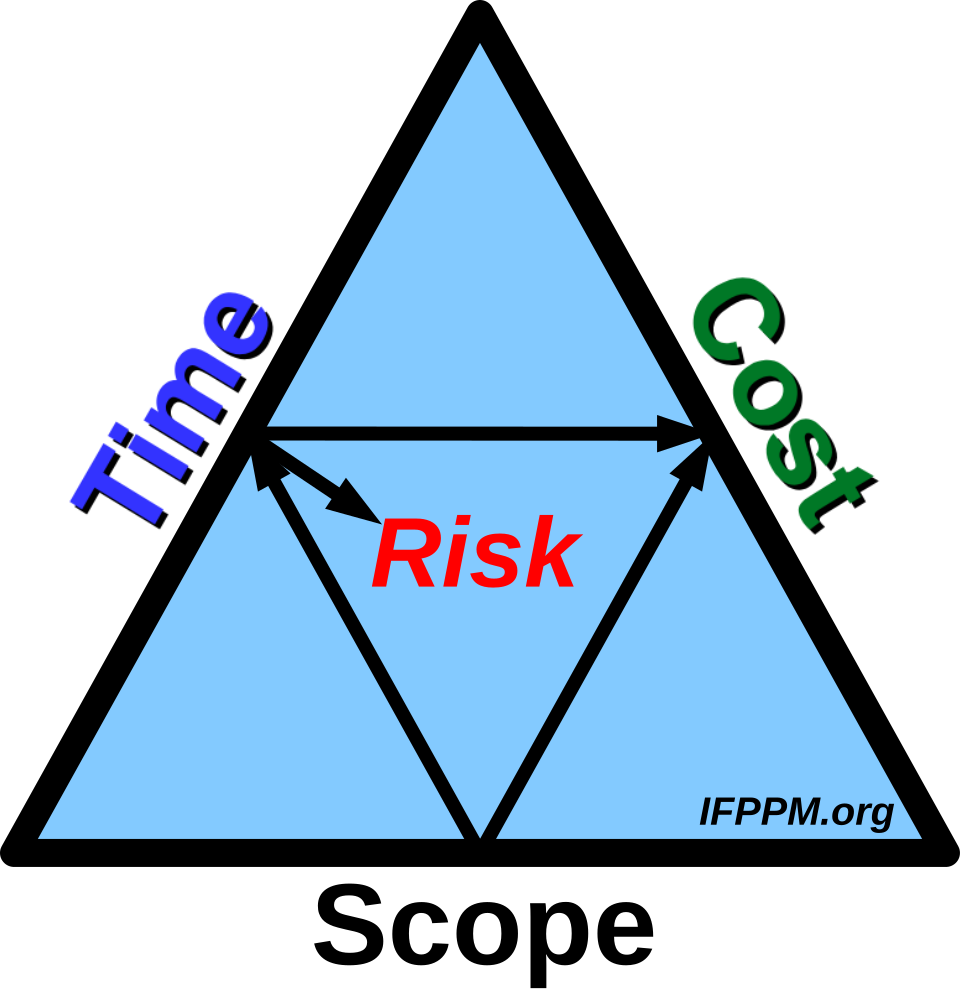 The classic scope-time-cost trade-off triangle with labeled arrows showing interdependence. (Image: Practicalpm, CC BY-SA 4.0, via Wikimedia Commons)
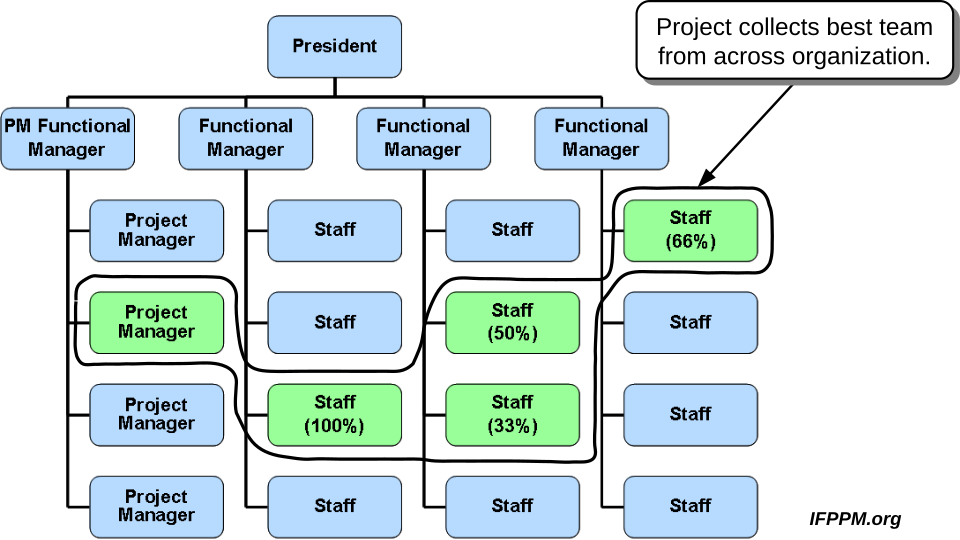 A tree diagram showing project manager, functional manager, and team members with dotted/solid lines. (Image: Practicalpm, CC BY-SA 4.0, via Wikimedia Commons)
Based on the TU BBM syllabus for Project management (EED217), unit 2.
Discussion
Loading…