Project managementUnit 312 min read
Project Org & Structure: Teams, Charts, WBS & Roles
Unit 3 of Project Management explores how projects are structured—from organizational charts to work breakdown structures (WBS)—and how roles, responsibilities, and teams interact to deliver results efficiently. Learn about functional, matrix, and projectized structures, their pros/cons, and real-world applications in
TAKEAWAYS:
- Project structures (functional, matrix, projectized) determine how teams collaborate, authority flows, and efficiency is achieved.
- Work Breakdown Structure (WBS) breaks projects into manageable tasks, linking them to timelines, costs, and responsibilities.
- Organizational charts (e.g., trees) visualize roles, reporting lines, and power distribution in projects.
- Project teams require clear roles (Project Manager, Sponsor, Team Members) to avoid conflicts and ensure accountability.
- Fast-tracking and phased delivery are techniques to accelerate projects without compromising quality.
- Nepal’s project environment (e.g., BOOT hydropower plants) faces unique challenges like bureaucracy, funding gaps, and stakeholder coordination.
1. Project Organization: Structures and Teams
Projects succeed or fail based on how teams are structured and how roles are defined. The project organization determines communication, authority, and resource allocation. Three primary structures are used:
A. Types of Project Organizations
mindmap
  root((Project Organizations))
    Functional
      "Authority: Functional Manager"
      "Project Manager: Coordination Role"
      "Pros: Clear career paths, specialized expertise"
      "Cons: Slow decision-making, project not priority"
    Matrix
      "Hybrid: Functional + Projectized"
      "Types: Weak, Balanced, Strong"
      "Pros: Flexible, shared resources, faster decisions"
      "Cons: Conflict between managers, complex reporting"
    Projectized
      "Dedicated Project Team"
      "Project Manager: Full Authority"
      "Pros: Fast decisions, clear focus, strong accountability"
      "Cons: Expensive, resource silos, limited career growth"
Worked Example: Daraz’s Warehouse Expansion Daraz (Alibaba’s Nepal unit) expanded its warehouse in Chitwan using a matrix structure:
- Functional Teams: Logistics, IT, Finance (report to Daraz HQ).
- Project Team: Led by a Project Manager (PM) with cross-functional members (e.g., a logistics expert and an IT specialist).
- Outcome: Faster decision-making than a purely functional approach, but required weekly conflict resolution meetings between the PM and functional managers.
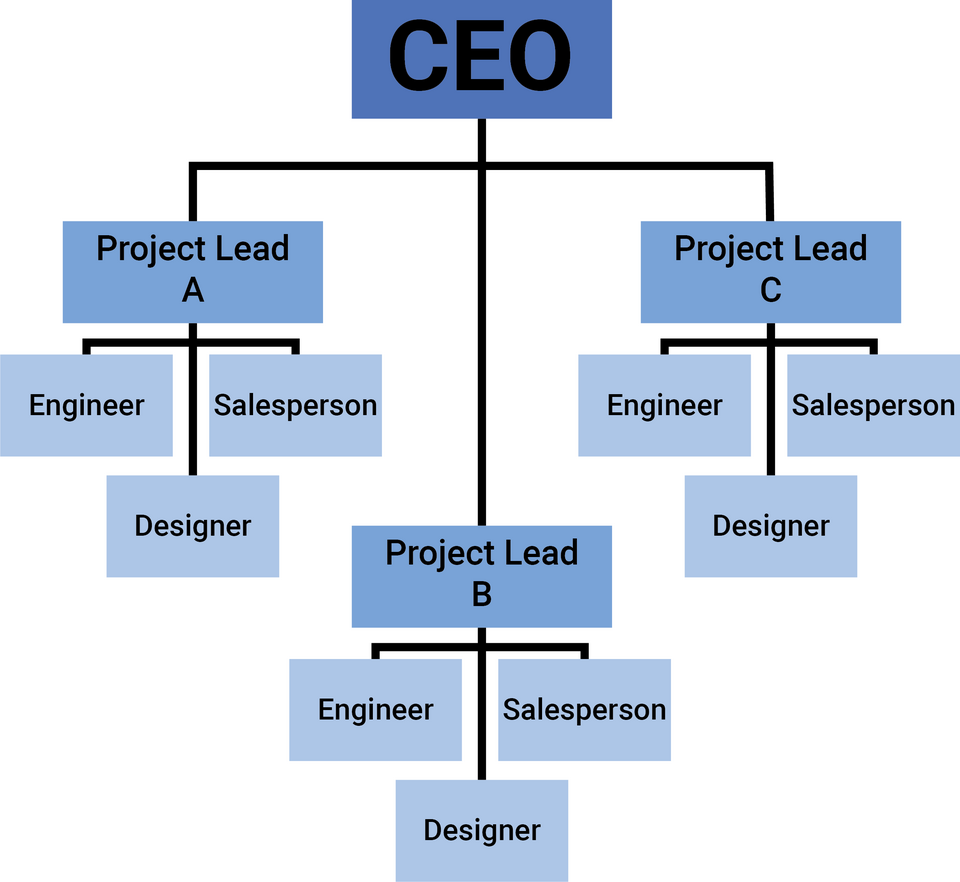 Example: Daraz’s warehouse expansion team structure (Image: Jorden Edmondstone, CC BY-SA 4.0, via Wikimedia Commons)
B. Key Roles in Project Organizations
Every project needs a core team with defined responsibilities:
| Role | Responsibilities | Example in Nepal |
|---|---|---|
| Project Sponsor | Provides funding, removes roadblocks, aligns with business goals. | NTC’s CEO approving a fiber-optic expansion. |
| Project Manager (PM) | Leads execution, manages scope/time/cost, communicates with stakeholders. | PM at Khimti-I Hydropower (BOOT model). |
| Team Members | Execute tasks, report progress, collaborate. | Engineers at Nabil Bank’s ATM upgrade. |
| Stakeholders | Clients, vendors, regulators (e.g., NEPSE for stock exchange projects). | SEB approving a new power plant’s environmental plan. |
Exam Tip: Always link roles to real-world examples (e.g., "In the Khimti-I BOOT project, the Project Sponsor was the Government of Nepal, while the PM was appointed by the private consortium").
2. Work Breakdown Structure (WBS): Breaking Down the Project
The WBS is a hierarchical decomposition of a project into deliverables, tasks, and subtasks. It ensures:
- Clear scope definition.
- Cost and time estimation at each level.
- Accountability (who does what).
A. How to Create a WBS
- Start with the final deliverable (e.g., "Construct a new bridge").
- Break into phases (Design → Procurement → Construction → Handover).
- Subdivide into tasks (e.g., "Design pillars" → "Calculate load-bearing capacity").
- Assign codes (e.g.,
1.1.2for "Procure steel beams").
mindmap
  root((WBS for NTC’s Fiber-Optic Expansion))
    1.0 Project Initiation
      1.1 Feasibility Study
      1.2 Stakeholder Approval
    2.0 Planning
      2.1 Route Survey
      2.2 Budget Allocation
    3.0 Execution
      3.1 Lay Cables
      3.2 Install Repeaters
    4.0 Handover
      4.1 Testing
      4.2 Training Staff
Worked Example: NTC’s Fiber-Optic Project
- Level 1: "Expand fiber network in Kathmandu Valley."
- Level 2: "Phase 1: Core routes (Ring Road)."
- Level 3: "Task 1.1: Survey existing poles."
- Level 4: "Subtask 1.1.1: GPS mapping of poles."
B. Advantages and Challenges of WBS
| Advantages | Challenges |
|---|---|
| Clarifies scope and avoids scope creep. | Overly detailed WBS can slow progress. |
| Helps estimate costs/time accurately. | Requires expertise to create. |
| Improves stakeholder communication. | Changes mid-project may disrupt WBS. |
Real-World Challenge in Nepal:
- Khimti-I Hydropower (BOOT): The WBS had to account for three phases:
- Construction (private sector).
- Operation (private sector profits).
- Transfer (to Government after 30 years).
- Issue: Delays in Phase 2 (operation) due to regulatory approvals from the Government caused cost overruns in Phase 3.
3. Project Structures in Action: Case Studies
A. Functional Structure: Nabil Bank’s ATM Upgrade
- Structure: Employees report to functional managers (e.g., IT Manager, Operations Manager).
- Project Role: A Project Coordinator (not a full PM) oversees the ATM upgrade.
- Pros: Bank maintains its core operations while upgrading.
- Cons: Slow decision-making (e.g., IT team prioritizes cybersecurity over the ATM project).
B. Matrix Structure: Pathao’s Ride-Hailing Expansion
- Structure: Product Teams (e.g., Driver App, Payment System) report to functional leads, but a Project Lead coordinates the new electric scooter fleet project.
- Pros: Shared resources (e.g., same payment gateway team works on both ride-hailing and food delivery).
- Cons: Conflict when the Payment Team Lead prioritizes food delivery over scooter payments.
C. Projectized Structure: Toyota’s Nepal Plant (BOOT Model)
- Structure: A dedicated team builds the plant, then hands it over to Toyota Nepal.
- Pros: Fast execution (Toyota’s global standards applied).
- Cons: High cost (Nepal’s labor laws require local hiring, adding complexity).
4. Special Project Structures
A. Fast-Track Projects
- Definition: Overlapping planning and execution phases to save time.
- Example: Nepal’s COVID-19 Vaccination Drive (2021)
- Normal Approach: Wait for full design → build → test → rollout.
- Fast-Track: Procured vaccines while simultaneously setting up cold storage and training staff.
- Risk: Higher costs due to parallel activities (e.g., buying extra vaccines for delays).
B. Phased Delivery (Staged Projects)
- Definition: Deliver the project in chunks (e.g., software releases).
- Example: eSewa’s Mobile App Updates
- Phase 1: Basic bill payment.
- Phase 2: Electricity bill integration.
- Phase 3: Loan repayment feature.
- Advantage: Early feedback from users (e.g., eSewa saw low adoption in Phase 1 and added USSD backup).
C. Bilateral Projects (Government-to-Government)
- Definition: Funded by two countries (e.g., ADB + Nepal Government).
- Example: Melamchi Drinking Water Project
- Structure: ADB provides 70% funding, Nepal Government 30%.
- Challenge: Corruption risks in procurement (e.g., overpriced pipes).
5. Project Organization in Nepal: Challenges and BOOT Model
Nepal’s project environment faces unique hurdles:
- Bureaucracy: Slow approvals (e.g., NEPSE’s IPO process takes 6–12 months).
- Funding Gaps: Many projects rely on foreign aid (e.g., World Bank-funded roads).
- Stakeholder Conflicts: Private vs. public interests (e.g., BOOT hydropower disputes).
BOOT Model: Build-Own-Operate-Transfer
Used in hydropower projects (e.g., Khimti-I, West Seti):
flowchart LR
  A["Private Sector"] -- Builds --> B["Plant"]
  B -- Owns & Operates --> C["Generates Profit"]
  C -- After 30 yrs --> D["Transfers to Govt"]
  D -- Govt Maintains --> E["Nepal’s Grid"]
Challenges in Nepal:
- Political Interference: Government changes policies mid-project.
- Regulatory Delays: Electricity Act amendments cause approval holdups.
- Force Majeure: Earthquakes (e.g., 2015 quake delayed West Seti).
6. Improving Project Structures
To avoid failures like delayed highways or corrupt tendering, projects can:
- Use Hybrid Structures: Combine matrix + projectized for flexibility.
- Adopt Agile Methods: Iterative planning (e.g., Ncell’s app updates).
- Leverage Technology:
- Project Management Software: Asana, Trello (used by Himalayan Java for supply chain).
- AI for Risk Prediction: Banks like NMB use AI to flag loan default risks early.
- Stakeholder Workshops: Involve local communities (e.g., Melamchi project consultations).
## In the Real World
eSewa’s App Development
- Idea Used: Phased Delivery + Agile Teams
- How: eSewa released its app in three sprints:
- Sprint 1: Basic bill payment (2018).
- Sprint 2: Electricity + water bills (2019).
- Sprint 3: Loan repayments + USSD backup (2020).
- Impact: 10M+ users in Nepal, reduced bank visits by 30%.
Daraz’s Warehouse Expansion (Chitwan)
- Idea Used: Matrix Structure + WBS
- How:
- WBS: Broken into storage zones, automation, staff training.
- Matrix Team: Logistics (functional) + Project Lead (cross-functional).
- Impact: 30% faster order fulfillment post-expansion.
NTC’s Fiber-Optic Rollout
- Idea Used: Fast-Tracking + Stakeholder Management
- How:
- Fast-Track: Laid cables while simultaneously training technicians.
- Stakeholders: Worked with municipalities to avoid pole conflicts.
- Impact: Doubled broadband users in 18 months.
## Exam Tip: How to Score Full Marks
Link Theory to Nepal:
- If asked about project structures, compare Nabil Bank (functional) vs. Khimti-I (projectized).
- For WBS, use NTC’s fiber project as an example.
Use Diagrams:
- Draw organizational charts (tree structure) for matrix vs. projectized.
- Sketch a WBS mindmap for any project (e.g., Pathao’s scooter fleet).
Critically Analyze Nepal’s Challenges:
- BOOT Projects: Discuss political risks, regulatory delays, and force majeure.
- Fast-Tracking: Mention COVID-19 vaccine drive as a success, but note cost overruns.
Define Key Terms Precisely:
- Fast-Track: "Overlapping phases to reduce time."
- Bilateral Project: "Funded by two governments (e.g., ADB + Nepal)."
- WBS: "Hierarchical task breakdown with codes (e.g.,
1.2.3)."
Case Study Approach:
- For project delays in Nepal, analyze:
- Khimti-I: BOOT model’s transfer phase risks.
- Melamchi: Stakeholder conflicts (politicians vs. engineers).
- NTC Fiber: Bureaucracy in land acquisition.
- For project delays in Nepal, analyze:
Final Visual Summary:
graph TD
  A["Project Organization"] --> B["Structures"]
  A --> C["WBS"]
  A --> D["Roles & Teams"]
  B --> B1["Functional"]
  B --> B2["Matrix"]
  B --> B3["Projectized"]
  C --> C1["Hierarchical Tasks"]
  C --> C2["Codes & Deliverables"]
  D --> D1["PM: Leadership"]
  D --> D2["Sponsor: Funding"]
  D --> D3["Stakeholders: Approval"]
  D --> D4["Team: Execution"]
Based on the TU BBM syllabus for Project management (EED217), unit 3.
Discussion
Loading…