microeconomics for businessUnit 116 min read
Microeconomics Basics: Definitions, Tools, and Business Applications
Unit 1 of microeconomics for business introduces core concepts like scarcity, choice, economic tools (graphs, models), normative vs. positive analysis, and how microeconomics solves real business problems—from pricing to efficiency—using examples from Nepal’s eSewa, Daraz, and Ncell.
TAKEAWAYS:
- Microeconomics studies individual decision-making (firms, households) under scarcity, while business economics applies these tools to optimize profits, costs, and pricing.
- Positive vs. normative: Positive analysis describes "what is" (e.g., "Daraz’s price cut increased demand by 15%"), while normative prescribes "what should be" (e.g., "Nepal’s NTC should lower tariffs to boost rural internet use").
- Key economic tools: Graphs (supply/demand curves), models (cost-revenue analysis), and metrics (price elasticity) help businesses predict outcomes (e.g., Pathao’s surge pricing during festivals).
- Economic efficiency is measured by tools like Pareto optimality (no one can be better off without making another worse off) and deadweight loss (lost welfare from market failures).
- Real-world tie: eSewa’s dynamic pricing (adjusting fees for transactions based on demand) uses microeconomic principles to maximize revenue and user convenience.
- Exam focus: Define terms precisely (e.g., "economic rent" = earnings above transfer earnings), differentiate static/dynamic analysis, and link theory to business decisions (e.g., shutdown rules for firms like Daraz sellers).
1. What is Microeconomics?
Microeconomics is the study of how individuals and businesses make choices under scarcity. It focuses on:
- Households: How they allocate income to maximize utility (e.g., choosing between Khalti payments and cash).
- Firms: How they produce goods/services to maximize profits (e.g., Daraz’s warehouse location decisions).
- Markets: How prices and quantities are determined (e.g., NEPSE stock prices reacting to remittance trends).
Why Study Microeconomics for Business?
Microeconomics helps businesses:
- Price products optimally (e.g., Ncell adjusting tariffs based on demand elasticity).
- Minimize costs (e.g., Pathao’s driver routing algorithms).
- Analyze competition (e.g., Daraz vs. Amazon Nepal).
- Regulate markets (e.g., NTC’s tariff policies for internet providers).
2. Core Microeconomic Concepts
A. Scarcity and Choice
- Scarcity: Unlimited wants vs. limited resources (e.g., Nepal’s limited arable land for food production).
- Choice: Deciding how to allocate resources (e.g., NTC choosing between expanding fiber or 4G networks).
B. Economic Tools
Microeconomics uses models and graphs to simplify reality. Key tools:
| Tool | Purpose | Example |
|---|---|---|
| Supply/Demand Curves | Predict price/quantity changes | Daraz’s demand for smartphones rises in Diwali. |
| Cost-Revenue Analysis | Decide production levels | A Daraz seller shuts down if price < AVC. |
| Elasticity | Measure sensitivity to price changes | Ncell’s tariff hike leads to 5% subscriber drop. |
| Pareto Efficiency | Check if resources are optimally allocated | Nepal’s traffic congestion: Pareto inefficient if reducing jams doesn’t hurt others. |
 (Image: OpenStax College, CC BY 4.0, via Wikimedia Commons)
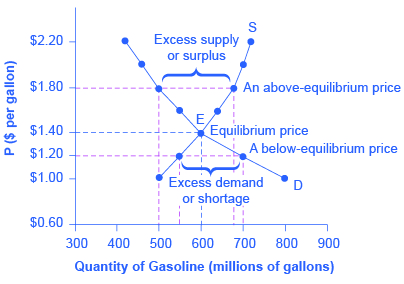
Caption: Equilibrium price (Rs. 22,000) and quantity (15,000 units) for smartphones in Nepal. A price of Rs. 24,000 creates a shortage of 3,000 units.
(Image: OpenStax College, CC BY 4.0, via Wikimedia Commons)
Caption: Equilibrium price (Rs. 22,000) and quantity (15,000 units) for smartphones in Nepal. A price of Rs. 24,000 creates a shortage of 3,000 units.
C. Positive vs. Normative Analysis
| Aspect | Positive Analysis | Normative Analysis |
|---|---|---|
| Nature | Descriptive ("What is?") | Prescriptive ("What should be?") |
| Example | "Khalti’s transaction fees increased by 2% after the new policy." | "Nepal’s NTC should lower internet tariffs to boost rural adoption." |
| Use in Business | Forecasts demand (e.g., "Daraz’s sales rise 10% in Dashain"). | Recommends actions (e.g., "Ncell should introduce family plans to retain customers"). |
WORKED EXAMPLE: Positive vs. Normative in NEPSE
- Positive: "NEPSE’s index fell by 5% last quarter due to global oil price shocks."
- Normative: "The government should subsidize fuel to stabilize NEPSE and protect investors."
3. Economic Efficiency and Welfare
A. Economic Efficiency
Efficiency means maximizing output from given inputs without waste. Types:
- Productive Efficiency: Producing at the lowest cost (e.g., Daraz’s warehouses located near highways to cut transport costs).
- Allocative Efficiency: Producing what consumers want (e.g., Ncell offering unlimited data plans to compete with NTC).
B. Welfare Economics
Measures societal well-being using tools like:
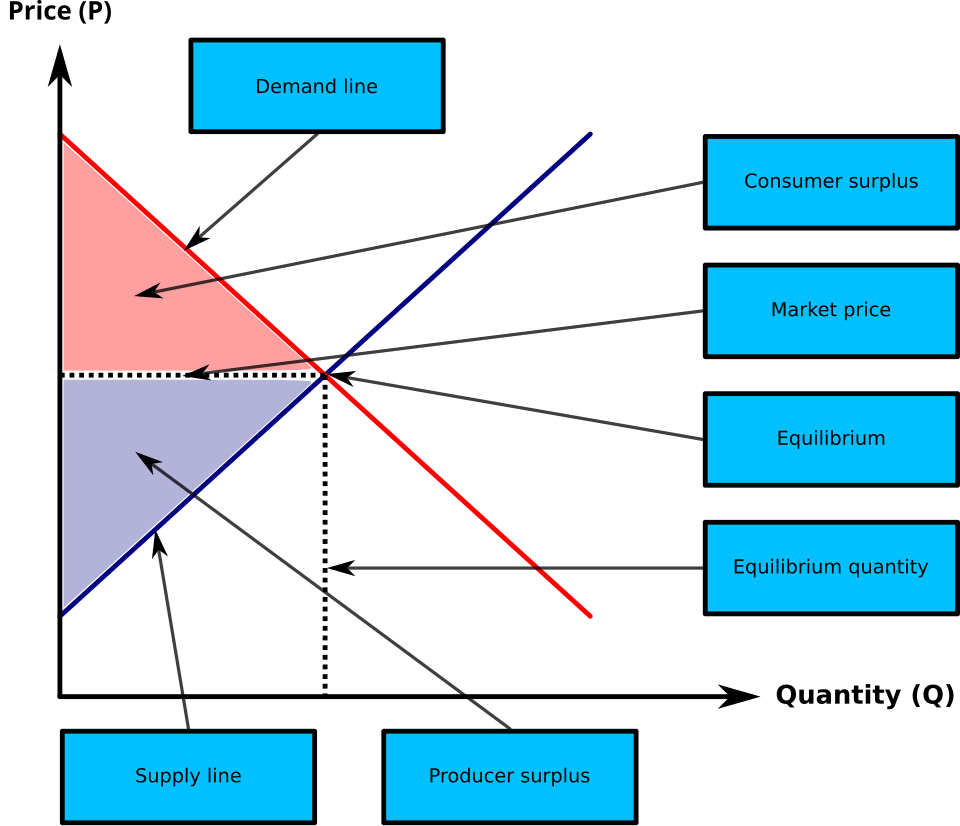
- Consumer Surplus (CS): Difference between what consumers pay and what they’re willing to pay.
- Example: If a Pathao ride costs Rs. 300 but you’d pay Rs. 400, your CS = Rs. 100.
- Producer Surplus (PS): Difference between what producers receive and their minimum acceptable price.
- Example: A Daraz seller sells a phone for Rs. 20,000 but would accept Rs. 18,000; PS = Rs. 2,000.
- Deadweight Loss (DWL): Loss of economic efficiency from market failures (e.g., traffic congestion in Kathmandu).
 (Image: Original Finnish PNG version made by Lendu at fi.wikipediaTr, CC BY-SA 3.0, via Wikimedia Commons)
Caption: CS = Triangle above price line; PS = Triangle below price line. Total surplus = CS + PS.
(Image: Original Finnish PNG version made by Lendu at fi.wikipediaTr, CC BY-SA 3.0, via Wikimedia Commons)
Caption: CS = Triangle above price line; PS = Triangle below price line. Total surplus = CS + PS.
C. Economic Rent
Economic rent = Actual earnings – Transfer earnings (minimum earnings needed to keep a resource in its current use).
- Example 1: A Kathmandu traffic policeman earns Rs. 50,000/month, but could earn Rs. 30,000 elsewhere. His economic rent = Rs. 20,000.
- Example 2: NEPSE’s top CEOs earn high salaries because their skills are scarce (high transfer earnings elsewhere).
WORKED EXAMPLE: Economic Rent for a Daraz Seller
- Actual earnings: Rs. 200,000/month from selling electronics.
- Transfer earnings: Rs. 150,000 (what they’d earn as a bank employee).
- Economic rent: Rs. 50,000 (the "extra" income keeping them in e-commerce).
4. Static vs. Dynamic Analysis
| Aspect | Static Analysis | Dynamic Analysis |
|---|---|---|
| Time Frame | Short-run, "snapshot" view | Long-run, "how things change over time" |
| Example | "Daraz’s sales in Dashain 2023 were Rs. 500M." | "How will Daraz’s sales grow if it enters rural Nepal over 5 years?" |
| Use in Business | Immediate decisions (e.g., pricing today). | Strategic planning (e.g., Ncell’s 5G rollout). |
flowchart TD
    A["Static Analysis: Short-run"] -->|"Example"| B["Daraz's sales in Dashain 2023: Rs. 500M"]
    C["Dynamic Analysis: Long-run"] -->|"Example"| D["Daraz's sales growth if it expands to rural Nepal"]
    D --> E["Adapts to new demand trends"]
Static vs. dynamic analysis in Daraz's business strategy.REAL-WORLD EXAMPLE: Pathao’s Dynamic Pricing
- Static: "Today’s average ride price is Rs. 250."
- Dynamic: "During Dashain, Pathao increases prices by 30% due to higher demand, then adjusts based on traffic data."
5. Microeconomics in Business Decision-Making
A. Shutdown Rules (Short-Run Decision)
A firm should shut down if: Price (P) < Average Variable Cost (AVC)
- Example: A Daraz seller has:
- P = Rs. 1,500 (selling price per unit)
- AVC = Rs. 1,600
- Decision: Shut down (loss of Rs. 100 per unit).
- If P > AVC but P < ATC, the firm continues but incurs losses.
Caption: The firm should shut down because P (Rs. 1,500) < AVC (Rs. 2,000).
B. Applications in Nepal’s Businesses
| Business | Microeconomic Concept Applied | Example |
|---|---|---|
| eSewa | Price elasticity of demand | Adjusts transaction fees based on user sensitivity. |
| Daraz | Cost minimization | Uses algorithmic pricing to compete with Amazon Nepal. |
| Ncell/NTC | Market segmentation | Offers rural-specific tariffs to increase market reach. |
| NEPSE | Investor behavior (risk/return) | Stock prices react to remittance inflows. |
| Pathao | Dynamic pricing | Surge pricing during festivals like Dashain. |
6. Exam Tip: How to Score Full Marks
Define terms precisely:
- ❌ "Economic rent is extra money."
- ✅ "Economic rent is the difference between actual earnings and transfer earnings (the minimum required to keep a resource in its current use)."
Use real-world examples:
- Link shutdown rules to Daraz sellers, elasticity to Ncell tariffs, or efficiency to Kathmandu traffic.
Draw graphs with labels:
- For supply/demand, mark equilibrium, shortages, and surpluses.
- For cost curves, show shutdown points (P = AVC) and loss-minimizing points (P = ATC).
Differentiate static/dynamic:
- Static = "current snapshot" (e.g., "Daraz’s sales in 2023").
- Dynamic = "how things change" (e.g., "Impact of 5G on Ncell’s revenue over 3 years").
For normative questions, structure your answer as:
- Problem (e.g., "Nepal’s traffic congestion causes inefficiency").
- Solution (e.g., "Improve public transport to reduce DWL").
- Justification (e.g., "This would lower commute times and increase productivity").
PAST EXAM QUESTION SOLVED: Question: A firm’s average revenue is Rs. 200, average cost is Rs. 220, and average variable cost is Rs. 175. The firm, suffering from loss, should shut down or stay in business in the short run? Answer:
- Step 1: Compare P (AR = Rs. 200) with AVC (Rs. 175).
- Since P > AVC, the firm covers variable costs and part of fixed costs.
- Step 2: Check if losses can be minimized by producing.
- Loss per unit = ATC – P = Rs. 220 – Rs. 200 = Rs. 20.
- If the firm shuts down, it loses all fixed costs (say, Rs. 50,000).
- If it produces, it loses Rs. 20 per unit. Decision depends on fixed costs:
- If fixed costs > Rs. 20 × quantity, stay open (minimize losses).
- If fixed costs < Rs. 20 × quantity, shut down.
- Conclusion: Without quantity data, the firm should stay open in the short run to minimize losses (since P > AVC).
Caption: Post-pandemic inflation (2022–23) outpaced growth, reflecting supply chain disruptions (microeconomic: firms facing higher costs).
In the Real World
eSewa’s Dynamic Fees:
- Concept: Price elasticity of demand.
- How it works: eSewa adjusts transaction fees based on user sensitivity. For example, during Dashain, when remittance volumes spike, fees might increase slightly (assuming demand is inelastic). If users switch to Khalti, fees are lowered to retain market share.
Daraz’s Warehouse Location:
- Concept: Cost minimization and allocative efficiency.
- How it works: Daraz locates warehouses near highways (e.g., Chobhar, Kathmandu) to reduce transport costs (a variable cost). This lowers ATC, making it more competitive against Amazon Nepal.
Ncell’s Family Plans:
- Concept: Market segmentation and demand elasticity.
- How it works: Ncell offers family plans (e.g., Rs. 1,500/month for 5 members) to target households where individual plans would be too expensive. This taps into the inelastic demand for mobile data in rural areas.
Kathmandu Traffic Congestion:
- Concept: Deadweight loss and Pareto efficiency.
- How it works: Traffic jams (e.g., on Ring Road) create DWL by wasting time and fuel. A Pareto improvement would be expanding metro services or congestion pricing (charging higher tolls during peak hours), which would reduce DWL without harming others.
WORKED EXAMPLE: NTC’s Tariff Decision (Normative Analysis) Scenario: NTC wants to decide whether to lower internet tariffs to boost rural adoption.
- Positive Analysis:
- Current rural internet penetration: 30% (vs. 70% in cities).
- Lowering tariffs by 20% could increase demand by 15% (based on elasticity studies).
- Normative Recommendation:
- Pro: Higher rural adoption improves digital inclusion and supports businesses like Daraz in tier-2 cities.
- Con: Lower tariffs reduce NTC’s revenue, potentially leading to lower investment in infrastructure.
- Decision: NTC should lower tariffs but subsidize rural areas selectively (e.g., offer Rs. 500/month plans in rural Nepal) to balance affordability and profitability.
Key Formulas to Remember
| Concept | Formula | Example |
|---|---|---|
| Price Elasticity of Demand (PED) | If Ncell raises tariffs by 10% and demand drops by 5%, (inelastic). | |
| Economic Rent | A Kathmandu doctor earns Rs. 200,000 but could earn Rs. 150,000 abroad; rent = Rs. 50,000. | |
| Shutdown Condition | Shut down if | A Daraz seller with P = Rs. 1,400 and AVC = Rs. 1,500 should shut down. |
Common Mistakes to Avoid
- Confusing AR and MR:
- In perfect competition, AR = MR = Price.
- In monopoly, AR > MR.
- Ignoring fixed costs in shutdown decisions:
- Always compare P vs. AVC for short-run shutdown, not ATC.
- Normative without justification:
- ❌ "NTC should lower tariffs."
- ✅ "NTC should lower tariffs because rural internet adoption is currently 30%, and lower costs would increase demand by 15%, benefiting 2 million rural households."
Summary Table: Microeconomics Tools for Business
| Tool | Business Use | Nepal Example |
|---|---|---|
| Supply/Demand Curves | Predict price/quantity effects | Daraz’s demand for laptops rises in exam seasons. |
| Cost Curves | Decide production levels | A Daraz seller shuts down if P < AVC. |
| Elasticity | Set prices and marketing strategies | Ncell offers discounts on data plans during festivals (elastic demand). |
| Economic Rent | Identify scarce resources | High salaries for IT professionals in Nepal. |
| Pareto Efficiency | Improve resource allocation | Expanding metro services to reduce traffic jams. |
Final Checklist for Exams
Before submitting your answer:
- Did I define all key terms? (e.g., economic rent, Pareto efficiency).
- Did I use a real-world example? (e.g., eSewa, Daraz, Ncell).
- Did I draw a graph where needed? (e.g., supply/demand, cost curves).
- Did I differentiate static/dynamic analysis?
- Did I justify normative statements? (e.g., "NTC should..." + reasons).
Based on the TU BBS syllabus for microeconomics for business, unit 1.
Discussion
Loading…