microeconomics for businessUnit 711 min read
Pricing Strategies & Business Decisions: Cost-Plus, Skimming, Penetration, Discounts & Dynamic Pricing
Unit 7 of microeconomics for business explores how firms set prices to maximize profit, cover costs, and respond to market conditions—covering cost-plus pricing, price discrimination, psychological pricing, and real-world applications like eSewa’s transaction fees and Daraz’s promotional discounts.
Key Concepts & Definitions
1. Pricing Objectives
Firms set prices to achieve specific goals. Common objectives include:
- Profit maximization: Setting prices to maximize total revenue minus total cost.
- Market share: Pricing low to capture a larger portion of the market (e.g., Daraz’s discounts).
- Survival: Pricing to cover variable costs during tough times (e.g., small restaurants during COVID-19).
- Social responsibility: Pricing to ensure affordability (e.g., NTC’s subsidized internet plans for students).
mindmap
  root((Pricing Objectives))
    Profit Maximization
    Market Share
    Survival
    Social Responsibility
    Customer Satisfaction
2. Cost-Based Pricing Methods
Firms often base prices on their costs to ensure profitability.
Cost-Plus Pricing (Markup Pricing)
Price = Average Total Cost (ATC) + Desired Profit Margin Formula: Where:
- ATC = Total Cost / Quantity
- Markup = Desired profit per unit (e.g., 20% of ATC)
Example: A local bakery sells a loaf of bread for Rs. 120. If the ATC is Rs. 80, the markup is Rs. 40 (33% of ATC).
Advantages:
- Simple to calculate.
- Ensures cost recovery.
- Easy to adjust for inflation or cost changes.
Disadvantages:
- Ignores demand (customers may not pay the price).
- May lead to overpricing in competitive markets.
Real-World Example:
- Nepalese Banks: Charge a markup on loan interest rates. For example, if the base rate is 8%, a bank might add a 2% markup for administrative costs, setting the final rate at 10%.
Break-Even Analysis
Determines the minimum price a firm must charge to cover all costs (fixed + variable).
Break-Even Point (Q):
Example: A small café has:
- Fixed costs (rent, salaries) = Rs. 50,000/month
- Variable cost per cup of coffee = Rs. 20
- Selling price per cup = Rs. 50
Break-even quantity:
Visual:
Exam Tip: Always label the break-even point clearly in diagrams.
3. Demand-Based Pricing Methods
Firms adjust prices based on elasticity of demand, customer willingness to pay, and competition.
Price Elasticity of Demand (PED)
- Elastic (PED > 1): Demand is sensitive to price changes (e.g., luxury goods like iPhones).
- Inelastic (PED < 1): Demand is less sensitive (e.g., essentials like salt or medicine).
- Unitary Elastic (PED = 1): Revenue remains constant despite price changes.
Business Applications:
| PED Scenario | Pricing Strategy | Example |
|---|---|---|
| Elastic (PED > 1) | Lower prices to increase revenue | Daraz’s seasonal sales (e.g., 50% off) |
| Inelastic (PED < 1) | Increase prices to boost revenue | NTC’s internet charges (essential service) |
| Unitary Elastic (PED = 1) | Price changes don’t affect revenue | WhatsApp’s pricing (free with ads) |
Real-World Example:
- Pathao’s Surge Pricing: During peak hours (e.g., 8–10 PM), demand for rides is highly elastic. Pathao increases prices by 2–3x to manage supply-demand imbalance.
Psychological Pricing
Uses perceived value to influence buying decisions.
- Charm Pricing: Ending prices with
.99(e.g., Rs. 999 instead of Rs. 1,000). - Premium Pricing: High prices for luxury brands (e.g., Rolex watches).
- Bundle Pricing: Selling multiple products together (e.g., McDonald’s meal deals).
Example:
- Khalti’s Transaction Fees: Charges Rs. 2.50 for online payments (psychologically cheaper than Rs. 3).
- Daraz’s "Rs. 999" Deals: Uses charm pricing to attract buyers.
Dynamic Pricing
Adjusts prices in real-time based on demand, time, or customer segment.
- Peak vs. Off-Peak: Airlines (e.g., Nepal Airlines) charge higher fares during holidays.
- Personalized Pricing: E-commerce sites (e.g., Amazon) show different prices to different users based on browsing history.
Example:
- NTC’s Call Rates: Higher during weekends (peak usage) vs. weekdays.
- eSewa’s Service Fees: Vary based on transaction size (e.g., Rs. 1.50 for small transfers, Rs. 5 for large ones).
4. Competition-Based Pricing
Firms set prices relative to competitors.
Price Leadership
One dominant firm sets the price, and others follow.
- Example: In Nepal’s mobile market, Ncell (largest provider) sets data rates, and NTC and Smart follow.
Price War
Firms repeatedly lower prices to gain market share (e.g., Nepal’s telecom industry in the 2000s).
Collusive Pricing
Firms secretly agree to set prices at a high level (illegal in many countries).
- Example: Cartels in oil markets (though rare in Nepal).
5. Promotional Pricing Strategies
Used to attract customers or clear inventory.
| Strategy | Description | Example |
|---|---|---|
| Discounts | Temporary price reductions | Daraz’s "Buy 1 Get 1 Free" |
| Loss Leaders | Selling at a loss to attract customers | Supermarkets selling milk at cost price |
| Seasonal Pricing | Adjusting prices for seasons (e.g., winter coats in summer) | Kathmandu’s winter clothing sales in May |
| Cash Discounts | Discounts for immediate payment (e.g., 5% off if paid in cash) | Local hardware stores |
In the Real World
eSewa’s Transaction Fees:
- Uses cost-plus pricing for its service charges (e.g., Rs. 2.50 per transaction).
- Applies dynamic pricing for larger transfers (higher fees for Rs. 50,000+).
- Employs psychological pricing (Rs. 1.50 instead of Rs. 2).
Daraz’s Discounts and Promotions:
- Uses price elasticity to offer deep discounts on non-essential items (e.g., electronics).
- Implements loss-leader pricing (e.g., selling phone chargers at cost to attract buyers to other products).
- Applies seasonal pricing (e.g., lower prices on winter jackets in summer).
Nepal’s Telecom Industry (Ncell, NTC, Smart):
- Engages in price wars during network expansions.
- Uses peak pricing (higher call rates on weekends).
- Practices price leadership (Ncell sets data rates, others follow).
Banks’ Loan Interest Rates:
- Use cost-plus pricing (base rate + markup for risk).
- Offer discounted rates for loyal customers (e.g., NMB Bank’s preferential rates).
Khalti’s Digital Payments:
- Charges transaction fees based on cost and demand elasticity.
- Uses psychological pricing (Rs. 2.50 instead of Rs. 3).
Worked Example: Pricing a Product Under Cost-Plus Method
Scenario: A small soap manufacturer in Kathmandu has:
- Fixed Costs (FC) = Rs. 50,000/month
- Variable Cost per unit (VC) = Rs. 20
- Desired Profit Margin = 25% of ATC
Step 1: Calculate ATC Assume production = 10,000 units/month.
Step 2: Add Markup for Profit Desired profit margin = 25% of ATC = Final Price: Rs. 31.25 (rounded to Rs. 31 for simplicity).
Break-Even Analysis: Visual:
Comparison of Pricing Strategies
| Strategy | When to Use | Pros | Cons |
|---|---|---|---|
| Cost-Plus | Stable markets, low competition | Simple, ensures profitability | Ignores demand, may price out customers |
| Dynamic Pricing | High demand variability (e.g., travel, rides) | Maximizes revenue, responds to demand | Complex to implement, may anger customers |
| Psychological | Consumer goods, retail | Influences perception, increases sales | Requires market research |
| Penetration Pricing | Entering new markets | Gains market share quickly | Low initial profits |
| Skimming | Innovative products (e.g., new tech) | Maximizes profit from early adopters | Attracts competitors quickly |
| Promotional | Clearing inventory, seasonal sales | Boosts sales, attracts customers | Reduces profit margins temporarily |
Exam Tip
- Always define key terms (e.g., "Cost-plus pricing is a method where price is set by adding a markup to the average total cost").
- Use real-world examples from Nepal (e.g., Daraz, Ncell, banks) to illustrate concepts.
- Draw diagrams for:
- Break-even analysis (label fixed costs, variable costs, total revenue, and break-even point).
- Demand curves with elastic/inelastic regions.
- Cost curves (AFC, AVC, MC, ATC).
- Memorize formulas:
- Cost-plus pricing:
- Break-even quantity:
- Price elasticity:
- Compare strategies in tables (as shown above) to show understanding of trade-offs.
- For short-answer questions, use bullet points to list advantages/disadvantages (e.g., "Advantages of dynamic pricing: maximizes revenue, responds to demand").
- Link to business decisions: Always end answers with how the strategy helps a firm (e.g., "Penetration pricing helps Daraz gain market share in rural Nepal").
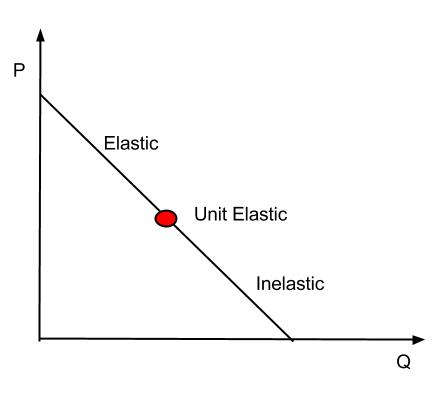 Elastic vs. inelastic demand regions for a luxury good (e.g., iPhone) (Image: Nber85, CC BY-SA 3.0, via Wikimedia Commons)
Based on the TU BBS syllabus for microeconomics for business, unit 7.
Discussion
Loading…