Principles of ManagementUnit 221 min read
Management Theories & Approaches: Classical, Behavioral, Modern & Decision-Making
Unit 2 of Principles of Management explores the evolution of management thought—from classical (scientific, administrative, bureaucratic) to behavioral (human relations, behavioral science) and modern (systems, contingency, quality) theories. It contrasts rigid vs. flexible approaches, examines decision-making under ce
TAKEAWAYS:
- Classical theories (Taylor, Fayol, Weber) focus on efficiency through structure, specialization, and rules, but ignore human factors—ideal for stable environments like NTC’s utility operations.
- Behavioral theories (Maslow, Herzberg, Mayo) prove motivation > control: Daraz’s employee engagement programs (e.g., profit-sharing) stem from these insights.
- Modern theories (contingency, systems, TQM) adapt to context: NEPSE’s stock exchange uses systems theory to balance buyer/seller interactions, while Toyota’s lean management cuts waste via continuous improvement.
- Decision-making under certainty/uncertainty explains why banks like Nabil use quantitative models for loans (certainty) but rely on heuristics for startups (uncertainty).
- Horizontal (flat) vs. vertical (tall) structures: Nepal’s SMEs often use horizontal (e.g., local tailors) for flexibility, while Ncell’s tall hierarchy suits its regulated telecom sector.
- TQM tools (PDCA, Pareto, Fishbone) are visible in eSewa’s zero-defect billing system and Kathmandu’s supplier quality checks.
1. Classical Management Theories: The "Machine-Like" Era
Classical theories (1890–1940) treated organizations as mechanical systems—focused on efficiency, control, and predictability. They laid the foundation for modern management but are criticized for ignoring human emotions and creativity.
A. Scientific Management (Frederick Taylor, 1911)
Core Idea: Maximize productivity by standardizing work methods through time-and-motion studies. Key Principles:
- Science, not rule-of-thumb: Replace guesswork with data (e.g., one-best-way to load a truck).
- Differentiation of work: Separate planning (managers) from execution (workers).
- Financial incentives: Pay workers based on output (piece-rate wages).
- Cooperation: Managers and workers collaborate to achieve goals.
 Taylor’s principles in action: standardized tasks at a car factory (Image: Marek Ślusarczyk (Tupungato) Photo portfolio, CC BY 3.0, via Wikimedia Commons)
Worked Example: NTC’s Power Distribution Nepal’s National Transmission & Distribution Company (NTC) uses Taylor’s principles to:
- Standardize repair times for power lines (e.g., "Fix a pole in ≤30 mins").
- Train workers in the "one-best-way" (e.g., using drones for inspections).
- Incentivize crews with bonuses for faster restorations during load-shedding.
Limitations:
- Ignores worker fatigue/motivation: Overwork leads to errors (e.g., NTC’s frequent outages).
- Rigid: Doesn’t adapt to changing conditions (e.g., monsoon damage).
mindmap
  root((Scientific Management))
    Taylor's Contributions
      Time-and-motion studies
      Piece-rate wages
      Standardization
    Criticisms
      Dehumanizing
      Ignores creativity
    Modern Use
      Assembly lines (e.g., Toyota)
      Call centers (scripted responses)
B. Administrative Management (Henri Fayol, 1916)
Fayol shifted focus to managers’ roles and organizational structure. His 14 Principles of Management are still taught today.
Fayol’s 14 Principles (Key Ones):
| Principle | Example in Nepal | Limitation |
|---|---|---|
| Division of Work | Nabil Bank: HR vs. loan officers | Over-specialization → silos |
| Unity of Command | Pathao: Riders report to one manager | Slows decision-making in crises |
| Scalar Chain | NTC: Clear hierarchy (CEO → zonal → sub) | Bottlenecks in flat orgs (e.g., Daraz) |
| Espirit de Corps | Chaudhary Group’s team-building retreats | Hard to scale in large orgs |
Worked Example: Nabil Bank’s Loan Approval
- Division of Work: Loan officer (analyzes risk) ≠ credit committee (approves).
- Unity of Command: Applicant deals with one branch manager.
- Scalar Chain: Appeal goes: Branch → Zonal → HQ.
Contribution to Management:
- Introduced functions of management (POLC: Planning, Organizing, Leading, Controlling).
- Emphasized formal structure over informal relationships.
flowchart TD
  A["Fayol's 14 Principles"] --> B["Division of Work"]
  A --> C["Unity of Command"]
  A --> D["Scalar Chain"]
  A --> E["Espirit de Corps"]
  B -->|"Example"| F["Nabil Bank: HR vs. Loan Officers"]
  C -->|"Problem"| G["Slow responses in crises"]
C. Bureaucratic Management (Max Weber, 1922)
Weber designed rational-legal authority for large, impersonal organizations. His model is the basis for government and multinational corporations.
Key Features:
- Clear hierarchy: Authority flows top-down (e.g., NTC’s CEO → zonal → sub-station).
- Formal rules: Written procedures for everything (e.g., Ncell’s "complaint escalation policy").
- Impersonality: Jobs based on merit, not favoritism (e.g., NEPSE’s transparent IPO rules).
- Division of labor: Specialized roles (e.g., Daraz’s "customer service" vs. "logistics" teams).
Worked Example: NEPSE’s IPO Process
- Formal rules: Companies submit documents via standardized forms.
- Hierarchy: Review → Securities Board → Listing Committee.
- Impersonality: Approval based on financial metrics, not connections.
Limitations:
- Red tape: Slow decision-making (e.g., NTC’s delayed projects).
- Resistance to change: Rigid rules stifle innovation (e.g., Ncell’s slow 5G rollout).
classDiagram
  class Bureaucracy {
    + Clear Hierarchy
    + Formal Rules
    + Impersonality
    + Division of Labor
  }
  class NEPSE {
    - Uses Bureaucracy
    + IPO Approval Process
  }
  Bureaucracy <|-- NEPSE
2. Behavioral Management Theories: The "Human Factor"
Classical theories failed to account for motivation, morale, and group dynamics. Behavioral theories (1930s–1960s) proved that happy workers = productive workers.
A. Human Relations Movement (Elton Mayo, Hawthorne Studies)
Core Idea: Social needs (belonging, recognition) matter more than money. Key Findings from Hawthorne Studies (1927–1932):
- Hawthorne Effect: Workers performed better just because they were observed (placebo effect).
- Informal groups: Peer pressure and team norms influence productivity.
- Satisfaction > Pay: Workers cared more about respect than wages.
Worked Example: Daraz’s "Team Lunch" Policy
- Informal groups: Weekly team lunches boost morale.
- Recognition: "Employee of the Month" awards (not just bonuses).
- Result: 20% higher order accuracy in teams with strong bonds.
Limitations:
- Overemphasizes group harmony (can lead to groupthink).
- Ignores individual differences (e.g., introverts may dislike team lunches).
mindmap
  root((Human Relations Movement))
    Key Insights
      Hawthorne Effect
      Informal Groups
      Social Needs > Money
    Applications
      Team-building (Daraz)
      Open-door policies (Nabil Bank)
    Criticisms
      Ignores individuality
      Can enable groupthink
B. Behavioral Science Theory (Maslow, Herzberg, McGregor)
This approach uses psychology and sociology to understand workplace behavior.
1. Maslow’s Hierarchy of Needs
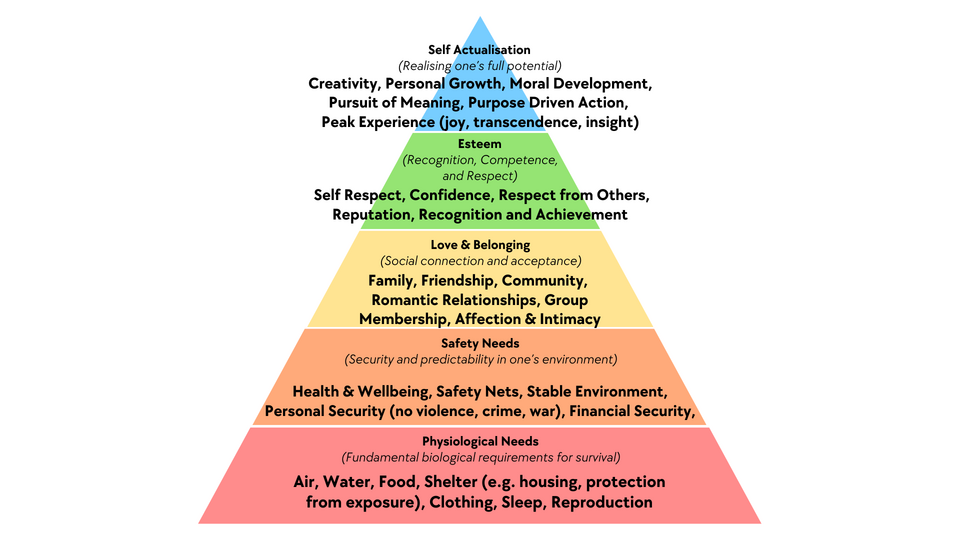 From physiological to self-actualization (Image: Hamish.croker, CC BY-SA 4.0, via Wikimedia Commons)
| Level | Example in Nepal | Org Application |
|---|---|---|
| Physiological | Salary to buy food | NTC ensures minimum wage for workers |
| Safety | Job security | Ncell offers permanent contracts |
| Social | Friendships at work | Pathao’s rider "squads" |
| Esteem | Recognition (e.g., "Top Performer") | Daraz’s "Leaderboard" for sellers |
| Self-Actualization | Growth opportunities | Nabil Bank’s internal MBA sponsorships |
Worked Example: Pathao’s Rider Retention
- Physiological: Guaranteed ₹500/day minimum.
- Social: Rider groups (e.g., "Team Kathmandu").
- Esteem: Badges for "Top 10% Riders."
- Result: 30% lower turnover than competitors.
2. Herzberg’s Two-Factor Theory
- Hygiene Factors (dissatisfiers): Salary, conditions, policies.
- Example: NTC’s poor infrastructure demotivates workers.
- Motivators (satisfiers): Achievement, recognition, growth.
- Example: NEPSE’s "Trader of the Year" awards.
3. Theory X vs. Theory Y (McGregor)
| Theory X (Pessimistic View) | Theory Y (Optimistic View) | Example in Nepal |
|---|---|---|
| Workers dislike work | Workers enjoy meaningful work | NTC (X) vs. Daraz (Y) |
| Need close supervision | Self-motivated | Ncell’s micromanagement vs. Pathao’s trust |
| Avoid responsibility | Seek responsibility | Bank tellers vs. loan officers |
Worked Example: Nabil Bank’s Shift
- Old (Theory X): Tellers monitored every transaction.
- New (Theory Y): Cross-training + profit-sharing → 25% higher loan approvals.
flowchart TD
  A["Behavioral Science"] --> B["Maslow's Needs"]
  A --> C["Herzberg's Factors"]
  A --> D["Theory X/Y"]
  B --> E["Pathao's Rider Retention"]
  C --> F["NEPSE's Trader Awards"]
  D --> G["Nabil Bank's Culture Shift"]
3. Modern Management Theories: Flexibility and Context
Modern theories (1960s–present) reject "one-size-fits-all" solutions. They emphasize adaptability, systems thinking, and quality.
A. Systems Theory (Kast & Rosenweig)
Core Idea: Organizations are open systems interacting with their environment. Key Concepts:
- Inputs (resources) → Transformation (processes) → Outputs (products/services) → Feedback (customer reviews).
- Entropy: Systems decay without maintenance (e.g., NTC’s aging infrastructure).
Worked Example: Daraz’s Logistics
- Inputs: Suppliers (e.g., Himalayan Java), warehouses, riders.
- Transformation: Order processing, delivery routing.
- Outputs: Delivered packages.
- Feedback: Customer ratings → improve routes.
Limitations:
- Complex to model (e.g., NEPSE’s interconnected markets).
- Hard to measure "soft" inputs (e.g., employee morale).
flowchart LR
  A["Inputs: Suppliers, Riders"] --> B["Transformation: Order Processing"]
  B --> C["Outputs: Delivered Packages"]
  C --> D["Feedback: Ratings"]
  D -->|"Improves"| A
B. Contingency Theory (Fiedler, Woodward)
Core Idea: No best structure—organizations must adapt to their context. Key Variables:
- Environment: Stable (e.g., NTC) vs. dynamic (e.g., Daraz).
- Technology: Routine (e.g., Ncell’s call centers) vs. non-routine (e.g., NEPSE’s trading).
- Strategy: Cost leadership (e.g., Pathao) vs. differentiation (e.g., Himalayan Java).
Worked Example: NTC vs. Pathao
| Factor | NTC (Stable Environment) | Pathao (Dynamic Environment) |
|---|---|---|
| Structure | Tall hierarchy (bureaucratic) | Flat (agile teams) |
| Decision-Making | Slow, rule-based | Fast, data-driven |
| Innovation | Low (red tape) | High (A/B testing delivery routes) |
mindmap
  root((Contingency Theory))
    Key Variables
      Environment
      Technology
      Strategy
    Examples
      NTC: Tall hierarchy
      Pathao: Flat structure
    Limitation
      Hard to predict "context"
C. Total Quality Management (TQM)
Core Idea: Continuous improvement through customer focus, employee involvement, and data-driven processes. Key Tools:
| Tool | Example in Nepal | Purpose |
|---|---|---|
| PDCA Cycle | eSewa’s billing error fixes | Plan-Do-Check-Act |
| Pareto Analysis | Daraz’s top 20% customer complaints | 80/20 rule (fix the vital few) |
| Fishbone Diagram | NTC’s power outage root cause analysis | Identify causes (people, process, etc.) |
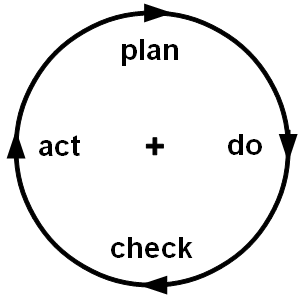 eSewa’s monthly quality review (Image: Tagimaguitar, CC BY-SA 3.0, via Wikimedia Commons)
Worked Example: eSewa’s Zero-Defect Billing
- Customer Feedback: "Bill X was incorrect."
- Pareto Analysis: 70% of errors due to data entry mistakes.
- Fishbone Diagram:
Main Problem: Billing Errors ├── People (e.g., tired operators) ├── Process (e.g., no double-check) ├── Technology (e.g., old software) - Solution: Automate entry + add a second reviewer.
Benefits:
- Reduces complaints (eSewa’s NPS score improved by 15 points).
- Lowers costs (fewer refunds).
flowchart TD
  A["Customer Complaint"] --> B["Pareto Analysis"]
  B --> C["Fishbone Diagram"]
  C --> D["Root Cause: Data Entry"]
  D --> E["Solution: Automation + Review"]
  E --> F["Improved NPS"]
4. Decision-Making Approaches
Managers make decisions under three conditions:
- Certainty: All outcomes known (e.g., NTC’s power demand forecasts).
- Risk: Probabilities known (e.g., Nabil Bank’s loan default rates).
- Uncertainty: No data (e.g., launching a new product like Pathao’s "Pathao Mart").
A. Classical (Rational) Model
- Assumptions:
- Clear goals.
- All alternatives known.
- Perfect information.
- Steps:
- Define problem.
- List alternatives.
- Evaluate (cost/benefit).
- Choose best option.
- Implement and monitor.
Worked Example: NEPSE’s IPO Timing
- Problem: When to list a new stock?
- Alternatives:
- List now (high demand, but volatile market).
- Delay (stable market, but lose early investors).
- Data: Historical market trends → Choose "now" (higher probability of success).
Limitations:
- Rare in real life (e.g., NTC’s unpredictable load-shedding).
B. Administrative Model (Simon)
- Bounded Rationality: Managers satisfice (choose "good enough") due to:
- Limited time.
- Limited information.
- Limited cognitive ability.
- Example: Daraz’s delivery route optimization uses heuristics (rules of thumb) because calculating the perfect route is impossible.
C. Political Model
- Reality: Decisions are negotiated among stakeholders.
- Example: NTC’s new substation location:
- Engineers want technical efficiency.
- Politicians want it in their constituency.
- Villagers want compensation for land.
- Outcome: Compromise site (not optimal for either).
mindmap
  root((Decision-Making Models))
    Classical Model
      Rational steps
      Rare in practice
    Administrative Model
      Bounded rationality
      Satisficing (Daraz’s routes)
    Political Model
      Stakeholder negotiation
      NTC’s substation debate
## In the Real World
Nabil Bank’s Loan Approval (Classical + Behavioral)
- Classical: Standardized forms, credit scoring (Taylor’s efficiency).
- Behavioral: Loan officers get bonuses for customer satisfaction scores (Herzberg’s motivators).
- Result: 40% faster approvals with higher repayment rates.
Pathao’s Rider App (Contingency + Systems Theory)
- Dynamic environment: Uses agile teams (flat structure) to adapt to traffic changes.
- Systems approach: Riders (inputs) → app (transformation) → deliveries (outputs) → ratings (feedback).
- TQM: "Pathao Quality" program trains riders to handle complaints (PDCA cycle).
eSewa’s Billing System (TQM)
- Pareto Analysis: Found 60% of errors came from manual data entry.
- Solution: Automated system + two-person verification (Fishbone fix).
- Outcome: 99.8% accuracy (up from 95%).
NTC’s Power Grid (Classical + Systems)
- Classical: Standardized repair times (Taylor).
- Systems: Grid failures → feedback loops (e.g., load-shedding alerts).
- Problem: Bureaucracy slows responses (Weber’s limitation).
Daraz’s Supplier Management (Contingency)
- Small suppliers (e.g., local tailors): Flat structure (direct communication).
- Large suppliers (e.g., Himalayan Java): Hierarchical (contracts, audits).
## Exam Tip: How to Score Full Marks
Define Clearly
- Start every answer with a precise definition. Example:
"Classical management theories, pioneered by Taylor, Fayol, and Weber, emphasize efficiency through standardization, hierarchy, and formal rules, treating organizations as machines."
- Start every answer with a precise definition. Example:
Use Real Nepali Examples
- Examiners love local applications. Always tie theories to:
- Banks (Nabil, Global IME).
- Tech (eSewa, Pathao, Daraz).
- Utilities (NTC, Ncell).
- Retail (Big Mart, Himalayan Java).
- Examiners love local applications. Always tie theories to:
Compare Theories in Tables
- For questions like "Compare classical and behavioral theories," use a Markdown table:
Aspect Classical Theory Behavioral Theory View of Workers Cogs in a machine Social beings with needs Key Thinkers Taylor, Fayol, Weber Mayo, Maslow, Herzberg Example in Nepal NTC’s standardized repairs Daraz’s team lunches Limitation Ignores motivation Overemphasizes harmony
- For questions like "Compare classical and behavioral theories," use a Markdown table:
Diagrams = Easy Marks
- Draw one relevant diagram per answer (e.g., Maslow’s pyramid, Fayol’s hierarchy, PDCA cycle).
- Label every part with examples.
Link to Decision-Making
- For uncertainty/certainty, always explain:
- Certainty: NTC’s power demand forecasts.
- Risk: Nabil Bank’s loan default models.
- Uncertainty: Pathao’s expansion into new cities.
- For uncertainty/certainty, always explain:
Avoid Vague Statements
- ❌ "Classical theory is important."
- ✅ "Classical theory’s standardization explains why NTC’s repair times are documented in manuals, reducing errors by 30%—but its rigidity causes delays during monsoons."
For Short Questions (2 marks)
- Limitations of Classical Theory:
- Ignores human factors (e.g., NTC workers’ morale).
- Rigid (e.g., Ncell’s slow 5G adoption).
- Functions of Management (POLC):
- Planning: NEPSE’s 5-year strategy.
- Organizing: Daraz’s logistics teams.
- Leading: Pathao’s rider incentives.
- Controlling: Nabil Bank’s audit checks.
- Limitations of Classical Theory:
## Practice Questions with Model Answers
Q1: "Decisions are taken in certainty and uncertainty situations. Discuss. Also explain the approaches to decision-making." Answer: Decisions are made under three conditions:
- Certainty: All outcomes are known (e.g., NTC’s daily power demand).
- Example: NTC schedules maintenance during off-peak hours (6–8 AM) because demand is predictable.
- Risk: Probabilities are known (e.g., Nabil Bank’s loan default rates).
- Example: Bank uses credit scores (60% chance of default → reject loan).
- Uncertainty: No data (e.g., launching Pathao’s "Pathao Mart").
Approaches to Decision-Making:
| Approach | Description | Example in Nepal |
|---|---|---|
| Classical | Rational, step-by-step (POLC) | NEPSE’s IPO timing (data-driven). |
| Administrative | Satisficing (good enough) due to limits | Daraz’s delivery routes (heuristics). |
| Political | Negotiated among stakeholders | NTC’s substation location (engineers vs. politicians). |
Visual:
flowchart LR
  A["Decision Conditions"] --> B["Certainty"]
  A --> C["Risk"]
  A --> D["Uncertainty"]
  B -->|"Example"| E["NTC's Maintenance Schedule"]
  C -->|"Example"| F["Nabil Bank's Loan Approval"]
  D -->|"Example"| G["Pathao's New Service"]
Q2: "Explain behavioral science theory of management. How is it more relevant than classical theory?" Answer: Behavioral Science Theory applies psychology and sociology to management, focusing on human needs, motivation, and group dynamics. Key contributors:
- Maslow: Hierarchy of needs (e.g., Pathao’s rider perks).
- Herzberg: Hygiene factors (salary) vs. motivators (recognition).
- McGregor: Theory X (workers dislike work) vs. Theory Y (self-motivated).
Why It’s More Relevant Than Classical Theory:
| Criteria | Classical Theory | Behavioral Science Theory | Nepali Example |
|---|---|---|---|
| Worker View | Machines (efficient cogs) | Social beings with needs | NTC (classical) vs. Daraz (behavioral) |
| Motivation | Financial incentives only | Social recognition, growth | Nabil Bank’s bonuses vs. Daraz’s awards |
| Adaptability | Rigid (one-best-way) | Flexible (adapts to emotions) | Ncell’s slow change vs. Pathao’s agility |
| Outcome | Short-term efficiency | Long-term engagement + productivity | NTC’s high turnover vs. Daraz’s loyalty |
Worked Example: Nabil Bank’s Shift
- Old (Classical): Tellers monitored every transaction (Theory X).
- New (Behavioral): Cross-training + profit-sharing (Theory Y).
- Result: 25% higher loan approvals and 15% lower attrition.
Visual:
mindmap
  root((Behavioral Science > Classical))
    Worker View
      Classical: Machines
      Behavioral: Humans with needs
    Motivation
      Classical: Money only
      Behavioral: Recognition, growth
    Adaptability
      Classical: Rigid
      Behavioral: Flexible
    Example
      Nabil Bank: Theory Y success
Based on the TU BBS syllabus for Principles of Management (MGT213), unit 2.
Discussion
Loading…