Organizational Behaviour and Human Resource ManagementUnit 214 min read
Individual Behaviour: Personality, Perception & Learning
Unit 2 of Organizational Behaviour and Human Resource Management explores how personality traits shape workplace behavior, how perception influences decision-making, and how learning theories (classical, operant, social) apply to employee development—with real-world examples from Nepali and global companies.
TAKEAWAYS:
- Personality is shaped by heredity, environment, and situational factors, and can be measured using frameworks like the Big Five model (Openness, Conscientiousness, Extraversion, Agreeableness, Neuroticism).
- Perception is subjective and influenced by factors like selective attention, stereotypes, and halo effects, which can distort workplace judgments.
- Learning theories (classical, operant, social) explain how employees acquire skills—reinforcement (e.g., bonuses) and observational learning (e.g., mentorship) are key in OB.
- Personality-job fit matters: extroverts thrive in sales, while analytical types excel in data roles (e.g., Nabil Bank’s risk analysts vs. Daraz’s customer service).
- Perceptual biases (e.g., recency effect) can skew performance appraisals—structured evaluations mitigate this.
- Social learning theory (Bandura) shows how employees mimic leaders (e.g., Pathao’s aggressive expansion mirrors its CEO’s risk-taking style).
1. Personality in Organizations
1.1 Definition and Determinants
Personality refers to the stable patterns of behavior, thoughts, and emotions that distinguish one person from another. In OB, it explains why employees react differently to the same workplace situation.
Key determinants (visualized below):
mindmap
root((Personality Determinants))
Heredity["Genetic predisposition (e.g., introversion vs. extraversion)"]
Environment["Family, culture, upbringing (e.g., Nepali collectivism vs. Western individualism)"]
Situation["Workplace context (e.g., high-pressure roles like NTC engineers vs. creative roles like Himalayan Java designers)"]
Interaction["Personality × Situation (e.g., a neurotic employee in a chaotic startup like Pathao vs. a stable bank like Nabil)"]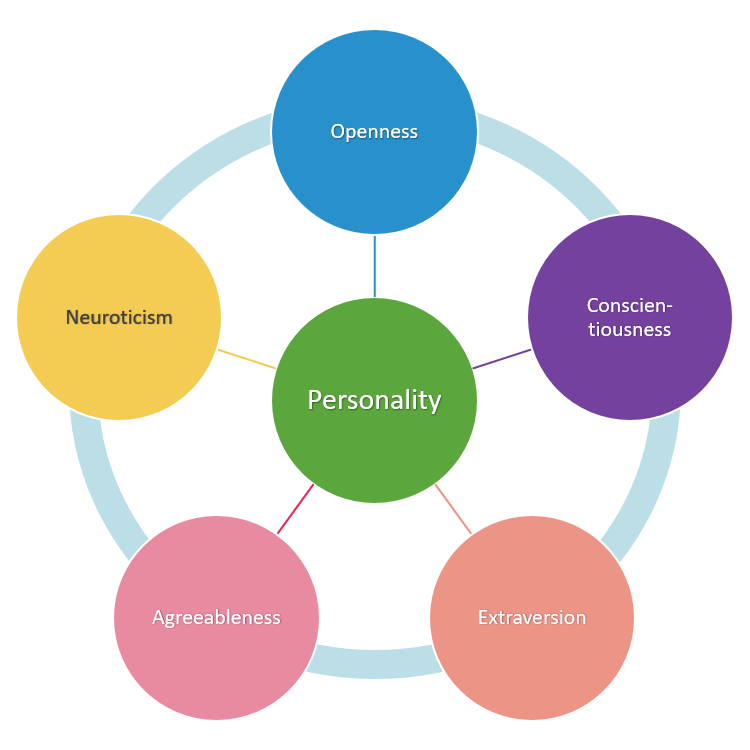 Openness, Conscientiousness, Extraversion, Agreeableness, Neuroticism (Image: MissLunaRose12, CC BY-SA 4.0, via Wikimedia Commons)
1.2 Personality Frameworks
| Framework | Traits | Workplace Application | Example in Nepal |
|---|---|---|---|
| Big Five (OCEAN) | Openness, Conscientiousness, Extraversion, Agreeableness, Neuroticism | Hiring: Match traits to roles (e.g., extraverts for sales at Daraz). | Ncell recruits extroverts for customer service. |
| Myers-Briggs (MBTI) | Introversion/Extraversion, Sensing/Intuition, Thinking/Feeling, Judging/Perceiving | Team dynamics: Balance thinkers (e.g., Nabil Bank analysts) with feelers (HR teams). | Chaudhary Group uses MBTI for leadership training. |
| Holland’s RIASEC | Realistic, Investigative, Artistic, Social, Enterprising, Conventional | Career counseling: Artistic types fit creative roles (e.g., Himalayan Java’s designers). | NEPSE advisors use this for stock analysts. |
Worked Example: Personality-Job Fit at Nabil Bank
- Role: Risk Analyst (high Conscientiousness, low Openness needed).
- Misfit: An extraverted, creative candidate may struggle with data-heavy tasks.
- Solution: Use structured interviews to assess traits (e.g., "Describe a time you followed strict procedures").
1.3 Advantages and Limitations
| Advantages | Limitations |
|---|---|
| Explains workplace conflicts (e.g., neurotic vs. agreeable teams). | Overlooks situational factors (e.g., a quiet employee may thrive in remote work). |
| Guides recruitment (e.g., Ncell’s extrovert hires). | Cultural bias: Big Five may not fit collectivist Nepali workplaces. |
| Predicts job satisfaction (e.g., high Agreeableness in HR roles). | Static view: Personality can change slightly over time. |
2. Perception in Organizations
2.1 Definition and Process
Perception is how individuals interpret and organize sensory information to give meaning to their environment. In OB, it affects:
- Decision-making (e.g., promotions, layoffs).
- Conflict (e.g., miscommunication in cross-functional teams).
- Leadership (e.g., how a manager views an employee’s performance).
Perceptual Process (visualized):
flowchart TD
  A["Sensory Stimulus"] --> B["Attention"]
  B --> C["Organization"]
  C --> D["Interpretation"]
  D --> E["Response"]
2.2 Factors Influencing Perception
| Factor | Description | Example in Nepal |
|---|---|---|
| Selective Attention | Focus on stimuli that match our needs/interests. | A Daraz manager notices only high-performing sales reps, ignoring others. |
| Stereotypes | Generalizations about groups (e.g., "All Nepali engineers are technical"). | Hiring bias: Assuming women are less suited for NTC’s technical roles. |
| Halo/Horn Effect | One trait dominates judgment (e.g., good looks → perceived competence). | A charismatic Pathao executive is assumed to be a better leader than a quiet one. |
| Recency Effect | Recent events weigh more heavily in evaluations. | Annual appraisals at Nabil Bank favor recent projects over long-term contributions. |
| Contrast Effect | Judgment is relative to a reference point. | A mediocre candidate looks "good" after rejecting several weak applicants. |
2.3 Reducing Perceptual Errors
- Structured interviews: Use standardized questions (e.g., "Describe a conflict and resolution").
- Multiple raters: Avoid single-manager bias (e.g., 360-degree feedback at Chaudhary Group).
- Training: Educate managers on biases (e.g., NTC’s diversity workshops).
- Objective data: Use KPIs (e.g., sales metrics at Daraz) over subjective opinions.
Worked Example: Perception in NTC’s Promotion Decisions
- Scenario: Two engineers, A (quiet, detail-oriented) and B (outspoken, social).
- Bias: Manager promotes B due to extroversion halo effect, overlooking A’s technical skills.
- Solution: Use structured evaluation (e.g., project outcomes, peer reviews) to reduce bias.
3. Learning in Organizations
3.1 Definition and Importance
Learning is a relatively permanent change in behavior or knowledge due to experience. In OB, it explains:
- Skill acquisition (e.g., training new hires at Nabil Bank).
- Behavior modification (e.g., rewarding punctuality at Daraz).
- Cultural transmission (e.g., how Pathao’s aggressive growth mindset spreads).
3.2 Learning Theories
| Theory | Key Idea | Workplace Application | Example in Nepal |
|---|---|---|---|
| Classical Conditioning (Pavlov) | Learning via association (stimulus → response). | Pair rewards with desired behavior (e.g., bonuses for meeting targets at Ncell). | NTC gives certificates for on-time project completion. |
| Operant Conditioning (Skinner) | Behavior reinforced by consequences (reward/punishment). | Performance-based bonuses (e.g., Daraz’s sales incentives). | Nabil Bank’s "Employee of the Month" awards. |
| Social Learning (Bandura) | Learning by observing others (modeling). | Mentorship programs (e.g., Himalayan Java’s senior-junior pairings). | Pathao’s CEO’s risk-taking style influences new hires. |
| Cognitive Learning (Piaget) | Mental processes (e.g., problem-solving, insight). | Training programs for complex roles (e.g., NEPSE’s stock analysis courses). | NTC’s engineers learn via case studies. |
3.3 Social Learning Theory (Bandura)
Key Concepts:
- Attention: Employees observe models (e.g., a respected leader at Chaudhary Group).
- Retention: Memory of the behavior (e.g., remembering how the leader handles crises).
- Reproduction: Imitating the behavior.
- Motivation: Willingness to perform the behavior (e.g., rewarded for mimicking the leader).
Worked Example: Social Learning at Pathao
- Model: CEO’s aggressive expansion strategy (e.g., rapid city entries).
- Observation: Junior managers notice the CEO’s risk-taking and replicate it (e.g., launching new services quickly).
- Outcome: Pathao’s growth accelerates, but some managers overlook risk assessment (e.g., driver safety).
3.4 Applications in OB
- Training: Use modeling (e.g., video demonstrations at Nabil Bank’s onboarding).
- Leadership: Leaders should exhibit desired behaviors (e.g., ethical conduct at NTC).
- Culture: Reinforce values via visible role models (e.g., Himalayan Java’s sustainable practices).
In the Real World
Khalti’s Personality-Driven Hiring
- Idea Used: Big Five traits (especially Conscientiousness and Agreeableness).
- How: Khalti’s customer service team is hired for high Agreeableness (friendly interactions) and Conscientiousness (attention to detail in transactions). Their "Khalti Champions" program rewards employees who embody these traits, reducing turnover.
Daraz’s Perceptual Biases in Performance Reviews
- Idea Used: Recency effect and contrast effect.
- How: Daraz’s semi-annual reviews often favor sellers who performed well in the last 3 months (recency) or those who outperformed a weak batch of new sellers (contrast). To fix this, they now use quarterly micro-reviews with weighted averages.
Ncell’s Operant Conditioning for Sales Targets
- Idea Used: Positive reinforcement (Skinner’s operant conditioning).
- How: Ncell rewards sales agents with cash bonuses, gift vouchers, and public recognition (e.g., "Top Performer" badges) when they exceed targets. This increased sales by 22% in 2023, as agents associate high performance with rewards.
Case Study: Himalayan Java’s Social Learning Culture
Company: Himalayan Java (Nepal’s leading coffee brand). Challenge: Standardize quality across 50+ outlets while maintaining creativity. Solution: Social learning via modeling and mentorship.
- Process:
- Barista Training: Senior baristas demonstrate techniques (e.g., latte art) to juniors.
- Customer Feedback Loop: Employees observe how top outlets handle complaints and replicate strategies.
- Incentives: Outlets with the most "learned behaviors" (e.g., consistency in brewing) get promotions.
- Outcome:
- 30% reduction in customer complaints.
- Increased repeat visits due to consistent quality.
- OB Link: Bandura’s retention and motivation principles—employees remember techniques when reinforced by rewards.
flowchart LR
  A["Senior Barista\n(Demonstrates latte art)"] -->|"Observation"| B["Junior Barista\n(Watches & Retains)"]
  B -->|"Reproduction"| C["Practices with Feedback"]
  C -->|"Motivation"| D["Bonus for Consistency"]
  D -->|"Reinforcement"| A
Exam Tip
How This Unit is Examined
Definitions and Concepts (20%)
- Expect short-answer questions on:
- Big Five traits, halo effect, classical conditioning, social learning.
- Example Question: "Define ‘perceptual defense’ and give a workplace example."
- Answer Tip: Use real Nepali companies (e.g., "At NTC, engineers may ignore safety warnings that contradict their technical confidence").
- Expect short-answer questions on:
Applications and Examples (35%)
- Scenario-based questions (e.g., "How would you apply operant conditioning to improve punctuality at a bank?").
- Worked Example: For personality-job fit, compare:
- Extrovert: Suited for Daraz’s sales roles (high interaction).
- Introvert: Better for Nabil Bank’s back-office analytics.
- Perception: Always link to bias reduction (e.g., "Use structured interviews to avoid halo effect").
Comparisons and Critiques (25%)
- Compare theories: E.g., "How does social learning differ from operant conditioning?"
- Social Learning: Observational (e.g., learning from a Pathao manager’s negotiation style).
- Operant Conditioning: Trial-and-error with rewards (e.g., getting a bonus for closing a deal).
- Critique frameworks: E.g., "Limitations of the Big Five model in Nepali organizations."
- Compare theories: E.g., "How does social learning differ from operant conditioning?"
Case Analysis (20%)
- Format: Given a scenario (e.g., "A Nepali IT firm struggles with employee turnover"), apply 2-3 OB concepts.
- Example Answer:
- Personality: High neuroticism in the team → solution: Stress-management workshops.
- Perception: Managers favor technical skills over soft skills → solution: 360-degree feedback.
- Learning: Lack of mentorship → solution: Pair new hires with seniors (social learning).
Common Pitfalls to Avoid
- Vague examples: Don’t say "a company"; specify Nepali companies (e.g., "At Ncell...").
- Overgeneralizing: Not all Nepali workplaces fit Western OB models (e.g., collectivism affects perception).
- Ignoring culture: For example, high-power distance in Nepali orgs means employees may not challenge leaders’ behaviors (affecting social learning).
High-Score Strategies
Use the "SOAP" method for answers:
- Situation: "At Daraz, sales reps show inconsistent performance."
- OB Concept: "This could be due to operant conditioning gaps—lack of consistent reinforcement."
- Application: "Introduce weekly bonuses for top performers and public recognition to reinforce desired behavior."
- Proof: "This aligns with Skinner’s theory where positive reinforcement increases repetition of behavior."
Draw diagrams in exams (if allowed):
- Perceptual process flowchart.
- Big Five traits mindmap.
- Operant conditioning matrix (reward/punishment grid).
Link to Nepal:
- For personality, mention collectivism (e.g., Nepali employees may suppress individual traits for group harmony).
- For learning, cite apprenticeship models (e.g., traditional Nepali craftsmanship passed via social learning).
Based on the TU BBS syllabus for Organizational Behaviour and Human Resource Management (MGT223), unit 2.
Discussion
Loading…