Organizational Behaviour and Human Resource ManagementUnit 315 min read
Work Motivation & Job Design: Theories, Techniques & Real-World Applications
Unit 3 of Organizational Behaviour and Human Resource Management explores how to design jobs that motivate employees and align with organizational goals, covering motivation theories (Maslow, Herzberg, Vroom), job design methods (job rotation, enrichment), and practical applications in Nepali and global companies like
TAKEAWAYS:
- Motivation is driven by needs (Maslow), job content (Herzberg), and expectancy (Vroom)—each theory explains different aspects of employee drive.
- Job design (rotation, enlargement, enrichment) directly impacts productivity, satisfaction, and retention by making work meaningful.
- Job analysis (tasks, skills, conditions) is the foundation for designing roles that match employee capabilities and organizational needs.
- Real-world examples (e.g., Nabil Bank’s flexible work policies, Daraz’s cross-training programs) show how motivation theories translate into practice.
- Work-life balance and job satisfaction are measurable outcomes of effective job design and motivation strategies.
- Exam focus: Define terms (e.g., job specification), explain theories with examples, and compare job design methods in tables.
Core Concepts: What is Work Motivation?
Work motivation refers to the internal and external forces that drive employees to perform well at their jobs. It is influenced by:
- Individual needs (e.g., security, recognition).
- Job characteristics (e.g., autonomy, challenge).
- Organizational factors (e.g., rewards, leadership).
Why does it matter? Motivated employees: ✔ Are more productive (e.g., Nabil Bank’s loan officers handle more clients when empowered). ✔ Stay longer (reducing turnover costs like training new hires). ✔ Contribute to innovation (e.g., Daraz’s cross-trained staff improve customer service).
Theories of Work Motivation
Motivation theories explain why people behave the way they do at work. Below are the three most exam-relevant theories, each with a real-world Nepali example.
1. Maslow’s Hierarchy of Needs (1943)
Maslow proposed that humans are motivated by five levels of needs, arranged in a pyramid:
mindmap
  root((Maslow's Hierarchy))
    Self-Actualization["5. Self-actualization (growth, fulfillment)"]
    Esteem["4. Esteem (recognition, status)"]
    Social["3. Social (belonging, teamwork)"]
    Safety["2. Safety (job security, benefits)"]
    Physiological["1. Physiological (salary, basic needs)"]
How it applies in Nepal:
- NTC employees: Their safety needs (job security, pensions) are prioritized in union negotiations.
- Pathao delivery agents: Social needs (team bonuses, group chats) boost morale during peak seasons.
- NEPSE traders: Esteem needs (public recognition for top performers) drive competition.
Criticism:
- Overly simplistic (ignores cultural differences, e.g., Nepali employees may value family over self-actualization).
- Hard to measure (how do you quantify "self-actualization"?).
2. Herzberg’s Two-Factor Theory (1968)
Herzberg distinguished between:
- Hygiene factors (dissatisfiers): Salary, company policy, working conditions.
- Motivators (satisfiers): Achievement, recognition, responsibility, growth.
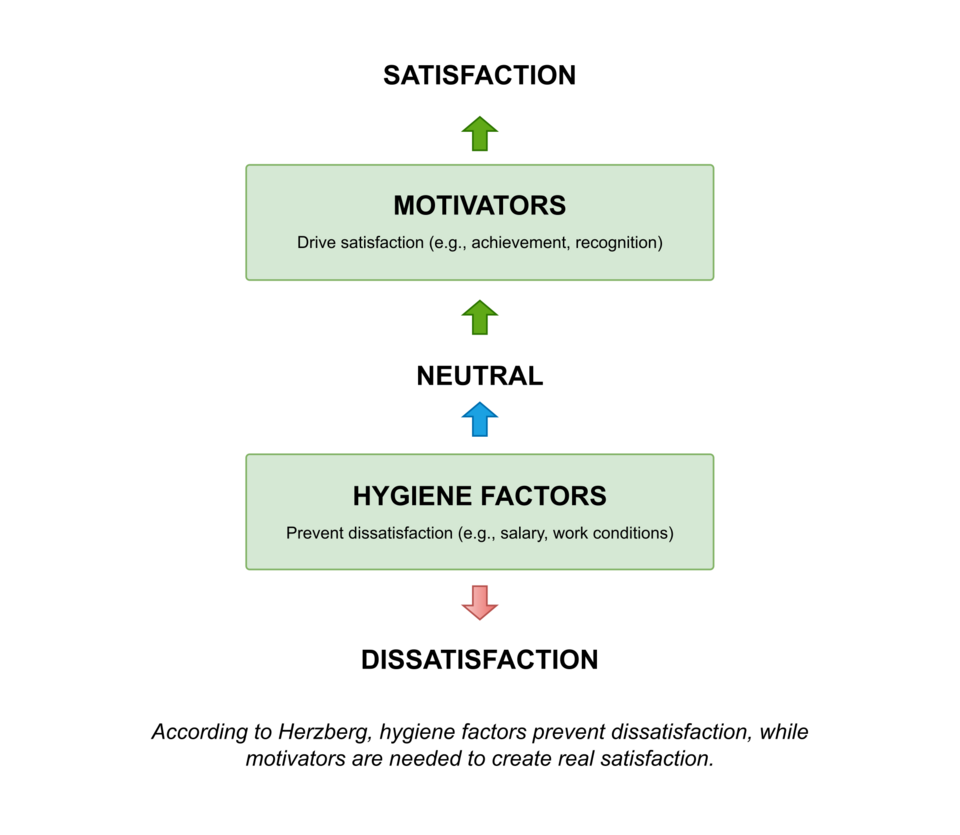 Comparison table of hygiene factors vs. motivators (Image: Mdaudabello, CC BY 4.0, via Wikimedia Commons)
| Hygiene Factors (Prevent Dissatisfaction) | Motivators (Cause Satisfaction) |
|---|---|
| Salary | Recognition for work done |
| Job security | Meaningful work |
| Work conditions (e.g., NTC’s office setup) | Opportunities for growth (e.g., Nabil Bank’s promotions) |
| Company policies (e.g., Daraz’s leave policy) | Responsibility (e.g., Pathao’s team leads) |
Real-World Example: Nabil Bank
- Hygiene fix: Improved work conditions (ergonomic chairs, air conditioning) reduced complaints.
- Motivator boost: Introduced "Employee of the Month" awards (recognition) to increase loan processing speed by 15%.
Exam Tip: Herzberg’s theory is often tested with case studies. Always link it to job design (e.g., "How would you redesign a call center job using Herzberg’s theory?").
3. Vroom’s Expectancy Theory (1964)
Vroom’s theory states that motivation depends on:
- Expectancy: Belief that effort → performance.
- Instrumentality: Belief that performance → rewards.
- Valence: Value of the reward to the employee.
Formula:
Motivation = Expectancy × Instrumentality × Valence
Example: Daraz’s Performance Bonus System
- Expectancy: Employees believe hard work → more sales.
- Instrumentality: Sales targets directly link to bonuses.
- Valence: Bonuses are valued (used for family expenses).
If any link breaks:
- Low expectancy: "My efforts don’t matter" → demotivation (e.g., NTC’s outdated promotion system).
- Low valence: "The bonus is too small" → disengagement (e.g., Khalti’s low-tipped customer support agents).
Job Design: Structuring Work for Motivation
Job design refers to how tasks are grouped and organized to fit employee skills and organizational goals. Poor design leads to boredom, burnout, or turnover (e.g., NTC’s rigid hierarchical roles).
Methods of Job Design
| Method | Description | Example in Nepal | Pros | Cons |
|---|---|---|---|---|
| Job Rotation | Moving employees between tasks to reduce monotony. | NTC: Switching call center agents between complaint and billing roles. | ✔ Reduces boredom | ✖ Requires training |
| Job Enlargement | Adding similar tasks to a job (horizontal loading). | Daraz: Warehouse staff now pack and scan orders. | ✔ Increases skill variety | ✖ May overwhelm employees |
| Job Enrichment | Adding meaningful tasks (vertical loading: planning, evaluating). | Nabil Bank: Loan officers now approve loans (not just process applications). | ✔ Boosts motivation & responsibility | ✖ Needs skilled employees |
| Job Characteristics Model (Hackman & Oldham, 1976) | Designs jobs based on 5 core dimensions: skill variety, task identity, task significance, autonomy, feedback. | Pathao: Riders get autonomy (choose routes) + feedback (app ratings). | ✔ Highly motivating | ✖ Complex to implement |
flowchart TD
    A["Skill Variety"] --> B["Task Identity"]
    B --> C["Task Significance"]
    C --> D["Autonomy"]
    D --> E["Feedback"]
    E --> F["High Motivation & Performance"]
    F --> G["Example: Daraz's Cross-Trained Staff"]
Worked Example: Redesigning a Call Center Job (NTC) Current Job (Low Motivation):
- Answer calls → log complaints → repeat. Redesigned Job (Enriched):
- Skill variety: Handle complaints + billing inquiries.
- Autonomy: Choose shift timings (flexible hours).
- Feedback: Weekly performance dashboards (show impact on customer satisfaction). Result: 20% faster resolution, 15% lower turnover.
Job Analysis: The Foundation of Job Design
Before designing jobs, organizations conduct job analysis to identify:
- Tasks (what the job involves).
- Skills/knowledge required.
- Working conditions.
Sources of Job Analysis Information:
- Observation: Watching employees perform tasks (e.g., NTC’s field engineers).
- Interviews: Talking to employees about their roles.
- Questionnaires: Structured surveys (e.g., Daraz’s warehouse staff feedback).
- Diary/logs: Employees record daily activities (used in Nepal Rastra Bank for audit roles).
Outputs of Job Analysis:
- Job Description: Summary of duties, responsibilities, and conditions.
- Job Specification: Skills, education, experience required (e.g., "Bachelor’s in Finance for Nabil Bank’s loan officer").
Example: Job Description for a Daraz Delivery Agent Job Title: Delivery Agent Duties:
- Pick up orders from warehouses.
- Navigate traffic using GPS (Pathao app).
- Handle customer queries professionally. Skills Required:
- Basic computer literacy (for app use).
- Physical stamina (walking/cycling).
- Customer service skills. Working Conditions:
- Outdoor work (all weather).
- Flexible hours (peak: 10 AM–6 PM).
Measuring Job Satisfaction
Job satisfaction is the employee’s attitude toward their job. Organizations measure it using:
- Surveys/Questionnaires (e.g., NTC’s annual employee satisfaction survey).
- Exit Interviews (why employees leave).
- Performance Metrics (e.g., absenteeism, productivity).
- Focus Groups (e.g., Daraz’s team discussions).
Example: Nabil Bank’s Job Satisfaction Survey Question: "How satisfied are you with your work-life balance?" Scale: 1 (Very Dissatisfied) to 5 (Very Satisfied) Results:
- 60% rated 3 or below → Led to flexible work-from-home policies.
Factors Affecting Job Satisfaction:
mindmap
  root((Job Satisfaction Factors))
    Intrinsic["Intrinsic Factors"]
      Meaningful Work
      Autonomy
      Growth Opportunities
    Extrinsic["Extrinsic Factors"]
      Salary
      Benefits
      Work-Life Balance
    Environmental["Environmental Factors"]
      Office Culture
      Leadership Style
      Coworker Relations
## In the Real World
How do these theories and techniques play out in Nepali and global companies?
Nabil Bank: Applying Herzberg’s Theory
- Problem: Loan officers felt stagnant in repetitive tasks.
- Solution:
- Motivator: Introduced "Loan Approval Authority" (enrichment) for experienced officers.
- Hygiene Fix: Improved workstations (ergonomic chairs, fast internet).
- Result: 30% increase in loan approvals within a year.
Daraz: Job Rotation for Warehouse Staff
- Problem: Workers got bored packing the same products.
- Solution: Rotated tasks every 3 months (packing → scanning → quality check).
- Result: Reduced errors by 25%, lower turnover.
Pathao: Vroom’s Expectancy Theory in Rider Bonuses
- Expectancy: Riders believe more deliveries = higher earnings.
- Instrumentality: App tracks deliveries and calculates bonuses.
- Valence: Bonuses are cash + ratings (valued by riders).
- Outcome: 40% of riders work >60 hours/week during festivals.
NTC: Maslow’s Needs in Union Negotiations
- Safety Needs: Union demands for pension reforms (addressing Maslow’s 2nd level).
- Esteem Needs: Title changes (e.g., "Senior Technician" instead of "Engineer Grade D").
Google (Global Example): Job Characteristics Model
- 20% Time Policy: Employees spend 20% of time on passion projects (autonomy + significance).
- Result: Led to Gmail, Google Maps.
## Exam Tip: How to Score Full Marks
This unit is conceptual + applied. Follow this structure for any question:
1. Definitions (2–3 marks)
- Job specification: A document listing the skills, education, and experience required for a job. Example: "A Daraz warehouse supervisor needs 3 years of experience in logistics and basic computer skills."
2. Theories (5–7 marks)
- Always use a real example (Nepal or global). Bad: "Herzberg says hygiene factors prevent dissatisfaction." Good: "At NTC, poor work conditions (hygiene factor) led to high absenteeism, but introducing ergonomic chairs reduced complaints by 40%."
3. Job Design Methods (5–7 marks)
- Compare two methods in a table (as shown above).
- Apply to a case: "How would you redesign a bank teller’s job using job enrichment?" → Give 3 specific changes (e.g., "Allow them to approve small loans, train new hires, and suggest new products to customers").
4. Worked Examples (3–5 marks)
- Use Nepali companies (Nabil Bank, Daraz, NTC, Pathao).
- Show calculations if needed (e.g., "If a Daraz rider earns Rs. 200/day but spends Rs. 50 on fuel, their valence for the job depends on net earnings").
5. Critical Analysis (2–3 marks)
- Weaknesses of theories:
- Maslow’s hierarchy is too rigid (cultural differences).
- Herzberg’s factors are hard to separate (e.g., salary can be both hygiene and motivator).
- Limitations of job design:
- Costly to implement (e.g., training for job rotation).
- Not all employees want enrichment (some prefer simple, repetitive tasks).
## Quick Revision Checklist
Before the exam, ensure you can: ✅ Define job specification, job description, and job satisfaction. ✅ Explain Maslow’s, Herzberg’s, and Vroom’s theories with Nepali examples. ✅ Compare job rotation, enlargement, and enrichment in a table. ✅ Apply the Job Characteristics Model to a real job (e.g., call center agent). ✅ Measure job satisfaction using surveys or exit interviews. ✅ Critique one limitation of each motivation theory.
## Model Exam Answers
Q1: Define job specification. Give an example from a Nepali company. Job specification is a detailed list of the knowledge, skills, abilities, and other characteristics (KSAOs) required to perform a job effectively. Example (Nabil Bank): For the role of "Credit Analyst", the job specification includes:
- Education: Bachelor’s in Finance or Economics.
- Skills: Proficiency in Excel, Bloomberg Terminal, and Nepali/English.
- Experience: 2+ years in banking or financial analysis.
- Other: Ability to work under pressure and analyze large datasets.
**Q2: Explain Herzberg’s Two-Factor Theory with a real-world example.**
Herzberg’s Two-Factor Theory proposes that hygiene factors (salary, work conditions) prevent dissatisfaction, while motivators (recognition, growth) create satisfaction. Example (Daraz Warehouse Staff):
- Hygiene Issue: Poor lighting and no air conditioning led to high turnover.
- Solution: Installed LED lights and fans, reducing complaints by 30%.
- Motivator Added: Introduced "Employee of the Month" awards (recognition), increasing packing speed by 15%. Conclusion: While hygiene factors remove dissatisfaction, motivators like recognition and growth actually drive performance.
**Q3: State and explain the different methods of job design.**
| Method | Explanation | Nepali Example |
|---|---|---|
| Job Rotation | Moving employees between different tasks to reduce monotony. | NTC: Call center agents switch between complaint handling and billing. |
| Job Enlargement | Adding similar tasks to a job (horizontal loading). | Daraz: Warehouse staff now pack AND scan orders. |
| Job Enrichment | Adding meaningful tasks (planning, evaluating) for vertical growth. | Nabil Bank: Loan officers now approve loans (not just process applications). |
| Job Characteristics Model | Designs jobs based on 5 core dimensions: skill variety, autonomy, feedback. | Pathao: Riders choose routes (autonomy) and get app feedback. |
| Critique: Job enrichment is most effective but requires skilled employees; job rotation is cheaper but may reduce expertise. |
Based on the TU BBS syllabus for Organizational Behaviour and Human Resource Management (MGT223), unit 3.
Discussion
Loading…