Business Environment And StrategyUnit 712 min read
Strategic Analysis & Evaluation: Tools, Processes & CEO Roles
Unit 7 of Business Environment And Strategy covers strategic analysis frameworks (PESTEL, EFEM, portfolio analysis), CEO roles in evaluation, scenario building, and control criteria—with real-world Nepali/global case studies (Nabil Bank, Daraz) and exam-focused worked examples.
TAKEAWAYS:
- Strategic analysis uses tools like PESTEL (external) and EFEM (competitive) to diagnose threats/opportunities, while portfolio analysis (BCG matrix) evaluates business units by growth/market share.
- CEOs lead evaluation by setting criteria (financial, operational, ethical), monitoring KPIs, and aligning strategies with organizational vision—e.g., Nabil Bank’s digital loan approval system.
- Scenario building anticipates future disruptions (e.g., NTC’s fiber expansion plans) by mapping high/low growth, high/low inflation scenarios with probability weights.
- Control systems (feedforward/feedback) must be timely, objective, and flexible—e.g., Daraz’s real-time inventory alerts for supply chain resilience.
- Ethical evaluation (e.g., Himalayan Java’s fair-trade coffee) requires balancing profitability with stakeholder trust, often using multi-criteria matrices.
- Strategic plans succeed when they include measurable goals, resource allocation, and contingency plans—like Pathao’s expansion into food delivery during COVID-19.
Core Concepts: Definitions and Frameworks
Strategic analysis evaluates an organization’s internal/external environment to inform decisions. Evaluation ensures chosen strategies align with goals and adapt to changes.
1. Environmental Analysis Tools
A. PESTEL Analysis
Definition: A macro-environmental scanning tool analyzing Political, Economic, Social, Technological, Environmental, and Legal factors. How it works:
- Political: Government stability, trade policies (e.g., Nepal’s FTA with India).
- Economic: Inflation, GDP growth, interest rates (e.g., Nabil Bank’s loan pricing).
- Social: Demographics, cultural shifts (e.g., eSewa’s elderly user adoption).
- Technological: Innovation adoption (e.g., Khalti’s UPI integration).
- Environmental: Sustainability regulations (e.g., NTC’s renewable energy targets).
- Legal: Labor laws, IP rights (e.g., Daraz’s copyright disputes).
Worked Example: NTC’s Fiber Expansion
mindmap
  root((NTC's Fiber Expansion: PESTEL))
    Political ["Government subsidies for rural connectivity"]
    Economic ["Declining ARPU (Average Revenue Per User) due to competition"]
    Social ["Urban-rural digital divide reduction"]
    Technological ["5G rollout delays"]
    Environmental ["Solar-powered base stations"]
Legal ["Telecom Regulatory Authority (TRA) licensing"]Advantages:
- Broad, structured overview.
- Identifies indirect risks (e.g., social media trends affecting brand perception). Limitations:
- Overlooks industry-specific factors (use Five Forces for that).
- Static snapshot; requires updates.
B. External Factor Evaluation Matrix (EFEM)
Definition: Quantifies PESTEL factors into a weighted score (1–4 scale) to prioritize opportunities/threats. Formula:
EFEM Score = Σ (Weight × Rating) / Total Weight
Worked Example: Daraz Nepal (2023)
| Factor | Weight | Rating (1–4) | Weighted Score | Notes |
|---|---|---|---|---|
| Political Stability | 0.15 | 3 | 0.45 | FTA with India boosts imports. |
| Economic Growth | 0.20 | 2 | 0.40 | Inflation erodes consumer spending. |
| Social Media Trends | 0.10 | 4 | 0.40 | TikTok Shop drives traffic. |
| Tech Infrastructure | 0.25 | 3 | 0.75 | Last-mile delivery challenges. |
| Environmental Regulations | 0.15 | 2 | 0.30 | Plastic ban affects packaging. |
| Legal IP Protection | 0.15 | 1 | 0.15 | Counterfeit goods rampant. |
| Total EFEM Score: 2.45/4 → Moderate threat level (focus on tech/logistics). |
Why Use EFEM?
- Prioritizes critical factors (e.g., Daraz’s score shows tech > legal issues).
- Compares competitors (e.g., Sastodeal’s lower tech rating).
2. Internal Analysis: Portfolio and SWOT
A. Portfolio Analysis (BCG Matrix)
Definition: Classifies business units by market growth vs. market share to allocate resources. Quadrants:
quadrantChart
  title BCG Matrix for Nabil Bank (2023)
  quadrant-1 "Stars (High Growth, High Share)"
  quadrant-2 "Question Marks (High Growth, Low Share)"
  quadrant-3 "Cash Cows (Low Growth, High Share)"
  quadrant-4 "Dogs (Low Growth, Low Share)"
  "Digital Banking": [0.8, 0.9]
  "SME Loans": [0.6, 0.4]
  "Retail Deposits": [0.3, 0.9]
  "Corporate Loans": [0.2, 0.1]
Example: Nabil Bank’s digital banking (star) requires investment, while retail deposits (cash cow) fund growth.
B. SWOT Analysis
Definition: Internal Strengths/Weaknesses + External Opportunities/Threats. Worked Example: Himalayan Java
mindmap
  root((Himalayan Java: SWOT))
    Strengths ["Premium organic coffee branding"]
    Weaknesses ["Limited export markets"]
    Opportunities ["Growing global health-conscious trend"]
    Threats ["Climate change affecting yield"]
3. Strategic Decision-Making Process
Steps:
- Identify Problem: Gap between current/desired performance (e.g., Pathao’s low rural penetration).
- Gather Data: Use PESTEL/SWOT/EFEM.
- Generate Alternatives: E.g., expand delivery fleet vs. partner with local shops.
- Evaluate Criteria:
- Financial: ROI, payback period.
- Operational: Feasibility, resource needs.
- Ethical: Stakeholder impact (e.g., fair wages for delivery partners).
- Select & Implement: Pilot test (e.g., Pathao’s rural trial in Pokhara).
- Monitor & Control: KPIs like delivery time, customer satisfaction.
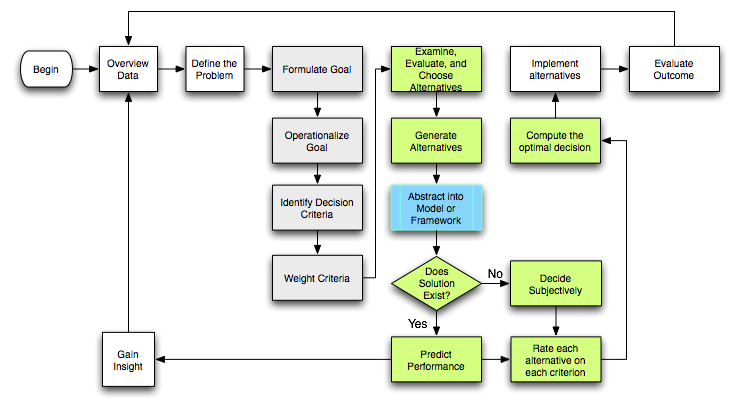 Standard 6-step process diagram (Image: DavidLevinson, CC BY-SA 3.0, via Wikimedia Commons)
4. CEO’s Role in Strategic Evaluation
CEOs oversee three key functions:
- Setting Evaluation Criteria: Aligns with vision (e.g., Chaudhary Group’s "Nepal’s largest retail chain" goal).
- Monitoring Performance: Uses dashboards (e.g., NEPSE’s real-time stock tracking).
- Corrective Action: Reallocates resources (e.g., Toyota’s shift to EVs post-Paris Agreement).
Case Study: Toyota’s Strategic Pivot
sequenceDiagram
    participant CEO as Akio Toyoda
    participant Team as Strategy Team
    participant Market as Global EV Demand
    CEO->>Team: "Analyze PESTEL: Regulatory shifts favor EVs"
    Team->>Market: "Growth in China/Europe = 20% CAGR"
    Team->>CEO: "Recommend $1T investment by 2030"
    CEO->>Team: "Prioritize battery tech R&D"
5. Scenario Building for Industry Analysis
Definition: Projects future states (best/worst case) to test strategy resilience. Steps:
- Identify Key Variables: E.g., for NTC: fiber adoption rate, TRA regulations.
- Define Scenarios:
- Optimistic: High adoption, low competition.
- Pessimistic: Low adoption, high competition.
- Assign Probabilities: E.g., 30% optimistic, 50% baseline, 20% pessimistic.
- Develop Contingency Plans: E.g., NTC’s backup satellite internet.
Example: Kathmandu Traffic Routes
pie
  title Traffic Congestion Scenarios (2025)
  "High Growth (30%)": 30
  "Stable (50%)": 50
  "Low Growth (20%)": 20
Features:
- Forces proactive planning (e.g., NTC’s fiber vs. copper backup).
- Reveals blind spots (e.g., underestimating Pathao’s competition from local apps).
6. Evaluation and Control Criteria
Guidelines for Effective Control:
| Criteria | Description | Example |
|---|---|---|
| Timeliness | Data must be current (e.g., real-time sales for Daraz). | Daily inventory turnover reports. |
| Accuracy | Objective metrics (e.g., NEPSE’s audited financials). | Third-party customer satisfaction surveys. |
| Flexibility | Adapts to changes (e.g., Khalti’s crypto payment pause). | Dynamic pricing algorithms. |
| Economic Feasibility | Costs < benefits (e.g., NTC’s fiber ROI). | NPV analysis of infrastructure projects. |
Control Systems:
- Feedforward: Prevents issues (e.g., Daraz’s supplier vetting).
- Concurrent: Real-time adjustments (e.g., Pathao’s dynamic pricing).
- Feedback: Post-action learning (e.g., Nabil Bank’s customer complaint analysis).
7. Ethical and Social Responsibility in Evaluation
Criteria for Ethical Evaluation:
- Stakeholder Impact: Does the strategy harm employees/communities? (e.g., Himalayan Java’s fair-trade practices).
- Transparency: Are data sources credible? (e.g., NEPSE’s disclosure rules).
- Long-Term Sustainability: Balances profit with environmental/social goals (e.g., Chaudhary Group’s solar-powered stores).
Case Study: Nabil Bank’s Loan Ethics
classDiagram
  class LoanApproval {
    +Financial Viability: "Debt-to-income < 30%"
    +Ethical Check: "No exploitation of vulnerable groups"
    +Transparency: "Full disclosure of terms"
  }
  class Customer {
    -Income: Number
    -Background: "Employment history"
  }
  LoanApproval --> Customer: "Approves if criteria met"
In the Real World
eSewa’s PESTEL Analysis:
- Technological: Leveraged Nepal’s low digital literacy to simplify UPI (unlike India’s complex apps).
- Social: Partnered with local NGOs to onboard elderly users via community centers.
- Legal: Faced scrutiny over data privacy (2022 GDPR-like debates in Nepal).
Daraz’s EFEM and Portfolio Strategy:
- EFEM Score: Prioritized technology infrastructure (weight: 0.25) over legal IP (weight: 0.15) due to rampant counterfeits.
- Portfolio: Shifted from cash cows (electronics) to stars (fashion, driven by TikTok Shop).
NTC’s Scenario Planning:
- Optimistic: 70% fiber coverage by 2025 (requires $500M investment).
- Pessimistic: 40% coverage (delays due to political instability).
- Contingency: Expanded satellite internet in remote areas (e.g., Mustang).
Exam Tip
For PESTEL/EFEM:
- Always link factors to the company’s strategy. Example:
"NTC’s fiber expansion (Technological) aligns with TRA’s 2025 broadband target (Political), but faces Economic threats from Khalti’s digital wallet growth."
- Use real data: Cite NEPSE’s inflation rate or TRA’s latest reports.
- Always link factors to the company’s strategy. Example:
For Portfolio Analysis:
- Memorize BCG quadrants and give a local example:
"Nabil Bank’s SME loans are ‘Question Marks’—high growth potential but low market share due to competition from Finance Companies."
- Critique: Discuss why a "Dog" (e.g., NTC’s landline phones) might still exist (legacy contracts).
- Memorize BCG quadrants and give a local example:
For Strategic Decisions:
- Structure answers in 3 parts:
- Problem (e.g., "Pathao’s rural delivery delays").
- Alternatives (fleet expansion vs. local partnerships).
- Evaluation (cost-benefit of each).
- Use bullet points for criteria (financial, operational, ethical).
- Structure answers in 3 parts:
For Scenario Building:
- Show calculations: If asked about probabilities, assign weights (e.g., "30% chance of high inflation").
- Connect to control: End with how the company would adapt (e.g., "NTC would delay rural fiber if inflation >10%").
For CEO Roles:
- Quote examples:
"Like Akio Toyoda at Toyota, Nabil Bank’s CEO must balance short-term profits (e.g., loan interest rates) with long-term trust (e.g., ethical lending practices)."
- Highlight monitoring tools: Dashboards, audits, stakeholder feedback.
- Quote examples:
Common Pitfalls:
- Avoid vague statements: ❌ "PESTEL is important" → ✅ "NTC’s PESTEL reveals that Political instability (weight 0.20, rating 2) threatens its 5G timeline."
- Don’t mix tools: Use SWOT for internal, PESTEL for external, EFEM for weighted scoring.
- Case studies: Always name the company and tie to Nepal/global trends.
Final Visual Summary:
flowchart TD
  A["Strategic Analysis"] --> B["PESTEL/EFEM: External"]
  A --> C["SWOT/Portfolio: Internal"]
  B --> D["Scenario Building: Future States"]
  C --> E["CEO Evaluation: Criteria & Control"]
  D --> F["Contingency Plans"]
  E --> G["Ethical/Social Responsibility"]
  G --> H["Stakeholder Impact Assessment"]
  H --> I["Strategic Decision: Implement/Monitor"]
Based on the TU BBS syllabus for Business Environment And Strategy, unit 7.
Discussion
Loading…