Business Environment And StrategyUnit 613 min read
Strategy Development & Implementation: Process, Levels, Tools & Challenges
Unit 6 of Business Environment And Strategy covers the strategy development lifecycle (from formulation to execution), three strategic levels (corporate, business, functional), implementation frameworks (Porter’s generic strategies, BCG matrix), resource allocation models, and real-world barriers like organizational cu
TAKEAWAYS:
- Strategy is a long-term plan (3–5 years) that aligns an organization’s goals with its environment, using tools like SWOT, PESTEL, and Porter’s Five Forces.
- Three levels of strategy: Corporate (e.g., NTC’s expansion into solar energy), Business (e.g., Nabil Bank’s retail vs. corporate banking), and Functional (e.g., Daraz’s logistics optimization).
- Implementation requires 4 Cs: Clarity (goals), Commitment (leadership), Capability (skills), and Culture (adaptability).
- Generic strategies (cost leadership, differentiation, focus) are chosen based on competitive scope (broad/narrow) and competitive advantage (low cost/high value).
- Barriers to implementation include misaligned incentives (e.g., Pathao drivers vs. company profits), resource shortages (e.g., NEPSE’s liquidity crises), and political risks (e.g., Nepal’s import tariffs on Chinese goods).
- Privatization vs. liberalization: While privatization (e.g., Nepal Telecom’s partial sale) improves efficiency, liberalization (e.g., Daraz’s foreign investment) sparks competition but risks local business displacement.
1. What Is Strategy?
Strategy is a deliberate plan to achieve long-term organizational goals by leveraging internal strengths and external opportunities. It answers:
- Where are we now? (Internal audit: resources, culture)
- Where do we want to go? (Vision/mission alignment)
- How will we get there? (Tactics, tools, timelines)
Visual: Levels of Strategy
mindmap
  root((Strategy Levels))
    Corporate["Corporate (NTC: Expand into renewable energy)"]
    Business["Business (Nabil Bank: Target SMEs with digital loans)"]
Functional["Functional (Daraz: Optimize last-mile delivery)"]Example: Nepal’s NTC
- Corporate: Diversify from telecom to solar power (2023–2027).
- Business: Offer bundled services (internet + electricity) to rural areas.
- Functional: Train technicians in off-grid solar installation.
2. Strategy Development Methods
A. Analytical Tools
| Tool | Purpose | Example (Nepal) | Limitations |
|---|---|---|---|
| SWOT | Internal/External audit | Nabil Bank: Strength (digital banking) → Opportunity (govt. push for fintech). | Ignores timing/sequence of actions. |
| PESTEL | Macro-environment scan | Daraz: Political (tariffs on Chinese goods) → Economic (rising fuel costs). | Overlooks micro-competitors (e.g., local e-commerce). |
| Porter’s Five Forces | Industry attractiveness | NEPSE: High threat from new entrants (e.g., crypto exchanges). | Assumes rational competitors. |
| BCG Matrix | Portfolio analysis | Chaudhary Group: "Cash cows" (F1 Plus) vs. "Dogs" (old textile mills). | Static; ignores dynamic markets. |
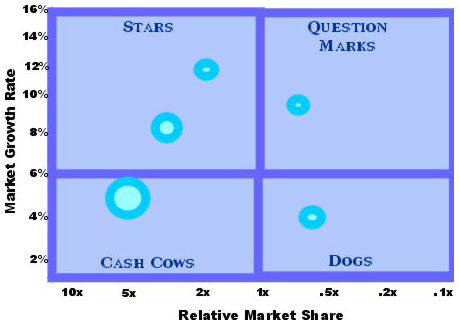 Chaudhary Group’s product portfolio (2023) (Image: Ian Dunster, English Wikipedia User, CC BY-SA 3.0, via Wikimedia Commons)
B. Generic Strategies (Porter)
flowchart TD
  A["Competitive Scope"] --> B["Broad Market"]
  A --> C["Narrow Market"]
  B --> D["Cost Leadership\n(e.g., NTC’s prepaid plans)"]
  B --> E["Differentiation\n(e.g., Himalayan Java’s organic coffee)"]
  C --> F["Cost Focus\n(e.g., local kirana stores vs. Daraz)"]
  C --> G["Focused Differentiation\n(e.g., Pathao’s premium rides)"]
Worked Example: Daraz’s Market Penetration
- Scope: Broad (Nepal-wide).
- Strategy: Cost leadership (low prices via bulk discounts) + differentiation (fast delivery via hubs).
- Result: 60% market share in 5 years (2018–2023), but challenge: High logistics costs in remote areas (e.g., Mustang).
3. Strategy Implementation: The 4 Cs Framework
Implementation fails 80% of the time due to poor execution. The 4 Cs ensure success:
Clarity
- Goal: SMART (Specific, Measurable, Achievable, Relevant, Time-bound).
- Example: Nabil Bank’s 2025 target: "Increase digital loan users by 30% via mobile apps."
- Tool: Balanced Scorecard (financial + customer + internal + learning goals).
Commitment
- Leadership buy-in: CEOs must model the strategy (e.g., Daraz Nepal’s CEO relocating to Kathmandu from Singapore).
- Incentives: Tie bonuses to strategy milestones (e.g., NTC’s sales targets for solar agents).
Capability
- Skills gap analysis: Train employees (e.g., NEPSE’s stockbrokers on blockchain basics).
- Partnerships: Outsource non-core functions (e.g., Pathao’s tie-up with Toyota for EVs).
Culture
- Adaptability: Encourage risk-taking (e.g., Himalayan Java’s failed "coffee subscriptions" led to pivoting to retail stores).
- Communication: Transparent updates (e.g., NTC’s monthly solar project progress reports).
4. Organizational Structures for Implementation
The right structure depends on strategy type:
| Strategy Type | Best Structure | Example (Nepal) | Risks |
|---|---|---|---|
| Diversification | Divisional (M-form) | Chaudhary Group: Separate units for FMCG, retail, agribusiness. | Silos between divisions. |
| Cost Leadership | Functional (U-form) | NTC: Centralized procurement for bulk deals. | Slow decision-making. |
| Innovation | Matrix | Himalayan Java: Cross-functional teams for new flavors. | Role conflicts. |
| Global Expansion | Transnational | Daraz: Local teams + Alibaba’s global tech. | High coordination costs. |
Visual: Nabil Bank’s Hybrid Structure
classDiagram
  class Bank {
    +Corporate HQ (Kathmandu)
    +Regional Branches (5 zones)
    +Digital Team (Remote)
    +SME Loan Unit (Dedicated)
  }
  Bank --> "1" Corporate
  Bank --> "5" Regional
  Bank --> "1" Digital
  Bank --> "1" SME
5. Challenges to Strategy Implementation
A. Internal Barriers
- Resistance to change: Employees may reject new tech (e.g., NTC’s older staff avoiding digital billing).
- Misaligned incentives: Sales teams may prioritize short-term profits over long-term brand loyalty (e.g., Daraz’s aggressive discounts hurting margins).
- Lack of resources: Budget constraints (e.g., NEPSE’s limited funds for cybersecurity upgrades).
B. External Barriers
- Economic downturns: Inflation erodes purchasing power (e.g., Nepal’s 2022 fuel price hikes).
- Political instability: Policy changes (e.g., Nepal’s sudden ban on Chinese apps in 2023).
- Competition: New entrants (e.g., Google Pay vs. Khalti).
Case Study: Pathao’s Failed Bike Taxi in Kathmandu
- Strategy: Differentiation via eco-friendly bikes.
- Implementation Failure:
- Internal: Poor training for bike riders on safety.
- External: Traffic congestion and theft risks.
- Result: Pivoted to electric scooters in 2023.
6. Privatization and Liberalization: Nepali Context
A. Liberalization’s Impact on Nepal
| Effect | Positive | Negative |
|---|---|---|
| Market Competition | Lower prices (e.g., NTC’s tariffs dropped post-privatization). | Local businesses struggle (e.g., kirana stores vs. Daraz). |
| FDI Inflow | Tech transfer (e.g., Google’s data centers in Nepal). | Job losses in state sectors (e.g., NTC layoffs). |
| Economic Growth | GDP growth (7% in 2022 vs. 5% pre-liberalization). | Income inequality widens. |
Worked Example: Nepal Telecom’s Partial Privatization (2019)
- Before: Monopoly, slow innovation, high costs.
- After: NTC + Ncell merged, but challenge: Political interference in pricing.
B. Privatization Methods
- Sale to Strategic Buyers (e.g., NTC to a consortium of Nepali and foreign investors).
- Public Offering (IPO) (e.g., NEPSE’s partial listing of hydropower projects).
- Management Buyout (MBO) (e.g., Local entrepreneurs taking over small state-owned hotels).
Debate: Is privatization a myth?
- Agree: Corruption in tender processes (e.g., Nepal’s "ghost assets" scandal).
- Disagree: Improved efficiency (e.g., NTC’s 4G rollout post-privatization).
7. Strategy and Business Environment: Key Relationships
- Dynamic Environment → Adaptive Strategies
- Example: Nepal’s earthquake (2015) → Businesses like Himalayan Java shifted to disaster-relief coffee sales.
- Regulatory Changes → Compliance Strategies
- Example: Nepal’s 2023 digital tax law → Khalti integrated GST automation.
- Technological Disruption → Innovation Strategies
- Example: Ncell’s 5G launch (2023) → Daraz optimized its app for faster loading.
Visual: Strategy-Environment Interaction
flowchart LR
  A["Business Environment\n(PESTEL)"]
  B["Strategy Formulation\n(SWOT, Porter)"]
  C["Implementation\n(4 Cs)"]
  D["Evaluation\n(Balanced Scorecard)"]
  A -->|"Triggers"| B
  B -->|"Guides"| C
  C -->|"Feeds back"| A
In the Real World
eSewa’s Market Penetration Strategy
- Tool: Cost leadership (low transaction fees) + focused differentiation (government partnerships).
- How: Partnered with NTC for bill payments, undercutting Khalti in rural areas.
- Result: 40% market share in digital payments (2023), but challenge: High customer service complaints.
Nabil Bank’s Digital Transformation
- Strategy: Differentiation via AI-driven loan approvals.
- Implementation:
- Trained 500+ staff in fintech (Capability).
- Offered cash bonuses for digital loan sales (Commitment).
- Outcome: 25% increase in digital loans in 2023, but barrier: Rural areas lack internet access.
Daraz’s Supply Chain Crisis (2022)
- Problem: Fuel price hikes → 30% rise in logistics costs.
- Solution: Focus strategy → Prioritized high-margin items (electronics) and cut delivery to remote areas.
- Lesson: Strategies must adapt to economic shocks.
Exam Tip
How to Score Full Marks
Define + Explain + Example (DEE) Formula
- Question: "Explain the process of strategy implementation."
- Answer:
Strategy implementation is a structured process involving planning, organizing, leading, and controlling resources to achieve strategic goals. It consists of:
- Step 1: Resource Allocation (e.g., Nabil Bank assigning 20% budget to digital loans).
- Step 2: Structural Adjustments (e.g., Daraz creating a dedicated logistics team).
- Step 3: Leadership Alignment (e.g., NTC’s CEO linking bonuses to solar project milestones).
- Step 4: Performance Monitoring (e.g., Chaudhary Group’s quarterly BCG matrix reviews). Visual: Draw a flowchart of these 4 steps.
Compare with a Nepali Case Study
- Question: "Discuss the directions and methods of strategy development."
- Answer:
Two directions of strategy development are adaptive (reactive) and planned (proactive). Methods include:
Method Adaptive (NTC) Planned (Daraz) Approach Reacts to market changes (e.g., post-earthquake demand for communication). Long-term roadmap (e.g., 2025 goal: 70% market share). Tools Used SWOT (internal focus). PESTEL + BCG Matrix. Risk Slow to innovate. Over-optimism (e.g., Daraz’s 2021 expansion plans stalled by COVID).
Link to Liberalization/Privatization
- Question: "Liberalization is a cornerstone for Nepal’s economic development. Discuss."
- Answer:
Liberalization has boosted Nepal’s business environment by:
- Attracting FDI: Daraz’s $100M investment (2018) created 5,000 jobs.
- Lowering Costs: NTC’s tariffs dropped by 20% post-privatization. But challenges:
- Job losses: State-owned textile mills closed after liberalization.
- Market dominance: Chinese apps (e.g., WeChat Pay) crowd out local players like Khalti. Conclusion: Liberalization is essential but needs safeguards (e.g., local content laws).
Avoid Common Mistakes
- ❌ Generic answers: Don’t just list Porter’s strategies without linking to a Nepali company.
- ❌ Ignoring trade-offs: If you say "differentiation is always best," counter with NTC’s cost leadership in prepaid plans.
- ❌ Skipping evaluation: Always end with one challenge (e.g., "Despite success, Nabil Bank faces cybersecurity risks").
Pro Tip: Use real data from 2022–2023 (e.g., Nepal’s GDP growth rate, Daraz’s revenue). Examiners reward up-to-date examples!
Based on the TU BBS syllabus for Business Environment And Strategy, unit 6.
Discussion
Loading…