Computer Fundamentals and ApplicationsUnit 913 min read
Emerging Tech: IoT, Blockchain, AI, Cloud, 5G & Cybersecurity
Unit 9 of Computer Fundamentals and Applications explores cutting-edge technologies reshaping industries—IoT, blockchain, AI/ML, cloud computing, 5G, and cybersecurity trends—with real-world applications, technical workings, and exam-focused insights.
TAKEAWAYS:
- IoT connects devices via sensors/actuators (e.g., smart homes, industrial monitoring) using protocols like MQTT and edge computing.
- Blockchain enables decentralized ledgers (cryptocurrencies, supply chains) with cryptographic hashing and consensus mechanisms.
- AI/ML automates decisions via neural networks (e.g., fraud detection, recommendation systems) with training data and model evaluation.
- Cloud computing delivers scalable services (IaaS/PaaS/SaaS) via virtualization and distributed storage (e.g., AWS, Google Cloud).
- 5G boosts speed/latency for IoT and AR/VR via mmWave and network slicing.
- Cybersecurity trends include zero-trust models, quantum-resistant encryption, and AI-driven threat detection.
1. Internet of Things (IoT): Connecting the Physical and Digital Worlds
IoT integrates sensors, actuators, and connectivity to enable real-time data exchange between devices and systems. Key components:
- Sensors/Actuators: Collect environmental data (e.g., temperature, motion) or trigger actions (e.g., turning on lights).
- Connectivity: Uses protocols like MQTT (lightweight messaging), LoRaWAN (long-range), or NB-IoT (narrowband).
- Edge Computing: Processes data locally to reduce latency (vs. cloud-dependent systems).
- Cloud Platforms: Store/analyze data (e.g., AWS IoT Core, Microsoft Azure IoT Hub).
How IoT Works: A Smart Home Example
sequenceDiagram
    participant User as User (Mobile App)
    participant Sensor as Smart Thermostat (Sensor)
    participant Gateway as Wi-Fi Router
    participant Cloud as AWS IoT Cloud
    participant Actuator as HVAC System

    User->>Sensor: "Set temperature to 22°C"
    Sensor->>Gateway: MQTT Publish (JSON: {"temp": 22, "device_id": "thermostat1"})
    Gateway->>Cloud: Forward to AWS IoT Topic
    Cloud->>Actuator: "Adjust HVAC to 22°C"
    Actuator-->>User: Confirmation via App
Real-World Applications in Nepal
- eSewa: Uses IoT for smart meter readings (electricity/water) via sensors → cloud → billing automation.
- Pathao: Leverages GPS IoT trackers in delivery vehicles for real-time route optimization and theft prevention.
- NTC’s Smart Grid: Deploys IoT-enabled transformers to monitor power quality and outages in remote areas.
Challenges of IoT
| Challenge | Solution | Example |
|---|---|---|
| Security Vulnerabilities | Encryption (TLS), device authentication | Google Nest uses end-to-end encryption for camera feeds. |
| Power Constraints | Low-power chips (ARM Cortex-M) | Philips Hue bulbs run on 2.4GHz RF. |
| Data Overload | Edge analytics (filter data locally) | Tesla processes sensor data in-car. |
2. Blockchain: Decentralized Trust Without Intermediaries
Blockchain is a distributed ledger where transactions are recorded in immutable blocks linked via cryptographic hashes. Core concepts:
- Decentralization: No single entity controls the data (e.g., Bitcoin vs. traditional banks).
- Consensus Mechanisms: Nodes agree on transaction validity (e.g., Proof of Work (PoW), Proof of Stake (PoS)).
- Smart Contracts: Self-executing code (e.g., Ethereum) for automated agreements.
- Use Cases: Cryptocurrencies, supply chains, voting systems, and digital identities.
How Blockchain Works: Bitcoin Transaction
sequenceDiagram
    participant Alice as Alice (Sender)
    participant Miner as Mining Node
    participant Blockchain as Blockchain Ledger

    Alice->>Miner: Broadcast Transaction (1 BTC to Bob)
    Miner->>Miner: Verify Digital Signature
    Miner->>Miner: Add to Mempool
    Miner->>Miner: Solve PoW (Hash < Target)
    Miner->>Blockchain: Broadcast New Block
    Blockchain-->>Alice: Confirmation (Block #12345)
Blockchain in Nepal
- Khalti: Explores blockchain for microtransactions to reduce fraud in peer-to-peer payments.
- Nepal Rastra Bank (NRB): Pilots blockchain for cross-border remittances (e.g., NRI funds) to cut fees.
- NEPSE: Tests blockchain for transparent share trading to prevent insider manipulation.
Blockchain vs. Traditional Databases
| Feature | Blockchain | Traditional Database |
|---|---|---|
| Control | Decentralized (nodes) | Centralized (server) |
| Immutability | High (tamper-proof) | Low (editable) |
| Speed | Slow (consensus delays) | Fast (milliseconds) |
| Use Case | Cryptocurrencies, contracts | Banking, CRM, ERP |
3. Artificial Intelligence and Machine Learning (AI/ML)
AI mimics human intelligence; ML is a subset where systems learn from data. Key techniques:
- Supervised Learning: Trained on labeled data (e.g., spam detection).
- Unsupervised Learning: Finds patterns in unlabeled data (e.g., customer segmentation).
- Neural Networks: Simulate brain synapses (e.g., CNNs for images, RNNs for text).
- Deep Learning: Multi-layered networks (e.g., Google’s AlphaGo).
How ML Works: Fraud Detection in Khalti
flowchart TD
    A["Raw Transaction Data"] --> B["Preprocessing: Clean & Normalize"]
    B --> C["Feature Extraction: Amount, Time, Location"]
    C --> D["Train Model: Logistic Regression"]
    D --> E["Predict: Fraud Probability (0.95)"]
    E --> F["Alert Security Team"]
AI in Nepalese Companies
- Ncell: Uses AI chatbots for customer queries (e.g., "Check my balance").
- Daraz: Recommends products via collaborative filtering (like Amazon).
- NTC: Employs predictive maintenance (AI analyzes transformer data to forecast failures).
AI Ethics and Limitations
- Bias: Models trained on skewed data (e.g., facial recognition errors for darker skin tones).
- Explainability: "Black box" issue (e.g., why an AI denied a loan?).
- Job Displacement: Automation may reduce roles like telemarketing or data entry.
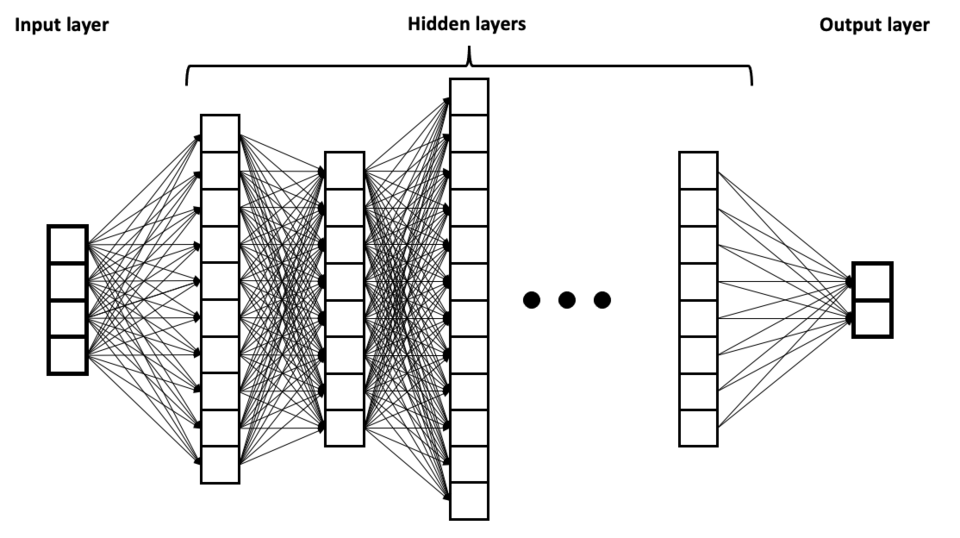 A 3-layer perceptron: input, hidden, and output layers. (Image: BrunelloN, CC BY-SA 4.0, via Wikimedia Commons)
4. Cloud Computing: On-Demand Resources
Cloud delivers computing services (servers, storage, apps) over the internet via virtualization. Service models:
- IaaS: Infrastructure (e.g., AWS EC2, Google Compute Engine).
- PaaS: Platform (e.g., Heroku, Google App Engine).
- SaaS: Software (e.g., Gmail, Microsoft 365).
How Cloud Works: Deploying a Website
sequenceDiagram
    participant User as Developer
    participant AWS as AWS Cloud
    participant DB as RDS Database

    User->>AWS: "Deploy App (GitHub → AWS CodePipeline)"
    AWS->>AWS: "Spin Up EC2 Instance (Ubuntu)"
    AWS->>DB: "Initialize RDS (PostgreSQL)"
    User->>AWS: "Configure Load Balancer"
    AWS-->>User: "Website Live (https://example.com)"
Cloud in Nepal
- eSewa: Hosts its payment gateway on AWS for scalability during Diwali sales.
- Nepal Police: Uses Google Cloud for crime data analytics to predict hotspots.
- Freelancers: Use Heroku (PaaS) to deploy portfolios without managing servers.
Cloud vs. On-Premises
| Aspect | Cloud | On-Premises |
|---|---|---|
| Cost | Pay-as-you-go | High upfront (servers, maintenance) |
| Scalability | Auto-scaling (seconds) | Manual upgrades (weeks) |
| Maintenance | Provider’s responsibility | IT team required |
| Security | Shared responsibility model | Full control (but risk of breaches) |
5. 5G: The Backbone of Next-Gen Connectivity
5G offers 100x faster speeds, 1ms latency, and 1M devices/km² via:
- Millimeter Wave (mmWave): High-frequency signals for gigabit speeds.
- Network Slicing: Custom "virtual networks" (e.g., one slice for IoT, another for AR).
- Edge Computing: Processes data closer to users (reduces lag).
5G Use Cases in Nepal
- Ncell: Tests 5G for remote healthcare (doctors in Kathmandu monitor patients in rural areas via telemedicine).
- NTC: Plans 5G for smart cities (traffic lights, waste management sensors).
- Pathao/Daraz: Uses ultra-low latency for real-time delivery tracking.
5G vs. 4G
| Feature | 4G | 5G |
|---|---|---|
| Speed | 10–100 Mbps | 1–10 Gbps |
| Latency | 30–50 ms | 1 ms |
| Frequency | Sub-6 GHz | Sub-6 GHz + mmWave (24 GHz+) |
| Use Case | Streaming, social media | AR/VR, autonomous vehicles, IoT |
6. Emerging Cybersecurity Trends
As technology evolves, so do threats. Key trends:
- Zero Trust: "Never trust, always verify" (e.g., Google BeyondCorp).
- Quantum Computing: Threatens RSA encryption; post-quantum cryptography (e.g., lattice-based schemes) is being developed.
- AI in Security: Detects anomalies (e.g., Darktrace) or generates phishing emails for training.
- Biometric Authentication: Fingerprint/face recognition (e.g., iPhone X).
Cybersecurity in Nepal
- Nepal Police: Trains officers on phishing awareness (common in eSewa/Khalti scams).
- Banks (NMB, Global IME): Use AI fraud detection to flag unusual transactions (e.g., sudden large withdrawals).
- NTC: Secures SCADA systems (critical for power grid) against cyberattacks.
In the Real World
Khalti’s Blockchain Pilot
- Idea: Uses blockchain to log every transaction in a tamper-proof ledger.
- How: When you send NPR 500 to a friend, the transaction is hashed and added to a block. Both parties see the same record—no dispute possible.
- Impact: Reduces chargeback fraud (common in P2P transfers).
Pathao’s IoT + AI Route Optimization
- Idea: Combines GPS IoT sensors in delivery bikes with AI traffic prediction.
- How: The app analyzes real-time traffic data (from NTC’s smart sensors) and rider behavior to reroute deliveries. If a bike is stolen, its GPS triggers an alert.
- Impact: 30% faster deliveries in Kathmandu traffic.
Ncell’s 5G + AI for Remote Healthcare
- Idea: Partners with CIET to let rural clinics use 5G-enabled AR for doctor consultations.
- How: A nurse in Dhankuta streams a patient’s vitals (via IoT wearables) to a specialist in Kathmandu. The specialist uses AI-assisted diagnostics (e.g., analyzing X-rays via cloud-based models).
- Impact: Reduces patient travel time by 80%.
Exam Tip
This unit tests conceptual understanding + applications. Focus on:
- Definitions: Know the core ideas (e.g., "Blockchain is a decentralized ledger with cryptographic hashing").
- Diagrams: Draw IoT architectures, blockchain transaction flows, or cloud service models in exams.
- Real-World Links: Connect theories to Nepalese examples (e.g., "Khalti uses blockchain for secure P2P payments").
- Pros/Cons Tables: Compare 5G vs. 4G, cloud vs. on-premises, or PoW vs. PoS.
- Short-Answer Tricks:
- For IoT, mention sensors + cloud + edge computing.
- For blockchain, highlight decentralization + immutability + smart contracts.
- For AI, explain training data → model → prediction with an example (e.g., "Khalti’s fraud detection model").
Past Exam Question Analysis:
"Explain blockchain and its applications." Model Answer Structure:
- Definition: "Blockchain is a distributed ledger where transactions are recorded in cryptographically linked blocks."
- How It Works: Briefly describe hashing, consensus (PoW/PoS), and decentralization.
- Applications:
- IT: Cryptocurrencies (Bitcoin), smart contracts (Ethereum).
- Other Fields:
- Supply Chain: Walmart uses blockchain to track food from farm to shelf.
- Voting: Estonia’s e-voting system prevents tampering.
- Healthcare: Nepal’s CIET could use blockchain for patient records (secure and portable).
- Limitations: Scalability (Bitcoin’s slow transactions), energy use (PoW), regulatory hurdles.
Visual Summary:
mindmap
  root((Emerging Technologies))
    IoT
      Sensors & Actuators
      Protocols (MQTT, LoRaWAN)
      Edge Computing
      Example: eSewa Smart Meters
    Blockchain
      Decentralized Ledger
      Consensus (PoW/PoS)
      Smart Contracts
      Example: Khalti P2P Payments
    AI/ML
      Supervised/Unsupervised Learning
      Neural Networks
      Example: Ncell Chatbots
    Cloud Computing
      IaaS/PaaS/SaaS
      Virtualization
      Example: Daraz on AWS
    5G
      mmWave & Network Slicing
      Ultra-Low Latency
      Example: NTC Smart Cities
    Cybersecurity
      Zero Trust
      Quantum Resistance
      AI Threat Detection
      Example: NMB Fraud Alerts
Based on the TU BCA syllabus for Computer Fundamentals and Applications (BCA101), unit 9.
Discussion
Loading…