Financial AccountingUnit 1014 min read
Sales & Purchase Transactions: Records, Journals & Control Accounts
Unit 10 of Financial Accounting covers how businesses record sales and purchases—cash vs. credit transactions, journal entries, control accounts, and reconciliation—with real-world examples from Nepali companies like Daraz, Ncell, and local retailers.
TAKEAWAYS:
- Sales/purchase transactions are recorded in journals (Sales/Purchase Day Book) before posting to ledgers, ensuring accuracy and traceability.
- Cash vs. credit transactions differ in timing (immediate vs. deferred payment) and journal treatment (e.g., "Cash A/c Dr" vs. "Debtors A/c Dr").
- Control accounts (Sales Ledger Control, Purchase Ledger Control) summarize individual customer/supplier balances for efficiency.
- Discounts (trade vs. cash) affect profit margins and are recorded separately in discount accounts.
- Returns (sales/purchase) are contra entries that reduce revenue/expenses and require reversal entries.
- Bank reconciliation for sales/purchase transactions resolves discrepancies between books and bank statements (e.g., unpresented cheques, bank charges).
1. Definitions and Classification
Sales and purchase transactions are the core revenue-generating and cost-incurring activities of a business. They can be classified into two types based on payment timing:
Types of Transactions
classDiagram
    class Transaction {
        +Type: Cash/Credit
        +Direction: Sales/Purchases
        +Journal: Day Book or General Journal
    }
    class CashTransaction {
        +Payment: Immediate
        +Journal Entry: Debit Cash A/c
    }
    class CreditTransaction {
        +Payment: Deferred (e.g., 30/60 days)
        +Journal Entry: Debit Debtors/Creditors A/c
    }
    Transaction <|-- CashTransaction
    Transaction <|-- CreditTransaction
Key Terms:
- Sales Transaction: Transfer of goods/services to customers for revenue. Example: Daraz selling a laptop to a customer in Kathmandu.
- Purchase Transaction: Acquisition of goods/services for resale or business use. Example: A local grocery store buying rice from a wholesaler.
- Cash Transaction: Payment/receipt is immediate (e.g., cash, cheque, digital payment via Khalti/eSewa).
- Credit Transaction: Payment/receipt is deferred (e.g., "30 days credit" from a supplier).
2. Recording Sales Transactions
Sales transactions are recorded in the Sales Day Book (for credit sales) or Cash Book (for cash sales). Below is the journal treatment for both:
A. Cash Sales
When goods are sold for cash (e.g., a street vendor selling samosas):
| Date       | Particulars                     | L.F. | Dr (Rs.) | Cr (Rs.) |
|------------|----------------------------------|------|----------|----------|
| 2079/Chaitra/1 | Cash A/c                          |      | 50,000   |          |
|            |   To Sales A/c                   |      |          | 50,000   |
|            |   (Cash sales of Rs. 50,000)      |      |          |          |
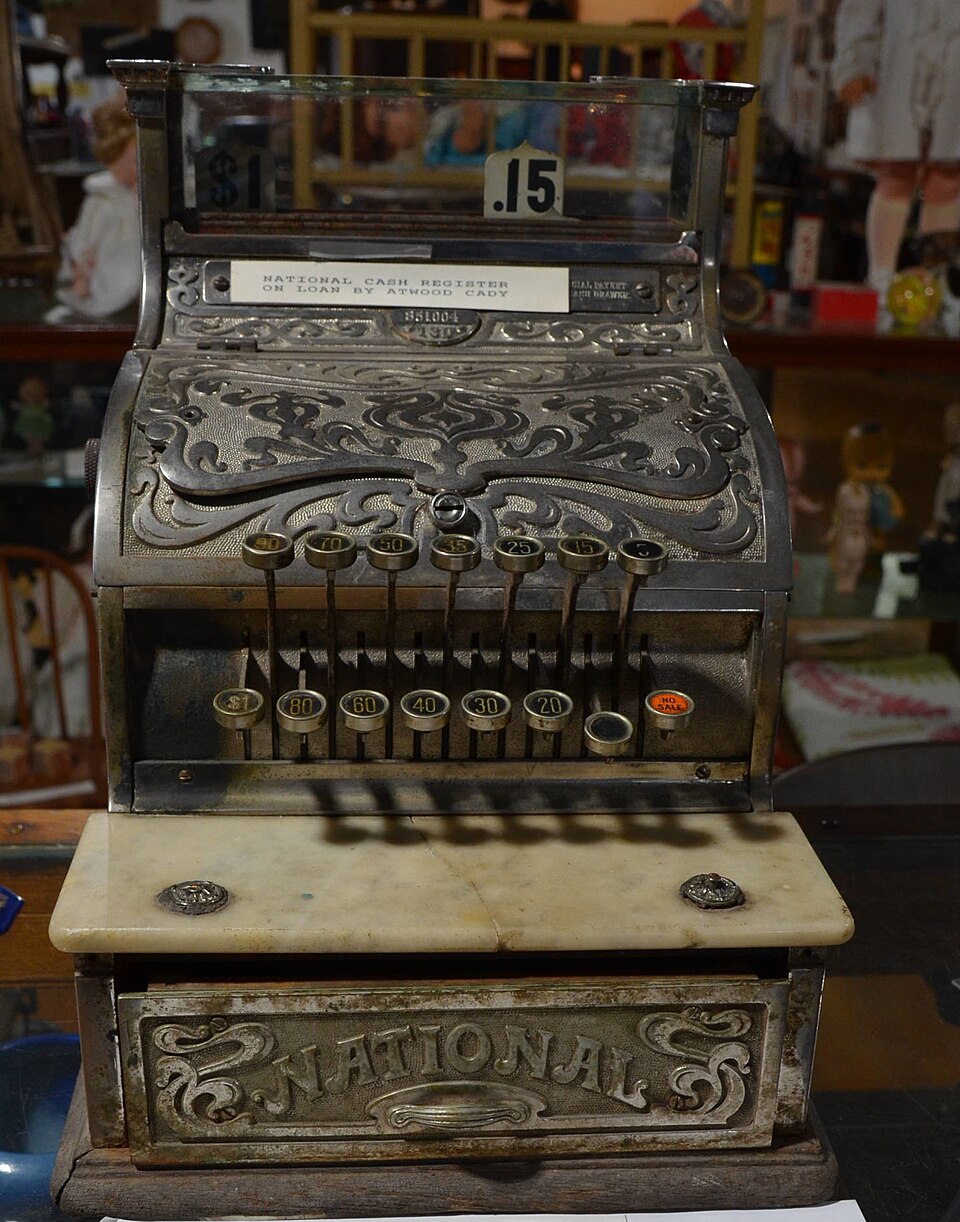 A typical POS system used in Nepali shops like BigMart. (Image: Public domain, via Wikimedia Commons)
B. Credit Sales
When goods are sold on credit (e.g., a retailer selling to a wholesaler):
| Date       | Particulars                     | L.F. | Dr (Rs.) | Cr (Rs.) |
|------------|----------------------------------|------|----------|----------|
| 2079/Chaitra/1 | Debtors A/c (Gurung Store)      |      | 300,000  |          |
|            |   To Sales A/c                   |      |          | 300,000  |
|            |   (Credit sales to Gurung Store) |      |          |          |
C. Sales Returns (Contra Entry)
If a customer returns goods (e.g., a defective fan sold to Saru Brothers):
| Date       | Particulars                     | L.F. | Dr (Rs.) | Cr (Rs.) |
|------------|----------------------------------|------|----------|----------|
| 2079/Chaitra/10 | Sales Returns A/c               |      | 15,000   |          |
|            |   To Debtors A/c (Saru Brothers) |      |          | 15,000   |
|            |   (Goods returned by Saru Brothers) |      |          |          |
3. Recording Purchase Transactions
Purchases are recorded in the Purchase Day Book (for credit purchases) or Cash Book (for cash purchases).
A. Cash Purchases
Example: A shopkeeper buys inventory for cash:
| Date       | Particulars                     | L.F. | Dr (Rs.) | Cr (Rs.) |
|------------|----------------------------------|------|----------|----------|
| 2079/Chaitra/5 | Purchases A/c                    |      | 40,000   |          |
|            |   To Cash A/c                    |      |          | 40,000   |
|            |   (Cash purchase of goods)      |      |          |          |
B. Credit Purchases
Example: A retailer buys goods from a supplier on credit:
| Date       | Particulars                     | L.F. | Dr (Rs.) | Cr (Rs.) |
|------------|----------------------------------|------|----------|----------|
| 2079/Chaitra/3 | Creditors A/c (Nepal Wholesalers)|      | 80,000   |          |
|            |   To Purchases A/c               |      |          | 80,000   |
|            |   (Credit purchase from Nepal Wholesalers) |      |          |          |
C. Purchase Returns
If goods are returned to the supplier (e.g., damaged inventory):
| Date       | Particulars                     | L.F. | Dr (Rs.) | Cr (Rs.) |
|------------|----------------------------------|------|----------|----------|
| 2079/Chaitra/8 | Creditors A/c (Nepal Wholesalers)|      |          | 5,000    |
|            |   To Purchase Returns A/c        |      | 5,000    |          |
|            |   (Goods returned to supplier)   |      |          |          |
4. Discounts in Sales/Purchase Transactions
Discounts reduce the final amount payable/receivable. There are two types:
A. Trade Discount (Not Recorded in Books)
- Given for bulk purchases (e.g., 10% off for buying 100 units).
- Not journalized; only the net amount is recorded. Example: Buying 100 fans at Rs. 1,500 each with a 10% trade discount. Amount recorded: Rs. 1,500 × 90 = Rs. 1,350 per fan.
B. Cash Discount (Recorded in Books)
- Given for early payment (e.g., "2/10, net 30" = 2% discount if paid within 10 days).
- Recorded in Discount Allowed A/c (for sales) or Discount Received A/c (for purchases).
Example: Cash Discount Allowed
| Date       | Particulars                     | L.F. | Dr (Rs.) | Cr (Rs.) |
|------------|----------------------------------|------|----------|----------|
| 2079/Chaitra/15 | Debtors A/c (Gurung Store)      |      | 2,000    |          |
|            |   To Discount Allowed A/c        |      |          | 2,000    |
|            |   (Discount allowed for early payment) |      |          |          |
5. Control Accounts for Sales and Purchases
Control accounts summarize all individual customer/supplier balances in a single account. This avoids posting to every ledger individually.
A. Sales Ledger Control Account
Records all credit sales, returns, and cash receipts from debtors. Example for a Kathmandu Retail Shop (NPR):
| Particulars                          | Dr (Rs.) | Cr (Rs.) |
|--------------------------------------|----------|----------|
| **Opening Balance (Debtors)**        |          | 50,000   |
| **Sales to Gurung Store**            | 300,000  |          |
| **Sales Returns**                    |          | 15,000   |
| **Cash Received from Debtors**      |          | 250,000  |
| **Closing Balance**                   | 95,000   |          |
| **Total**                            | **395,000** | **315,000** |
B. Purchase Ledger Control Account
Records all credit purchases, returns, and cash payments to creditors. Example:
| Particulars                          | Dr (Rs.) | Cr (Rs.) |
|--------------------------------------|----------|----------|
| **Opening Balance (Creditors)**      | 40,000   |          |
| **Purchases from Nepal Wholesalers** |          | 80,000   |
| **Purchase Returns**                 | 5,000    |          |
| **Cash Paid to Creditors**           |          | 60,000   |
| **Closing Balance**                   | 25,000   |          |
| **Total**                            | **65,000** | **140,000** |
6. Bank Reconciliation for Sales/Purchase Transactions
Discrepancies arise due to:
- Unpresented cheques (cheques issued but not yet cleared by the bank).
- Bank charges (e.g., Ncell deducting transaction fees).
- Direct deposits (e.g., a customer paying via Khalti, which the bank records but the business’s cash book misses).
Example Reconciliation Statement (NPR): Assume:
- Cash Book Balance (Dr): Rs. 200,000
- Bank Statement Balance (Cr): Rs. 180,000
- Unpresented Cheques: Rs. 10,000
- Direct Deposit (Khalti): Rs. 5,000
**Bank Reconciliation Statement**
**As on: 2079/Chaitra/31**

| Particulars                          | Amount (Rs.) |
|--------------------------------------|--------------|
| **Cash Book Balance**                | 200,000      |
| **Less: Unpresented Cheques**       | (10,000)     |
| **Add: Direct Deposit (Khalti)**    | 5,000        |
| **Bank Statement Balance**           | **195,000**  |
Note: The bank statement shows Rs. 180,000, but after adjustments, the correct balance is Rs. 195,000.
7. Worked Example: Full Cycle for a Nepali Business
Scenario: Kathmandu Electronics sells electronic goods. Record the following transactions for Chaitra 2079:
- Started business with cash: Rs. 500,000.
- Purchased goods on credit from Nepal Electronics: Rs. 300,000.
- Sold goods to Gurung Store on credit: Rs. 400,000.
- Received cash from Gurung Store: Rs. 300,000.
- Paid cash to Nepal Electronics: Rs. 200,000.
- Goods returned by Gurung Store: Rs. 20,000.
- Cash discount allowed to Gurung Store: Rs. 5,000.
Journal Entries
| Date       | Particulars                     | L.F. | Dr (Rs.) | Cr (Rs.) |
|------------|----------------------------------|------|----------|----------|
| Chaitra/1  | Cash A/c                         |      | 500,000  |          |
|            |   To Capital A/c                 |      |          | 500,000  |
| Chaitra/2  | Purchases A/c                    |      | 300,000  |          |
|            |   To Creditors A/c               |      |          | 300,000  |
| Chaitra/3  | Debtors A/c (Gurung Store)       |      | 400,000  |          |
|            |   To Sales A/c                   |      |          | 400,000  |
| Chaitra/4  | Cash A/c                         |      | 300,000  |          |
|            |   To Debtors A/c (Gurung Store)  |      |          | 300,000  |
| Chaitra/5  | Creditors A/c (Nepal Electronics)|      | 200,000  |          |
|            |   To Cash A/c                    |      |          | 200,000  |
| Chaitra/6  | Sales Returns A/c                |      | 20,000   |          |
|            |   To Debtors A/c (Gurung Store)  |      |          | 20,000   |
| Chaitra/7  | Debtors A/c (Gurung Store)       |      | 5,000    |          |
|            |   To Discount Allowed A/c        |      |          | 5,000    |
Ledger Postings (T-Accounts)
**Debtors A/c (Gurung Store)**
| Date       | Particulars                     | Dr (Rs.) | Cr (Rs.) |
|------------|----------------------------------|----------|----------|
| Chaitra/3  | To Sales A/c                     | 400,000  |          |
| Chaitra/4  | By Cash A/c                      |          | 300,000  |
| Chaitra/6  | By Sales Returns A/c             |          | 20,000   |
| Chaitra/7  | By Discount Allowed A/c          |          | 5,000    |
| **Balance**|                                 | **75,000** |          |

**Creditors A/c (Nepal Electronics)**
| Date       | Particulars                     | Dr (Rs.) | Cr (Rs.) |
|------------|----------------------------------|----------|----------|
| Chaitra/2  | To Purchases A/c                 |          | 300,000  |
| Chaitra/5  | By Cash A/c                      | 200,000  |          |
| **Balance**|                                 |          | **100,000** |
## In the Real World
Daraz (Nepal’s Amazon)
- Idea Used: Credit Sales and Discounts
- How: Daraz offers "cash on delivery" (credit sales) and discounts for bulk orders (e.g., "Buy 2, Get 10% Off"). The platform records these in its Sales Ledger Control Account to track outstanding payments and apply discounts automatically.
Ncell (Telecom Provider)
- Idea Used: Purchase Returns and Bank Reconciliation
- How: When a customer returns a defective phone, Ncell processes a purchase return entry to adjust inventory and refund the customer. The bank reconciliation ensures that refunds via Khalti/eSewa match the company’s records.
Local Grocery Stores (e.g., BigMart, Reliance)
- Idea Used: Cash vs. Credit Transactions
- How: Stores like BigMart use cash sales for walk-in customers and credit sales for wholesale buyers (e.g., small shops). The Sales Day Book tracks credit sales, while the Cash Book records immediate payments.
Khalti/eSewa (Digital Payments)
- Idea Used: Bank Reconciliation for Direct Deposits
- How: When a customer pays via Khalti, the amount is directly deposited into the business’s bank account. The business must reconcile this with its Cash Book to avoid discrepancies (e.g., unrecorded transactions).
## Exam Tip
Always match the question type:
- For journal entries, use the correct accounts (e.g., "Debtors A/c" for credit sales, not "Cash A/c").
- For ledger postings, show debit and credit sides clearly with balances.
Discounts are tricky:
- Trade discount = not recorded (only net amount is used).
- Cash discount = recorded in a separate account (Discount Allowed/Received).
Control accounts save time:
- In exams, if asked to prepare a Sales Ledger Control Account, list:
- Opening balance
- Total sales
- Sales returns
- Cash received
- Closing balance.
- In exams, if asked to prepare a Sales Ledger Control Account, list:
Bank reconciliation is common:
- Always adjust for:
- Unpresented cheques (subtract from cash book balance).
- Direct deposits (add to cash book balance).
- Bank charges (subtract from bank statement balance).
- Always adjust for:
Real-world examples score extra marks:
- Relate answers to Nepali businesses (e.g., "Like Daraz’s bulk discounts" or "Similar to a local shop’s credit sales").
Trace the full cycle:
- Start with journal entries, then ledger postings, and finally control accounts. Examiners check if you link all steps.
flowchart TD
    A["Sales/Purchase Transaction"] --> B{"Cash or Credit?"}
    B -->|"Cash"| C["Record in Cash Book"]
    B -->|"Credit"| D["Record in Sales/Purchase Day Book"]
    C --> E["Post to Ledger"]
    D --> E
    E --> F["Prepare Control Account"]
    F --> G["Reconcile with Bank Statement"]
    G --> H["Final Accounts"]
Based on the TU BCA syllabus for Financial Accounting (CAAC152), unit 10.
Discussion
Loading…