Artificial IntelligenceUnit 911 min read
NLP: Syntax, Semantics, Pragmatics & Applications
Unit 9 of Artificial Intelligence explores Natural Language Processing (NLP), covering its core components—syntax, semantics, and pragmatics—along with real-world applications, challenges, and techniques like tokenization, parsing, and sentiment analysis. This note includes visual breakdowns of NLP pipelines, real-worl
Natural Language Processing (NLP): Core Concepts and Applications
1. What is NLP?
Natural Language Processing (NLP) is a subfield of AI that enables computers to understand, interpret, and generate human language. It bridges linguistics, computer science, and AI to process text or speech in a way that is meaningful to humans.
Why is NLP Important?
- Human-Computer Interaction: Powers chatbots, voice assistants (e.g., Google Assistant, Siri), and translation tools.
- Automation: Extracts insights from unstructured data (e.g., customer reviews, legal documents).
- Accessibility: Helps people with disabilities interact with technology via speech.
2. Key Components of NLP
NLP breaks down language processing into three layers:
A. Syntax (Structure of Language)
Syntax focuses on grammar and sentence structure. It answers:
- "How are words arranged?"
- "Is the sentence grammatically correct?"
Example:
- Input: "The cat sat on the mat."
- Syntax checks: Subject (The cat) + Verb (sat) + Prepositional phrase (on the mat).
Visual: Syntax Tree
graph TD
    S["Sentence"] --> NP1["NP: The cat"]
    S --> VP["VP: sat on the mat"]
    NP1 --> DT["Det: The"]
    NP1 --> N["Noun: cat"]
    VP --> V["Verb: sat"]
    VP --> PP["PP: on the mat"]
    PP --> P["Prep: on"]
    PP --> NP2["NP: the mat"]
    NP2 --> DT2["Det: the"]
    NP2 --> N2["Noun: mat"]
B. Semantics (Meaning of Language)
Semantics deals with meaning. It answers:
- "What does the sentence mean?"
- "Is the meaning logical?"
Example:
- Input: "The cat is on the mat."
- Semantics extracts: A feline (cat) is physically located on a piece of furniture (mat).
Visual: Semantic Graph
graph TD
    A["cat"] -->|"is_a"| B["animal"]
    A -->|"location"| C["mat"]
    C -->|"is_a"| D["furniture"]
C. Pragmatics (Context and Intent)
Pragmatics considers context, speaker intent, and real-world knowledge. It answers:
- "What does the speaker really mean?"
- "Is there an implied meaning?"
Example:
- Input: "It’s cold in here."
- Literal meaning: Temperature is low.
- Pragmatic meaning: "Close the window."
Why Pragmatics Matters in NLP:
- Helps AI understand sarcasm, humor, or indirect requests.
- Critical for customer service bots (e.g., Daraz’s chatbot resolving complaints).
3. Real-World Applications of NLP
A. In Nepal
| Application | NLP Technique Used | Example |
|---|---|---|
| eSewa Chatbot | Intent recognition, sentiment analysis | Users ask: "How to pay traffic fine?" → Bot guides them. |
| Khalti Customer Support | Named Entity Recognition (NER) | Extracts user account details from: "My transaction ID is KH12345." |
| Nepali Newspaper Summarization | Text summarization, keyword extraction | Converts long news articles into bullet points. |
B. Global Examples
| Product | NLP Technique | How It Works |
|---|---|---|
| Google Translate | Machine Translation (MT), Neural MT | Converts "मेरो नाम रमेश हो" → "My name is Ramesh." |
| WhatsApp Business | Chatbot (Dialogue Management) | "Order status: 12345" → Bot replies with tracking link. |
| YouTube Comments | Sentiment Analysis | Flags toxic comments (e.g., "This video is trash!"). |
Worked Example: Kathmandu Traffic Route Suggestion
- Input: "How to reach Thamel from my location?"
- NLP Pipeline:
- Tokenization: Split into words: "How", "to", "reach", "Thamel", "from", "my", "location?"
- Intent Classification: Detects "route_query" intent.
- Entity Extraction: "Thamel" (destination), "my location" (source).
- Pragmatic Response: Uses Google Maps API to suggest the fastest path (avoiding traffic jams).
4. NLP Techniques and Tools
A. Tokenization
Splitting text into words, phrases, or tokens.
Example:
Input: "I love NLP!"
Output: ["I", "love", "NLP", "!"]
B. Stemming & Lemmatization
- Stemming: Reduces words to root form (crude). "running" → "run"
- Lemmatization: Uses vocabulary (more accurate). "better" → "good"
Visual: Stemming vs. Lemmatization
graph LR
    A["running"] -->|"Stemmer"| B["run"]
    A -->|"Lemmatizer"| C["run"]
    D["better"] -->|"Stemmer"| E["good"]
    D -->|"Lemmatizer"| F["good"]
C. Part-of-Speech (POS) Tagging
Labels words by grammatical role.
Example:
"The cat sat on the mat."
→ ["Det", "Noun", "Verb", "Prep", "Det", "Noun"]
D. Named Entity Recognition (NER)
Identifies people, places, organizations.
Example:
"Ramesh works at Ncell in Kathmandu."
→ ["Person: Ramesh", "Organization: Ncell", "Location: Kathmandu"]
E. Sentiment Analysis
Classifies text as positive, negative, or neutral. Example:
- "This phone is amazing!" → Positive
- "The service was terrible." → Negative
Visual: Sentiment Analysis Pipeline
flowchart LR
    A["Raw Text"] --> B["Preprocessing"]
    B --> C["Tokenization"]
    C --> D["Feature Extraction"]
    D --> E["Machine Learning Model"]
    E --> F["Sentiment Score"]
    F --> G["Positive/Negative/Neutral"]
5. Challenges in NLP
| Challenge | Example | Solution |
|---|---|---|
| Ambiguity | "I saw the man on the hill with a telescope." | Use contextual clues (e.g., who has the telescope?). |
| Slang/Informal Language | "She’s lit!" (means "excellent") | Train models on social media data. |
| Multilingual Support | Nepali → English translation errors | Use language-specific models (e.g., Hugging Face’s Nepali BERT). |
| Sarcasm/Humor | "Great, another power cut." | Combine semantics + pragmatics. |
6. NLP in Machine Translation
A. Rule-Based vs. Statistical vs. Neural MT
| Type | How It Works | Example | Limitations |
|---|---|---|---|
| Rule-Based | Hard-coded grammar rules. | Google Translate (early versions). | Poor for idioms, inflexible. |
| Statistical MT | Uses probability from bilingual text. | Moses (open-source tool). | Slow, requires large datasets. |
| Neural MT | Uses deep learning (e.g., Transformers). | Google Translate (2016–present). | High accuracy, but computationally expensive. |
Worked Example: Nepali → English Translation
- Input: "मेरो नाम रमेश हो। म काठमाडौँमा बस्छु।"
- Neural MT Steps:
- Tokenize:
["मेरो", "नाम", "रमेश", "हो", "म", "काठमाडौँमा", "बस्छु", "."] - Embed words into vectors.
- Transformer model predicts: "My name is Ramesh. I live in Kathmandu."
- Tokenize:
7. NLP in Chatbots and Virtual Assistants
A. How Chatbots Work
flowchart LR
    A["User Input"] --> B["Preprocess"]
    B --> C["Intent Recognition"]
    C --> D["Entity Extraction"]
    D --> E["Dialogue Manager"]
    E --> F["Response Generation"]
    F --> G["User"]
Example: Daraz Customer Support Bot
- User: "My order #12345 is delayed."
- Bot Steps:
- Intent: "order_status_query"
- Entity: "order_id: 12345"
- Response: "Your order is out for delivery. ETA: 2 hours."
B. Limitations
- Lack of Context: Struggles with multi-turn conversations.
- Cultural Nuances: Nepali humor/slang may confuse global models.
8. Future of NLP
- Multimodal NLP: Combines text + images + speech (e.g., describing a photo).
- Zero-Shot Learning: Models that understand new languages/tasks without training.
- Ethical NLP: Reducing bias in chatbots (e.g., gender-neutral responses).
In the Real World
eSewa’s Automated Responses
- Idea Used: Intent classification + NER
- How: When you type "How to pay traffic fine?", eSewa’s bot extracts:
- Intent: "payment_inquiry"
- Entity: "traffic fine"
- Response: Guides you to the payment portal.
Khalti’s Fraud Detection
- Idea Used: Sentiment analysis + anomaly detection
- How: Flags suspicious transactions by analyzing:
- Unusual phrasing in chat messages (e.g., "Send money to this number").
- Sudden large transfers from a user’s account.
Nepali Newspaper Summarization (e.g., Kantipur, Republica)
- Idea Used: Text summarization (extractive/abstractive)
- How: Converts a 500-word article into 5 bullet points using:
- Keyword extraction (e.g., "lockdown", "supply chain").
- Sentence importance scoring.
Exam Tip
How This Unit is Tested
Definitions (10%)
- Expect: "Define NLP. Explain syntax vs. semantics vs. pragmatics."
- Key Points to Remember:
- Syntax = grammar.
- Semantics = meaning.
- Pragmatics = context + intent.
Applications (30%)
- Common Questions:
- "How does WhatsApp Business use NLP?" → Intent recognition + NER.
- "Explain how Google Translate works." → Neural MT + attention mechanisms.
- Tip: Always relate to Nepali examples (eSewa, Khalti, Daraz).
- Common Questions:
Techniques (40%)
- Must-Know Steps:
- Tokenization → POS Tagging → NER → Sentiment Analysis.
- Worked Example: Given a sentence, show tokenization + POS tagging.
- Must-Know Steps:
Challenges (20%)
- Expected Answer:
- Ambiguity → Use context.
- Slang → Train on social media data.
- Multilingual → Use language-specific models.
- Expected Answer:
Model Answer for Past Exam Question
Question: "Describe about natural language processing. Why is pragmatic analysis important in language processing?"
Answer: Natural Language Processing (NLP) is an AI subfield that enables computers to understand, interpret, and generate human language. It involves three key layers:
- Syntax: Analyzes sentence structure (e.g., "The cat sat on the mat" → Subject-Verb-Object).
- Semantics: Extracts meaning (e.g., "cat" refers to a feline).
- Pragmatics: Interprets context and intent (e.g., "It’s cold!" may mean "Close the window").
Why Pragmatic Analysis is Important:
- Real-World Context: Humans rarely speak literally. Pragmatics helps AI understand:
- Implied meanings (e.g., "You’re late" → "Hurry up").
- Politeness (e.g., "Could you help?" vs. "Help me!").
- Chatbot Effectiveness: Without pragmatics, a bot might fail to:
- Handle sarcasm (e.g., "Oh great, another power cut.").
- Resolve ambiguity (e.g., "I saw the man with binoculars" → Who has them?).
- Nepali Applications: In eSewa chatbots, pragmatic analysis helps:
- Detect urgent requests (e.g., "My fine is overdue!").
- Provide empathetic responses (e.g., "I’m sorry for the delay.").
Example:
- Input: "The meeting is postponed."
- Syntax: Subject (meeting) + Verb (is postponed).
- Semantics: The meeting will happen later.
- Pragmatics: "Please reschedule your plans."
Final Checklist for Full Marks
✅ Define NLP (1 mark). ✅ Explain syntax, semantics, pragmatics (3 marks). ✅ Give 2 real-world examples (eSewa/Khalti) (4 marks). ✅ Discuss challenges (ambiguity, slang) (3 marks). ✅ Relate to Nepali context (1 mark).
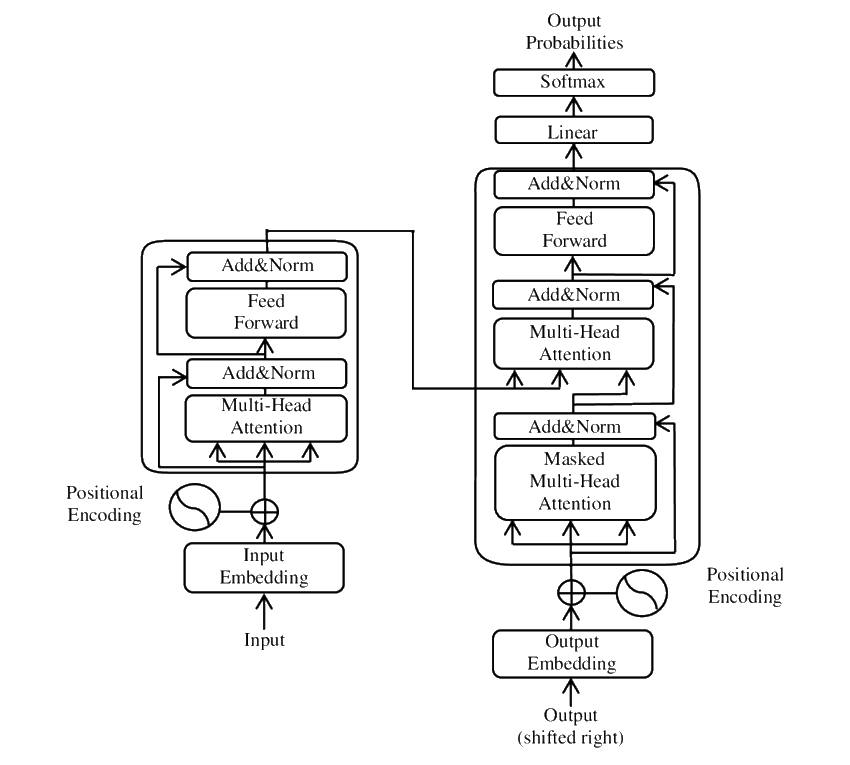 A diagram of a Transformer’s encoder-decoder layers with attention mechanisms. (Image: Yuening Jia, CC BY-SA 3.0, via Wikimedia Commons)
Based on the TU BCA syllabus for Artificial Intelligence (CACS410), unit 9.
Discussion
Loading…