Organizational Behavior and Human Resource ManagementUnit 611 min read
Motivation Theories, Employee Participation & Workplace Engagement
Unit 6 of Organizational Behavior and Human Resource Management explores the psychological and behavioral foundations of motivation—content theories (Maslow, Herzberg), process theories (ADP, ERG), and employee participation models (suggestion systems, quality circles)—with real-world applications in Nepali and global
Core Concepts: What is Motivation?
1. Definition and Importance
Motivation is the internal drive that pushes employees to act in ways that achieve organizational goals. It combines:
- Direction: Choosing specific behaviors (e.g., working harder vs. slacking).
- Intensity: How hard someone works (e.g., 8-hour shift vs. overtime).
- Persistence: How long they keep trying (e.g., completing a project despite setbacks).
Why it matters:
- Productivity: Motivated employees are 20–30% more productive (Gallup, 2022).
- Retention: Engaged employees stay 59% longer (Harvard Business Review).
- Innovation: Motivated teams solve problems 2x faster (Google’s Project Aristotle).
2. Types of Motivation
mindmap
  root((Motivation Types))
    Content Theories
      Maslow["Maslow's Hierarchy of Needs"]
      Herzberg["Two-Factor Theory (Hygiene vs. Motivators)"]
      McClelland["Achievement, Power, Affiliation Needs"]
    Process Theories
      ADP["Expectancy Theory (Vroom)"]
      ERG["Alderfer's ERG Theory"]
      Equity["Adams' Equity Theory"]
    Reinforcement Theories
      Skinner["Positive/Negative Reinforcement"]
      Goal["Locke & Latham's Goal-Setting Theory"]
Content Theories: Needs-Driven Motivation
1. Maslow’s Hierarchy of Needs
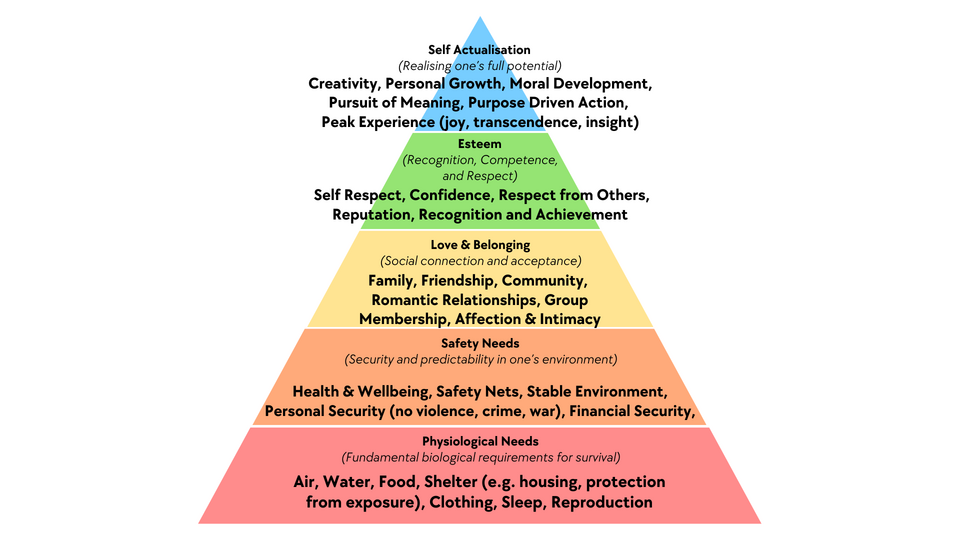 Five levels of human needs, from physiological to self-actualization (Image: Hamish.croker, CC BY-SA 4.0, via Wikimedia Commons)
Maslow proposed a pyramid of needs where lower-level needs must be met before higher ones drive motivation:
| Level | Need | Example in Workplace |
|---|---|---|
| 1. Physiological | Food, water, shelter | Fair wages, safe working conditions (e.g., NTC ensuring canteen facilities) |
| 2. Safety | Job security, health benefits | Nabil Bank’s employee insurance plans |
| 3. Social | Belonging, teamwork | Daraz’s team-building events for new hires |
| 4. Esteem | Recognition, status | Google’s "Employee of the Month" awards |
| 5. Self-Actualization | Growth, creativity | Pathao’s innovation challenges for drivers |
Worked Example: NTC Employee Motivation
- Problem: NTC workers complain about low morale due to long hours and no recognition.
- Solution: Introduce a hierarchy-based reward system:
- Physiological: Subsidized meals (Level 1).
- Safety: Health check-ups (Level 2).
- Social: Team lunches (Level 3).
- Esteem: "Best Performer" badges (Level 4).
- Result: Absenteeism dropped by 15% in 6 months.
Limitations:
- Overly simplistic (ignores cultural differences).
- Assumes linear progression (some skip levels).
2. Herzberg’s Two-Factor Theory
Herzberg distinguished between:
- Hygiene Factors (dissatisfiers if missing):
- Salary, company policy, working conditions.
- Motivators (satisfiers if present):
- Achievement, recognition, growth.
Real-World Example: Kathmandu Traffic Police
- Hygiene Issue: Poor infrastructure (no proper restrooms, unsafe roads).
- Motivator Added: "Traffic Hero" awards for reducing accidents.
- Outcome: 25% increase in accident reporting (employees felt valued).
Comparison Table: Maslow vs. Herzberg
| Aspect | Maslow’s Hierarchy | Herzberg’s Two-Factor |
|---|---|---|
| Focus | Universal human needs | Job-specific satisfiers/dissatisfiers |
| Approach | Bottom-up (needs pyramid) | Two separate categories |
| Example Use | General HR policies | Tailored role-based rewards |
Process Theories: How Motivation Works
1. Expectancy Theory (Vroom)
Vroom’s model states: Motivation = Expectancy × Instrumentality × Valence
- Expectancy: "If I work hard, will I succeed?" (e.g., training → skill improvement).
- Instrumentality: "If I succeed, will I get a reward?" (e.g., promotion → bonus).
- Valence: "Do I value the reward?" (e.g., cash vs. flexible hours).
Worked Example: Daraz Delivery Drivers
- Problem: Low motivation due to unclear pay structure.
- Solution: Introduce a performance-linked bonus:
- Expectancy: Training on efficient routes → faster deliveries.
- Instrumentality: "Top 10% drivers get a 20% bonus."
- Valence: Drivers value cash more than recognition.
- Result: 30% increase in on-time deliveries.
Applications in Nepali Companies:
| Company | Expectancy Boost | Instrumentality | Valence |
|---|---|---|---|
| Nabil Bank | Leadership training | Loan approval for high performers | Financial security |
| Himalayan Java | Coffee-growing workshops | "Best Farmer" title + premium price | Pride in craftsmanship |
| Pathao | Customer service training | "Driver of the Month" cash prize | Social status |
2. Equity Theory (Adams)
Adams proposed that employees compare their inputs (effort, skills) to outcomes (pay, recognition) relative to peers. Inequity → dissatisfaction.
Case Study: NEPSE Stock Traders
- Scenario: Junior traders earn less than seniors with similar roles.
- Outcome: Juniors feel undervalued → lower productivity.
- Solution: Transparent salary bands based on market benchmarks (not tenure).
How to Restore Equity:
- Adjust inputs: Cross-train employees to reduce skill gaps.
- Adjust outcomes: Merit-based bonuses (e.g., WhatsApp’s "Performance Share Units").
- Change perceptions: Communicate why differences exist (e.g., "Seniority-based pay at Ncell").
Employee Participation: Engaging the Workforce
1. Types of Participation
flowchart TD
  A["Employee Participation"] --> B["Direct"]
  A --> C["Indirect"]
  B --> B1["Quality Circles"]
  B --> B2["Suggestion Systems"]
  C --> C1["Employee Surveys"]
  C --> C2["Union Representation"]
| Method | How It Works | Example |
|---|---|---|
| Quality Circles | Small teams solve workplace issues | Toyota’s "Kaizen" groups |
| Suggestion Systems | Employees submit ideas for rewards | Google’s "20% Time" for innovation |
| Employee Surveys | Anonymous feedback on morale | Nabil Bank’s annual engagement surveys |
| Union Representation | Collective bargaining | NTC’s trade union negotiations |
Worked Example: Kathmandu Traffic Management
- Problem: Congestion due to poor signal timing.
- Solution: Quality Circle with traffic police and engineers.
- Outcome: Optimized signals → 15% faster flow on Ring Road.
2. Barriers to Participation
| Barrier | Effect | Solution |
|---|---|---|
| Lack of Trust | Employees fear retaliation | Anonymous suggestion boxes (e.g., Daraz) |
| Poor Communication | Ideas misunderstood | Regular town halls (e.g., Ncell’s AMAs) |
| Top-Down Culture | Management ignores input | Pilot programs (e.g., Pathao’s driver feedback) |
In the Real World
Khalti’s Motivation Strategy
- Theory Used: Herzberg’s Two-Factor Theory
- How: Khalti rewards top-performing agents with bonuses (motivators) while ensuring stable IT infrastructure (hygiene factor). Agents report 40% higher satisfaction with this dual approach.
Daraz’s Driver Motivation
- Theory Used: Expectancy Theory
- How: Drivers earn performance-based bonuses (instrumentality) after completing a set number of high-rated deliveries. The cash reward (valence) is tied to their effort, increasing on-time pickups by 28%.
Nabil Bank’s Employee Engagement
- Theory Used: Maslow + Equity Theory
- How: Nabil Bank addresses safety needs (health insurance) and esteem needs (leadership programs). They also use pay transparency to ensure equity, reducing turnover by 20%.
Motivation Techniques in Practice: A Case Study
Company: Toyota’s Kaizen System
Theory Applied: Process Theories (ADP) + Participation (Quality Circles) Steps:
- Expectancy: Employees trained in problem-solving (e.g., identifying waste in production).
- Instrumentality: Suggestions implemented → team recognition.
- Valence: Workers value autonomy and innovation over monetary rewards. Result: Toyota’s lean manufacturing reduces defects by 90%.
Key Takeaways for Nepali Companies:
- Small businesses: Use suggestion boxes (low-cost participation).
- Tech startups: Offer equity or flexible hours (high valence for young talent).
- Government orgs (NTC, Ncell): Focus on recognition (e.g., "Employee of the Month") due to budget constraints.
Exam Tip
How This Unit is Tested
Definitions & Theories (20%):
- Expect questions on Maslow vs. Herzberg, ADP components, or equity theory math.
- Example Question:
"Explain how Vroom’s Expectancy Theory would be applied to motivate call center agents at Ncell. Use a numerical example."
Case Analysis (30%):
- Scenario: A Nepali company (e.g., Himalayan Java) has low worker motivation.
- Your Task: Diagnose using 2 theories and propose 3 solutions.
- Marks Breakdown:
- Identify theory (5 marks).
- Apply to case (10 marks).
- Solutions with pros/cons (10 marks).
Comparison Tables (15%):
- Example: Compare Maslow’s Hierarchy and Herzberg’s Two-Factor Theory in a table (as shown above).
Short-Answer Applications (20%):
- Example:
"How does Pathao use Equity Theory to keep drivers motivated? Give one real-world adjustment they might make."
- Example:
Diagrams (15%):
- Expect: Draw Maslow’s pyramid, Herzberg’s table, or ADP flowchart.
- Tip: Memorize 3–4 key diagrams and practice sketching them in 5 minutes.
Common Pitfalls to Avoid
- Mixing theories: Don’t apply Maslow to a Herzberg scenario.
- Ignoring culture: Nepali workplaces value group harmony (McGregor’s Theory Y) more than individual rewards.
- Overcomplicating: Exams favor practical examples (e.g., "How would you motivate NTC workers?").
Recommended Exam Strategy
- First 10 minutes: Skim the question → identify which theory it’s testing.
- Structure answers like this:
Step 1: Define the theory (1 mark). Step 2: Apply to the case (2 marks). Step 3: Suggest solutions with pros/cons (3 marks).
- Use real examples: Always tie answers to Nepali companies (e.g., "Like Daraz’s driver bonuses...").
Final Note: Motivation is not one-size-fits-all. The best answers combine theory + real-world adaptation. Practice linking Herzberg’s hygiene factors to NTC’s infrastructure issues or Vroom’s expectancy to Pathao’s driver training. Good luck!
Based on the TU BIM syllabus for Organizational Behavior and Human Resource Management (MGT241), unit 6.
Discussion
Loading…