Organizational Behavior and Human Resource ManagementUnit 515 min read
Performance Management & Job Satisfaction: Systems, Metrics & Employee Well-being
Unit 5 of Organizational Behavior and Human Resource Management explores how organizations measure, evaluate, and enhance employee performance while ensuring job satisfaction—covering appraisal systems, feedback mechanisms, satisfaction theories, and their impact on productivity and retention.
TAKEAWAYS:
- Performance management is a continuous cycle (not just annual reviews) linking goals, feedback, and development to organizational success.
- Job satisfaction depends on both intrinsic factors (e.g., meaningful work) and extrinsic rewards (e.g., pay, recognition), as shown by Herzberg’s Two-Factor Theory.
- 360-degree feedback and balanced scorecards are modern tools to assess performance holistically beyond just quantitative metrics.
- High job satisfaction correlates with lower turnover (costly for businesses) and higher innovation (e.g., Google’s 20% time policy).
- Nepali companies like Nabil Bank use behaviorally anchored rating scales (BARS) to reduce bias in appraisals, while Daraz ties performance bonuses to sales targets.
- Mismatched expectations (e.g., a call-center agent expecting managerial roles) are a top cause of dissatisfaction—addressed via realistic job previews (RJPs).
1. Performance Management: Definition and Process
Performance management (PM) is a strategic process to align employee goals with organizational objectives through planning, monitoring, evaluating, and developing performance. It is not just annual appraisals but an ongoing dialogue between managers and employees.
Key Components of Performance Management
flowchart TD
    A["Performance Management Cycle"] --> B["1. Goal Setting\n(SMART goals)"]
    B --> C["2. Continuous Feedback\n(Weekly/Monthly check-ins)"]
    C --> D["3. Performance Appraisal\n(Formal evaluation)"]
    D --> E["4. Development Plan\n(Training, mentoring)"]
    E --> F["5. Reward & Recognition\n(Bonuses, promotions)"]
    F -->|"Loop"| A
Why it matters:
- Nepal’s NTC uses PM to track engineers’ project completion rates, linking bonuses to on-time delivery of infrastructure projects (e.g., bus routes in Kathmandu).
- Pathao evaluates driver performance via real-time GPS metrics (e.g., trip completion rate, customer ratings) to identify top performers for incentives.
Types of Performance Appraisal Systems
| System | Description | Example in Nepal | Pros | Cons |
|---|---|---|---|---|
| Graphic Rating Scale | Ranks employees on traits (e.g., "Teamwork: 1-5"). | Used in Nabil Bank for teller evaluations. | Simple, quick. | Subjective, halo effect. |
| Behaviorally Anchored Rating Scale (BARS) | Uses specific behaviors (e.g., "Resolves conflicts by X"). | Himalayan Java for team leaders. | Reduces bias, clear criteria. | Time-consuming to design. |
| 360-Degree Feedback | Feedback from peers, subordinates, and supervisors. | Nepal Investment Bank for mid-level managers. | Holistic view. | Complex, potential for politics. |
| Management by Objectives (MBO) | Sets objectives collaboratively (e.g., "Increase sales by 15%"). | Daraz for sales teams. | Aligns with company goals. | Requires strong goal-setting. |
| Balanced Scorecard | Evaluates financial, customer, internal, and learning metrics. | Nepal Rastra Bank for regulatory compliance. | Balanced view. | Overwhelming data. |
Worked Example: Nabil Bank’s Teller Appraisal
- Graphic Rating Scale: A teller is rated on:
- Accuracy (4/5)
- Customer Service (5/5)
- Speed (3/5)
- Issue: Low speed score → Manager identifies training need in core banking software.
- Outcome: Teller attends a weekly refresher course, speed improves to 4/5, and is nominated for "Customer Service Champion."
2. Job Satisfaction: Theories and Drivers
Job satisfaction is an attitude reflecting how employees feel about their jobs. It influences productivity, absenteeism, and turnover.
Major Theories of Job Satisfaction
Real-World Application: Daraz’s Driver Satisfaction
- Hygiene Factors: Daraz ensures drivers have insurance, fuel subsidies, and safe vehicles (reducing dissatisfaction).
- Motivators: Top drivers get bonuses, early access to new bikes, and recognition on leaderboards (increasing satisfaction).
- Equity Theory: Drivers compare their pay to peers in Pathao/Khatikhas—if Daraz pays less, dissatisfaction rises.
Factors Affecting Job Satisfaction
Case Study: Kathmandu Traffic Police
- Low Satisfaction Drivers:
- Pay: Police constables earn Rs. 35,000–50,000/month (below market for risk level).
- Work Conditions: Long shifts, no proper rest areas, political interference.
- High Satisfaction Drivers:
- Recognition: Awards for "Best Traffic Manager" (e.g., Rs. 50,000 bonus).
- Coworkers: Strong team culture in Metro Police units.
3. Link Between Performance Management and Job Satisfaction
Poor PM leads to dissatisfaction; good PM enhances motivation and engagement.
flowchart LR
    A["Performance Management"] --> B["Clear Goals"]
    B --> C["Fair Appraisals"]
    C --> D["Development Opportunities"]
    D --> E["Recognition & Rewards"]
    E --> F["Job Satisfaction ↑"]
    F --> G["Productivity ↑\nTurnover ↓"]
    G --> H["Organizational Success"]
Example: Google’s 20% Time Policy
- PM Link: Employees spend 20% of time on passion projects (e.g., Gmail, Google Maps).
- Satisfaction Impact: High autonomy → 90% employee satisfaction (vs. industry avg. 70%).
- Outcome: Innovations like Google Drive emerged from this system.
Nepali Example: Chaudhary Group’s "Employee of the Month"
- Process:
- Managers nominate top performers based on sales targets, teamwork, and innovation.
- Winners get cash bonuses (Rs. 20,000–50,000) and public recognition.
- Impact:
- Satisfaction: 78% of employees report higher motivation (internal survey).
- Performance: Sales teams with recognized members outperform by 12% (company data).
4. Challenges in Performance Management and Job Satisfaction
| Challenge | Cause | Solution | Nepali Example |
|---|---|---|---|
| Subjectivity in Appraisals | Managers favor certain employees (e.g., "buddy bias"). | Use BARS or 360-degree feedback. | Nabil Bank trains managers on unbiased scoring. |
| Low Engagement | Employees feel their work is meaningless. | Implement job enrichment (e.g., cross-training). | NTC lets engineers design new bus routes. |
| High Turnover | Dissatisfaction due to poor pay/recognition. | Conduct exit interviews and adjust compensation. | Daraz increased driver pay by 15% → turnover dropped by 20%. |
| Resistance to Feedback | Employees fear criticism or lack trust in managers. | Use constructive feedback models (e.g., SBI: Situation-Behavior-Impact). | Himalayan Java uses "growth conversations" instead of "appraisals." |
| Mismatched Expectations | Hiring for "sales" but promoting based on "loyalty" (not skills). | Provide realistic job previews (RJPs) during hiring. | Nepal Investment Bank clarifies promotion criteria upfront. |
5. Tools and Techniques for Improvement
A. Performance Improvement Tools
| Tool | How It Works | Example |
|---|---|---|
| SMART Goals | Goals are Specific, Measurable, Achievable, Relevant, Time-bound. | Pathao: "Increase trip completions by 25% in 3 months." |
| Balanced Scorecard | Tracks financial, customer, internal, and learning metrics. | Nepal Rastra Bank: Monitors compliance + employee training hours. |
| KPIs (Key Performance Indicators) | Quantifiable metrics (e.g., "Customer complaints per month"). | NTC: "Bus punctuality rate >90%." |
B. Job Satisfaction Enhancement Techniques
| Technique | Application | Nepal Case |
|---|---|---|
| Job Rotation | Employees switch roles to reduce monotony. | Nepal Telecom: Engineers rotate between IT and customer support. |
| Job Enrichment | Adds responsibility (e.g., decision-making authority). | Himalayan Java: Baristas train to manage inventory. |
| Flexible Work Arrangements | Remote work, compressed hours. | F1Soft (IT firm): 4-day workweeks for developers. |
| Employee Recognition Programs | Public praise, awards, or small gifts. | Daraz: "Driver of the Month" with a new helmet. |
6. Case Study: Toyota’s Performance Management System
Why Toyota? Toyota’s Toyota Production System (TPS) links performance management to continuous improvement (Kaizen) and job satisfaction.
flowchart TD
    A["Toyota's PM System"] --> B["1. Goal Setting\n(Team-based, aligned with company vision)"]
    B --> C["2. Daily Stand-ups\n(5-minute team meetings to discuss progress)"]
    C --> D["3. Andon System\n(Employees can stop production lines to flag issues)"]
    D --> E["4. Annual Appraisals\n(Linked to team performance, not just individual)"]
    E --> F["5. Kaizen\n(Continuous improvement suggestions rewarded)"]
    F --> G["High Job Satisfaction\n(Low turnover, high engagement)"]
Key Takeaways for Nepal:
- Team-based goals reduce competition (common in Nepali offices).
- Daily feedback prevents annual appraisal surprises.
- Kaizen culture: Nepal’s Chaudhary Group uses a similar system in warehouses (e.g., suggesting layout improvements).
In the Real World
eSewa’s Performance-Linked Bonuses
- Idea Used: Management by Objectives (MBO)
- How: Customer service agents get bonuses for reducing call resolution time by 10% (from 5 to 4.5 minutes). Agents with top metrics earn Rs. 10,000–30,000 extra/month.
- Impact: 22% faster resolutions and higher employee retention (internal data).
Khalti’s Driver Satisfaction Hack
- Idea Used: Equity Theory + Recognition
- How: Khalti’s delivery partners (e.g., food/delivery drivers) earn tiered pay:
- Bronze: Rs. 300/trip
- Silver: Rs. 350/trip (for 90%+ delivery success)
- Gold: Rs. 400/trip + free Khalti wallet credits
- Result: Gold-tier drivers have 30% lower attrition than Bronze-tier.
Nepal Stock Exchange (NEPSE) Trader Performance
- Idea Used: Balanced Scorecard
- How: Traders are evaluated on:
- Financial: Profitability of trades.
- Customer: Client satisfaction scores.
- Internal: Speed of order execution.
- Learning: Completion of compliance training.
- Outcome: Top 10% traders get priority seating on the trading floor (a high-status perk).
Exam Tip
This unit is heavily tested in TU/PU exams with:
- Definitions: Be ready to explain performance management, job satisfaction, 360-degree feedback, and Herzberg’s Two-Factor Theory in 3–4 sentences.
- Comparisons: Expect tables comparing appraisal methods (e.g., Graphic Rating vs. BARS) or satisfaction theories (e.g., Maslow vs. Herzberg).
- Case Analysis: You’ll get a short scenario (e.g., "A call center has high turnover—suggest 3 solutions"). Always link to theories (e.g., "Use Herzberg’s motivators: offer recognition").
- Nepali Context: Questions may ask how Nabil Bank, Daraz, or NTC apply PM systems. Use real examples from the note.
- Diagrams: Draw performance management cycles or job satisfaction models (e.g., Herzberg’s hierarchy). Mermaid flowcharts are safe bets.
- Critical Thinking: Discuss pros/cons of tools (e.g., "Why might 360-degree feedback fail in a Nepali family business?" → Answer: Fear of conflict, lack of anonymity).
High-Score Strategy:
- Memorize: Key terms (SMART goals, BARS, Kaizen, Equity Theory).
- Visualize: Draw 2–3 diagrams in your exam (e.g., performance cycle, Herzberg’s pyramid).
- Apply: For every theory, give a Nepali example (e.g., "Nabil Bank uses BARS to reduce bias").
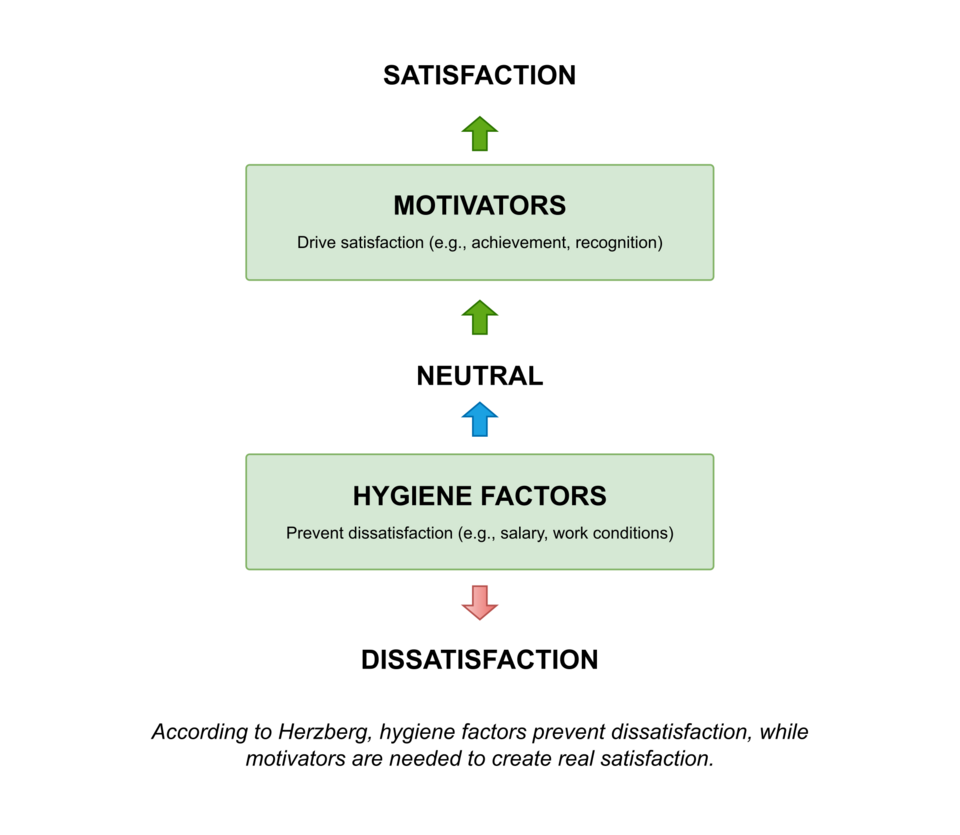 Two-factor theory with Nepali workplace examples. (Image: Mdaudabello, CC BY 4.0, via Wikimedia Commons)
Based on the TU BIM syllabus for Organizational Behavior and Human Resource Management (MGT241), unit 5.
Discussion
Loading…