Economics for BusinessUnit 56 min read
Cost Theory: Short-run vs. Long-run, Revenue, Profit Maximization
Unit 5 of Economics for Business explores the theory of cost, distinguishing between short-run and long-run costs, analyzing cost curves (AFC, AVC, MC, AC), revenue concepts (TR, AR, MR), and profit maximization rules. It applies these to real-world firms like Daraz, Ncell, and banks, using visuals and worked examples.
Key Concepts in Cost Theory
1. Cost Classification: Short-run vs. Long-run
Costs are classified based on the time period and flexibility of factors of production.
Short-run Costs
- Fixed Costs (FC): Costs that do not change with output (e.g., rent, salaries, insurance).
- Example: A Daraz warehouse’s monthly rent remains the same regardless of how many orders are processed.
- Variable Costs (VC): Costs that change with output (e.g., raw materials, wages of temporary workers).
- Example: Ncell’s cost of additional SIM cards increases as more subscribers join.
- Total Cost (TC): Sum of fixed and variable costs.
Long-run Costs
- All costs are variable because all factors (including plant size) can be adjusted.
- No fixed costs exist in the long run.
classDiagram
    class Costs {
        +Fixed Costs (FC)
        +Variable Costs (VC)
        +Total Cost (TC = FC + VC)
    }
    class ShortRun {
        <<includes>>
        FC: Unchangeable
        VC: Changeable
    }
    class LongRun {
        <<includes>>
        All costs variable
        No fixed costs
    }
    Costs --> ShortRun
    Costs --> LongRun
2. Cost Curves
A. Per Unit Costs
| Cost Type | Formula | Shape of Curve | Real-world Example |
|---|---|---|---|
| Average Fixed Cost (AFC) | Downward-sloping (declines as Q increases) | A bank’s fixed cost per loan decreases as it issues more loans. | |
| Average Variable Cost (AVC) | U-shaped (first falls, then rises) | A Daraz seller’s cost per product drops initially due to bulk discounts but rises if overproduction occurs. | |
| Average Total Cost (AC) | U-shaped (minimum at efficient scale) | A Pathao driver’s cost per trip is lowest at optimal fleet size. | |
| Marginal Cost (MC) | U-shaped (cuts AC at its minimum) | NTC’s cost of adding one more phone line rises after a point. |
B. Relationship Between Cost Curves
- MC cuts AC at its minimum (this is the profit-maximizing rule).
- AVC is the lower envelope of AC (AC = AFC + AVC).
- AFC always declines as output increases.
graph LR
    A["MC"] -->|"Cuts at minimum"| B["AC"]
    B -->|"Composed of"| C["AFC + AVC"]
    C --> D["AFC: Declines"]
    C --> E["AVC: U-shaped"]
3. Revenue Concepts
| Revenue Type | Formula | Shape of Curve | Real-world Example |
|---|---|---|---|
| Total Revenue (TR) | Linear (if P is constant) | Daraz’s total revenue rises linearly if it sells more products at the same price. | |
| Average Revenue (AR) | Horizontal (perfect competition) or downward-sloping (monopoly) | Ncell’s AR per call declines if it charges less for more minutes. | |
| Marginal Revenue (MR) | Downward-sloping (monopoly/oligopoly) | A monopolistic YouTube creator earns less per additional view. |
4. Profit Maximization
Rule 1: MR = MC (Short-run)
- A firm maximizes profit where Marginal Revenue (MR) = Marginal Cost (MC).
- Worked Example: Daraz’s Profit-Maximizing Quantity
- Suppose Daraz sells a product at Rs. 500.
- At Q=50 units, MR = Rs. 500, MC = Rs. 400 → Profit increases (MR > MC).
- At Q=60 units, MR = Rs. 500, MC = Rs. 550 → Profit decreases (MR < MC).
- Optimal Q = 55 units (where MR = MC).
Rule 2: AC < AR (Long-run Survival)
- In the long run, firms must cover all costs (AC ≤ AR).
- If AC > AR, the firm shuts down (e.g., a failing e-commerce startup).
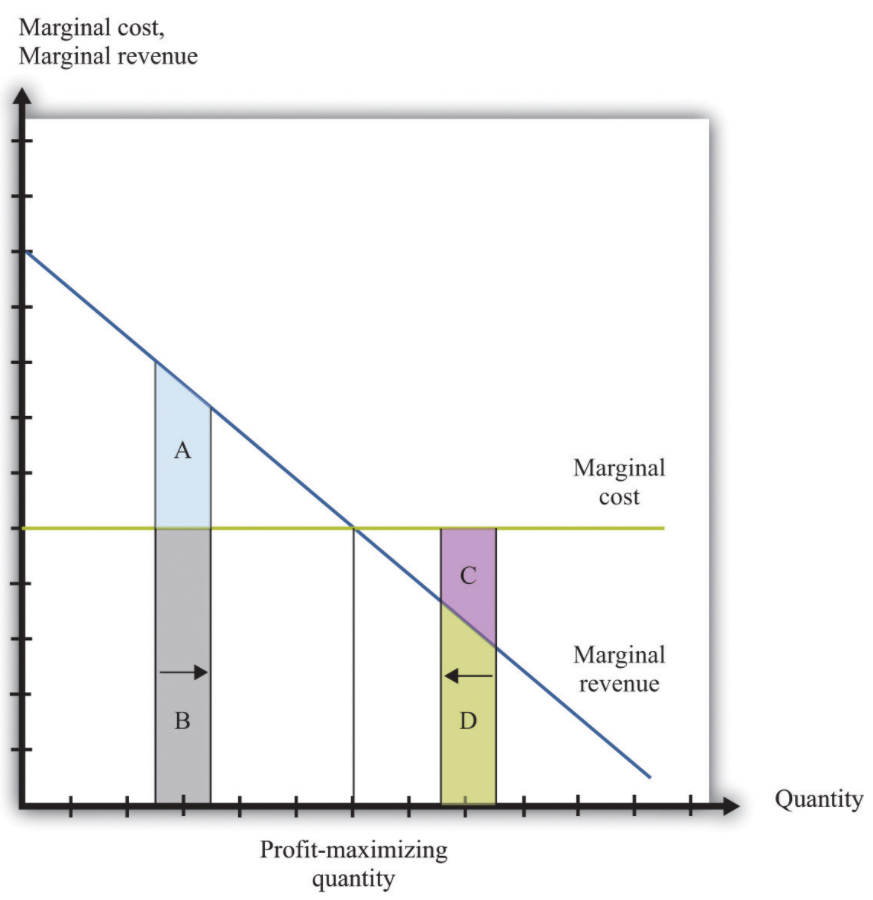 MC and MR intersecting at Q=55, with AC below AR at this point. (Image: 2012. Theory And Applications Of Microeconomics. [Place of p, CC BY-SA 4.0, via Wikimedia Commons)
5. Short-run vs. Long-run Decisions
| Decision | Short-run | Long-run |
|---|---|---|
| Fixed Costs | Must be paid | Can be avoided |
| Shutdown Rule | Operate if | Exit if |
| Example | A restaurant stays open if revenue covers variable costs (food, wages). | A bank closes a branch if long-run costs exceed revenue. |
In the Real World
Daraz’s Order Fulfillment
- Daraz uses marginal cost analysis to decide how many orders to process.
- If the cost of delivering one more order (MC) exceeds the revenue per order (MR), it stops expanding deliveries.
- Example: During Dashain sales, Daraz may increase delivery fees if MC rises due to higher fuel costs.
Ncell’s Pricing Strategy
- Ncell applies average cost pricing to set call rates.
- If AC per minute is Rs. 2, it charges Rs. 2.50 to ensure profitability.
- During promotions, it may lower AR but ensures MR > MC to attract customers.
Bank Loan Interest Rates
- Banks calculate marginal cost of lending (additional cost per loan).
- If MC of a loan = Rs. 50,000, but AR (interest) = Rs. 60,000, the bank profits.
- Example: NMB Bank sets loan rates based on AC + profit margin.
Exam Tip
- Memorize the Profit-Maximizing Rule: MR = MC (short-run) and AC ≤ AR (long-run).
- Draw Cost Curves Correctly:
- MC cuts AC at its minimum.
- AFC declines continuously.
- AVC is U-shaped.
- Apply to Real Firms:
- Use Daraz, Ncell, or bank examples in numerical problems.
- Always label axes (Q, Cost, Revenue) in graphs.
- Common Mistakes to Avoid:
- Confusing short-run (fixed costs) with long-run (all variable).
- Forgetting that shutdown rule is (not AC).
- Numerical Questions:
- If given TC = 100 + 5Q, derive:
- FC = 100
- VC = 5Q
- MC = 5
- AC = 100/Q + 5
- If given TC = 100 + 5Q, derive:
Final Note: Cost theory is the backbone of pricing and production decisions. Master the relationships between MC, AC, and MR, and you’ll ace both theory and numerical questions in your exams!
Based on the TU BIM syllabus for Economics for Business (ECO206), unit 5.
Discussion
Loading…