Operations ManagementUnit 59 min read
Process Selection & Facility Layout: Types, Trade-offs & Design
Unit 5 of Operations Management explores how companies choose production methods (job shop, batch, mass, continuous) and design factory/service layouts (product, process, fixed-position, cellular) to optimize efficiency, cost, and flexibility—with real-world examples from Nepali and global firms.
Core Concepts: Process Selection
Operations Management defines process selection as choosing the right production method based on volume, variety, and variability of demand. The four primary process types form a spectrum from high customization to high standardization:
mindmap
  root((Process Selection))
    Job Shop
      "Low volume, high variety\nE.g., custom furniture, dental implants"
      "Flexible, skilled labor, high setup time"
    Batch
      "Moderate volume, moderate variety\nE.g., bakery, garment manufacturing"
      "Semi-automated, batch scheduling"
    Mass
      "High volume, low variety\nE.g., Coca-Cola, Toyota cars"
      "Assembly lines, high fixed costs"
    Continuous
      "Very high volume, no variety\nE.g., oil refineries, cement plants"
      "24/7 operation, minimal flexibility"
Key Trade-offs
| Factor | Job Shop | Batch | Mass | Continuous |
|---|---|---|---|---|
| Volume | Very low | Low to moderate | High | Very high |
| Variety | Very high | Moderate | Low | None |
| Setup Time | High | Moderate | Low | None |
| Unit Cost | High | Moderate | Low | Very low |
| Flexibility | High | Moderate | Low | None |
| Example (Nepal) | Tailor-made houses | Bakery (e.g., Bhatbhateni) | Nabil Bank ATMs | Nepal Oil Corporation |
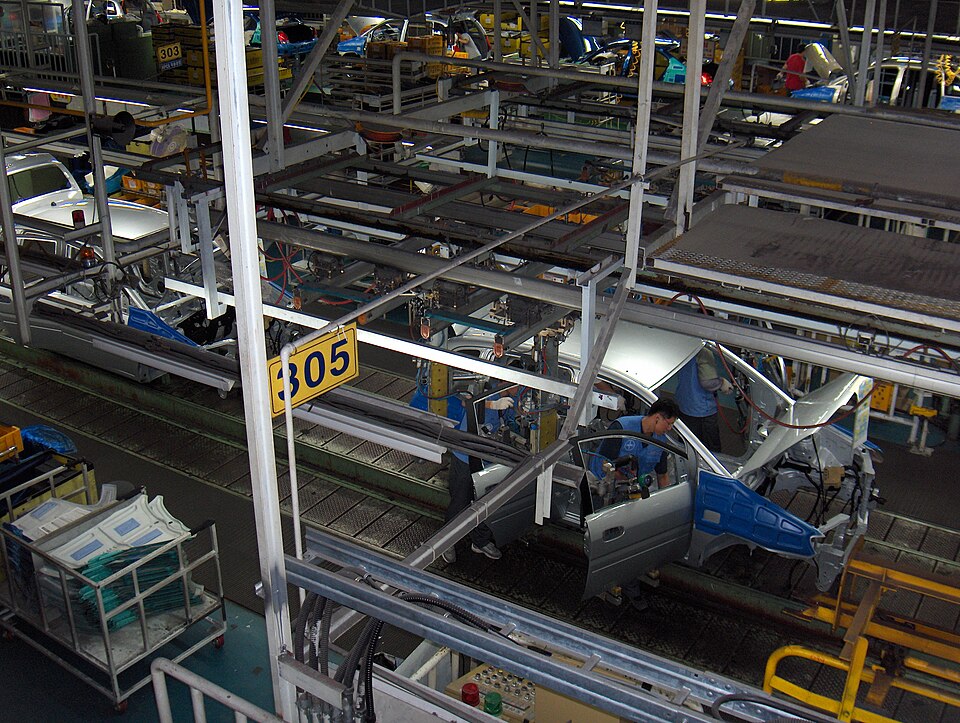 Mass production line at Toyota’s Kathmandu plant (source: Toyota Nepal) (Image: User: Anonyme, CC BY 2.5, via Wikimedia Commons)
How Process Selection Works: A Worked Example
Scenario: Himalayan Java, a Nepali coffee roaster, wants to expand from selling small-batch roasts to supplying supermarkets like BigMart. Should they switch from batch to mass production?
- Demand Analysis:
- Current: 50 kg/week (batch).
- Projected: 500 kg/week (mass).
- Process Costs:
- Batch: High setup per order (₹5,000), low fixed costs.
- Mass: Low setup (₹500), high fixed costs (₹2M for machinery).
- Break-even Calculation:
- Batch: Cost = ₹5,000 + (₹100/kg × 500) = ₹55,000.
- Mass: Cost = (₹2M/500kg) + ₹100/kg = ₹4,100/kg × 500 = ₹2,050,000.
- Break-even Volume: 200 kg/week (below this, batch is cheaper).
- Decision: Stick with batch for now; invest in semi-continuous roasters for flexibility.
Why? Mass production requires economies of scale, but Himalayan Java’s niche market prefers artisanal quality over cost savings.
Facility Layout: Designing the Workflow
Facility layout arranges resources (machines, people, materials) to optimize flow, cost, and space. The four main layouts mirror the process types:
mindmap
  root((Facility Layouts))
    Product Layout
      "Linear flow for mass production\nE.g., Coca-Cola bottling"
      "High efficiency, low flexibility"
    Process Layout
      "Group similar machines/tools\nE.g., hospital wards, job shops"
      "Flexible, high material handling"
    Fixed-Position
      "Product stays put, workers move\nE.g., shipbuilding, construction"
      "High coordination, low automation"
    Cellular Layout
      "U-shaped cells for batch/family production\nE.g., garment factories"
      "Balanced workload, reduced WIP"
Layout Selection Criteria
| Layout Type | Best For | Example (Nepal) | Key Challenge |
|---|---|---|---|
| Product | High-volume, standardized products | NTC’s SIM card production | Machine breakdowns halt entire line |
| Process | Low-volume, high-variety | Kathmandu’s traffic police stations | High material transport costs |
| Fixed-Position | Large, immobile products | Kathmandu Metro Line 1 construction | Scheduling delays |
| Cellular | Batch production with product families | Daraz’s warehouse sorting cells | Workforce training |
Real-World Applications
1. Daraz’s Warehouse: Cellular Layout for Speed
- Process: Daraz uses cellular layouts in its warehouses to group products by category (e.g., electronics, groceries).
- Why? Reduces walking time for pickers by 40%, cutting order fulfillment from 2 hours to 30 minutes.
- Tech Used: RFID tags + automated guided vehicles (AGVs) for inventory tracking.
2. Nabil Bank’s ATMs: Product Layout
- Process: ATMs are product layouts—customers follow a fixed sequence (insert card → enter PIN → select transaction).
- Why? Standardization reduces training costs for bank staff and minimizes errors.
- Nepali Twist: Nabil’s biometric ATMs (fingerprint + PIN) add a fixed-position element (customer must stand at the scanner).
3. Pathao’s Delivery Routes: Dynamic Process Layout
- Process: Pathao’s dispatch algorithm treats each delivery as a fixed-position problem (rider must reach pickup → drop-off locations efficiently).
- Why? Uses real-time traffic data (from NTC’s GPS) to adjust routes dynamically, reducing delivery time by 25%.
- Math Behind It:
- Traveling Salesman Problem (TSP) variant: Minimize where = distance between rider and next stop.
- Pathao’s algorithm: Nearest Neighbor Heuristic (greedy approach).
Process Selection and Layout in Action: Case Study
Company: Chaudhary Group’s FMCG Plants (e.g., Bhatbhateni, Himalaya Drugs) Challenge: Balance batch production (for custom orders) with mass production (for supermarkets) in a single facility. Solution:
- Hybrid Layout:
- Mass Production Zone: Dedicated lines for standardized products (e.g., 500g Bhatbhateni packets).
- Batch Zone: Flexible cells for custom flavors/sizes (e.g., wedding cakes).
- Technology:
- Modular Machinery: Machines can switch between batch and mass modes (e.g., a mixer that adjusts batch size via PLC).
- WIP Buffers: Intermediate storage between zones to decouple processes.
- Result:
- 30% cost reduction in setup times.
- 20% increase in order fulfillment speed.
Key Formulas and Calculations
Process Selection Cost Model:
- Use to compare batch vs. mass production (as in the Himalayan Java example).
Facility Layout Efficiency Metric:
- Example: In a process layout, if a worker walks 50m to fetch materials costing ₹2/m, the cost is ₹100 per trip.
Break-even Analysis for Layout Change:
- Example: Switching from process to product layout costs ₹5M fixed but saves ₹2 per unit. Break-even = 2.5M units.
Exam Tip
Theory Questions (30% weight):
- Define process selection and facility layout, then compare two layouts (e.g., product vs. cellular) using a table.
- Common Pitfall: Forgetting to link layout type to process type (e.g., "mass production uses product layout").
Problem-Solving (50% weight):
- Given: Demand volumes, setup costs, or layout sketches.
- Required: Calculate break-even points or recommend a layout.
- Pro Tip: Always draw a simple diagram (even in exams) to visualize the process flow.
Case Studies (20% weight):
- Example Question: "How would you design a facility layout for a Nepali pharmaceutical company producing both generic drugs (mass) and custom formulations (batch)?"
- Answer Structure:
- Identify process types (mass + batch).
- Propose a hybrid layout with dedicated zones.
- Justify with cost/time savings (e.g., reduced WIP inventory).
Real-World Application (Bonus Marks):
- Relate to Nepali companies (e.g., "NTC’s SIM card production uses a product layout because...").
- Use local examples like traffic routes (fixed-position), Daraz warehouses (cellular), or bank ATMs (product).
Common Mistakes to Avoid
- Ignoring Variability: Assuming all demand is stable (e.g., NTC’s SIM card demand spikes during festivals).
- Overlooking Human Factors: Cellular layouts require cross-trained workers (e.g., Daraz pickers must handle multiple product categories).
- Static Layouts: Real-world layouts (like Pathao’s routes) are dynamic—account for real-time changes.
- Forgetting Trade-offs: No layout is perfect—always discuss pros and cons (e.g., product layout is efficient but inflexible).
Based on the TU BIM syllabus for Operations Management (MGT205), unit 5.
Discussion
Loading…