Strategic ManagementUnit 311 min read
External Environment Analysis: PESTEL, Porter’s 5 Forces, SWOT, Competitor Analysis
Unit 3 of Strategic Management explores how organizations analyze their external environment—PESTEL (political, economic, social, technological, environmental, legal), Porter’s Five Forces, SWOT, and competitor analysis—to identify opportunities and threats. This note covers definitions, frameworks, real-world applicat
Core Concepts: Why External Analysis Matters
External environment analysis helps businesses scan, monitor, and evaluate factors beyond their control that can impact strategy. These factors are categorized into macro-environmental (broad, indirect) and micro-environmental (direct, competitive) forces.
1. Macro-Environmental Analysis: PESTEL Framework
PESTEL stands for Political, Economic, Social, Technological, Environmental, and Legal factors. It helps identify opportunities and threats at a broad level.
How PESTEL Works
mindmap
  root((PESTEL Framework))
    Political
      Government stability
      Tax policies
      Trade regulations
    Economic
      Inflation rates
      GDP growth
      Interest rates
    Social
      Demographics
      Cultural trends
      Consumer behavior
    Technological
      Innovation trends
      R&D investment
      Digital transformation
    Environmental
      Climate change
      Sustainability laws
      Resource scarcity
    Legal
      Labor laws
      Consumer protection
      Intellectual property
Worked Example: Ncell’s PESTEL Analysis
Scenario: Ncell (Nepal’s largest telecom operator) faces rising competition from NTC and Smart Telecom. How does PESTEL help?
| Factor | Opportunity/Threat | Impact on Ncell |
|---|---|---|
| Political | Government’s push for digital inclusion | Opportunity: Expand 4G/5G in rural areas |
| Economic | High inflation → lower disposable income | Threat: Reduced spending on premium plans |
| Social | Rising smartphone penetration (70% in 2024) | Opportunity: Target youth with data bundles |
| Technological | 5G rollout delayed due to spectrum issues | Threat: Competitors may gain first-mover advantage |
| Environmental | Pressure to use renewable energy for towers | Opportunity: Partner with solar firms for green energy |
| Legal | New data privacy laws (e.g., GDPR-like regulations) | Threat: Higher compliance costs |
Key Takeaway: Ncell must leverage social trends (smartphone growth) while mitigating economic threats (inflation) and legal risks (data laws).
2. Micro-Environmental Analysis: Porter’s Five Forces
Developed by Michael Porter, this framework assesses industry competitiveness by analyzing:
- Threat of New Entrants
- Bargaining Power of Suppliers
- Bargaining Power of Buyers
- Threat of Substitutes
- Rivalry Among Existing Competitors
How Porter’s Five Forces Works
graph TD
  A["Porter's Five Forces"] --> B["Threat of New Entrants"]
  A --> C["Bargaining Power of Suppliers"]
  A --> D["Bargaining Power of Buyers"]
  A --> E["Threat of Substitutes"]
  A --> F["Rivalry Among Competitors"]
Worked Example: Daraz (Nepal’s Amazon) vs. Competitors
Scenario: Daraz dominates Nepal’s e-commerce, but competitors like Sanjhya, Hamrobazaar, and local shops are growing. How strong is rivalry?
| Force | Analysis for Daraz | Impact |
|---|---|---|
| New Entrants | High startup costs (logistics, warehousing), but low barriers for small sellers | Moderate threat: New marketplaces may emerge, but scaling is hard |
| Suppliers | Many small vendors → weak bargaining power | Opportunity: Negotiate better rates with bulk suppliers |
| Buyers | Price-sensitive Nepali consumers → high bargaining power | Threat: Discount wars erode margins |
| Substitutes | Physical stores (e.g., Big Mart, Mega Mart) and local shops | Threat: Convenience of offline shopping |
| Rivalry | Intense competition with Sanjhya, Hamrobazaar, and international players (Amazon India) | High threat: Price wars, marketing battles |
Key Takeaway: Daraz must differentiate (e.g., faster delivery, cash-on-delivery) to reduce rivalry and lock in suppliers (e.g., exclusive deals with brands).
3. SWOT Analysis: Linking Internal & External Factors
SWOT combines internal (Strengths, Weaknesses) and external (Opportunities, Threats) analysis to guide strategy.
How SWOT Works
mindmap
  root((SWOT Analysis))
    Strengths
      Unique selling points
      Brand reputation
      Cost advantages
    Weaknesses
      Limited resources
      Poor distribution
      High debt
    Opportunities
      Market gaps
      Tech advancements
      Government incentives
    Threats
      Competitors
      Economic downturns
      Regulatory changes
Worked Example: Nabil Bank’s SWOT (Post-COVID Recovery)
| Internal | External |
|---|---|
| Strengths | Strong digital banking (Nabil eBanking) |
| Weaknesses | High NPAs (Non-Performing Assets) |
| Strategic Move: Nabil Bank could partner with fintechs to reduce NPAs and expand digital loans to tap into the fintech opportunity. |
4. Competitor Analysis: Benchmarking & Strategic Groups
Competitor analysis involves:
- Direct competitors (e.g., Ncell vs. NTC)
- Indirect competitors (e.g., OTT apps like YouTube vs. traditional TV)
- Strategic groups (companies following similar strategies)
Worked Example: Kathmandu Traffic Routes (Public vs. Private Transport)
Scenario: Kathmandu’s traffic congestion is a public policy issue, but private companies (e.g., Pathao, Uber) and public transport (e.g., KTM Metro, buses) compete for commuters.
| Competitor | Strategy | Strengths | Weaknesses |
|---|---|---|---|
| Public Transport | Government-run buses, Metro | Low cost, widespread coverage | Slow, unreliable, poor maintenance |
| Pathao/Uber | Ride-hailing apps | Fast, cashless, real-time tracking | High cost, limited rural reach |
| Bike Taxis | Informal, cheap | Affordable, flexible routes | Unregulated, safety concerns |
Key Insight:
- Public transport must improve reliability (e.g., better scheduling, electric buses).
- Pathao/Uber can expand in rural areas with subsidized rides.
- Bike taxis could be formalized to reduce chaos.
In the Real World
eSewa & Khalti (Digital Payments)
- PESTEL Impact:
- Technological: Rise of UPI-like systems (e.g., Nepal Rastra Bank’s digital payment push).
- Legal: Anti-money laundering (AML) laws require KYC for transactions.
- Social: Cashless trend post-COVID (70% of transactions now digital).
- Porter’s Five Forces:
- Rivalry: High between eSewa, Khalti, and IME Pay.
- Substitutes: Traditional banking (e.g., Nabil Bank’s internet banking).
- PESTEL Impact:
Toyota’s Hybrid Strategy (Global Example)
- PESTEL:
- Environmental: Carbon emission laws pushed Toyota to develop hybrids.
- Technological: Battery tech advancements reduced hybrid costs.
- Competitor Analysis:
- Strength: Dominance in hybrid market (Prius, Corolla Hybrid).
- Threat: Tesla’s EV dominance in premium segment.
- PESTEL:
NEPSE (Nepal Stock Exchange) Volatility
- Porter’s Five Forces:
- Bargaining Power of Buyers: High (institutional investors like NMB, Standard Chartered).
- Threat of Substitutes: Low (no major alternatives to NEPSE).
- SWOT:
- Opportunity: Fintech integration (e.g., digital IPOs).
- Threat: Low liquidity deters foreign investors.
- Porter’s Five Forces:
Comparison Table: PESTEL vs. Porter’s Five Forces vs. SWOT
| Framework | Scope | Focus | Best Used For | Example |
|---|---|---|---|---|
| PESTEL | Macro-environment | Broad external trends | Long-term strategy, industry entry | Ncell’s 5G expansion plan |
| Porter’s 5 Forces | Micro-environment | Industry competitiveness | Market entry, pricing strategy | Daraz vs. Sanjhya |
| SWOT | Internal + External | Strengths/Weaknesses + Opportunities | Business positioning, risk assessment | Nabil Bank’s digital transformation |
Exam Tip
For PESTEL:
- Always link to strategy. Example: *"Due to legal threats (new data laws), Ncell must invest in KYC automation to reduce compliance costs."*
- Avoid generic answers. Use Nepali examples (e.g., NTC’s fiber expansion due to economic growth).
For Porter’s Five Forces:
- Draw the diagram in exams (even if not asked).
- Explain "why" for each force. Example: "The threat of substitutes (YouTube vs. traditional TV) is high because OTT platforms offer ad-free, on-demand content at lower cost."
For SWOT:
- Match S/W with O/T. Example: "Strength (Nabil Bank’s digital platform) → Opportunity (partner with fintechs) to reduce NPAs."
- Avoid vague weaknesses. Example: ❌ "Weakness: Poor marketing" → ✅ "Weakness: Low social media engagement (only 50K followers vs. NMB’s 200K)"
For Competitor Analysis:
- Use real data. Example: "Pathao’s market share (60% of ride-hailing) is threatened by Uber’s entry in Kathmandu due to better driver incentives."
Common Mistakes to Avoid:
- ❌ Listing PESTEL factors without strategic implications.
- ❌ Ignoring Nepali context (e.g., using Coca-Cola instead of Thapathali Beverages).
- ❌ Forgetting to link internal (SWOT) and external (PESTEL/Porter’s) factors.
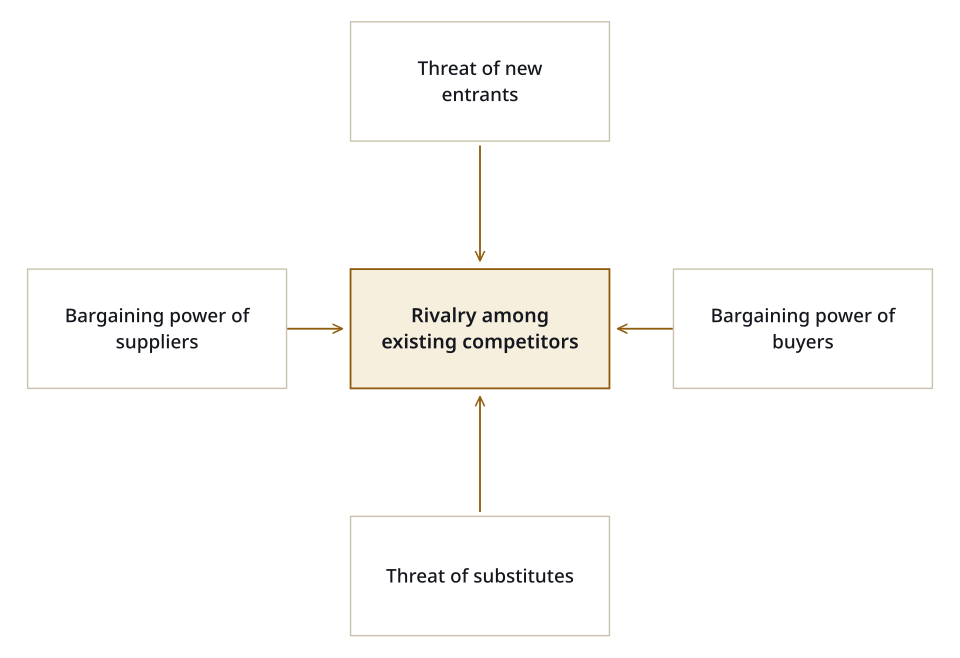 Porter’s Five Forces framework diagram (Image: Peter Gladdish, CC BY 4.0, via Wikimedia Commons)
Based on the TU BIM syllabus for Strategic Management (MGT240), unit 3.
Discussion
Loading…