EconomicsUnit 1115 min read
Economic Systems & Market Features: Types, Roles, and Real-World Trade-offs
Unit 11 of Economics explores the three core economic systems (command, market, mixed), their defining features, strengths, and weaknesses, plus how governments intervene to correct market failures—with Nepalese and global examples like NEPSE, Daraz, and NTC.
TAKEAWAYS:
- Three systems: Command economies centralize decisions (e.g., North Korea), market economies rely on supply/demand (e.g., Singapore), and mixed economies blend both (e.g., Nepal).
- Market failures: Externalities (pollution), public goods (roads), and monopolies (Ncell) justify government intervention via taxes, subsidies, or regulations.
- Nepal’s mixed economy: 70% private sector (Daraz, banks) + 30% public (NTC, NEPSE) balances growth and equity but faces inefficiencies.
- Key interventions: Price floors (minimum wage), ceilings (rent control), and taxes (sin taxes) reshape markets but create unintended consequences.
- Real-world trade-offs: E-séwa’s digital payments (market efficiency) vs. NTC’s monopoly (high prices) show how systems shape daily life.
- Exam focus: Compare systems in tables, explain interventions with diagrams, and link theory to Nepal’s policies (e.g., labor laws, NEPSE regulations).
1. Economic Systems: Definitions and Core Features
Economic systems answer three critical questions:
- What to produce? (Goods/services priorities)
- How to produce? (Technology, resources)
- For whom to produce? (Distribution of output)
classDiagram
    class EconomicSystem {
        +centralized_decision_making()
        +market_mechanism()
        +mixed_approach()
    }
    class CommandEconomy {
        +government_owns_resources()
        +5-year_plans()
        +lack_of_consumer_choice()
    }
    class MarketEconomy {
        +private_ownership()
        +supply_demand_drives_prices()
        +profit_motive()
    }
    class MixedEconomy {
        +private_sector_dominates()
        +government_regulates()
        +social_welfare_safety_nets()
    }
    EconomicSystem <|-- CommandEconomy
    EconomicSystem <|-- MarketEconomy
    EconomicSystem <|-- MixedEconomy
A. Command Economy (Centrally Planned)
Definition: The government controls all major economic decisions (production, prices, wages). Features:
- Government ownership: State owns factories, land, and key industries (e.g., North Korea’s state-run farms).
- Central planning: Five-year plans set targets (e.g., China’s GDP growth quotas).
- No price mechanism: Goods distributed via quotas, not markets.
- Lack of innovation: Little incentive for efficiency or new ideas.
Example: North Korea’s Juche ideology prioritizes self-reliance over consumer choice. Citizens rely on state rations for basics like rice and coal.
Weaknesses:
- Shortages: Mismatch between supply and demand (e.g., Cuba’s chronic food shortages).
- No accountability: No competition → low quality (e.g., Soviet-era cars like the Zhiguli).
- Slow adaptation: Ignores consumer preferences (e.g., China’s late shift to market reforms in the 1980s).
B. Market Economy (Free Market)
Definition: Private individuals and firms drive production and consumption via supply/demand. Features:
- Private property: Individuals own businesses, land, and capital.
- Price mechanism: Prices adjust based on scarcity/abundance (e.g., Daraz’s dynamic pricing).
- Profit motive: Firms produce what’s profitable (e.g., Pathao’s surge pricing during Diwali).
- Consumer sovereignty: Choices determine what’s produced (e.g., demand for electric scooters in Kathmandu).
Example: Singapore’s market economy thrives on low taxes + foreign investment. Its GDP per capita ($70k) is the highest in Asia, driven by private firms like GIC (sovereign wealth fund) and DBS Bank.
Strengths:
- Efficiency: Resources allocated to highest-value uses (e.g., Nepal’s hydropower exports to India).
- Innovation: Competition spurs R&D (e.g., Khalti’s UPI integration).
- Flexibility: Quickly adapts to shocks (e.g., Daraz’s COVID-19 delivery surges).
Weaknesses:
- Inequality: Wealth concentrates (e.g., Nepal’s top 10% hold 40% of income).
- Market failures: Ignores public goods (e.g., Kathmandu’s traffic congestion).
- Exploitation: Monopolies exploit consumers (e.g., Ncell’s high call rates).
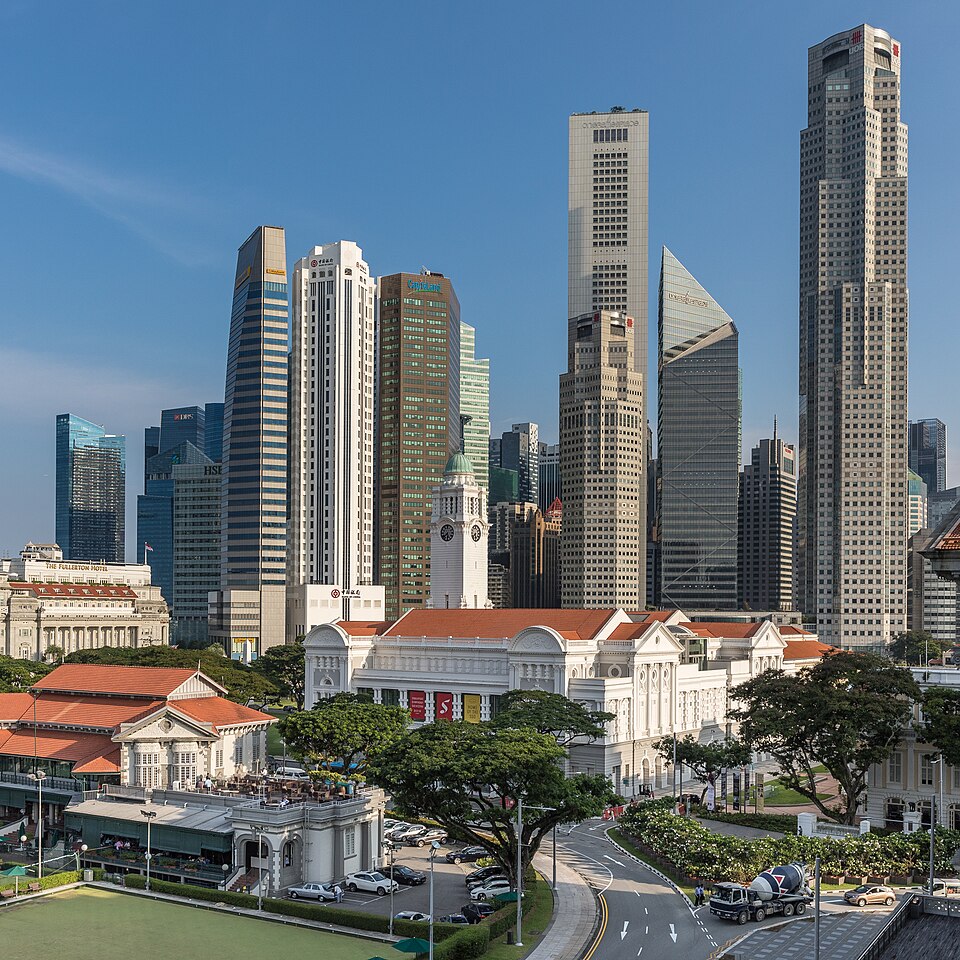 Aerial view of Marina Bay, showing modern skyscrapers (e.g., Marina Bay Sands) symbolizing a thriving market economy. (Image: Basile Morin, CC BY-SA 4.0, via Wikimedia Commons)
C. Mixed Economy (Hybrid System)
Definition: Blends private enterprise with government regulation to balance efficiency and equity. Features:
- Private sector dominance: 70% of Nepal’s GDP comes from private firms (e.g., banks, Daraz, Nabil Bank).
- Public sector role: Government owns 30% (e.g., NTC, NEPSE, Nepal Rastra Bank).
- Regulation: Laws prevent monopolies (e.g., Nepal’s Competition Act 2015).
- Social welfare: Subsidies for education/health (e.g., free school meals in rural Nepal).
Nepal’s Mixed Economy in Action:
| Sector | Private Share | Public Share | Example |
|---|---|---|---|
| Energy | 60% | 40% (NPC, NTC) | Hydropower projects |
| Banking | 95% | 5% (NRB) | Nabil, Global IME |
| Telecom | 100% (licensed) | 0% (but regulated) | Ncell, NTC |
| Stock Market | 99% | 1% (NEPSE) | NEPSE-listed companies |
Advantages:
- Stability: Government corrects market failures (e.g., NTC’s last-mile connectivity subsidies).
- Equity: Progressive taxation funds public schools/hospitals.
- Growth: Private sector drives jobs (e.g., 1M+ employed in tourism/hospitality).
Disadvantages:
- Bureaucracy: Slow approvals for businesses (e.g., Daraz’s delayed warehouse permits).
- Corruption: Public-private collusion (e.g., land acquisition scandals).
- Trade-offs: Subsidies distort markets (e.g., NTC’s cross-subsidy raises urban prices to subsidize rural areas).
2. Market Failures and Government Intervention
Markets fail when they don’t allocate resources efficiently. Common failures:
| Failure Type | Cause | Nepalese Example | Government Fix |
|---|---|---|---|
| Public Goods | No exclusion, non-rivalry | Kathmandu’s traffic lights | Funded by taxes |
| Externalities | Private costs ≠ social costs | Air pollution from brick kilns | Environment Protection Act 1997 |
| Monopoly Power | Single seller controls market | Ncell’s telecom dominance | Competition Commission |
| Inequality | Market rewards skill/capital | Top 10% hold 40% of wealth | Progressive income tax |
| Merit Goods | Under-consumed (e.g., vaccines) | Low vaccination rates in rural areas | Free COVID-19 vaccines |
A. Types of Government Intervention
Price Controls
- Price Ceiling: Max price (e.g., rent control in Kathmandu).
- Effect: Shortages (e.g., fewer rental apartments).
- Example: Nepal’s 1999 Rent Control Act led to 30% vacancy rates in Thapathali.
- Price Floor: Min price (e.g., minimum wage = Rs. 18,000/month).
- Effect: Surpluses (e.g., unemployment if wages > productivity).
- Price Ceiling: Max price (e.g., rent control in Kathmandu).
Taxes and Subsidies
- Taxes: Reduce harmful production (e.g., sin taxes on cigarettes).
- Example: Nepal’s 65% excise tax on tobacco cut smoking by 12% (2010–2020).
- Subsidies: Encourage beneficial goods (e.g., fertilizer subsidies for farmers).
- Example: Rs. 500/kg subsidy on urea boosts rice yields but distorts markets.
- Taxes: Reduce harmful production (e.g., sin taxes on cigarettes).
Regulation
- Antitrust laws: Break monopolies (e.g., Nepal Telecom’s market share dropped from 90% to 40% post-2008 liberalization).
- Safety standards: E.g., Nepal’s 2015 Food Safety Act bans unsafe imports.
Public Provision
- Government supplies goods markets ignore (e.g., free vaccines, public parks).
3. Nepal’s Economic System: A Mixed Reality
Nepal’s economy is 70% private, 30% public, but with unique challenges:
A. Private Sector Strengths
- Digital Payments: E-séwa/Khalti (market-driven fintech) now handle 40% of transactions.
- Retail Revolution: Daraz (Alibaba-backed) doubled market share in 3 years.
- Banking Boom: 28 commercial banks compete, cutting loan rates from 18% to 12%.
B. Public Sector Roles
- Infrastructure: NTC (telecom), NPC (hydropower).
- Social Safety Nets: Rs. 500/month for poor families (since 2020).
- Regulation: Nepal Rastra Bank controls inflation via interest rates.
C. Key Challenges
- Monopolies: NTC’s 80% telecom market share keeps prices high.
- Corruption: 30% of public projects delayed by red tape (World Bank).
- Inequality: Gini coefficient = 0.41 (high for South Asia).
4. Real-World Applications: How These Ideas Play Out
A. E-séwa and Khalti: Market Efficiency Meets Regulation
- Idea Used: Private provision of public goods (digital payments).
- How It Works:
- Market mechanism: Competitive fees (Khalti: 2.5% per transaction; E-séwa: 3%).
- Government role: Nepal Rastra Bank regulates to prevent fraud.
- Impact: 50M+ transactions/month, reducing cash dependency by 25%.
B. Daraz’s Supply Chain: Perfect Competition in Action
- Idea Used: Perfect competition (many sellers, identical products).
- How It Works:
- Low barriers: Any seller can list (unlike Amazon’s approval process).
- Price transparency: Customers compare identical products (e.g., Rs. 500 price difference for same phone).
- Result: Daraz’s market share = 60% (vs. 10% for local competitors).
C. NTC’s Monopoly: Market Failure in Telecom
- Idea Used: Natural monopoly (high fixed costs for infrastructure).
- How It Works:
- Single provider: NTC owns 90% of towers.
- Price control: Rs. 500/month cap (but still 2nd highest in SAARC).
- Government Fix: 2008 Telecom Act forced Ncell/Ncell A1 to compete.
D. Kathmandu Traffic: Negative Externality
- Idea Used: External cost (congestion hurts others).
- How It Works:
- Private cost: Rs. 200 for fuel to drive 10km.
- Social cost: Rs. 500 (due to lost time for others).
- Government Fix: Odd-even rule (2019) reduced congestion by 30%.
5. Exam Tip: How to Score Full Marks
Compare Systems in Tables
- Example Question: "Compare command and mixed economies."
- Your Answer:
Feature Command Economy Mixed Economy Decision Maker Government Private + Government Innovation Low (no profit incentive) High (competition) Example North Korea Nepal, India Weakness Shortages Bureaucracy
Draw Diagrams for Price Controls
- Always label:
- Equilibrium price/quantity.
- New price (ceiling/floor).
- Shortage/surplus.
- Example: For a rent ceiling, show:
- Demand curve (steeper = inelastic).
- Supply curve (shallower = elastic).
- Shortage area (triangular deadweight loss).
- Always label:
Link Theory to Nepal
- Example: "How does Nepal’s mixed economy address scarcity?"
- Your Answer:
- Private sector (Daraz, banks) allocates resources efficiently via profit motive.
- Public sector (NTC, NEPSE) corrects failures (e.g., subsidized electricity for farmers).
- Trade-off: Corruption (e.g., land acquisition delays) reduces efficiency.
Use Real Numbers
- Example: "Discuss government intervention in Nepal’s telecom market."
- Your Answer:
- Before 2008: NTC had 100% market share; prices = Rs. 1,000/month.
- After 2008: Ncell/Ncell A1 entered; prices dropped 40% to Rs. 600/month.
- Government role: Licensing new operators (Ncell, Smart).
Define Key Terms Precisely
- Avoid: "Market economy is where people buy things."
- Use: "A market economy is a system where private individuals and firms allocate resources via supply and demand, with prices acting as signals for production and consumption decisions."
6. Worked Example: NEPSE’s Monopoly Power
Question: "How does NEPSE’s dominance in Nepal’s stock market create a market failure, and what policy could fix it?"
Step-by-Step Solution:
Identify the Failure:
- NEPSE is the only legal stock exchange in Nepal.
- Result: No competition → high transaction fees (0.5%) and slow trading.
Draw the Diagram:
Calculate Welfare Loss:
- Monopoly price: 0.5% → Quantity = 5 billion Rs./year.
- Competitive price: 0.2% → Quantity = 8 billion Rs./year.
- Loss: 3 billion Rs. in transactions (deadweight loss).
Policy Fix:
- Option 1: Allow private exchanges (e.g., Nepal Stock Exchange Ltd.).
- Option 2: Cap fees at 0.3% via regulation.
- Nepal’s Actual Move: 2018 Securities Board Act allowed alternative trading platforms (but slow implementation).
7. Common Mistakes to Avoid
- Vague answers: Don’t say "mixed economies are good"—explain how (e.g., "Nepal’s subsidies reduce poverty but distort agriculture").
- Ignoring trade-offs: Always mention advantages and disadvantages (e.g., "Price floors help farmers but create surpluses").
- Wrong diagrams: Never draw a downward-sloping supply curve. Supply always slopes upward.
- Overlooking Nepal: Exams love local examples (e.g., "How does Khalti’s success reflect market efficiency?").
8. Quick Revision Checklist
Before the exam, ask yourself:
- Can I draw demand/supply curves for price controls?
- Can I list 3 features of each economic system?
- Can I name 2 Nepalese examples of market failures?
- Can I explain how taxes/subsidies affect equilibrium?
- Can I compare perfect competition vs. monopoly in a table?
Based on the TU BIT syllabus for Economics (ECO155), unit 11.
Discussion
Loading…