Artificial IntelligenceUnit 610 min read
SDLC Phases, CASE Tools, OOAD & System Maintenance
Unit 6 of Artificial Intelligence covers the Systems Development Life Cycle (SDLC) phases, Computer-Aided Software Engineering (CASE) tools, Object-Oriented Analysis and Design (OOAD), and system maintenance—explaining each phase with diagrams, real-world applications (e.g., eSewa’s SDLC), and exam-focused comparisons
TAKEAWAYS:
- The SDLC is a structured process (planning → analysis → design → implementation → maintenance) with 6 phases, each requiring deliverables like DFDs, ERDs, or prototypes.
- CASE tools automate SDLC phases (e.g., Lucidchart for DFDs, Visual Paradigm for UML), reducing errors and speeding up development.
- OOAD uses use cases, class diagrams, and inheritance to model real-world systems (e.g., Pathao’s driver-passenger classes).
- System maintenance includes corrective, adaptive, perfective, and preventive types, with maintainability factors like modularity and documentation.
- Context diagrams show system boundaries (e.g., Nepal Rastra Bank’s transaction system), while Level-0 DFDs break down processes (e.g., Khalti’s payment flow).
- Exam focus: Draw SDLC phase diagrams, compare waterfall vs. agile, and explain CASE tool support for each phase.
1. Systems Development Life Cycle (SDLC): Phases and Deliverables
The SDLC is a structured methodology to develop, maintain, and replace information systems. It ensures systematic planning, analysis, design, and implementation. The 6 phases are:
Phase 1: Planning
- Goal: Define system goals, feasibility, and scope.
- Deliverables:
- Project charter (objectives, budget, timeline).
- Feasibility study (technical, economic, operational, legal).
- Example:
- eSewa started with a feasibility study to check if digital payments were viable in Nepal before launching.
Phase 2: Analysis
- Goal: Understand user needs and system requirements.
- Techniques:
- Interviews, questionnaires, observation.
- Requirements gathering (functional vs. non-functional).
- Deliverables:
- System requirements document (SRD).
- Use case diagrams (e.g., WhatsApp’s "Send Message" use case).
- Worked Example:
- NTC’s online bill payment system requires:
- Functional: "User pays bill via eSewa."
- Non-functional: "System must handle 10,000 transactions/hour."
- NTC’s online bill payment system requires:
Phase 3: Design
- Goal: Define system architecture, interfaces, and data models.
- Sub-phases:
- Conceptual Design (high-level model, e.g., ER diagram).
- Logical Design (database schema, e.g., SQL tables).
- Physical Design (hardware/software specs, e.g., cloud vs. on-premise).
- Deliverables:
- Data Flow Diagrams (DFDs) (Level 0, 1, 2).
- Entity-Relationship Diagrams (ERDs).
- UI/UX wireframes (e.g., Daraz’s checkout page).
- Visual: SDLC Design Phases
flowchart LR
  A["Conceptual Design"] --> B["Logical Design"]
  B --> C["Physical Design"]
  A --> D["ER Diagram"]
  B --> E["DFD Level 1"]
  C --> F["Database Schema"]
Phase 4: Implementation (Coding)
- Goal: Develop the system using programming languages (e.g., Python for AI models, Java for Android apps).
- Techniques:
- Prototyping (e.g., Pathao’s MVP).
- Agile/Waterfall methodologies.
- Deliverables:
- Source code, test cases, user manuals.
Phase 5: Testing
- Goal: Ensure the system meets requirements.
- Types of Testing:
- Unit testing (individual modules).
- Integration testing (module interactions).
- System testing (end-to-end).
- User acceptance testing (UAT).
- Example:
- Nepal Stock Exchange (NEPSE) tests its trading platform with load testing (10,000 simulated trades/hour).
Phase 6: Maintenance
- Goal: Fix errors, adapt to changes, and improve performance.
- Types of Maintenance:
Type Description Example Corrective Fix bugs (e.g., Khalti’s app crash). Patch updates. Adaptive Update for new tech (e.g., NTC’s 5G readiness). Migrate to new OS. Perfective Enhance features (e.g., WhatsApp’s voice messages). Add new functionalities. Preventive Improve future maintainability (e.g., code refactoring). Optimize database queries.
## In the Real World
eSewa’s SDLC:
- Phase 2 (Analysis): Conducted surveys to identify user pain points (e.g., "I need to pay bills without visiting banks").
- Phase 3 (Design): Designed a DFD Level 0 showing interactions between users, banks, and NTC.
- Phase 5 (Testing): Tested with 10,000 users before full launch to catch UX issues.
Pathao’s Driver-Passenger System (OOAD):
- Class Diagram:
classDiagram class Driver { +String licenseNumber +String vehicleType +ride() } class Passenger { +String userID +bookRide() } class Ride { +Driver driver +Passenger passenger +status } Driver --> Ride : "offers" Passenger --> Ride : "books" - Inheritance:
DriverandPassengerinherit fromUser(shared fields likewalletBalance).
- Class Diagram:
NTC’s Online Payment System (DFD):
- Level 0 DFD:
flowchart TD
  A["User"] -->|"Pay Bill"| B["Payment System"]
  B -->|"Validate"| C["NTC Database"]
  B -->|"Confirm"| A
- Level 1 DFD: Breaks down
Binto:- Process 1: Authenticate user (e.g., via eSewa).
- Process 2: Deduct amount.
- Process 3: Update NTC records.
- Level 0 DFD:
2. CASE Tools: Automating SDLC
Computer-Aided Software Engineering (CASE) tools help design, model, and document systems. Examples:
- Lucidchart (DFDs, flowcharts).
- Visual Paradigm (UML diagrams).
- ERwin (ER diagrams).
- JIRA (Agile project management).
How CASE Supports SDLC Phases
| SDLC Phase | CASE Tool Support | Example |
|---|---|---|
| Analysis | Generate use case diagrams from interviews. | WhatsApp’s "Send Media" use case. |
| Design | Auto-generate SQL schema from ERDs. | NEPSE’s trading database. |
| Implementation | Code generation from UML. | Android Studio (Java/Kotlin). |
| Testing | Automated test case generation. | Selenium for web apps. |
Advantages of CASE Tools
- Reduces errors (e.g., automated syntax checks in ERwin).
- Saves time (e.g., Lucidchart’s drag-and-drop DFDs).
- Improves documentation (e.g., auto-generated user manuals).
Disadvantages
- High initial cost (e.g., Visual Paradigm license).
- Steep learning curve (e.g., UML notation).
- Over-reliance on tools may reduce manual creativity.
3. Object-Oriented Analysis and Design (OOAD)
OOAD models systems using objects, classes, and relationships (e.g., inheritance, polymorphism).
Key Concepts
Use Case Diagrams:
- Show actors (users) and actions (e.g., Khalti’s "Make Payment").
- Example:
flowchart TD
  A["User"] -->|"Make Payment"| B["Khalti System"]
  B -->|"Success/Failure"| A
Class Diagrams:
- Define attributes and methods (e.g., Bank Account class).
- Example:
classDiagram
  class BankAccount {
    -String accountNumber
    -double balance
    +deposit(amount)
    +withdraw(amount)
  }
Inheritance:
- Child classes inherit from parent classes (e.g., SavingsAccount → BankAccount).
OOAD vs. Traditional SDLC
| Aspect | OOAD | Traditional (Structured) |
|---|---|---|
| Modeling | Objects, classes, relationships. | Functions, data flows. |
| Flexibility | High (easy to extend). | Low (rigid structure). |
| Example | Pathao’s driver-passenger system. | NTC’s linear bill payment flow. |
Worked Example: Daraz Order System (OOAD)
- Classes:
Customer,Order,Product,Cart.
- Relationships:
CustomerplacesOrder.OrdercontainsProduct.
- Method:
Cart.addProduct()→Order.generateInvoice().
4. System Maintenance: Types and Factors
Types of Maintenance (Reviewed Earlier)
- Corrective, Adaptive, Perfective, Preventive.
Factors Affecting Maintainability
| Factor | Description | Example |
|---|---|---|
| Modularity | System divided into independent modules. | WhatsApp’s "Chat" vs. "Status" modules. |
| Documentation | Clear code/comments. | Google’s internal API docs. |
| Language Choice | Easy-to-read code (e.g., Python > COBOL). | Nepal Rastra Bank’s Python scripts. |
| Testing Coverage | High test cases reduce bugs. | NEPSE’s 99% test coverage. |
Maintenance Process
flowchart LR
  A["Maintenance Request"] --> B["Analyze Impact"]
  B --> C["Plan Changes"]
  C --> D["Implement Fix"]
  D --> E["Test"]
  E --> F["Deploy"]
  F --> G["Monitor"]
## Exam Tip
SDLC Phases:
- Memorize the 6 phases and their deliverables (e.g., "Phase 3 delivers DFDs").
- Draw a SDLC diagram in exams (use arrows for flow).
- Compare waterfall vs. agile in a table (e.g., "Waterfall is rigid; Agile is iterative").
CASE Tools:
- Name 2 tools (e.g., Lucidchart, Visual Paradigm) and link them to a phase (e.g., "Visual Paradigm for UML in Design").
- Explain how CASE reduces errors (e.g., "Auto-validation in ERwin").
OOAD:
- Draw a class diagram for a real system (e.g., bank account system).
- Explain inheritance with an example (e.g., "SavingsAccount extends BankAccount").
Maintenance:
- Define all 4 types and give one example each.
- List 3 maintainability factors (e.g., "Modularity, documentation, testing").
DFDs:
- Practice drawing Level 0 and Level 1 DFDs for systems like:
- eSewa payment.
- NTC bill payment.
- Label processes, data stores, and external entities clearly.
- Practice drawing Level 0 and Level 1 DFDs for systems like:
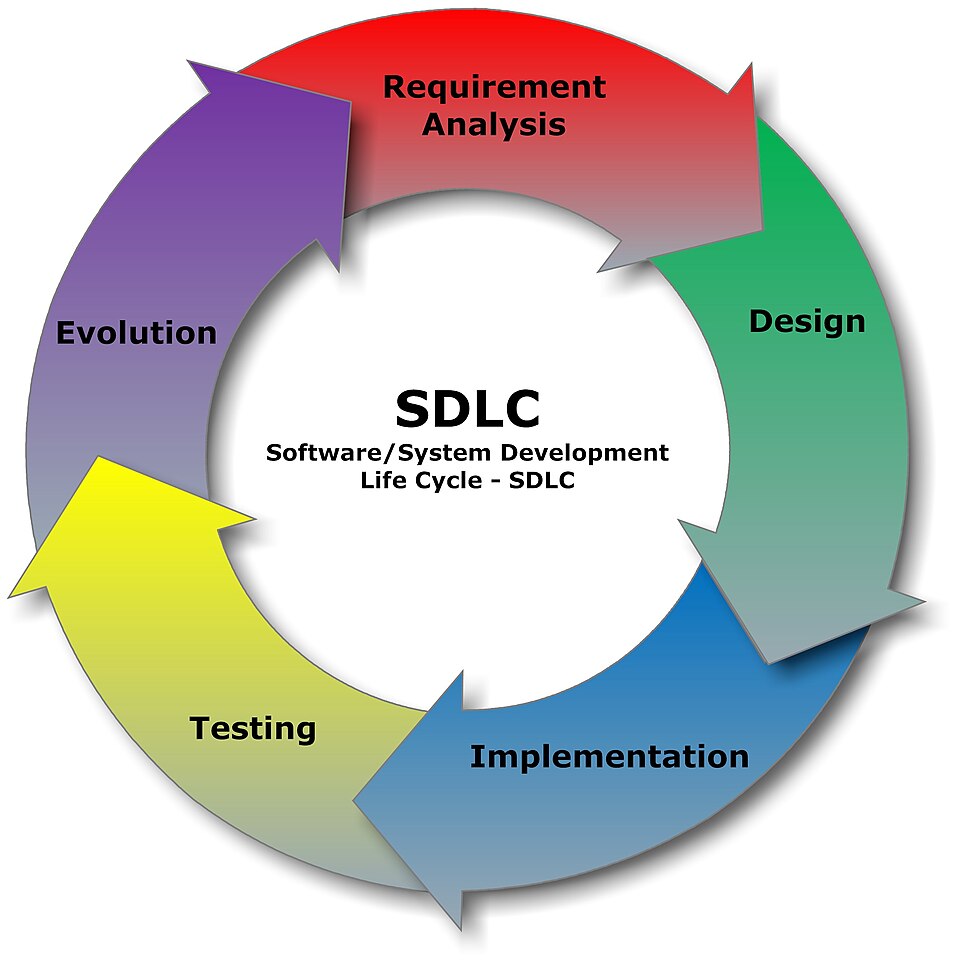 SDLC phases with arrows showing flow (Image: Cliffydcw, CC BY-SA 3.0, via Wikimedia Commons)
Based on the TU BIT syllabus for Artificial Intelligence (BIT252), unit 6.
Discussion
Loading…