PsychologyUnit 912 min read
Social Thought & Behaviors: Attitudes, Conformity, Obedience, Prejudice & Prosocial Acts
Unit 9 of Psychology explores how individuals think, perceive, and act in social contexts, covering attitudes (formation, change, and functions), conformity and obedience (Asch’s and Milgram’s experiments), prejudice and discrimination (real-world impacts), and prosocial behaviors (altruism, cooperation). It links theo
Core Concepts & Definitions
1. Social Thought: Attitudes
Definition: Attitudes are evaluations (positive, negative, or neutral) toward people, objects, or ideas. They shape our thoughts, feelings, and behaviors.
Components of Attitudes (ABC Model)
- Affective: Emotional reactions (e.g., liking/disliking a political leader).
- Cognitive: Beliefs or knowledge (e.g., "Organic food is healthier").
- Behavioral: Actions influenced by attitudes (e.g., voting for a candidate).
Functions of Attitudes
| Function | Example | Real-World Link |
|---|---|---|
| Knowledge | Helps categorize the world (e.g., "Banks are trustworthy"). | Ncell’s branding as reliable. |
| Ego-Defensive | Protects self-esteem (e.g., "I’m better than others"). | Social media comparisons (e.g., Instagram). |
| Value-Expressive | Reflects core values (e.g., "I support environmental conservation"). | Daraz’s sustainability initiatives. |
| Utilitarian | Guides practical decisions (e.g., "I buy from brands with good reviews"). | Khalti’s user trust due to security features. |
How Attitudes Form & Change
- Classical Conditioning: Associating a neutral stimulus with a positive/negative one (e.g., Pavlov’s dogs → liking a brand after seeing a celebrity endorse it).
- Operant Conditioning: Rewards/punishments reinforce attitudes (e.g., praising a child for sharing → prosocial behavior).
- Social Learning: Observing and imitating others (e.g., copying a friend’s political views).
- Persuasion Techniques:
- Foot-in-the-Door: Small requests first, then bigger ones (e.g., charity donations starting with a small ask).
- Door-in-the-Face: Large request first, then a smaller one (e.g., "Can you donate $1000?" → "How about $50?").
- Cognitive Dissonance: Reducing discomfort when attitudes/behaviors clash (e.g., smoking despite knowing it’s harmful).
2. Social Influence: Conformity & Obedience
Conformity (Asch’s Experiment)
- Definition: Changing one’s behavior to match a group’s norms, even if incorrect.
- Why it happens:
- Normative Influence: Fear of rejection (e.g., laughing at a joke you don’t get).
- Informational Influence: Uncertainty → relying on others (e.g., following a crowd in a new city).
- Asch’s Line Judgment Study (1951):
- Participants judged which line matched a standard line. Confederates (actors) gave wrong answers.
- Result: 75% conformed at least once.
- Why? Group pressure, even when the answer is obvious.
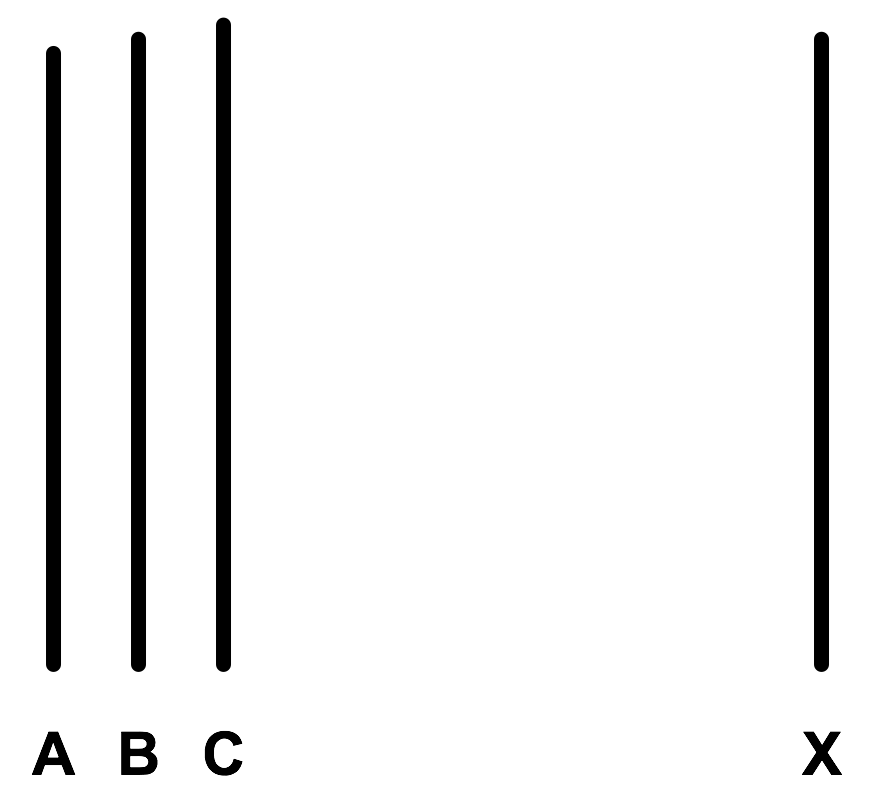 Shows the line-matching setup and participant responses. (Image: Daniel Göhler, CC BY-SA 3.0, via Wikimedia Commons)
Obedience (Milgram’s Experiment)
- Definition: Following orders from an authority figure, even if it conflicts with personal ethics.
- Milgram’s Shock Experiment (1963):
- Participants were told to administer electric shocks to a "learner" (actor) for wrong answers.
- Result: 65% obeyed until the "maximum" shock (450V), despite the learner’s protests.
- Why? Authority figure (experimenter), gradual escalation, diffusion of responsibility.
Real-World Applications
| Scenario | Conformity/Obedience Example | Nepali Context |
|---|---|---|
| Workplace | Employees following unsafe practices because others do. | Factory workers ignoring safety rules. |
| Education | Students copying answers during exams. | Group study cheating in TU exams. |
| Technology | Following trends (e.g., using WhatsApp because everyone else does). | Pathao drivers adopting new routes. |
| Government | Citizens obeying unjust laws due to fear of punishment. | NTC’s traffic rules enforcement. |
3. Prejudice & Discrimination
Definitions
- Prejudice: Prejudgment or negative attitude toward a group (e.g., racism, sexism).
- Discrimination: Behavioral expression of prejudice (e.g., denying a job based on gender).
- Stereotypes: Overgeneralized beliefs about a group (e.g., "All Nepalis are poor").
Theories of Prejudice
| Theory | Explanation | Example |
|---|---|---|
| Scapegoat Theory | Blaming a group for problems (e.g., economic downturn → targeting immigrants). | Anti-Indian sentiment during economic crises. |
| Realistic Conflict | Competition for resources → prejudice (e.g., land disputes → ethnic tensions). | Madhesi vs. Janajati conflicts in Nepal. |
| Social Identity Theory | Boosting self-esteem by favoring in-groups and disliking out-groups. | Caste-based discrimination. |
| Authoritarian Personality | Rigid, conformist people are more prejudiced. | Political leaders using divisive rhetoric. |
Reducing Prejudice
- Contact Hypothesis: Positive interactions between groups reduce prejudice (e.g., school integration programs).
- Education: Teaching critical thinking (e.g., media literacy to counter stereotypes).
- Legal Measures: Anti-discrimination laws (e.g., Nepal’s 2015 Constitution prohibiting caste-based discrimination).
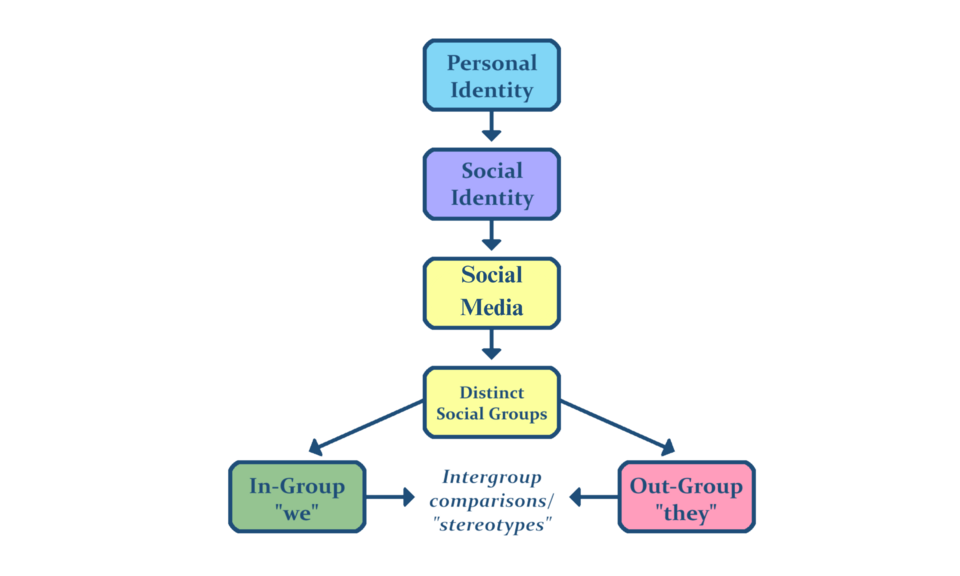 Shows in-group vs. out-group dynamics and self-esteem enhancement. (Image: Daniel Baxter, Public domain, via Wikimedia Commons)
4. Prosocial Behavior
Definitions
- Altruism: Helping others without expecting rewards (e.g., donating blood).
- Cooperation: Working together for mutual benefit (e.g., community clean-up drives).
- Bystander Effect: The more people present, the less likely anyone helps (e.g., Kitty Genovese case).
Why Do People Help?
| Theory | Explanation | Nepali Example |
|---|---|---|
| Empathy-Altruism | Helping because we feel the other’s pain (e.g., rescuing a drowning child). | Volunteers in earthquake relief efforts. |
| Kin Selection | Helping genetic relatives (e.g., caring for a sick sibling). | Family supporting a sick member. |
| Reciprocal Altruism | Expecting future help in return (e.g., sharing food in a group). | Village cooperative farming. |
| Social Exchange | Helping to gain rewards (e.g., praise, social approval). | Donating to a charity for tax benefits. |
Bystander Intervention
flowchart LR
    A["Emergency Occurs"] --> B["Notice the Event"]
    B --> C["Interpret as Emergency"]
    C --> D["Assume Responsibility"]
    D --> E["Know How to Help"]
E --> F["Decide to Help"]- Barriers: Diffusion of responsibility, ambiguity, fear of negative consequences.
In the Real World
eSewa & Khalti (Digital Payments)
- Attitudes & Persuasion: Both apps use foot-in-the-door tactics (e.g., "Pay a small bill first, then we’ll offer discounts") to build user trust.
- Social Influence: Users conform to peer behavior (e.g., "Everyone is using Khalti, so I should too").
Pathao (Ride-Hailing App)
- Obedience: Drivers follow app instructions (e.g., "Take this route") even if it’s less familiar, due to authority of the algorithm.
- Prejudice: Some drivers discriminate against certain areas (e.g., avoiding "unsafe" neighborhoods), reinforcing stereotypes.
Nepal Stock Exchange (NEPSE)
- Groupthink: Investors follow herd mentality (e.g., buying stocks because "everyone is doing it"), leading to bubbles or crashes.
- Conformity: Analysts may avoid dissenting opinions to fit in with the majority view.
Traffic in Kathmandu
- Bystander Effect: During accidents, multiple people may ignore a victim if others are present, assuming someone else will help.
- Prejudice: Traffic police may unfairly target certain groups (e.g., motorcyclists), reflecting societal biases.
Worked Example: Social Media & Attitude Change
Scenario: A TU student sees ads for Daraz claiming "90% off on electronics." The student initially distrusts online shopping but later buys a phone due to peer recommendations.
Analysis:
- Persuasion Technique: Daraz uses authority (customer reviews) and social proof ("10,000+ happy customers").
- Cognitive Dissonance: The student resolves conflict by telling themselves, "I’m smart for saving money this way."
- Conformity: Friends posting about their Daraz purchases reinforce the behavior.
Real-World Tie: This mirrors how Khalti gained users—initial skepticism → trust through word-of-mouth and ease of use.
Exam Tip
Define Key Terms Clearly:
- Always start answers with definitions (e.g., "Conformity is...").
- Use Asch/Milgram for conformity/obedience questions.
Apply Theories to Examples:
- For prejudice, link to Nepal’s caste system or ethnic conflicts.
- For prosocial behavior, use blood donation drives or community service.
Compare & Contrast:
- Conformity vs. Obedience: Conformity = peer pressure; obedience = authority pressure.
- Altruism vs. Reciprocal Altruism: Pure help vs. expected return.
Diagrams Are Your Friends:
- Draw Asch’s line experiment or Milgram’s shock setup for high marks.
- Use flowcharts for bystander intervention or attitude change processes.
Real-World Applications:
- Always tie answers to Nepali contexts (e.g., Khalti, Daraz, NTC traffic rules).
- Mention global examples (e.g., WhatsApp groups, YouTube algorithms) for broader relevance.
Common Pitfalls:
- Don’t confuse prejudice (attitude) with discrimination (action).
- Avoid vague answers—use specific studies (Asch, Milgram) and theories (Social Identity Theory).
Practice Questions for TU Exams
Short Answer:
- "Explain the foot-in-the-door technique with an example from Nepali society."
- "How does the bystander effect explain why no one helped in the 2015 earthquake relief efforts?"
Long Answer (10 marks):
- "Discuss how social media platforms like Facebook use persuasion techniques to change users’ attitudes. Support your answer with theories of attitude change."
- "Analyze the role of conformity and obedience in workplace safety violations, using Milgram’s and Asch’s experiments."
Case Study:
- "A group of TU students refuse to join a protest against exam malpractice because their friends disapprove. Explain this behavior using social influence theories."
Based on the TU BIT syllabus for Psychology (PSY359), unit 9.
Discussion
Loading…