PsychologyUnit 814 min read
Personality: Theories, Assessment, and Applications
Unit 8 of Psychology explores the nature of personality—its definitions, major theories (trait, psychoanalytic, humanistic, and social-cognitive), assessment tools (MMPI, 16PF, MBTI), and real-world applications in IT, leadership, and mental health. Learn how personality shapes behavior, how to measure it, and its role
TAKEAWAYS:
- Personality is the unique pattern of thoughts, feelings, and behaviors that distinguishes one person from another, shaped by biology, environment, and experiences.
- The Big Five traits (OCEAN model)—Openness, Conscientiousness, Extraversion, Agreeableness, and Neuroticism—are the most scientifically validated framework for describing personality.
- Psychoanalytic theories (Freud, Jung) emphasize unconscious drives (id, ego, superego), while humanistic theories (Maslow, Rogers) focus on self-actualization and growth.
- Social-cognitive theories (Bandura) explain personality as a result of interactions between thoughts, behaviors, and environment (e.g., self-efficacy).
- Personality assessments like the MMPI, 16PF, and MBTI are widely used in workplace hiring, therapy, and IT user experience design (e.g., tailoring apps to user traits).
- Personality influences IT-related behaviors, such as adoption of technology (e.g., extraverts prefer social apps like WhatsApp; neurotic users may avoid high-risk apps like eSewa).
1. What is Personality?
Personality refers to the unique and relatively stable patterns of thoughts, emotions, and behaviors that define how a person interacts with the world. It is influenced by:
- Biological factors (genetics, brain structure, hormones).
- Psychological factors (cognitive processes, emotions, past experiences).
- Social and cultural factors (family, peers, societal norms).
Key Characteristics of Personality:
- Consistency: A person’s behavior is relatively stable across situations (though not identical).
- Individual differences: No two people have the exact same personality.
- Adaptability: Personality can change slightly due to major life events (e.g., trauma, career shifts).
Why Study Personality in IT?
In IT, understanding personality helps in:
- User experience (UX) design (e.g., tailoring interfaces for introverts vs. extraverts).
- Team dynamics (e.g., assigning roles based on traits like conscientiousness).
- Cybersecurity awareness (e.g., neurotic users may be more cautious about phishing scams).
2. Major Theories of Personality
Personality theories attempt to explain why people think, feel, and behave the way they do. The four main approaches are:
A. Psychoanalytic/Psychodynamic Theories
Founders: Sigmund Freud, Carl Jung, Alfred Adler. Core Idea: Personality is shaped by unconscious conflicts, early childhood experiences, and psychosexual stages.
Freud’s Structural Model
Freud proposed that personality consists of three interacting systems:
- Id: The primitive, instinctual part (pleasure principle—demands immediate gratification).
- Ego: The rational mediator (reality principle—balances id and superego).
- Superego: The moral conscience (internalized rules from parents/society).
graph TD
    A["Id\n(Unconscious, Pleasure Principle)"] -->|"Demands"| B["Ego\n(Conscious, Reality Principle)"]
    B -->|"Balances"| C["Superego\n(Conscience, Morality)"]
    C -->|"Guilt"| A
    B -->|"Compromise"| A
    B -->|"Controls"| C
Example in Real Life:
- A procrastinator (weak superego) may ignore deadlines (id wins).
- A perfectionist (strong superego) may overwork (superego dominates).
Jung’s Analytical Psychology
Jung expanded Freud’s ideas with:
- Collective unconscious: Shared archetypes (e.g., hero, shadow, anima/animus).
- Personas: The social mask we wear (e.g., a quiet person acting extraverted at work).
- Introversion vs. Extraversion: Key dimension of personality.
Real-World Link:
- eSewa’s user interface is designed for extraverts (social features like sharing payments) but may overwhelm introverts (who prefer privacy).
B. Humanistic Theories
Founders: Carl Rogers, Abraham Maslow. Core Idea: Personality is driven by growth, self-actualization, and positive human potential.
Maslow’s Hierarchy of Needs
Maslow proposed that personality development depends on fulfilling needs in this order:
- Physiological (food, water).
- Safety (security, stability).
- Love/Belonging (friendship, family).
- Esteem (respect, status).
- Self-Actualization (fulfilling potential).
pie
    title Maslow's Hierarchy of Needs
    "Self-Actualization" : 10
    "Esteem" : 15
    "Love/Belonging" : 20
    "Safety" : 25
    "Physiological" : 30
Example in IT:
- Pathao drivers (who work for safety and esteem) may prioritize quick earnings over long-term career growth.
- Software developers (self-actualizing) may choose projects that challenge their creativity.
Rogers’ Self-Theory
- Real Self vs. Ideal Self: Personality is healthy when these align.
- Unconditional Positive Regard: Essential for personal growth.
Real-World Link:
- Khalti’s customer support succeeds because it provides esteem (trust) and safety (secure transactions) to users.
C. Trait Theories
Core Idea: Personality is composed of stable, measurable traits that vary across individuals.
The Big Five (OCEAN) Model
The most widely accepted trait model, consisting of five dimensions:
| Trait | High Score | Low Score | Example in IT Users |
|---|---|---|---|
| Openness | Creative, curious, loves novelty | Practical, traditional | Open users try new apps (e.g., Daraz’s beta features). |
| Conscientiousness | Organized, disciplined | Careless, impulsive | Conscientious users back up data regularly. |
| Extraversion | Sociable, energetic | Reserved, independent | Extraverts use WhatsApp more; introverts prefer email. |
| Agreeableness | Kind, cooperative | Skeptical, competitive | Agreeable users trust Ncell’s customer service. |
| Neuroticism | Anxious, moody | Calm, resilient | Neurotic users avoid high-risk apps (e.g., crypto trading). |
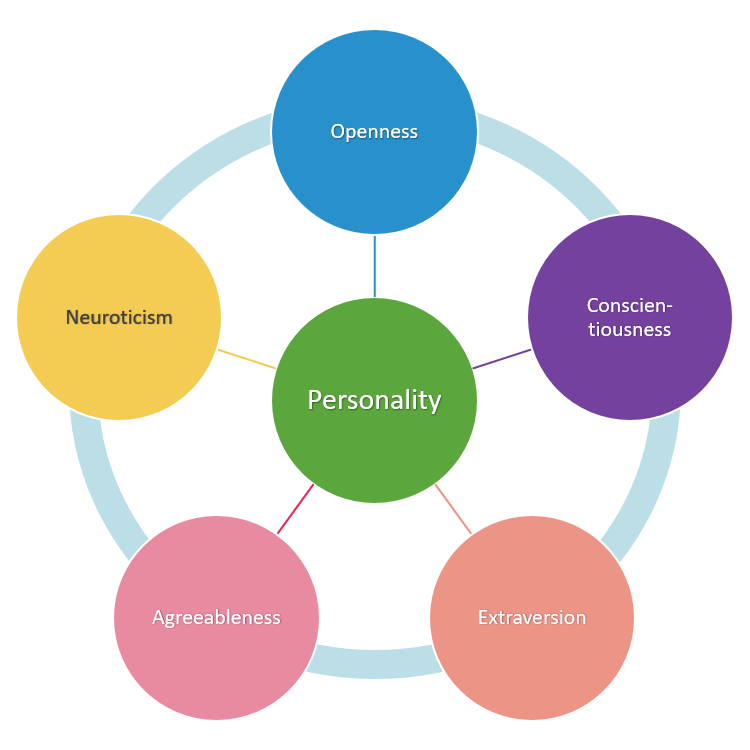 A labeled infographic showing the OCEAN model with real-world examples. (Image: MissLunaRose12, CC BY-SA 4.0, via Wikimedia Commons)
Worked Example: Personality in a Tech Team
- A high-openness developer may propose innovative but risky features.
- A high-conscientiousness tester ensures bug-free code.
- A high-neuroticism project manager may over-stress about deadlines.
D. Social-Cognitive Theories
Founder: Albert Bandura. Core Idea: Personality is shaped by interactions between thoughts, behaviors, and environment.
Key Concepts
- Reciprocal Determinism: Personality is influenced by a three-way interaction between:
- Behavior (what a person does).
- Cognitive factors (thoughts, beliefs).
- Environment (social context).
graph LR
    A["Behavior"] -->|"Influences"| B["Cognitive Factors\n(Beliefs, Expectations)"]
    B -->|"Influences"| C["Environment\n(Social, Cultural)"]
    C -->|"Influences"| A
A -->|"Feedback Loop"| C- Self-Efficacy: A person’s belief in their ability to succeed (e.g., confidence in coding).
- Observational Learning: Learning by watching others (e.g., mimicking a senior developer’s workflow).
Real-World Link:
- YouTube tutorials rely on observational learning—users adopt behaviors they see (e.g., editing videos like a pro).
- NEPSE traders with high self-efficacy take more risks in stock markets.
3. Assessing Personality
Personality is measured using psychometric tests, which help in hiring, therapy, and IT user research.
A. Self-Report Inventories
Users rate their own behaviors/feelings on scales.
| Test | Description | Use in IT/Workplace |
|---|---|---|
| MMPI (Minnesota Multiphasic Personality Inventory) | Detects psychological disorders (e.g., depression, anxiety). | Used in mental health apps (e.g., Woebot). |
| 16PF (16 Personality Factors) | Measures 16 traits (e.g., warmth, intelligence). | Team-building in IT firms. |
| MBTI (Myers-Briggs Type Indicator) | Classifies into 16 types (e.g., INTJ, ESFP). | Job matching (e.g., extraverts in sales). |
| Big Five Inventory (BFI) | Measures OCEAN traits. | UX design (e.g., simplifying apps for neurotic users). |
B. Projective Tests
Users respond to ambiguous stimuli (revealing unconscious traits).
| Test | Example Stimulus | Use Case |
|---|---|---|
| Rorschach Inkblot | Symmetrical inkblots | Clinical psychology (not IT). |
| Thematic Apperception Test (TAT) | Ambiguous images of people | Leadership training (e.g., how managers interpret conflict). |
4. Personality in IT and Real-World Applications
A. User Experience (UX) Design
Personality affects how users interact with technology:
- Extraverts prefer social apps (WhatsApp, Facebook).
- Introverts favor private, minimalist apps (e.g., Notion for solo work).
- High-neuroticism users may avoid complex apps (e.g., preferring eSewa over crypto trading).
Example: Daraz’s Checkout Process
- Conscientious users appreciate detailed product reviews.
- Impulsive users may abandon carts if checkout is too long.
B. Workplace and Leadership
- High-openness leaders encourage innovation (e.g., Google’s "20% time" policy).
- High-agreeableness teams work well in collaborative projects.
- High-neuroticism employees may need stress management training.
C. Mental Health and Therapy
- CBT (Cognitive Behavioral Therapy) uses social-cognitive theories to change maladaptive thoughts.
- Apps like Woebot use MBTI-like assessments to tailor mental health advice.
D. Cybersecurity Awareness
- Neurotic users are more cautious about phishing scams.
- Extraverts may share passwords more easily (higher risk).
5. Criticisms and Limitations
| Theory | Strengths | Weaknesses |
|---|---|---|
| Psychoanalytic | Explains unconscious motives. | Hard to test scientifically. |
| Humanistic | Focuses on growth and positivity. | Too optimistic; ignores dark traits. |
| Trait (Big Five) | Highly research-backed, measurable. | Overlooks situational influences. |
| Social-Cognitive | Explains behavior change. | Ignores biological factors. |
In the Real World
eSewa’s Personality-Based Design
- Extraverts are targeted with social payment features (e.g., splitting bills with friends).
- Conscientious users get reminders for bill payments.
- Neurotic users are reassured with two-factor authentication.
Pathao’s Driver Personality Matching
- High-openness drivers explore new routes (better efficiency).
- High-conscientiousness drivers maintain clean vehicles (higher ratings).
- Impulsive drivers may take risky shortcuts (leading to accidents).
Ncell’s Customer Support Strategy
- Agreeable users respond well to friendly, empathetic agents.
- Neurotic users need clear, step-by-step troubleshooting guides.
- Extraverts prefer live chat; introverts prefer email support.
Exam Tip
How This Unit is Examined
Definitions and Theories (30%)
- Expect short-answer questions on:
- Freud’s id/ego/superego.
- Maslow’s hierarchy.
- Big Five traits.
- Example Question: "Explain Jung’s concept of ‘persona’ with an example from a Nepali workplace."
- Expect short-answer questions on:
Applications (30%)
- Case studies on how personality affects IT, business, or daily life.
- Example Question: "How would you design a mobile app for a user who scores high in neuroticism?"
Comparisons (20%)
- Compare and contrast theories (e.g., Freud vs. Rogers).
- Example Question: "Differentiate between trait and social-cognitive theories of personality."
Critical Analysis (20%)
- Strengths/weaknesses of assessment tools (e.g., MBTI vs. Big Five).
- Example Question: "Why is the MBTI popular despite criticisms? Discuss with reference to IT recruitment."
Marks Boosters
- Use real-world examples (e.g., eSewa, Daraz, Ncell).
- Draw diagrams for theories (e.g., Freud’s iceberg, Maslow’s pyramid).
- Relate to IT (e.g., "How would a high-openness user interact with YouTube?").
- Avoid vague answers—always link theories to observable behaviors.
Quick Revision Table
| Concept | Key Idea | Real-World Example |
|---|---|---|
| Id/Ego/Superego | Unconscious drives vs. rational mediator vs. moral conscience. | A procrastinator (weak superego). |
| Big Five (OCEAN) | Five stable personality traits. | Extraverts use WhatsApp more. |
| Self-Efficacy | Belief in one’s ability to succeed. | A confident coder takes on hard projects. |
| MBTI | 16 personality types (e.g., INTJ, ESFP). | INTJs excel in IT strategy roles. |
| Reciprocal Determinism | Behavior, cognition, and environment interact. | A shy person avoids public speaking (environment reinforces trait). |
Based on the TU BIT syllabus for Psychology (PSY359), unit 8.
Discussion
Loading…