MarketingUnit 36 min read
Consumer & Org Buying Behaviour: Models, Influences & Decision-Making
Unit 3 of Marketing explores the psychological and organizational factors driving consumer and business purchasing decisions, comparing individual vs. group buying processes, key models (Maslow, AIDA, B2B buying center), and real-world applications in Nepali markets like Daraz, Nabil Bank, and Pathao.
Key Concepts & Models
1. Consumer Buying Behaviour
Definition & Process
Consumer buying behaviour refers to the decision-making process individuals or households go through when purchasing goods/services. It involves need recognition → information search → evaluation of alternatives → purchase decision → post-purchase evaluation.
flowchart TD
    A["Need Recognition"] --> B["Information Search"]
    B --> C["Evaluation of Alternatives"]
    C --> D["Purchase Decision"]
    D --> E["Post-Purchase Evaluation"]
    E -->|"Satisfaction"| A
    E -->|"Dissatisfaction"| A
Types of Consumer Buying Decisions
| Type | Description | Example (Nepal) |
|---|---|---|
| Routine Response | Low involvement, frequent purchases (e.g., groceries). | Buying milk from a local shop. |
| Limited Decision | Moderate involvement, occasional purchases (e.g., clothes). | Buying a new phone from Ncell. |
| Extensive Decision | High involvement, infrequent purchases (e.g., cars, homes). | Buying a house in Kathmandu. |
Factors Influencing Consumer Buying
mindmap
root((Consumer Buying Influences))
Cultural
Culture
Subculture
Social Class
Social
Reference Groups
Family
Roles & Status
Personal
Age & Life-Cycle
Occupation
Economic Situation
Psychological
Motivation
Perception
Learning
Beliefs & Attitudes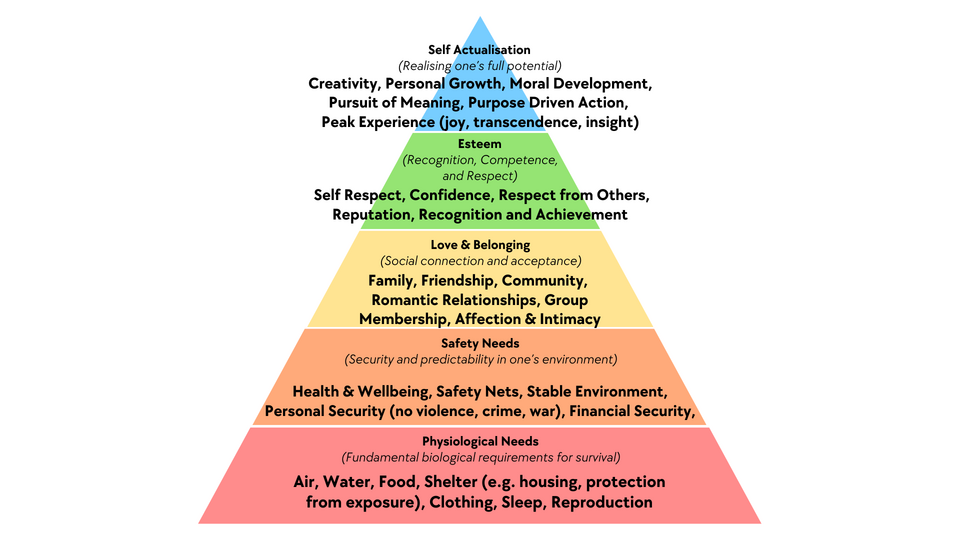 A pyramid showing physiological → safety → social → esteem → self-actualization needs, with a red arrow pointing to Marketing appeals target specific levels. (Image: Hamish.croker, CC BY-SA 4.0, via Wikimedia Commons)
2. Organizational (B2B) Buying Behaviour
Key Differences from Consumer Buying
| Aspect | Consumer Buying | Organizational Buying |
|---|---|---|
| Decision-Makers | Individuals/households. | Buying centers (multiple roles). |
| Purchase Volume | Small, frequent. | Large, infrequent. |
| Buying Process | Emotional & impulsive. | Rational, data-driven. |
| Relationship | Transactional. | Long-term partnerships. |
B2B Buying Center Roles
classDiagram
    class User["User"] { Initiates purchase request }
    class Influencer["Influencer"] { Provides input (e.g., IT department) }
    class Decider["Decider"] { Approves budget }
    class Buyer["Buyer"] { Executes purchase }
    class Gatekeeper["Gatekeeper"] { Controls information flow }
    User --> Influencer : "Consults"
    Influencer --> Decider : "Recommends"
    Decider --> Buyer : "Authorizes"
    Buyer --> Gatekeeper : "Filters suppliers"
3. Real-World Applications in Nepal
Example 1: Daraz’s Consumer Buying Strategy
- Target Segment: Urban youth (18–35) with disposable income.
- Psychological Trigger: Limited decision-making for electronics (e.g., smartphones).
- AIDA Model Application:
- Attention: Ads on Facebook/YouTube showing product unboxing.
- Interest: Discount coupons via email/SMS.
- Decision: "Buy Now" button with free shipping.
- Action: One-click checkout.
- AIDA Model Application:
- Post-Purchase: Reviews and loyalty points to reinforce satisfaction.
Example 2: Nabil Bank’s B2B Loan Approval
- Buying Center: SME owner (User) + Bank manager (Decider) + Auditor (Gatekeeper).
- Process:
- SME applies for a loan (User).
- Bank evaluates financials (Gatekeeper).
- Manager approves based on risk (Decider).
- Loan disbursed (Buyer = Bank’s operations team).
- Psychological Factor: Perception of risk → Bank uses collateral requirements to reduce uncertainty.
Example 3: Pathao’s Ride-Hailing Motivation
- Consumer Motivation (Maslow’s Hierarchy):
- Safety Need: Pre-booked rides for women at night.
- Social Need: Sharing rides to reduce costs (group buying).
- Organizational Buying: Pathao partners with hotels (B2B) for bulk ride discounts, targeting business travelers.
4. Exam Tip
How This Unit is Tested
- Definitions & Models:
- Expect 2–3 marks for definitions (e.g., "Explain the AIDA model").
- Draw diagrams (e.g., Maslow’s hierarchy, B2B buying center) for 5 marks.
- Case Studies:
- 10–15 marks for applying concepts to Nepali companies (e.g., "How does Daraz use consumer behaviour theories?").
- Trace the buying process step-by-step (e.g., "Explain how Ncell sells a postpaid plan to a consumer").
- Comparisons:
- 5 marks for tables comparing consumer vs. organizational buying.
- Short Answers:
- 1–2 marks for listing factors (e.g., "Name 3 social influences on buying behaviour").
Common Pitfalls
- Ignoring the buying center: Always mention all 5 roles (User, Influencer, Decider, Buyer, Gatekeeper) in B2B questions.
- Overlooking post-purchase: Consumer behaviour isn’t just about buying—satisfaction/dissatisfaction is critical.
- Vague examples: Use specific Nepali brands (e.g., "Khalti’s impulse purchases" for routine response).
Worked Example: Kathmandu Traffic Routes as a Consumer Decision Model
Scenario: A student chooses between bus, Pathao, or walking to reach TU’s Central Campus.
- Need Recognition: Needs to reach campus on time.
- Information Search:
- Cultural: Family advises against buses due to safety.
- Social: Friends use Pathao for reliability.
- Personal: Budget limits Pathao to ₹200.
- Evaluation:
- Bus: Cheap (₹20) but unreliable (traffic delays).
- Pathao: Reliable but expensive (₹200).
- Walking: Free but takes 45 mins (vs. 20 mins by Pathao).
- Decision: Chooses Pathao (compromise between cost and time).
- Post-Purchase: If delayed, may switch to walking next time (learning).
Key Takeaways for Exams
- Consumer Behaviour: Focus on psychological (Maslow, AIDA) + social factors.
- B2B Behaviour: Remember the buying center roles and rational decision-making.
- Nepal Context: Link theories to Daraz, Ncell, banks, and Pathao for higher marks.
- Diagrams: Always draw models (e.g., Maslow’s pyramid, buying center flowchart).
Based on the TU BIT syllabus for Marketing, unit 3.
Discussion
Loading…