MarketingUnit 89 min read
Distribution Channels, Supply Chain, Logistics & Retail Strategies
Unit 8 of Marketing explores how goods move from producers to consumers—covering distribution channels, supply chain management, logistics, retail formats, and e-commerce strategies with real-world Nepali/Global case studies and exam-focused visuals.
Core Concepts: Definitions & How They Work
1. Distribution Channels: The Path to the Customer
Definition: A distribution channel is the route through which a product travels from the manufacturer to the end consumer. It includes intermediaries like wholesalers, retailers, and agents who facilitate the flow of goods, services, and information.
Types of Distribution Channels
graph TD
    A["Direct Channel"] --> B["Producer → Consumer"]
    C["Indirect Channel"] --> D["Producer → Retailer → Consumer"]
    C --> E["Producer → Wholesaler → Retailer → Consumer"]
    C --> F["Producer → Agent/Broker → Wholesaler → Retailer → Consumer"]
    G["Hybrid Channel"] --> H["Producer → E-commerce (e.g., Daraz) + Physical Stores"]
How It Works:
- Direct Channel: Sells straight to consumers (e.g., Apple’s online store, Nabil Bank’s ATMs).
- Indirect Channel: Uses intermediaries to reach customers (e.g., Daraz selling Himalayan Java coffee via wholesalers).
- Hybrid Channel: Combines online and offline (e.g., Pathao delivering food from restaurants to homes).
Worked Example: Nepal’s NTC (Nepal Telecom) Distribution:
- Channel: Producer (NTC) → Retailers (e.g., Ncell stores, authorized dealers) → Consumer.
- Why? NTC cannot sell SIMs directly to every village; retailers handle last-mile delivery.
2. Supply Chain Management (SCM): The Backbone of Logistics
Definition: A supply chain is the network of all parties involved in producing and delivering a product, from raw materials to the final consumer. Supply Chain Management (SCM) coordinates these flows to maximize efficiency.
Key Components of SCM
mindmap
  root((Supply Chain))
    Suppliers
    Manufacturers
    Warehouses
    Transportation
    Retailers
    Customers
How It Works:
- Upstream: Raw materials → Production (e.g., Himalayan Java sourcing coffee beans from farmers).
- Downstream: Distribution → Consumers (e.g., Daraz delivering orders via Pathao).
- Reverse Logistics: Returns, recycling (e.g., Nepal’s NTC recycling old SIM cards).
Real-World Trace: Daraz’s Supply Chain
- Supplier: Factories in China/India.
- Warehouse: Daraz’s fulfillment centers in Kathmandu/Lalitpur.
- Transport: Pathao/Khalti Cash on Delivery (COD) partners.
- Customer: Home delivery in 24–48 hours.
3. Logistics: The Art of Moving Goods
Definition: Logistics is the process of planning, implementing, and controlling the efficient flow of goods, services, and information from point of origin to consumption.
Logistics Activities
graph LR
    A["Transportation"] --> B["Road/Rail/Air/Sea"]
    C["Warehousing"] --> D["Storage & Inventory"]
    E["Inventory Management"] --> F["Just-in-Time (JIT) vs. Bulk"]
    G["Packaging"] --> H["Protecting Goods"]
    I["Information Flow"] --> J["ERP Systems (e.g., SAP)"]
Worked Example: Nepal’s Traffic Jam Problem (Logistics Challenge)
- Issue: Kathmandu’s narrow roads delay Khalti Cash deliveries.
- Solution: Pathao uses optimized routes via GPS (like Google Maps for logistics).
4. Retail Formats: Where Consumers Meet Products
Definition: Retail is the final step in the distribution channel where consumers purchase goods. Different formats serve different needs.
Types of Retailers
| Retail Format | Example (Nepal/Global) | Key Feature | Pros | Cons |
|---|---|---|---|---|
| Department Store | Big Mart, Mega Mart | Multiple product categories under one roof | One-stop shopping | High overhead costs |
| Supermarket | Biggest Supermarket | Self-service, grocery focus | Competitive pricing | Limited non-grocery items |
| Convenience Store | 7-Eleven, local kirana | Small, quick purchases | 24/7 availability | Higher per-unit prices |
| Specialty Store | Himalayan Java, Nabil Bank | Niche products/services | Expertise & personalized service | Limited product range |
| E-commerce | Daraz, Sastodeal | Online sales via websites/apps | Global reach, 24/7 access | Returns/logistics challenges |
| Direct Selling | Amway, Tupperware parties | Door-to-door or home parties | Personalized interaction | High commission costs |
Real-World Case: Himalayan Java’s Retail Strategy
- Direct Sales: Coffee shops in Thamel.
- E-commerce: Online store with home delivery.
- Wholesale: Supplies to hotels/restaurants.
5. E-Commerce & Digital Distribution
Definition: E-commerce is buying/selling goods/services online via websites, apps, or social media.
How E-Commerce Works in Nepal
sequenceDiagram
    participant Customer
    participant Daraz
    participant Pathao
    participant Bank
    Customer->>Daraz: Orders product online
    Daraz->>Pathao: Dispatches order
    Pathao->>Customer: Delivers product
    Customer->>Bank: Pays via Khalti/Mobile Banking
    Bank-->>Daraz: Transfers payment
Example: Khalti’s Role in E-Commerce
- Payment Gateway: Enables Daraz/Sastodeal to accept digital payments.
- Cash on Delivery (COD): Still dominant in rural Nepal due to low internet penetration.
6. Supply Chain Challenges in Nepal
Key Issues & Solutions
| Challenge | Cause | Solution |
|---|---|---|
| Infrastructure Gaps | Poor roads, unreliable electricity | Use hybrid logistics (e.g., Pathao bikes + trucks) |
| Last-Mile Delivery | Rural areas lack addresses | Partner with local kirana shops |
| Inventory Management | Seasonal demand (e.g., umbrellas in monsoon) | Just-in-Time (JIT) inventory |
| Payment Barriers | Low digital literacy | Offer COD + mobile banking options |
Case Study: NTC’s SIM Distribution
- Problem: Remote villages have no NTC stores.
- Solution: Mobile vans with SIMs + Khalti payments.
In the Real World
Pathao’s Logistics Network
- Idea Used: Last-mile delivery optimization (like Uber Eats).
- How? Uses GPS to avoid Kathmandu traffic jams, reducing delivery time by 30%.
Daraz’s Supply Chain in Nepal
- Idea Used: Hybrid distribution channels (online + physical warehouses).
- How? Stores products in Kathmandu/Lalitpur hubs for faster delivery.
Nabil Bank’s ATM Network
- Idea Used: Direct distribution channel (bank → customer).
- How? ATMs in every major city ensure cash access without intermediaries.
Himalayan Java’s Coffee Supply Chain
- Idea Used: Vertical integration (farmer → roaster → retailer).
- How? Controls quality from bean sourcing to café sales.
Nepal’s NTC & Ncell Partnership
- Idea Used: Strategic alliances for distribution.
- How? NTC uses Ncell’s retail stores to sell SIMs nationwide.
Exam Tip
How This Unit is Tested
Definitions & Differences
- Expect questions on:
- Direct vs. indirect channels.
- Push vs. pull supply chains.
- Just-in-Time (JIT) vs. bulk inventory.
- Expect questions on:
Case Studies & Scenarios
- Example Question:
"How would you design a distribution channel for a new organic vegetable brand in Nepal?"
Answer Structure:
- Channel: Producer → Local wholesalers → Kirana shops → Consumers (direct to urban areas).
- Logistics: Partner with Pathao for last-mile delivery.
- Retail: Sell via eSewa for online orders.
- Example Question:
"How would you design a distribution channel for a new organic vegetable brand in Nepal?"
Answer Structure:
Diagrams & Flowcharts
- Draw:
- A supply chain network for a Nepali product (e.g., Himalayan Java).
- A distribution channel for NTC SIMs.
- A retail format comparison table (as above).
- Draw:
Numerical Problems
- Example:
"A retailer buys 100 units at ₹50 each and sells at ₹75. If the wholesaler charges a 10% commission, calculate the retailer’s profit per unit."
- Solution:
- Cost to retailer = ₹50 + 10% commission = ₹55.
- Selling price = ₹75.
- Profit = ₹75 – ₹55 = ₹20 per unit.
- Solution:
- Example:
"A retailer buys 100 units at ₹50 each and sells at ₹75. If the wholesaler charges a 10% commission, calculate the retailer’s profit per unit."
Real-World Applications
- Link concepts to Nepali companies:
- Daraz: E-commerce distribution.
- Pathao: Last-mile logistics.
- NTC/Ncell: Direct vs. indirect channels.
- Link concepts to Nepali companies:
Final Advice:
- Memorize: Channel types, SCM components, retail formats.
- Practice: Draw diagrams for case studies (e.g., Chaudhary Group’s supply chain).
- Relate to Nepal: Always use local examples (e.g., Khalti payments in e-commerce).
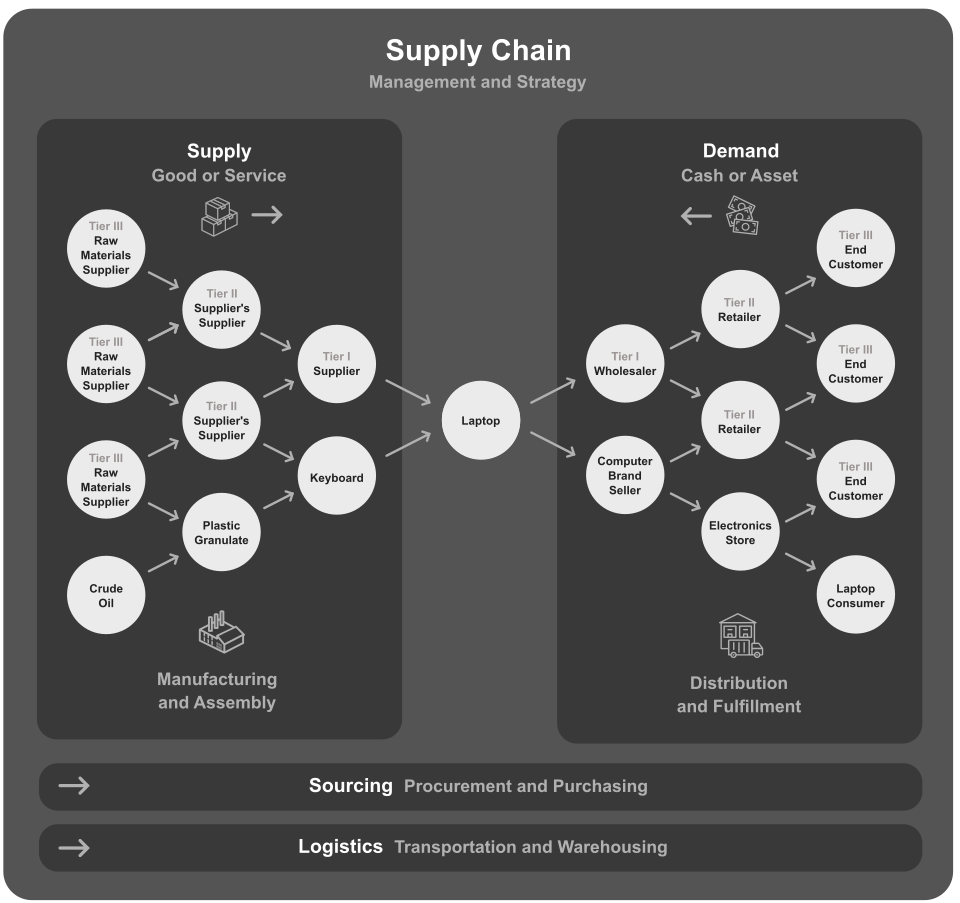 A labeled flowchart showing suppliers → manufacturers → warehouses → retailers → customers. (Image: Miguel Garcia Gonzalez, CC BY-SA 4.0, via Wikimedia Commons)
Based on the TU BIT syllabus for Marketing, unit 8.
Discussion
Loading…