Software Project ManagementUnit 911 min read
Coordination, Leadership & Org Dependencies in Projects
Unit 9 of Software Project Management explores how teams coordinate across organizational boundaries, compares leadership styles (autocratic, democratic, laissez-faire), maps dependency types (internal/external, sequential/reciprocal), and analyzes real-world project coordination challenges using tools like RACI matric
TAKEAWAYS:
- Coordination bridges gaps between project teams and external stakeholders using tools like RACI matrices and communication plans.
- Leadership styles (autocratic, democratic, laissez-faire) impact team performance—choose based on project urgency and team expertise.
- Organizational dependencies (internal vs. external) require clear contracts, SLAs, and buffer management to avoid delays.
- Conflict resolution techniques (collaborating, compromising, forcing) depend on the situation’s urgency and importance.
- Agile coordination relies on daily standups, sprint planning, and cross-functional teams to adapt to changing dependencies.
- Case studies (eSewa’s API integrations, Daraz’s vendor coordination) show how real projects handle dependencies in practice.
Core Concepts: Coordination in Projects
Coordination ensures that all project activities, teams, and stakeholders work harmoniously to meet deadlines and quality standards. Poor coordination leads to:
- Delays (e.g., a bank’s loan processing system failing due to misaligned IT and finance teams).
- Budget overruns (e.g., NTC’s fiber-optic project delays costing millions in penalties).
- Quality issues (e.g., Pathao’s driver-app mismatch causing customer complaints).
Types of Coordination Dependencies
Dependencies are relationships where one task or team cannot proceed without another. They are classified into:
mindmap
  root((Coordination Dependencies))
    Internal
      Task Dependencies
        Finish-to-Start (FS)
        Start-to-Start (SS)
        Finish-to-Finish (FF)
        Start-to-Finish (SF)
      Resource Dependencies
        Shared Resources (e.g., developers, servers)
        Limited Resources (e.g., testers, budget)
    External
      Organizational Dependencies
        Vendor Dependencies (e.g., Daraz relying on third-party logistics)
        Stakeholder Dependencies (e.g., NEPSE requiring regulatory approvals)
      Inter-Project Dependencies
        Shared Teams (e.g., IT team working on multiple bank projects)
        Shared Infrastructure (e.g., cloud services like AWS)
Key Definitions:
| Dependency Type | Example | Risk if Unmanaged |
|---|---|---|
| Task Dependency | A software module cannot be tested until coding is complete. | Delays in testing phase. |
| Resource Dependency | Two projects competing for the same QA team. | Reduced quality in both projects. |
| External Dependency | A project relies on a third-party API (e.g., eSewa using Khalti’s payment gateway). | API downtime halts transactions. |
| Organizational | A bank’s loan system depends on the RBI’s approval process. | Regulatory delays stall project. |
How Coordination Works: Tools and Techniques
RACI Matrix
- Assigns roles to team members for each task:
- Responsible (does the work)
- Accountable (owns the outcome)
- Consulted (provides input)
- Informed (kept updated)
- Example: In a Khalti payment integration project, the RACI might look like this:
Task: API Integration
Developer (R), Project Manager (A), Security Team (C), Finance (I)
- Assigns roles to team members for each task:
Communication Plans
- Defines who communicates what, when, and how (meetings, emails, tools like Slack/Teams).
- Example: NTC’s fiber-optic project uses weekly syncs between civil engineers and IT teams to avoid misalignment.
Dependency Mapping
- Visualizes dependencies using Gantt charts or precedence diagrams.
- Example: For eSewa’s new feature rollout, dependencies might include:
- Backend development → API testing → Frontend integration → UAT.
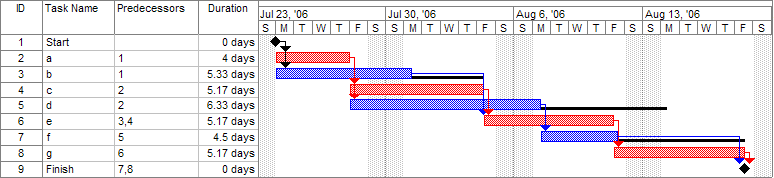 A Gantt chart showing task dependencies in a software project (e.g., coding → testing → deployment). (Image: Dbsheajr at English Wikipedia, CC BY-SA 3.0, via Wikimedia Commons)
Leadership Styles in Project Management
Leadership directly impacts team motivation, decision-making speed, and project success. Three primary styles:
classDiagram
  class LeadershipStyle {
    +Name: String
    +Description: String
    +BestFor: String[]
    +Risks: String[]
  }
  LeadershipStyle <|-- Autocratic
  LeadershipStyle <|-- Democratic
  LeadershipStyle <|-- LaissezFaire
  Autocratic : +Name = "Autocratic" +Description = "Leader makes decisions alone" +BestFor = ["Crises", "Tight deadlines"] +Risks = ["Low team morale", "High turnover"]
  Democratic : +Name = "Democratic" +Description = "Team input in decisions" +BestFor = ["Creative projects", "Long-term teams"] +Risks = ["Slower decisions", "Conflict if unmanaged"]
  LaissezFaire : +Name = "Laissez-Faire" +Description = "Hands-off approach" +BestFor = ["Experienced teams", "Innovative work"] +Risks = ["Lack of direction", "Poor accountability"]
When to Use Which Style?
| Style | Best For | Example in Nepal | Risk |
|---|---|---|---|
| Autocratic | Crises, urgent fixes | NTC’s emergency network repair during a blackout. | Team disengagement. |
| Democratic | Agile teams, innovation | Daraz’s product development team brainstorming new features. | Decision delays. |
| Laissez-Faire | Highly skilled teams (e.g., R&D) | A startup’s backend developers working on AI models. | Lack of progress tracking. |
Worked Example: Scenario: A bank is launching a new mobile loan approval system with a 3-month deadline.
- Autocratic: The PM makes all decisions quickly but risks developer burnout.
- Democratic: The team suggests a two-week sprint cycle, improving buy-in but slowing initial progress.
- Laissez-Faire: Developers work independently but miss deadlines due to unclear priorities.
Best Choice: Democratic with autocratic phases (e.g., democratic for design, autocratic for final approval).
Organizational Dependencies: Managing External Factors
External dependencies involve third parties, regulations, or other projects. Common types:
Vendor Dependencies
- Example: Pathao relies on Google Maps API for real-time traffic updates.
- Risk: API changes or downtime disrupts the app.
- Mitigation: Use Service Level Agreements (SLAs) and backup APIs.
Regulatory Dependencies
- Example: Nepal Rastra Bank (NRB) approvals for a new fintech product.
- Risk: Delays in compliance can halt the project.
- Mitigation: Start regulatory discussions early and assign a compliance officer.
Inter-Project Dependencies
- Example: NTC’s fiber project depends on the Ministry of Communications for land permits.
- Risk: Permit delays cause cost overruns.
- Mitigation: Include buffer time in the schedule.
Conflict Resolution in Projects
Conflicts arise due to miscommunication, resource clashes, or differing priorities. Use the Thomas-Kilmann Conflict Mode Instrument to choose a strategy:
stateDiagram-v2
  [*] --> ChoosingStrategy
  ChoosingStrategy --> Collaborating : High assertiveness, high cooperation
  ChoosingStrategy --> Compromising : Moderate assertiveness, moderate cooperation
  ChoosingStrategy --> Forcing : High assertiveness, low cooperation
  ChoosingStrategy --> Avoiding : Low assertiveness, low cooperation
  ChoosingStrategy --> Accommodating : Low assertiveness, high cooperation
  Collaborating --> Resolved : Best for win-win situations
  Compromising --> Resolved : Quick but may not satisfy all
  Forcing --> Resolved : Fast but risks resentment
  Avoiding --> Unresolved : Temporary fix, may worsen
  Accommodating --> Resolved : Good for maintaining relationships
Example: Scenario: Two teams in a banking software project are competing for the same QA tester.
- Collaborating: Both teams agree to share the tester for critical phases.
- Compromising: One team gets the tester for first two weeks, the other for the next two.
- Forcing: The PM assigns the tester to the higher-priority team, risking resentment.
Best Approach: Collaborating (if time allows) or compromising (for urgent projects).
In the Real World
eSewa’s API Integrations
- Dependency: eSewa relies on Khalti, IME Pay, and Nabil Bank APIs for payments.
- Coordination: Uses RACI matrices to assign roles (e.g., Khalti team is Consulted on payment failures).
- Risk Mitigation: Maintains backup payment gateways to avoid downtime.
Daraz’s Vendor Coordination
- Dependency: Daraz’s third-party logistics (3PL) partners (e.g., DHL, GDS) handle deliveries.
- Conflict: A vendor delays shipments due to traffic in Kathmandu.
- Solution: Daraz uses real-time tracking tools and penalty clauses in contracts.
NTC’s Fiber-Optic Project
- Dependency: Civil engineers and IT teams must sync cable laying with network configuration.
- Tool Used: Gantt charts to show sequential dependencies (e.g., "Cable laid → Network tested").
- Challenge: Monsoon rains delay fieldwork → buffer time added in the schedule.
Nepal Rastra Bank (NRB) Compliance
- Dependency: Any fintech project (e.g., a new digital wallet) must get NRB approval.
- Coordination: Projects start regulatory discussions 6 months early to avoid delays.
- Tool Used: Dependency mapping in project plans to track approval timelines.
Pathao’s Driver-App Sync
- Dependency: Driver availability affects app performance.
- Conflict: Drivers go offline during peak hours, causing customer complaints.
- Solution: Pathao uses real-time dashboards to monitor driver status and incentivizes online drivers.
Exam Tip
For "Explain leadership styles":
- Must include: Definitions, pros/cons, and real-world examples (e.g., autocratic for NTC emergencies, democratic for Daraz’s product teams).
- Avoid: Generic descriptions without project scenarios.
For "Classification of coordination dependencies":
- Structure your answer using a table (like above) with examples from Nepalese companies (e.g., eSewa’s APIs, NTC’s vendors).
- Key points to cover:
- Internal vs. external dependencies.
- Task vs. resource vs. organizational dependencies.
- Tools used (RACI, Gantt charts, SLAs).
Worked Examples:
- Always tie to a real scenario (e.g., "How would you handle a delay in Khalti’s API for eSewa?").
- Use visuals (e.g., draw a dependency map for a bank’s loan system).
Common Pitfalls:
- Don’t confuse "coordination" with "communication." Coordination is action-oriented (e.g., assigning tasks via RACI).
- Don’t forget external dependencies—examiners love questions on vendor/regulatory risks.
Final Checklist Before Exam: ✅ Can you draw a RACI matrix for a given project? ✅ Can you classify dependencies in a real-world example (e.g., Daraz’s logistics)? ✅ Can you match leadership styles to project scenarios (e.g., autocratic for crises)? ✅ Can you resolve a conflict using the Thomas-Kilmann model?
Based on the TU BIT syllabus for Software Project Management (BIT402), unit 9.
Discussion
Loading…