Introduction to TelecommunicationsUnit 815 min read
Cellular Mobile Communication: 2G/3G/4G/5G, GSM/CDMA, Handoff, Spectrum, IoT
Unit 8 of Introduction to Telecommunications covers cellular mobile systems: how they divide coverage into cells, assign frequencies, route calls via base stations, and evolve from 2G to 5G. You’ll learn GSM/CDMA standards, handoffs, spectrum allocation, and real-world deployments in Nepal (Ncell, NTC) and globally (Wh
TAKEAWAYS:
- Cellular networks divide coverage into hexagonal cells (macro, micro, pico) to reuse frequencies and avoid interference, with base stations (BTS) handling calls in each cell.
- GSM (2G/3G) uses FDMA+TDMA and circuit switching, while CDMA (used in Ncell’s older networks) uses spread spectrum and code division for multiple users.
- Handoff (handover) seamlessly transfers a call from one cell to another as a user moves, using measurement reports and target cell selection.
- 5G introduces massive MIMO, beamforming, and network slicing to support ultra-low latency (for autonomous cars) and IoT (for smart meters).
- Spectrum allocation in Nepal is managed by NTCC, with licensed bands (700 MHz, 1800 MHz) for voice/data and unlicensed (2.4 GHz, 5 GHz) for Wi-Fi/IoT.
- IoT in cellular uses NB-IoT (low-power wide-area) for devices like smart water meters (eSewa’s utility billing) or traffic sensors (Kathmandu’s smart city pilot).
1. Cellular Network Basics: Cells, Frequencies, and Base Stations
How Coverage Works: Hexagonal Cells and Frequency Reuse
Cellular networks divide geographic areas into hexagonal cells (why hexagons? Minimizes overlap and gaps). Each cell has a Base Transceiver Station (BTS) that communicates with mobile devices. To maximize spectrum efficiency, the same frequencies are reused in non-adjacent cells (reuse factor K = 4 or 7).
graph TD
    A["Macro Cell\n(Rural, 1-35 km radius)"] -->|"Frequency F1"| B["Micro Cell\n(Urban, 100m-2km)"]
    A -->|"Frequency F2"| C["Pico Cell\n(Indoor, <100m)"]
    B -->|"Frequency F1"| D["Femto Cell\n(Home, <10m)"]
Why hexagons?
- Coverage areas with minimal overlap (unlike circles/squares).
- Reuse distance (D) = R × √3 × K (where R = cell radius, K = reuse factor).
- Example: If K = 4 and R = 1 km, D = 6.93 km. Ncell’s 1800 MHz band uses K = 4 in Kathmandu.
Base Stations (BTS) and Their Types
| Type | Range | Use Case | Power | Example in Nepal |
|---|---|---|---|---|
| Macro BTS | 1–35 km | Rural, highways | 20–40 W | NTC towers in Chitwan |
| Micro BTS | 100 m–2 km | Urban streets | 2–10 W | Ncell in Thamel |
| Pico BTS | <100 m | Indoor (malls, hotels) | <1 W | Daraz warehouses |
| Femto BTS | <10 m | Home/office | <0.1 W | Ncell’s home Wi-Fi extenders |
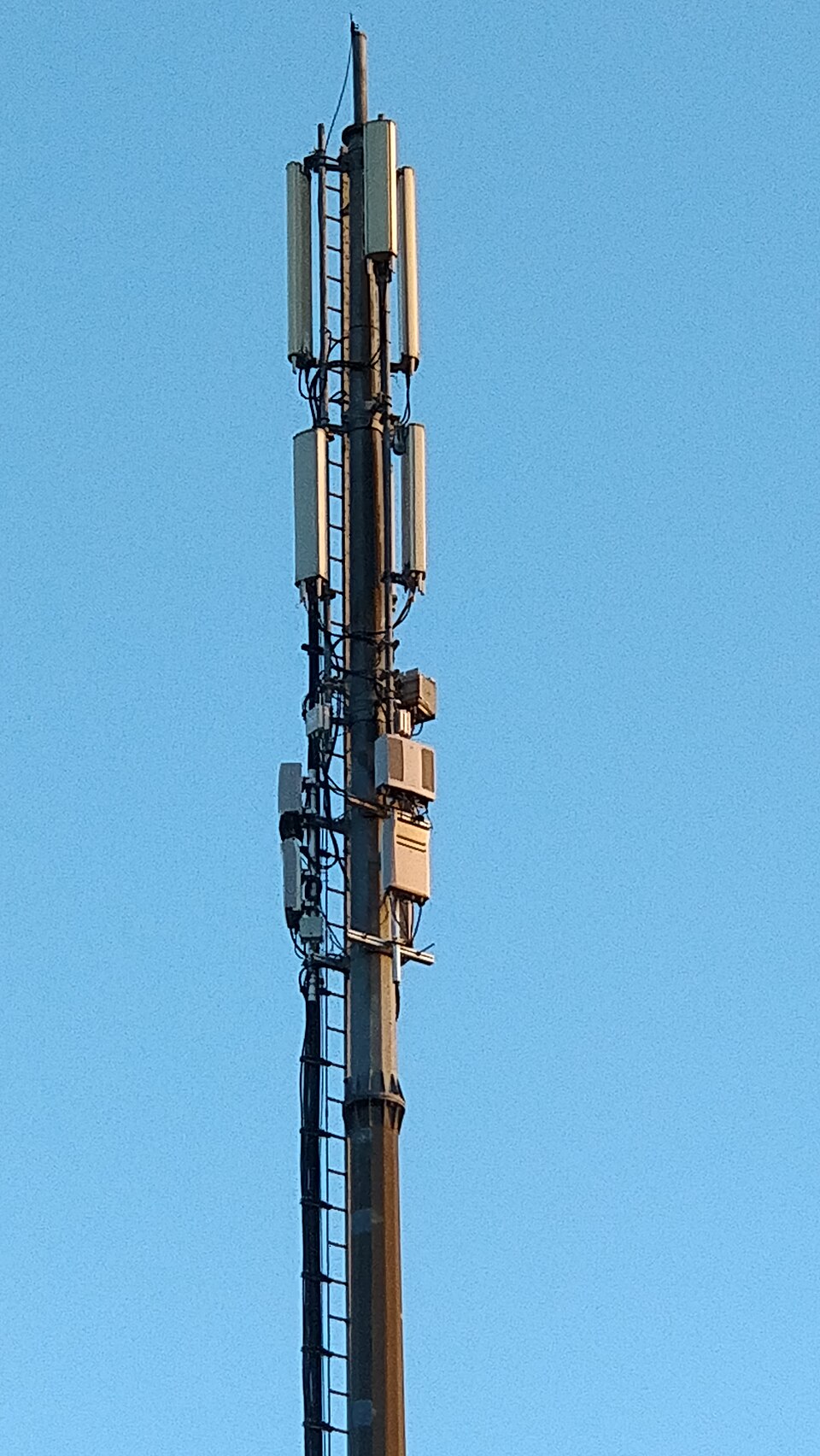 Ncell 4G macro BTS with sector antennas (Image: Arto Alanenpää, CC BY-SA 4.0, via Wikimedia Commons)
Real-world link: NTC’s 700 MHz towers cover remote areas like Darchula (must use macro cells due to low population density).
Ncell 4G macro BTS with sector antennas (Image: Arto Alanenpää, CC BY-SA 4.0, via Wikimedia Commons)
Real-world link: NTC’s 700 MHz towers cover remote areas like Darchula (must use macro cells due to low population density).
2. Multiple Access Techniques: GSM vs. CDMA
GSM (Global System for Mobile Communications)
- Standard: 2G (voice), 3G (HSDPA for data).
- Multiple Access: FDMA (Frequency Division) + TDMA (Time Division).
- FDMA: Divides spectrum into 200 kHz channels (e.g., 900 MHz band).
- TDMA: Each channel split into 8 time slots (users take turns).
- Channel Structure:
- Pros: Simple, widely deployed (Nepal: Ncell, NTC).
- Cons: Limited capacity (only 8 users per channel).
CDMA (Code Division Multiple Access)
- Standard: Used by Ncell’s older CDMA2000 networks (now phased out for LTE/5G).
- How it works:
- All users share the same frequency and time slot.
- Each user gets a unique pseudo-noise code (e.g., Walsh codes).
- Spread spectrum: Signal spread over 1.25 MHz (vs. GSM’s 200 kHz).
- Channel Structure:
- Pros: Higher capacity (more users per MHz), soft handoff (seamless call transfer).
- Cons: Complex, requires precise power control (Ncell’s CDMA networks are being replaced by LTE).
Comparison Table:
| Feature | GSM (FDMA/TDMA) | CDMA (Code Division) |
|---|---|---|
| Spectrum Use | Fixed channels | All users share spectrum |
| Capacity | Lower (8 slots/channel) | Higher (theoretically unlimited) |
| Handoff | Hard handoff (break before make) | Soft handoff (no break) |
| Nepal Use | NTC, Ncell (2G/3G) | Ncell (older CDMA2000) |
| Data Speed | 384 kbps (3G) | 3.1 Mbps (EV-DO Rev. A) |
Real-world example:
- Ncell’s migration: Initially used CDMA2000 (2000s), then switched to GSM (2010s), and now LTE/5G. Why? CDMA’s complexity made upgrades harder, while GSM’s global standards allowed cheaper equipment.
3. Handoff (Handover) Mechanisms
When a mobile user moves between cells, the network must transfer the call/data session without dropping it. Two types:
A. Hard Handoff (GSM)
- Mobile measures signal strength from neighboring cells.
- When target cell’s signal > current cell + threshold, mobile requests handoff.
- Break before make: Call drops briefly during switch.
- Example: Crossing from Thamel (Ncell micro cell) to Kathmandu Durbar Square (NTC macro cell).
B. Soft Handoff (CDMA)
- Mobile connects to new cell before breaking old one.
- No call drop: Both cells transmit simultaneously.
- More spectrum needed (since both cells use the same code).
- Example: Driving on Ring Road (seamless switch between Ncell and NTC towers).
sequenceDiagram
    participant Mobile
    participant CurrentBTS
    participant NewBTS
    participant MSC

    Mobile->>CurrentBTS: Measures neighbor cells (RSCP > -80 dBm)
    Mobile->>NewBTS: Handoff Request
    NewBTS->>MSC: Handoff Required
    MSC->>CurrentBTS: Prepare Handoff
    MSC->>NewBTS: Assign Resources
    MSC->>Mobile: Handoff Command
    Mobile->>NewBTS: Sync & Start Transmission
    CurrentBTS-->>Mobile: Release (Hard Handoff)
    Note over Mobile,NewBTS: Soft Handoff: Both BTSs transmit simultaneously
Worked Example:
- Scenario: You’re in a bus from Bhaktapur to Kathmandu, moving from Ncell’s micro cell to NTC’s macro cell.
- Steps:
- Your phone measures NTC’s signal = -75 dBm (stronger than Ncell’s -85 dBm).
- Phone sends Measurement Report to Ncell’s BTS.
- Ncell’s MSC (Mobile Switching Center) decides handoff to NTC.
- Hard handoff: Call briefly drops (you hear a click).
- NTC takes over; call resumes.
Why does this matter?
- Drop calls annoy users (Nepal’s complaint rate is high in hilly areas due to poor handoff).
- 5G solves this with predictive handoff (AI anticipates your movement).
4. Evolution of Cellular Standards: 2G to 5G
| Generation | Year | Speed | Key Tech | Nepal Status | Real-World Use in Nepal |
|---|---|---|---|---|---|
| 1G | 1980s | Analog voice | FDMA | Never deployed | — |
| 2G (GSM) | 1990s | 9.6 kbps | TDMA, Circuit Switching | NTC, Ncell (still used) | Voice calls, SMS |
| 2.5G (GPRS) | 2000s | 56–114 kbps | Packet Switching | Ncell | Basic internet (eSewa app) |
| 3G (UMTS) | 2000s | 384 kbps–2 Mbps | HSDPA, OFDM | Ncell (limited coverage) | YouTube, WhatsApp calls |
| 4G (LTE) | 2010s | 100 Mbps–1 Gbps | OFDMA, MIMO | Ncell, NTC (nationwide) | Pathao rides, Daraz orders |
| 5G | 2020s | 1–10 Gbps | mmWave, Network Slicing, URLLC | Pilot in Kathmandu (2023) | Smart cities, IoT (Nepal Police drones) |
Key 5G Features
- Ultra-Reliable Low Latency (URLLC):
- <1 ms latency (vs. 4G’s 30 ms).
- Example: Autonomous buses in Kathmandu (real-time braking decisions).
- Massive MIMO:
- 64+ antennas per BTS to focus beams on users.
- Example: Ncell’s 5G trial in Thapathali uses MIMO to serve 1000+ users in a stadium.
- Network Slicing:
- One physical network split into virtual slices for different needs.
- Example:
- Slice 1: Low latency for Pathao drivers (GPS updates every 10 ms).
- Slice 2: High capacity for Nepal Police drones (video streaming).
Real-world link:
- WhatsApp in Nepal uses 4G/LTE for calls (VoLTE). 5G would make calls crystal clear even in crowded Durbar Square.
5. Spectrum Allocation in Nepal
Nepal’s National Telecommunications Commission (NTCC) manages spectrum via auctions and licenses. Key bands:
| Frequency Band | Use Case | License Holder | Example in Nepal |
|---|---|---|---|
| 700 MHz | Rural coverage, IoT | NTC, Ncell | Remote areas (Darchula, Humla) |
| 800 MHz | Voice/data | Ncell | Kathmandu Valley |
| 1800 MHz | Urban high-speed data | NTC, Ncell | Thamel, Lakshmi Path |
| 2.6 GHz | 4G/LTE | Ncell | Pokhara, Biratnagar |
| 3.5 GHz | 5G (mmWave) | Ncell (pilot) | Kathmandu (2023 trials) |
| 2.4 GHz | Wi-Fi, Bluetooth, IoT | Unlicensed | eSewa’s smart meters |
Spectrum Reuse Example:
- Ncell’s 1800 MHz band in Kathmandu uses reuse factor K = 4.
- Cell radius (R) = 500 m.
- Reuse distance (D) = 500 × √3 × 4 ≈ 3.46 km.
- Result: Only 7 cells can reuse the same frequency in a 10 km² area.
6. Cellular IoT: NB-IoT and LTE-M
IoT in Nepal is growing with smart meters, traffic sensors, and agriculture monitoring. Two key standards:
A. NB-IoT (Narrowband IoT)
- Bandwidth: 180 kHz (fits inside a GSM channel).
- Power: Battery lasts 10+ years (for smart meters).
- Use in Nepal:
- eSewa’s smart water meters (sends usage data every 24 hours).
- Nepal Electricity Authority’s grid monitoring.
B. LTE-M (Cat-M1)
- Speed: 1 Mbps (faster than NB-IoT).
- Use in Nepal:
- Traffic sensors on Ring Road (real-time congestion data for Pathao).
- Livestock tracking (farmers in Pokhara monitor cattle via GPS).
erDiagram
    NB_IoT ||--o{ Device : "uses"
    Device ||--|{ Application : "sends data to"
    Application {
        string name "eSewa Billing"
        string name "Traffic Monitoring"
    }
    NB_IoT {
        string bandwidth "180 kHz"
        string range "10+ km"
        string power "0.1 W"
    }
Worked Example:
- Scenario: Nepal Police deploys NB-IoT sensors on Ring Road to detect over-speeding.
- How it works:
- Sensor measures car speed via radar.
- Sends data to Ncell’s NB-IoT network (uses 800 MHz band for long range).
- Police dashboard in Singha Durbar gets alerts in <5 seconds.
7. Challenges in Nepal’s Cellular Networks
| Challenge | Cause | Impact | Solution |
|---|---|---|---|
| Poor coverage in hills | Terrain blocking signals | Drop calls in Dhading, Gorkha | More 700 MHz towers, repeaters |
| Network congestion | Limited spectrum, urban density | Slow speeds in Thamel | 5G deployment, carrier aggregation |
| Power outages | Frequent loadshedding | BTS downtime | Solar-powered BTS (NTC’s pilot) |
| Affordability | High data costs | Low 4G adoption | Ncell’s 4G for Rs. 500/month |
In the Real World
Pathao’s Ride Hailing
- Idea Used: 4G/LTE + GPS handoff
- How: When you request a ride in Kathmandu, Pathao’s app uses Ncell/NTC’s 4G for real-time driver location updates. If you move between Ncell and NTC cells, the handoff ensures your ride details (pickup point, driver route) sync seamlessly.
eSewa’s Smart Payments
- Idea Used: NB-IoT for IoT + GSM for transactions
- How: When you pay Rs. 500 for electricity via eSewa, the smart meter (NB-IoT) sends your usage data to Nepal Electricity Authority’s server. Your payment is processed over GSM/GPRS, and the meter updates via SMS or cellular IoT.
Nepal Police’s Drone Surveillance
- Idea Used: 5G + LTE-M for low-latency video
- How: During protests in 2023, Ncell’s 5G pilot in Kathmandu allowed drones to stream 4K video to police HQ with <10 ms latency. Older 4G would cause buffering delays.
Exam Tip
Memorize the layers:
- Cellular networks have 3 layers:
- Physical: Cells, BTS, antennas.
- Link: FDMA/TDMA/CDMA, handoff.
- Network: MSC, BSC, core network.
- Exam trick: Draw a hexagonal cell diagram with BTS, MSC, and handoff arrows.
- Cellular networks have 3 layers:
Compare GSM vs. CDMA:
- GSM: "Fixed channels, hard handoff" (like bus routes with fixed stops).
- CDMA: "All share spectrum, soft handoff" (like radio stations overlapping).
- Exam question: "Why does Ncell use LTE instead of CDMA?" → Answer: CDMA’s complexity and spectrum inefficiency.
Calculate reuse distance:
- Formula: D = R × √3 × K.
- Example: If R = 1 km, K = 7 → D = 12.12 km.
- Exam question: "A cell has radius 500 m and reuse factor 4. What’s the reuse distance?" → Answer: 3.46 km.
5G is the hot topic:
- Key points to mention:
- mmWave (high speed, short range).
- Network slicing (virtual networks for different needs).
- URLLC (for autonomous vehicles).
- Exam question: "How does 5G improve smart cities?" → Answer: Low latency for traffic lights, emergency services, and IoT sensors.
- Key points to mention:
Nepal-specific applications:
- Always relate to local examples:
- Ncell/NTC: Spectrum bands, coverage.
- eSewa: IoT for billing.
- Pathao: Handoff for ride tracking.
- Exam question: "How does cellular IoT help Nepal’s agriculture?" → Answer: NB-IoT sensors monitor soil moisture for terrace farming in Pokhara.
- Always relate to local examples:
Diagrams are worth marks:
- Always draw:
- Cellular topology (hexagonal cells with BTS).
- GSM/CDMA channel structures.
- Handoff sequence diagrams.
- Example: If asked "Explain GSM’s TDMA frame", draw the 8-slot TDMA burst structure.
- Always draw:
Final Note: Cellular networks are the backbone of Nepal’s digital economy. From WhatsApp calls to eSewa payments, every interaction relies on the principles you’ve learned. Master GSM/CDMA, handoffs, and 5G—these will be the core of your exam and future career in telecom!
Based on the TU BIT syllabus for Introduction to Telecommunications, unit 8.
Discussion
Loading…