Introduction to TelecommunicationsUnit 710 min read
Telephone Networks & Signalling: Calls, Switches & Protocols
Unit 7 of Introduction to Telecommunications covers how telephone networks route calls, the role of switches (PSTN, ISDN, VoIP), signalling protocols (SS7, SIP), and the evolution from analog to digital telephony—with real-world examples from Ncell, NTC, and eSewa.
TAKEAWAYS:
- Telephone networks use circuit switching (PSTN) and packet switching (VoIP) to connect calls, with signalling protocols (SS7, SIP) managing call setup/teardown.
- Central offices (COs) and switches (e.g., Class 4/5) route calls via hierarchical networks, balancing load and cost.
- Signalling System No. 7 (SS7) enables real-time call control, while Session Initiation Protocol (SIP) powers modern VoIP (e.g., WhatsApp calls).
- Analog vs. digital signalling: Analog uses frequency division (e.g., dual-tone multifrequency, DTMF), while digital uses ISDN or VoIP codecs (e.g., G.711).
- Nepal’s telephony: NTC’s PSTN, Ncell’s GSM, and eSewa’s VoIP all rely on these principles for call routing and billing.
- Exam focus: Trace a call path (e.g., Pokhara→Kathmandu), compare PSTN/VoIP, and explain SS7/SIP message flows.
1. Telephone Network Architecture: How Calls Travel
Telephone networks connect users via switches and transmission media. The core components are:
- End offices (Class 5 switches): Local switches handling subscriber lines (e.g., your home phone → local CO).
- Tandem offices (Class 4 switches): Intermediate switches routing long-distance calls (e.g., Pokhara CO → Kathmandu CO).
- Toll offices (Class 3 switches): High-level switches for international calls (e.g., Nepal→India via undersea cables).
graph TD
    A["User A\n(Pokhara)"] -->|"Local Call"| B["Class 5 Switch\n(Pokhara CO)"]
    B -->|"Toll Call"| C["Class 4 Switch\n(Kathmandu CO)"]
    C --> D["User B\n(Kathmandu)"]
    B -->|"International"| E["Class 3 Switch\n(NTC Gateway)"]
    E -->|"Undersea Cable"| F["India CO"]
Worked Example: A Call from Pokhara to Kathmandu
- You dial 9800123456 (Ncell number).
- Your Class 5 switch (Pokhara CO) checks the prefix (
98= mobile) and routes to Ncell’s mobile switching center (MSC). - The MSC queries the home location register (HLR) to locate the subscriber in Kathmandu.
- The call travels via fiber optic cables to Kathmandu’s MSC, then to the destination’s base transceiver station (BTS).
- The recipient’s phone rings; the call is circuit-switched end-to-end until hung up.
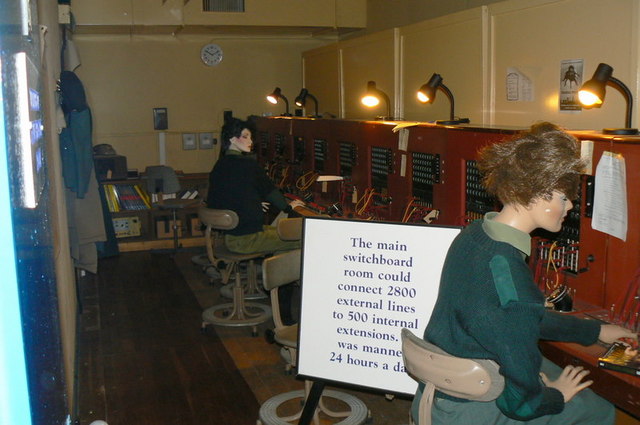 Labelled diagram of a 1950s PSTN switchboard showing manual patch cords (Image: Malcolm Carruthers, CC BY-SA 2.0, via Wikimedia Commons)
2. Circuit Switching vs. Packet Switching in Telephony
| Feature | Circuit Switching (PSTN) | Packet Switching (VoIP) |
|---|---|---|
| Connection Type | Dedicated path (e.g., copper wires) | Shared network (e.g., internet) |
| Setup Time | ~100ms (SS7 signalling) | ~200ms (SIP/DNS lookup) |
| Bandwidth | Fixed (e.g., 64 kbps for voice) | Variable (compressed, e.g., 16 kbps) |
| Examples | NTC landline, Ncell 2G/3G calls | WhatsApp calls, eSewa VoIP services |
| Fault Tolerance | Dedicated path fails = call drops | Packets rerouted if path fails |
Why PSTN Still Matters in Nepal:
- NTC’s landline network (used by banks, hospitals) relies on Time Division Multiplexing (TDM) over copper pairs.
- Ncell’s 2G/3G uses circuit-switched data for voice, while 4G/5G uses VoIP (IMS core).
- VoIP in Nepal: eSewa’s customer service uses SIP trunking to route calls over the internet, reducing costs.
3. Signalling Protocols: The Invisible Handshake
Signalling protocols control call setup, routing, and teardown. The two key systems are:
A. SS7 (Signalling System No. 7)
- Used in PSTN and mobile networks (e.g., Ncell’s call routing).
- Operates over separate signalling links (not the same as voice data).
- Message types:
- Initial Address Message (IAM): "Start call from A to B."
- Address Complete Message (ACM): "B’s number is valid."
- Answer Message (ANM): "B picked up."
- Release Message (REL): "Call ended."
sequenceDiagram
    participant A as User A (Pokhara)
    participant CO1 as Pokhara CO (Class 5)
    participant CO2 as Kathmandu CO (Class 4)
    participant B as User B (Kathmandu)
    A->>CO1: Dial 9800123456 (DTMF)
    CO1->>CO2: IAM (SS7)
    CO2->>B: Ring (via MSC)
    B->>CO2: Off-hook (ANM)
    CO2->>CO1: ACM (SS7)
    CO1->>A: Call connected
    A->>CO1: Hang up (REL)
    CO1->>CO2: REL (SS7)
Real-World Use in Nepal:
- When you call Ncell customer care (100), the SS7 network routes you to their Intelligent Network (IN) server, which plays pre-recorded menus.
- NTC’s 198 call center uses SS7 to log call durations for billing.
B. SIP (Session Initiation Protocol)
- Used in VoIP (e.g., WhatsApp calls, Zoom).
- Works over IP networks (like the internet).
- Message flow:
sequenceDiagram
    participant A as User A (VoIP)
    participant SIPServer as SIP Proxy Server
    participant B as User B (VoIP)
    A->>SIPServer: INVITE (SIP)
    SIPServer->>B: INVITE
    B->>SIPServer: 200 OK
    SIPServer->>A: 200 OK
    A->>B: RTP (Voice Data)
Worked Example: WhatsApp Call from Kathmandu to India
- You start a call → WhatsApp sends SIP INVITE to Google’s servers.
- Google’s SIP proxy routes to the recipient’s device via WebRTC.
- Voice is compressed (Opus codec) and sent as RTP packets.
- If the call drops, SIP sends BYE to tear down the session.
4. Signalling Methods: Analog vs. Digital
| Method | Description | Example in Nepal |
|---|---|---|
| DTMF (Dual-Tone) | Analog tones (e.g., 1 = 697+1336 Hz) | Pressing buttons on a landline phone |
| ISDN (Digital) | 64 kbps digital signalling | NTC’s ISDN lines for businesses |
| SIP (VoIP) | Text-based (e.g., INVITE sip:user@server) |
eSewa’s VoIP customer service |
Worked Example: Dialing a Bank’s IVR (e.g., NMB Bank)
- You call 9800123456 → DTMF tones
1(for English) are sent. - The Class 5 switch forwards DTMF to the bank’s IVR server.
- The IVR plays: "Press 1 for balance inquiry" → You press
1→ DTMF1triggers a database query.
5. Telephone Network Topologies in Nepal
Nepal’s telephony uses hierarchical and mesh topologies:
Hierarchical (PSTN):
- Local calls: Star topology (all users → central CO).
- Long-distance: Tree topology (CO → tandem → toll office).
graph TD
    A["Pokhara CO"] --> B["Kathmandu CO"]
    A --> C["Bhaktapur CO"]
    B --> D["India Gateway"]
Mesh (Mobile Networks):
- Ncell’s 4G/5G uses a partial mesh where BTSs connect to multiple MSCs for redundancy.
- Fiber backhaul: NTC’s undersea cable (connecting Nepal to India) uses a ring topology for fault tolerance.
6. Specialized Services and Signalling
A. Intelligent Network (IN)
- Adds extra services (e.g., Ncell’s "Missed Call Alert").
- Uses SS7 to trigger actions:
- If you miss a call → SMS sent via SS7 to your phone.
- If you call a premium number (e.g., 16600) → IN routes to a special server.
B. Number Portability (Nepal’s Example)
- Since 2018, Nepal allows mobile number portability (switch carriers without changing number).
- How it works:
- You request porting from Ncell to NTC.
- SS7’s HLR updates the new MSC’s database.
- Incoming calls are automatically routed to your new network.
7. Challenges in Nepal’s Telephone Networks
| Challenge | Cause | Solution in Nepal |
|---|---|---|
| Call drops | Poor fiber backhaul | NTC’s fiber expansion (e.g., Kathmandu Ring) |
| High latency | Satellite links (e.g., rural areas) | Ncell’s 5G rollout (lower latency) |
| Fraud (e.g., SIM cloning) | Weak SS7 security | Diameter protocol (SS7’s successor) for authentication |
| Power outages | Unstable grid | NTC’s solar-powered COs in remote areas |
Real-World Fix: NTC’s Kathmandu Ring
- A 1,200 km fiber optic loop around Kathmandu to prevent single-point failures.
- Uses DWDM (Dense Wavelength Division Multiplexing) to carry 160+ channels on one fiber.
In the Real World
Ncell’s Call Routing
- When you call a Ncell number from a landline, the Class 5 switch uses SS7 to query Ncell’s MSC, which then pages the nearest BTS to ring your phone.
- Why it matters: Ensures calls reach you even if you’re moving (e.g., from Pokhara to Chitwan).
eSewa’s VoIP Customer Service
- eSewa uses SIP trunking to route calls from their Kathmandu call center to your phone over the internet.
- How it saves money: Avoids NTC’s per-minute landline charges (costs ~Rs. 10/min vs. ~Rs. 2/min over VoIP).
NTC’s 198 Emergency Service
- When you dial 198, the SS7 network automatically routes you to the nearest police station’s IVR, even if you’re roaming.
- Tech used: Location Register (LR) updates in real-time via SS7.
Exam Tip
Trace a call path: Always draw a sequence diagram for:
- Pokhara→Kathmandu (PSTN).
- Kathmandu→India (international via SS7).
- WhatsApp call (SIP + RTP).
Compare PSTN vs. VoIP:
- PSTN: Circuit switching, SS7, copper wires.
- VoIP: Packet switching, SIP, internet.
SS7/SIP messages:
- Memorize IAM, ACM, ANM, REL for SS7.
- For SIP: INVITE, 200 OK, BYE.
Nepal-specific:
- NTC’s fiber backhaul and DWDM.
- Ncell’s MSC + HLR for roaming.
- Number portability (SS7’s role).
Worked examples:
- Always quantify: "A call from Pokhara to Kathmandu takes 200ms for SS7 signalling + 50ms for circuit setup."
- Use real numbers: NTC’s 64 kbps for voice, Ncell’s 16 kbps for compressed VoIP.
Final Visual Summary:
mindmap
  root((Telephone Networks & Signalling))
    PSTN
      Circuit Switching
      SS7 (IAM/ACM/ANM)
      Copper/Wireless
    VoIP
      Packet Switching
      SIP (INVITE/RTP/BYE)
      Internet
    Nepal Examples
      NTC: Fiber + SS7
      Ncell: MSC + HLR
      eSewa: SIP Trunking
    Challenges
      Call Drops (Fiber)
      Fraud (SS7 Weakness)
      Solutions (5G/Diameter)
Based on the TU BIT syllabus for Introduction to Telecommunications, unit 7.
Discussion
Loading…