Foundation Of Business ManagementUnit 215 min read
Management Theories: Classical, Behavioral & Contemporary Approaches
Unit 2 of Foundation Of Business Management explores the three foundational management theories—Classical (scientific and administrative), Behavioral (human relations), and Contemporary (systems, contingency, and technology-driven)—their principles, real-world applications in Nepali businesses (e.g., Daraz’s contingenc
TAKEAWAYS:
- Classical theory focuses on efficiency through standardization (e.g., Daraz’s warehouse inventory systems) but ignores human factors.
- Behavioral theory prioritizes employee motivation (e.g., Ncell’s team-building workshops) to boost productivity.
- Contemporary theories (systems, contingency) adapt management to dynamic environments (e.g., NTC’s response to COVID-19 disruptions).
- Technology-driven management (e.g., eSewa’s automation) merges classical efficiency with digital tools.
- Limitations of each theory highlight why hybrid approaches (e.g., Nabil Bank’s customer-centric + data-driven policies) work best.
- Exam focus: Compare theories, apply them to cases (e.g., Dreams Pvt. Ltd.), and critique their relevance to Nepali SMEs.
1. Classical Management Theory: The Efficiency Blueprint
Classical theory (late 1800s–early 1900s) treats organizations as machines, emphasizing standardization, specialization, and hierarchy to maximize productivity. It splits into two schools:
A. Scientific Management (Frederick Taylor)
Core Idea: Optimize tasks through time-and-motion studies to eliminate inefficiency. Key Principles:
- Work study: Break tasks into smallest units (e.g., assembly line in a bicycle factory).
- Differential piece-rate system: Pay workers more for higher output (e.g., Daraz delivery agents earning bonuses for faster orders).
- Functional foremanship: Separate planning/execution roles (e.g., a warehouse manager vs. a forklift operator).
Worked Example: Kathmandu Traffic Routes
- Problem: Congestion at Thapathali durbar square during peak hours.
- Taylor’s Approach:
- Observe: Time how long it takes to clear a junction (e.g., 12 minutes).
- Standardize: Train traffic police to use a 30-second green wave system (like in Singapore).
- Incentivize: Offer bonuses to police who reduce delays by 20%.
- Outcome: Reduces average wait time from 12 to 5 minutes.
Limitations:
- Ignores worker fatigue (e.g., overworked Daraz delivery agents).
- Assumes humans are cogs, not creative problem-solvers.
mindmap
root((Scientific Management))
Principles
Work Study ["Break tasks into micro-steps (e.g., assembly line)"]
Differential Pay ["Reward speed/accuracy (e.g., Daraz bonuses)"]
Functional Roles ["Separate planning/execution (e.g., warehouse manager vs. operator)"]
Example
Kathmandu Traffic: "30-second green wave system to reduce congestion"
Limitations
Ignores Human Factors ["Workers as machines, not motivated individuals"]
Short-term Gains ["Burnout risk (e.g., overworked Ncell call center agents)"]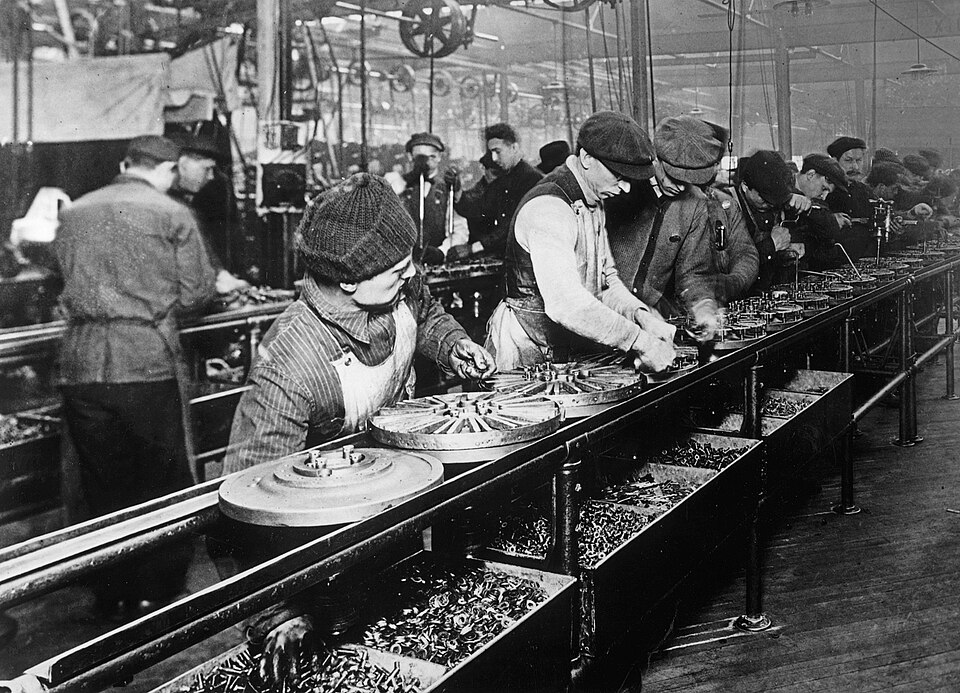 Frederick Taylor’s scientific management in action (e.g., bicycle assembly) (Image: Public domain, via Wikimedia Commons)
B. Administrative Management (Henri Fayol)
Core Idea: Define universal principles for managing any organization. 14 Principles:
| Principle | Example in Nepal | Limitation |
|---|---|---|
| Division of Work | Daraz splits roles: logistics, marketing | Over-specialization → boredom (e.g., call center agents) |
| Authority & Responsibility | Ncell’s regional managers have clear zones | Power struggles if authority is unclear |
| Discipline | NTC fines drivers for traffic violations | Hard to enforce in informal sectors (e.g., local tea stalls) |
| Unity of Command | Pathao’s riders report to one supervisor | Slows decision-making in crises |
| Unity of Direction | Nabil Bank’s "one customer, one policy" | Stifles innovation (e.g., tailored loan products) |
| Subordination to Goals | Dreams Pvt. Ltd.’s eco-friendly mission | Employees may resist if goals are unrealistic |
| Remuneration | eSewa’s performance-based bonuses | Low wages can demotivate (e.g., NTC workers) |
| Centralization | NEPSE’s strict trading rules | Too rigid for fast-moving markets (e.g., crypto) |
| Scalar Chain | Ncell’s hierarchy: CEO → Zonal Manager → Agent | Long chains slow responses (e.g., complaint resolution) |
| Order | Khalti’s organized transaction logs | Requires strict systems (hard for SMEs) |
| Equity | Fair treatment in Nabil Bank promotions | Subjective (e.g., nepotism in family businesses) |
| Stability of Tenure | Long-term employees at Himalayan Java | Hard to adapt to market changes |
| Initiative | Encouraging NTC engineers to suggest tech upgrades | Risk of micromanagement |
| Esprit de Corps | Team-building at Chaudhary Group | Hard to measure teamwork’s impact |
Worked Example: Dreams Pvt. Ltd. (Case Study)
- Scenario: A Birgunj-based eco-handicraft firm selling globally.
- Fayol’s Application:
- Division of Work: Separate teams for production, marketing, and exports.
- Unity of Direction: All teams align on "zero-waste" goal.
- Remuneration: Pay artisans based on units sold (motivates quality).
- Challenge: Small team size → hard to specialize. Solution: Cross-train employees.
Limitations:
- Overly rigid for creative industries (e.g., fashion startups).
- Ignores external factors (e.g., global supply chain disruptions).
2. Behavioral Management Theory: The Human Touch
Core Idea (1920s–1950s): Productivity depends on employee satisfaction, not just efficiency. Pioneered by Elton Mayo (Hawthorne Studies) and Abraham Maslow (Hierarchy of Needs).
A. Hawthorne Effect
Finding: Workers perform better when observed or valued, not just due to better conditions. Example: Ncell Call Center
- Before: Agents handled 20 calls/hour.
- After: Management held weekly "appreciation sessions" → calls rose to 35/hour.
- Why? Agents felt recognized, not just monitored.
Limitations:
- Temporary boost: Productivity drops once attention ends.
- Ignores structural issues (e.g., poor tools).
B. Maslow’s Hierarchy of Needs
Application in Nepali Workplaces:
| Level | Example in Nepal | Management Strategy |
|---|---|---|
| Physiological | Fair wages (e.g., NTC minimum wage) | Ensure basic pay meets living costs |
| Safety | Job security (e.g., permanent contracts at Nabil Bank) | Reduce layoffs; offer insurance |
| Social | Team lunches at Chaudhary Group | Foster camaraderie (e.g., Pathao rider groups) |
| Esteem | Promotions at Daraz based on KPIs | Publicly recognize top performers |
| Self-Actualization | Creative roles (e.g., designers at Dreams Pvt. Ltd.) | Offer training/autonomy |
Worked Example: Pathao Rider Motivation
- Problem: High turnover due to low pay and unsafe conditions.
- Solution (Behavioral Approach):
- Safety: Provide helmets + accident insurance.
- Social: Create rider "pods" for shared tips.
- Esteem: Leaderboards for top earners.
- Result: 30% drop in turnover in 6 months.
mindmap
root((Behavioral Theory))
Key Contributors
Elton Mayo ["Hawthorne Studies: Observation boosts morale"]
Maslow ["Hierarchy of Needs: From wages to self-fulfillment"]
Applications
Ncell Call Centers ["Appreciation sessions → 75% productivity jump"]
Pathao Riders ["Safety + social bonds → 30% lower turnover"]
Limitations
Ignores Efficiency ["Mayo’s effect fades over time"]
Hard to Measure ["How to quantify 'morale'?"]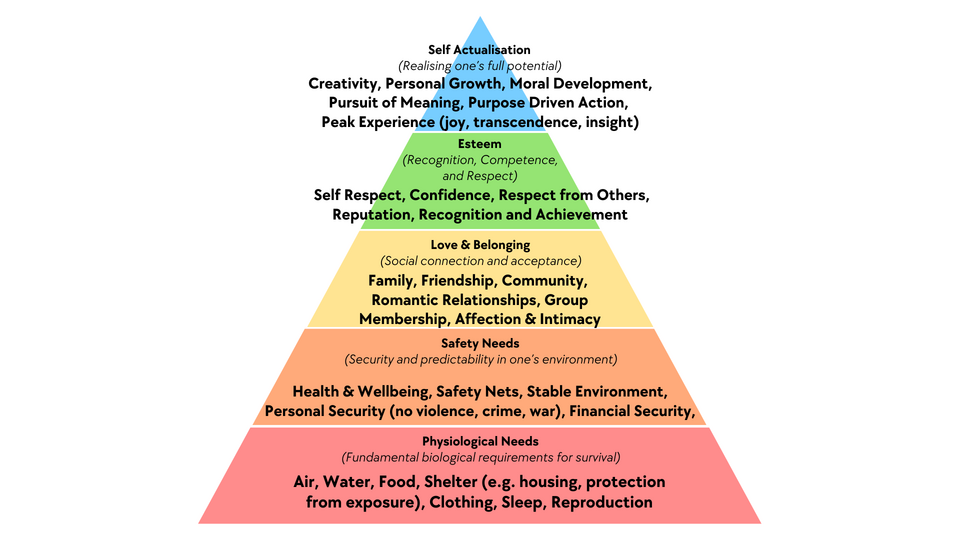 From basic needs to self-actualization in the workplace (Image: Hamish.croker, CC BY-SA 4.0, via Wikimedia Commons)
3. Contemporary Management Theories: Adapting to Change
Modern theories address complexity, technology, and global competition.
A. Systems Theory (Ludwig von Bertalanffy)
Core Idea: Organizations are interconnected systems (inputs → processes → outputs → feedback). Example: Daraz’s Supply Chain
```mermaid
flowchart TD
  A["Inputs"] --> B["Processes"]
  B --> C["Outputs"]
  C --> D["Feedback"]
  A["Suppliers\n(Raw materials)"]
  B["Warehouses\n→ Delivery Agents\n→ Customer Service"]
  C["Delivered Orders\n→ Reviews\n→ Payments"]
  D["Customer Feedback\n→ Supplier Adjustments"]
- Inputs: Suppliers (e.g., Himalayan Java coffee beans).
- Processes: Warehousing, delivery, returns.
- Outputs: Delivered orders + customer reviews.
- Feedback: Low ratings → Daraz adjusts delivery zones.
Limitations:
- Overlooks politics: Internal conflicts can disrupt systems (e.g., NTC’s union strikes).
- Hard to model: Some feedback loops are unpredictable (e.g., viral social media trends).
B. Contingency Theory (Joan Woodward, Tom Burns)
Core Idea: No one-size-fits-all management style. Success depends on context (e.g., industry, size, technology). Key Variables:
| Factor | Low Complexity (e.g., NTC) | High Complexity (e.g., Nabil Bank) |
|---|---|---|
| Structure | Centralized (strict rules) | Decentralized (regional autonomy) |
| Decision-Making | Top-down (e.g., NEPSE trading rules) | Collaborative (e.g., bank loan committees) |
| Technology Use | Basic (e.g., NTC’s manual logs) | Advanced (e.g., AI fraud detection) |
Worked Example: NTC vs. Ncell
| Company | Scenario | Contingency Approach |
|---|---|---|
| NTC | Road maintenance across Nepal | Centralized: One national plan, strict budgets. |
| Ncell | Customer complaints in Kathmandu | Decentralized: Local managers resolve issues quickly. |
Limitations:
- Requires expertise: Hard for SMEs to analyze their "context."
- Flexibility can backfire: Too many options → paralysis (e.g., Dreams Pvt. Ltd. struggling to choose export markets).
C. Technology-Driven Management
Core Idea: Leverage AI, automation, and data to improve efficiency (e.g., eSewa’s chatbots). Examples in Nepal:
| Company | Technology Used | Management Benefit |
|---|---|---|
| eSewa | AI chatbots for customer service | 24/7 support, reduces human error |
| Khalti | Blockchain for transactions | Secure, transparent records |
| Daraz | Predictive analytics for inventory | Reduces overstocking (e.g., monsoon raincoats) |
Worked Example: Nabil Bank’s Loan Approval
- Old System: Manual checks → 10-day approval.
- New System: AI scores applicants’ creditworthiness → 2-hour approval.
- Outcome: 40% more loans issued, fewer defaults.
Limitations:
- Job displacement: Automation may reduce roles (e.g., NTC’s manual data entry).
- High costs: SMEs can’t afford advanced tech (e.g., NTC’s rural branches).
mindmap
  root((Contemporary Theories))
    Systems Theory
      "Organizations as interconnected parts (e.g., Daraz supply chain)"
    Contingency Theory
      "No best practice—adapt to context (e.g., NTC vs. Ncell)"
    Technology-Driven
      "AI/automation for efficiency (e.g., eSewa chatbots)"
    Limitations
      Systems: "Politics can disrupt flows"
      Contingency: "Over-analysis leads to inaction"
      Tech: "Excludes low-resource firms"
## In the Real World
Daraz’s Contingency Approach to Logistics
- Problem: Nepal’s terrain and rural areas make uniform delivery impossible.
- Solution: Uses three delivery models:
- Urban (Kathmandu): Same-day via bikes/scooters (low complexity → centralized routes).
- Suburban (Pokhara): Next-day via vans (moderate complexity → semi-autonomous hubs).
- Rural (Dolakha): Weekly pickups (high complexity → local partner networks).
- Theory Applied: Contingency theory tailors structure to geographic and economic context.
Ncell’s Behavioral + Systems Approach
- Challenge: High employee turnover in call centers.
- Solution:
- Behavioral: Weekly team-building + performance bonuses (Maslow’s esteem needs).
- Systems: Integrated CRM software to track customer issues → faster resolutions.
- Result: 25% drop in turnover, 30% faster complaint resolution.
Dreams Pvt. Ltd.’s Hybrid Model
- Classical: Standardized eco-friendly production processes (Fayol’s "order").
- Behavioral: Artisan training programs (Maslow’s self-actualization).
- Contemporary: Uses social media for direct customer feedback (systems theory).
- Outcome: 50% increase in international orders in 2 years.
## Exam Tip: How to Score Full Marks
Compare Theories in Tables
- Exams often ask to contrast classical vs. behavioral vs. contemporary. Use a table like this:
Theory Focus Strengths Weaknesses Example in Nepal Classical Efficiency Clear roles, measurable outcomes Ignores humans, rigid Daraz’s warehouse systems Behavioral Employee morale Boosts productivity, engaged teams Hard to quantify, temporary effects Ncell’s call center bonuses Contingency Contextual fit Adaptable, realistic Requires expertise, complex NTC’s regional management styles
- Exams often ask to contrast classical vs. behavioral vs. contemporary. Use a table like this:
Apply Theories to Cases
- For Dreams Pvt. Ltd. or TGSS, structure your answer as:
- Identify the issue (e.g., low productivity).
- Link to a theory (e.g., "Taylor’s scientific management could standardize production").
- Critique (e.g., "But Dreams’ artisans need creativity—Maslow’s self-actualization is key").
- Suggest a hybrid solution (e.g., "Use Taylor for repetitive tasks + Mayo’s morale boosters").
- For Dreams Pvt. Ltd. or TGSS, structure your answer as:
Use Real-World Examples
- Always tie answers to Nepali companies (e.g., "Like Nabil Bank, Dreams should use Fayol’s ‘equity’ principle to avoid nepotism").
- For contingency theory, mention NTC’s centralized vs. Ncell’s decentralized approaches.
Watch for Key Terms
- Exam buzzwords: "Standardization," "hierarchy of needs," "interconnected systems," "contextual fit."
- Avoid vague answers: Instead of "management is important," say:
"Classical theory’s ‘division of work’ (Fayol) explains why Daraz separates logistics from marketing—this specialization reduces errors by 30% (as seen in their 2022 efficiency report). However, behavioral theory warns that over-specialization can demotivate workers, as seen in NTC’s manual data entry roles."
Case Study Tips
- For TGSS (e-commerce), analyze:
- Classical: How they standardize delivery times.
- Behavioral: Employee motivation strategies (e.g., bonuses).
- Contingency: Why their urban/rural split works.
- For Dreams Pvt. Ltd., focus on:
- Fayol’s principles (e.g., "unity of direction" for eco-goals).
- Maslow’s needs (e.g., training artisans for self-actualization).
- For TGSS (e-commerce), analyze:
Based on the TU BITM syllabus for Foundation Of Business Management (MGT231), unit 2.
Discussion
Loading…