Business Data Communication and NetworkingUnit 314 min read
Physical Layer: Media, Signals & Transmission
Unit 3 of Business Data Communication and Networking explores the foundational physical layer—transmission media (guided vs. unguided), signal types (analog/digital), modulation techniques, and real-world applications like fiber optics in NTC’s backbone or Wi-Fi in Pathao’s delivery tracking. Learn how data travels phy
Core Concepts & Definitions
1. Physical Layer: The Foundation of Networks
The physical layer (Layer 1 of the OSI model) defines:
- Hardware (cables, connectors, repeaters, hubs).
- Signal transmission (how bits are encoded as electrical, optical, or radio waves).
- Bit synchronization (clocking to ensure sender/receiver alignment).
- Physical topology (how devices are physically connected: bus, star, ring, mesh).
Why it matters: Without the physical layer, no data can travel—it’s the "wiring" of the network, whether it’s a fiber-optic cable under Kathmandu or a Wi-Fi signal in Pokhara.
2. Transmission Media: Guided vs. Unguided
Media are classified by how they guide or do not guide signals. The choice affects speed, cost, and distance.
A. Guided Media (Bounded)
Transmission occurs through a physical path (cable). Used in LANs, ISP backbones (e.g., NTC), and bank ATMs.
| Type | Description | Speed | Distance | Example Use Case | Advantages | Disadvantages |
|---|---|---|---|---|---|---|
| Twisted-Pair | Copper wires twisted to reduce interference. | 10 Mbps–10 Gbps | Up to 100m | Phone lines, Ethernet (Cat5e/Cat6) in offices | Cheap, easy to install | Susceptible to noise, limited bandwidth |
| Coaxial | Copper core + insulating shield (used in old TV cables). | 10 Mbps–1 Gbps | Up to 500m | Cable TV, old Ethernet (10BASE5) | Higher bandwidth than twisted-pair | Expensive, bulky, difficult to install |
| Fiber-Optic | Glass/plastic fibers transmitting light pulses. | 10 Mbps–100 Tbps | Up to 100 km | NTC’s backbone, Ncell’s 4G towers | Immune to EMI, high speed, secure | Fragile, expensive, requires special tools |
| Wireless | No physical medium (radio waves, microwaves, infrared). | Varies | Varies | Wi-Fi (Pathao’s delivery tracking) | Mobility, no cables needed | Interference, limited range, security risks |
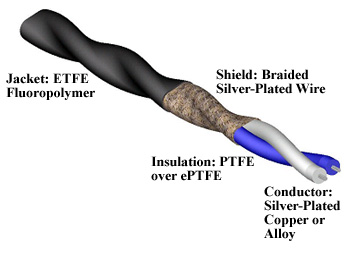 Labelled parts: inner conductors, shielding, outer jacket (Image: Oyuhain, CC BY-SA 4.0, via Wikimedia Commons)
B. Unguided Media (Wireless)
Uses electromagnetic waves (radio, microwave, infrared). Critical for mobile networks (Ncell), satellite TV, and IoT devices.
| Type | Frequency Range | Example Use Case | Pros | Cons |
|---|---|---|---|---|
| Radio Waves | 3 Hz–300 GHz | FM radio, Wi-Fi (2.4 GHz/5 GHz) | Long range, penetrates walls | Low bandwidth, interference |
| Microwaves | 1 GHz–300 GHz | Satellite links, 4G/5G (Ncell) | High bandwidth, directional | Line-of-sight required, weather affected |
| Infrared | 300 GHz–400 THz | TV remotes, short-range comms | Secure, no licensing needed | Very short range, blocked by obstacles |
REAL-WORLD EXAMPLE:
- NTC’s Fiber-Optic Backbone: Uses multimode fiber for high-speed data between Kathmandu and Pokhara, ensuring low latency for eSewa transactions.
- Pathao’s Wi-Fi Hotspots: Relies on 2.4 GHz/5 GHz radio waves for rider tracking and payment processing via Khalti.
- Nepal Rastra Bank’s ATMs: Use coaxial or fiber cables for secure transactions, while wireless fallback is used for mobile banking apps.
3. Signal Types: Analog vs. Digital
Signals carry data as continuous waves (analog) or discrete pulses (digital).
A. Analog Signals
- Definition: Continuous variations in voltage/frequency (e.g., sound waves, old telephone lines).
- Modulation Techniques:
- Amplitude Modulation (AM): Varies amplitude (used in radio broadcasts).
- Frequency Modulation (FM): Varies frequency (used in FM radio, TV).
- Phase Modulation (PM): Varies phase (used in fiber optics).
B. Digital Signals
- Definition: Discrete pulses (0s and 1s) representing binary data.
- Encoding Techniques:
- NRZ (Non-Return to Zero): Simple 1/0 pulses (used in Ethernet).
- Manchester Encoding: Self-clocking (used in Wi-Fi, Bluetooth).
- AMI (Alternate Mark Inversion): Reduces DC bias (used in T1 lines).
COMPARISON TABLE:
| Feature | Analog | Digital |
|---|---|---|
| Representation | Continuous wave | Discrete pulses (0/1) |
| Noise Susceptibility | High (degrades signal) | Low (error detection/correction) |
| Bandwidth | Limited by frequency | Higher (multiplexing possible) |
| Example | Voice calls (PSTN), AM radio | Internet, 4G/5G, fiber optics |
WORKED EXAMPLE: Problem: A voice call travels from a landline in Kathmandu to a mobile user in Pokhara. Trace the signal path and identify the media/signal type at each stage. Solution:
- Landline to Exchange: Analog signal over twisted-pair copper wire (PSTN).
- Exchange to ISP: Converted to digital (PCM encoding) over fiber-optic cable.
- ISP to Mobile Tower: Transmitted as radio waves (4G/5G).
- Mobile Tower to User: Received as digital signal, converted back to analog for speaker.
4. Transmission Modes
How data is sent over a medium: simplex, half-duplex, or full-duplex.
| Mode | Description | Example |
|---|---|---|
| Simplex | One-way transmission (sender → receiver only). | TV broadcast, radio |
| Half-Duplex | Two-way but not simultaneous (e.g., walkie-talkie). | Old telephone lines (before VoIP) |
| Full-Duplex | Simultaneous two-way transmission (both send/receive at once). | Internet, VoIP calls (WhatsApp) |
REAL-WORLD EXAMPLE:
- WhatsApp Calls: Use full-duplex over the internet (TCP/IP).
- Police Radio: Uses half-duplex (officer presses "PTT" to talk).
5. Multiplexing: Sharing a Single Medium
Combines multiple signals into one for efficient transmission.
| Type | Description | Example |
|---|---|---|
| FDM (Frequency Division) | Divides bandwidth into frequency slots. | FM radio, cable TV |
| TDM (Time Division) | Divides time into slots (synchronous). | T1 lines, old telephone networks |
| WDM (Wavelength Division) | Uses different wavelengths (colors) of light in fiber optics. | NTC’s fiber backbone |
| STDM (Statistical TDM) | Dynamically allocates time slots based on demand. | Modern 4G/5G networks |
WORKED EXAMPLE: Problem: NTC wants to provide internet to 10 villages using a single fiber-optic cable. Which multiplexing technique should they use, and why? Solution:
- WDM (Wavelength Division Multiplexing) is ideal because:
- Each village gets a dedicated wavelength (e.g., 1550 nm, 1560 nm).
- High bandwidth (up to 100 Tbps per fiber).
- Scalable: Add more wavelengths as demand grows.
6. Signal Degradation & Noise
Even the best media suffer from attenuation (signal loss) and noise (interference).
A. Causes of Degradation
- Attenuation: Signal weakens over distance (e.g., Wi-Fi signal fading in a crowded mall).
- Distortion: Signal shape changes (e.g., fiber bending causes light scattering).
- Noise:
- EMI (Electromagnetic Interference): From power lines (affects twisted-pair).
- Crosstalk: Signals bleed between wires (common in old phone lines).
- Thermal Noise: Random electron movement (affects all media).
B. Solutions
| Problem | Solution | Example |
|---|---|---|
| Attenuation | Repeaters/Amplifiers | NTC’s fiber repeaters every 50 km |
| EMI/Crosstalk | Shielding (STP cables), fiber optics | Bank ATMs use shielded twisted-pair |
| Noise in Digital Signals | Error Detection (CRC, Parity) | Ethernet uses CRC-32 |
| Bandwidth Limitations | Multiplexing (WDM, TDM) | Ncell’s 5G uses carrier aggregation |
REAL-WORLD EXAMPLE: Kathmandu Traffic & 4G Networks:
- Problem: Dense buildings cause multipath interference (signal bounces off walls, creating delays).
- Solution: Ncell uses MIMO (Multiple Input Multiple Output) with multiple antennas to improve signal quality.
7. Physical Layer Devices
Devices that operate at Layer 1 to extend or regenerate signals.
| Device | Function | Example Use Case |
|---|---|---|
| Repeater | Regenerates signals to extend distance (bit-level). | Fiber-optic repeaters in NTC backbone |
| Hub | Connects multiple devices in a star topology (broadcasts to all ports). | Old office networks (pre-Switch) |
| Bridge | Connects two LAN segments (filtering based on MAC addresses). | Linking two departments in a bank |
| Modem | Converts digital → analog (and vice versa) for phone lines. | Dial-up internet (obsolete now) |
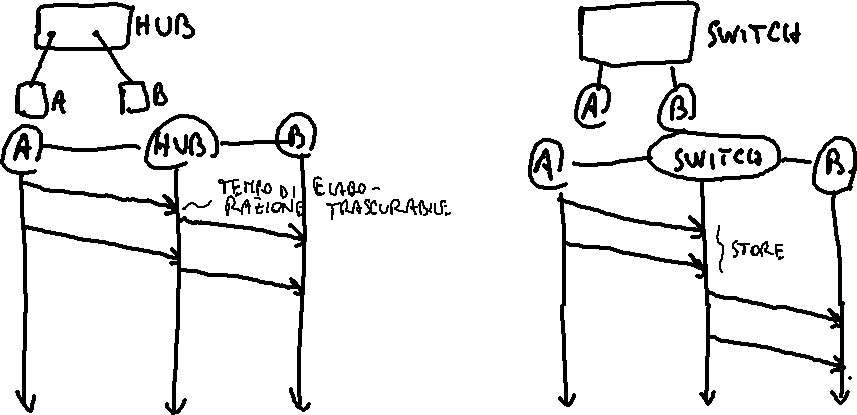 Show collision domain differences (Image: Luca Ghio, CC BY-SA 3.0, via Wikimedia Commons)
In the Real World
eSewa & Khalti Payments:
- Fiber-Optic Cables: Transactions between eSewa’s servers and NTC’s backbone use multimode fiber for low-latency processing.
- 4G/5G Wireless: Mobile payments rely on microwave signals (Ncell’s towers) for real-time authentication.
Daraz’s Order Fulfillment:
- Wi-Fi (802.11n/ac): Warehouse scanners use 2.4 GHz/5 GHz radio waves to update inventory in real time.
- Fiber to the Node: Daraz’s data centers connect to ISPs via single-mode fiber for high-speed order processing.
Nepal Rastra Bank’s ATM Network:
- Coaxial/Fiber Cables: ATMs in branches are connected via shielded twisted-pair or fiber to prevent fraud.
- Full-Duplex Communication: Ensures simultaneous transaction processing and balance updates.
Pathao’s Ride-Hailing:
- GPS (Microwave Signals): Driver locations are transmitted via satellite signals (L-band).
- Wi-Fi Hotspots: Riders’ phones connect to 2.4 GHz access points for live tracking.
Exam Tip
What to Expect in TU/PU Exams
Diagram-Based Questions (30% weight):
- Draw and label:
- Twisted-pair vs. fiber-optic cable cross-sections.
- AM/FM/PM waveforms.
- WDM or TDM multiplexing diagrams.
- Common Mistake: Forgetting to label all parts (e.g., core/cladding in fiber).
- Draw and label:
Scenario-Based Problems (25% weight):
- Example Question:
"A company in Pokhara uses a 10 Mbps Ethernet network with Cat5e cables. After adding more devices, performance degrades. Suggest two solutions using physical layer concepts."
Answer:
- Upgrade to Cat6 (higher bandwidth).
- Replace hubs with a switch (reduces collisions).
- Use fiber-optic cables (immune to EMI).
- Example Question:
"A company in Pokhara uses a 10 Mbps Ethernet network with Cat5e cables. After adding more devices, performance degrades. Suggest two solutions using physical layer concepts."
Answer:
Comparison Tables (20% weight):
- Always compare speed, cost, distance, and use cases (e.g., twisted-pair vs. fiber).
- Example:
Media Max Speed Max Distance Best For Twisted-Pair 1 Gbps 100 m Offices (Ethernet) Fiber-Optic 100 Tbps 100 km ISP backbones (NTC)
Short Answer (15% weight):
- Define terms precisely:
- "What is attenuation, and how does a repeater mitigate it?"
- "Differentiate between simplex and full-duplex communication."
- Avoid: Vague answers like "it’s about signals." Always give examples.
- Define terms precisely:
Case Study (10% weight):
- Example:
"Nepal Telecom is expanding 5G in Chitwan. Explain how WDM and fiber optics will improve coverage."
Answer:
- WDM: Multiple wavelengths allow higher data rates without interference.
- Fiber Optics: Longer range (reduces need for repeaters) and security (tapped lines are harder to detect).
- Example:
"Nepal Telecom is expanding 5G in Chitwan. Explain how WDM and fiber optics will improve coverage."
Answer:
Final Checklist Before Exam
- Can you draw a fiber-optic cable and label its parts?
- Do you know the modulation techniques (AM/FM/PM) and their uses?
- Can you compare guided vs. unguided media in a table?
- Do you understand multiplexing (FDM, TDM, WDM) with real-world examples?
- Are you familiar with physical layer devices (repeater, hub, modem) and their roles?
mindmap
  root((Physical Layer))
    Transmission Media
      Guided
        Twisted-Pair
        Coaxial
        Fiber-Optic
      Unguided
        Radio Waves
        Microwaves
        Infrared
    Signal Types
      Analog
        AM
        FM
        PM
      Digital
        NRZ
        Manchester
        AMI
    Multiplexing
      FDM
      TDM
      WDM
      STDM
    Degradation & Noise
      Attenuation
      EMI
      Crosstalk
      Solutions: Repeaters, Shielding, Error Detection
    Devices
      Repeater
      Hub
      Bridge
      Modem
Based on the TU BITM syllabus for Business Data Communication and Networking (IT240), unit 3.
Discussion
Loading…