Multimedia System ApplicationUnit 45 min read
Audio Fundamentals: Waves, Formats, Compression & Applications
Unit 4 of Multimedia System Application covers the physics of sound waves, digital audio formats (WAV, MP3, AAC), sampling theory, bit depth, compression techniques (lossy vs. lossless), and real-world applications in apps like WhatsApp voice notes and Ncell’s music streaming.
Core Concepts of Audio Fundamentals
1. Sound Waves: The Physics Behind Audio
Sound is a mechanical wave that travels through a medium (air, water, or solids) by vibrating particles. Key properties:
- Frequency (Hz): Measures how many cycles occur per second. Humans hear 20 Hz to 20,000 Hz.
- Amplitude (dB): Measures sound intensity (loudness). A whisper is ~30 dB; a jet engine is ~140 dB.
- Wavelength (λ): Distance between two identical points in a wave. Shorter wavelengths = higher frequency.
graph LR
A["Sound Source\n(e.g., vocal cords)"] -->|"Vibration"| B["Medium\n(air, water, etc.)"]
B -->|"Wave Propagation"| C["Eardrum\n(Vibrates)"]
C -->|"Nerve Signal"| D["Brain\n(Interprets as sound)"]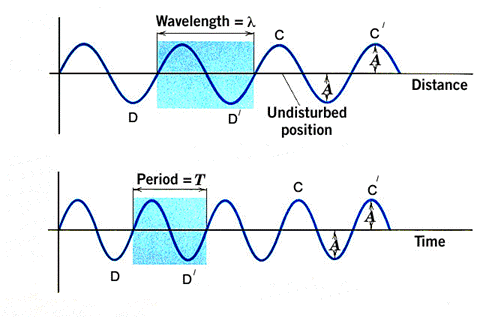 A sine wave showing amplitude, wavelength, and frequency. (Image: Kulayada, CC BY-SA 4.0, via Wikimedia Commons)
Worked Example: A siren emits a sound at 500 Hz. If the speed of sound is 343 m/s, what is its wavelength?
2. Digital Audio: Sampling and Quantization
To digitize sound, we use:
- Sampling Rate (kHz): How often the analog wave is measured per second.
- CD Quality: 44.1 kHz (16-bit depth)
- Telephony: 8 kHz (8-bit depth)
- Bit Depth (bits): Determines audio quality (more bits = better resolution).
- 16-bit: Standard for CDs (~96 dB dynamic range).
- 24-bit: Used in professional studios (~144 dB dynamic range).
Nyquist Theorem: To avoid aliasing, the sampling rate must be at least twice the highest frequency in the signal.
3. Audio File Formats: WAV vs. MP3 vs. AAC
| Format | Type | Compression | Quality | Use Case |
|---|---|---|---|---|
| WAV | Uncompressed | Lossless | High | Audio editing, CDs |
| MP3 | Compressed | Lossy | Medium | Music streaming (Spotify, YouTube) |
| AAC | Compressed | Lossy | High | Apple Music, Netflix |
| FLAC | Compressed | Lossless | Very High | Archival, high-fidelity audio |
How MP3 Works (Lossy Compression):
- Removes inaudible frequencies (human ear can’t detect >16 kHz).
- Uses psychoacoustic models to discard less noticeable sounds.
- Reduces file size by ~90% compared to WAV.
4. Audio Compression Techniques
Lossless Compression (No Quality Loss)
- FLAC, ALAC, WMA Lossless: Reduces file size by finding repetitive patterns (e.g., silence in audio).
- Used in archival storage (e.g., lossless music libraries).
Lossy Compression (Quality Sacrifice for Smaller Size)
- MP3, AAC, OGG: Removes redundant or imperceptible data.
- Used in streaming (e.g., WhatsApp voice messages, Ncell music).
Comparison Table:
| Method | Quality Loss? | File Size | Use Case |
|---|---|---|---|
| Lossless | ❌ No | Large | Archival, master copies |
| Lossy | ✅ Yes | Small | Streaming, mobile apps |
In the Real World
WhatsApp Voice Notes (MP3/AAC)
- Uses lossy compression to reduce file size for faster uploads.
- Sampling Rate: ~44.1 kHz (standard for voice clarity).
- Bit Depth: 16-bit (balanced quality and size).
Ncell Music Streaming (AAC)
- Uses AAC encoding for high-quality streaming at lower bitrates (~128 kbps).
- Dynamic Bitrate Adjustment: Reduces quality on slow networks to prevent buffering.
Nepal’s Traffic Noise Monitoring (Digital Audio)
- NTC and local governments use microphones + digital recorders to analyze noise pollution.
- Sampling Rate: 48 kHz (high fidelity for analysis).
- FFT (Fast Fourier Transform): Used to identify dominant frequencies (e.g., horns, engines).
Exam Tip
- Always relate theory to real-world apps (e.g., "WhatsApp uses MP3 because...").
- Memorize key numbers:
- Human hearing range: 20 Hz – 20 kHz
- CD quality: 44.1 kHz, 16-bit
- Nyquist limit: Sampling Rate ≥ 2 × Highest Frequency
- Compare formats in tables (WAV vs. MP3 vs. AAC).
- Explain compression with psychoacoustic models (MP3) vs. lossless techniques (FLAC).
Final Note: Audio fundamentals are the backbone of voice assistants (Google Assistant), music apps (Spotify), and telephony (Ncell calls). Mastering sampling, bit depth, and compression will help you optimize multimedia for storage, streaming, and real-time applications.
Based on the TU BITM syllabus for Multimedia System Application (IT273), unit 4.
Discussion
Loading…