Operations ManagementUnit 110 min read
Operations Management: Definitions, Functions, and Importance
Unit 1 of Operations Management introduces the core concepts of OM, its role in organizations, and how it transforms inputs into outputs efficiently. This note covers definitions, functions, objectives, and the strategic importance of OM with real-world examples, visuals, and exam-focused insights.
What is Operations Management (OM)?
Operations Management (OM) is the design, operation, and improvement of the production system that creates and delivers the organization’s primary products and services. It is the backbone of any business, ensuring that goods and services are produced and delivered efficiently, effectively, and profitably.
Key Definition
"Operations Management is the management of systems or processes that create goods and/or provide services." — Heizer & Render
Why is OM Important?
OM is critical because it:
- Transforms inputs (resources) into outputs (products/services).
- Ensures customer satisfaction by delivering quality products/services on time.
- Optimizes costs while maintaining efficiency.
- Supports strategic goals of the organization (e.g., growth, competitiveness).
Functions of Operations Management
OM performs five key functions in any organization:
1. Inputs (Resources)
- Raw materials (e.g., steel for a car, wheat for bread).
- Labor (skilled/unskilled workers).
- Capital (machinery, technology).
- Information (data, market trends).
- Time (delivery schedules).
2. Transformation (Conversion Process)
- Physical transformation (e.g., manufacturing a phone).
- Location transformation (e.g., transporting goods from factory to store).
- Exchange transformation (e.g., selling products in a retail store).
- Storage transformation (e.g., warehousing goods).
- Information transformation (e.g., processing an online order).
3. Outputs (Goods & Services)
- Tangible goods (e.g., laptops, clothes).
- Intangible services (e.g., banking, healthcare, eSewa transactions).
4. Quality Control
- Ensures products meet standards (ISO, industry norms).
- Uses Six Sigma, TQM (Total Quality Management).
- Reduces defects, waste, and customer complaints.
5. Inventory Management
- Balances stock levels to avoid shortages or excess.
- Uses Just-in-Time (JIT) to reduce holding costs.
- Manages supply chain logistics (e.g., Daraz’s warehouse network).
Objectives of Operations Management
The primary goals of OM are:
| Objective | Description | Example |
|---|---|---|
| Cost Efficiency | Minimize production costs without sacrificing quality. | Nabil Bank reduces ATM transaction costs by optimizing branch locations. |
| Quality Improvement | Ensure products/services meet or exceed customer expectations. | Toyota’s "Zero Defect" policy in car manufacturing. |
| Delivery Speed | Meet deadlines and reduce lead times. | Pathao delivers food within 30 minutes using efficient routing. |
| Flexibility | Adapt to changing customer demands. | Daraz adjusts inventory based on festival sales (e.g., Dashain). |
| Innovation | Introduce new processes or products. | eSewa uses AI for fraud detection in digital payments. |
| Customer Satisfaction | Deliver value through reliable, high-quality outputs. | NTC ensures stable internet service with minimal downtime. |
Operations Management in Different Sectors
OM is universal—applied in manufacturing, services, healthcare, banking, and logistics.
1. Manufacturing Sector (e.g., Chaudhary Group, Himalayan Java)
- Focus: Physical production of goods.
- Key OM Activities:
- Process planning (how to make a product).
- Machine scheduling (optimizing production lines).
- Supply chain coordination (raw material procurement).
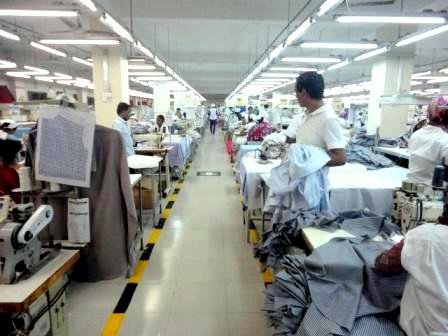 A modern assembly line in a Nepalese garment factory (Image: Fahad Faisal, CC BY-SA 4.0, via Wikimedia Commons)
2. Service Sector (e.g., Ncell, Nabil Bank, eSewa)
- Focus: Intangible outputs (e.g., mobile services, banking).
- Key OM Activities:
- Customer service optimization (call centers, chatbots).
- Process automation (ATM machines, online banking).
- Service recovery (handling complaints efficiently).
flowchart TD
    A["Customer Request"] --> B["Service Process"]
    B --> C[ATM Machine
    Online Banking
    Call Center]
    C --> D[Transaction
    Resolution
    Feedback]
    D --> E[Service Recovery
    if Needed]
    E --> F["Customer Satisfaction"]
An ATM transaction process flow (Image: Alan Tennyson, CC BY-SA 4.0, via Wikimedia Commons)3. Healthcare (e.g., CIMS Hospital, Patan Hospital)
- Focus: Delivering medical services efficiently.
- Key OM Activities:
- Patient flow management (reducing wait times).
- Inventory of medicines (avoiding stockouts).
- Hospital layout design (ergonomic workflow).
## In the real world
1. eSewa – Digital Payment Processing
- OM Idea Used: Process Transformation & Quality Control
- How?
- eSewa converts cash payments into digital transactions (input → transformation → output).
- Uses AI fraud detection (quality control) to reduce errors.
- Just-in-Time (JIT) processing ensures instant money transfer.
2. Daraz – E-Commerce Logistics
- OM Idea Used: Inventory Management & Supply Chain
- How?
- Uses warehouse automation to manage stock levels.
- Route optimization (like Pathao’s delivery system) reduces delivery time.
- Demand forecasting adjusts inventory before festivals (e.g., Dashain, Tihar).
3. Nabil Bank – ATM & Branch Operations
- OM Idea Used: Facility Layout & Service Process Design
- How?
- ATM placement is optimized for high footfall areas (cost efficiency).
- Branch layout ensures smooth customer flow (reduces wait time).
- 24/7 operations with minimal downtime (reliability).
## Worked Example: Kathmandu Traffic Management (Process Flow)
Problem: Traffic jams in Kathmandu waste 2-3 hours daily, increasing fuel costs and pollution.
OM Solution:
- Inputs: Vehicles, roads, traffic signals, police.
- Transformation:
- Smart traffic lights (adjust timings based on real-time data).
- Dedicated bus lanes (reduces congestion).
- Ride-sharing incentives (like Pathao’s carpooling).
- Output: Faster commute, lower emissions, cost savings.
flowchart TD
    A["Traffic Inputs: Vehicles, Roads, Signals"] --> B["Transformation: Smart Systems"]
    B --> C["Dedicated Lanes<br/>Carpooling<br/>AI Traffic Control"]
    C --> D["Output: Reduced Congestion<br/>Faster Travel<br/>Lower Costs"]
## Comparison: Manufacturing vs. Service Operations
| Aspect | Manufacturing (e.g., Himalayan Java) | Service (e.g., Ncell) |
|---|---|---|
| Output | Tangible goods (coffee, cars) | Intangible (calls, banking) |
| Customer Interaction | Limited (post-purchase) | High (real-time service) |
| Inventory | Physical stock (warehouses) | Digital (data, bandwidth) |
| Quality Measurement | Defect rates, durability | Customer satisfaction, response time |
| Key OM Focus | Production efficiency, supply chain | Process design, service recovery |
## Case Study: Toyota’s Lean Manufacturing
Company: Toyota (Global Automotive Giant) OM Strategy: Lean Operations (Just-in-Time, Kaizen) How It Works:
- Eliminates waste (overproduction, excess inventory).
- Pull system (produces only what is ordered).
- Continuous improvement (Kaizen) – workers suggest efficiency upgrades.
Result:
- 30% faster production than competitors.
- Near-zero defects in assembly lines.
- Lower costs passed to customers.
## Exam Tip
How This Unit is Tested in TU Exams
Definitions & Concepts (20%)
- Expect short-answer questions on:
- What is OM?
- Functions of OM.
- Differences between goods and services.
- Expect short-answer questions on:
Real-World Applications (30%)
- Case-based questions (e.g., "How does Daraz use OM in logistics?").
- Scenario analysis (e.g., "A factory has high defects—what OM strategies would you apply?").
Diagrams & Flowcharts (20%)
- Draw and explain:
- Input-Transformation-Output model.
- Process flow of a service (e.g., eSewa transaction).
- Supply chain of a product (e.g., Himalayan Java coffee).
- Draw and explain:
Comparisons & Critical Thinking (30%)
- Compare manufacturing vs. service OM.
- Evaluate pros/cons of JIT vs. traditional inventory.
- Suggest improvements for a given scenario (e.g., "How would you reduce wait time at a bank?").
Top 5 Exam Tips
✅ Memorize key definitions (OM, inputs, outputs, transformation). ✅ Relate theories to Nepali companies (e.g., Nabil Bank, Daraz, NTC). ✅ Practice drawing flowcharts (input → process → output). ✅ Understand JIT, TQM, and Lean—these are high-weightage topics. ✅ Use bullet points in answers—examiners prefer structured, concise responses.
Based on the TU BITM syllabus for Operations Management (MGT205), unit 1.
Discussion
Loading…