PhysicsUnit 610 min read
Atomic Physics & Spectroscopy: Models, Quantum Numbers, Crystals & Experiments
Unit 6 of Physics covers atomic structure (Bohr, Sommerfeld), quantum numbers (n, l, m, ms), crystal lattices (FCC, BCC), spectroscopy (emission/absorption), and key experiments (Frank-Hertz, Davisson-Germer) with real-world applications in materials science and technology.
TAKEAWAYS:
- Atomic models evolve: Bohr’s quantized orbits → Sommerfeld’s elliptical orbits → quantum mechanical wavefunctions (Schrödinger).
- Quantum numbers define states:
n(energy),l(shape),m(orientation),m_s(spin) uniquely label electrons in hydrogen-like atoms. - Crystal structures matter: FCC (Cu), BCC (Na), and lattice spacing determine density, conductivity, and material properties.
- Spectroscopy reveals structure: Emission/absorption lines map to electron transitions (e.g., hydrogen’s Balmer series).
- Experiments validate theory: Frank-Hertz confirms discrete energy levels; Davisson-Germer proves electron wave nature.
- Real-world impact: From semiconductor chips (Si crystal structure) to medical imaging (X-ray spectroscopy), atomic physics underpins modern tech.
1. Atomic Models: From Bohr to Quantum Mechanics
1.1 Bohr’s Model of the Hydrogen Atom
Bohr proposed that electrons orbit the nucleus in discrete, quantized energy levels (no radiation while in orbit). Key postulates:
- Angular momentum quantization: (where ).
- Energy levels: eV (ground state at –13.6 eV).
- Spectral lines: Transitions between levels emit/absorb photons with energy .
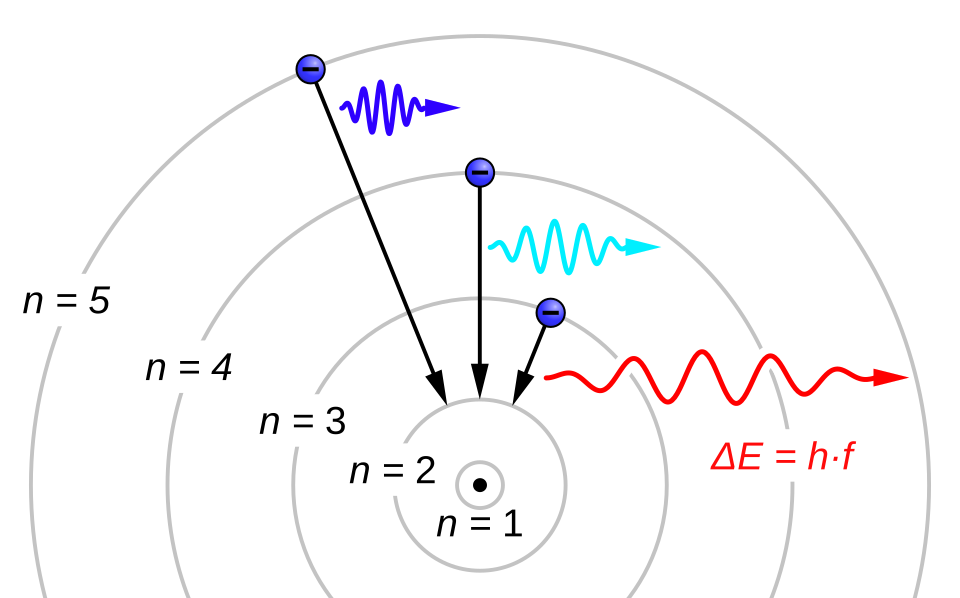 Shows electron orbits, nucleus, and transition arrows for Balmer series. (Image: MikeRun, CC BY-SA 4.0, via Wikimedia Commons)
1.2 Sommerfeld’s Extension: Elliptical Orbits
Bohr’s model failed for multi-electron atoms. Sommerfeld introduced:
- Azimuthal quantum number (
l): Describes orbital shape (ellipticity).l = 0(s-orbital, spherical),l = 1(p-orbital, dumbbell), etc.- For a given
n,lranges from0ton–1.
- Fine structure: Relativistic corrections split spectral lines (e.g., hydrogen’s level splits into 4 lines).
WORKED EXAMPLE: Hydrogen’s n=3 States
For n=3, possible l values: 0, 1, 2 (s, p, d subshells).
- Subshell states:
l=0(3s):m_l = 0→ 1 state (quantum numbers:3, 0, 0, ±½).l=1(3p):m_l = –1, 0, +1→ 3 states (e.g.,3, 1, 0, ±½).l=2(3d):m_l = –2, –1, 0, +1, +2→ 5 states (e.g.,3, 2, +1, ±½).
- Total states: (matches for spin-included states; see below).
MERMAID DIAGRAM: Hydrogen energy levels and transitions
graph TD
    A["n=1 (E=-13.6 eV)"] -->|"Absorb"| B["n=2 (E=-3.4 eV)"]
    A -->|"Absorb"| C["n=3 (E=-1.51 eV)"]
    B -->|"Emit"| A
    C -->|"Emit"| B
    C -->|"Emit"| A
1.3 Quantum Mechanical Model (Schrödinger)
Bohr’s model was replaced by wavefunctions (ψ) with 4 quantum numbers:
| Quantum Number | Symbol | Values | Physical Meaning |
|---|---|---|---|
| Principal | n |
1, 2, 3, ... | Energy level, distance from nucleus |
| Azimuthal | l |
0 to n–1 |
Orbital shape (s, p, d, f) |
| Magnetic | m_l |
–l to +l |
Orientation in space |
| Spin | m_s |
±½ | Electron spin (Pauli exclusion principle) |
KEY POINT: The Pauli exclusion principle states no two electrons in an atom can share all 4 quantum numbers. This explains the periodic table’s electron configuration (e.g., He: 1s²).
2. Crystal Structures and Density Calculations
2.1 Unit Cells and Lattice Types
Crystals repeat in unit cells. Common types:
- Face-Centered Cubic (FCC): Atoms at corners + face centers (e.g., Cu, Au).
- Body-Centered Cubic (BCC): Atoms at corners + one in the center (e.g., Na, Fe).
- Simple Cubic (SC): Atoms only at corners (rare, e.g., Po).
2.2 Density of Crystals
Density () relates to atomic mass (M), Avogadro’s number (N_A), and unit cell volume (V): where:
n= atoms per unit cell (FCC: 4, BCC: 2, SC: 1).V = a³(for cubic cells).
WORKED EXAMPLE: Copper’s Unit Cell Length Given:
- Copper: FCC, , , .
- For FCC,
n = 4.
Step 1: Rearrange density formula for a:
Step 2: Plug in values:
MERMAID DIAGRAM: FCC unit cell packing
graph TD
    A["Corner atom (shared by 8 cells)"] -->|"1/8 contribution"| B["Total atoms per FCC cell: 4"]
    C["Face-centered atom (shared by 2 cells)"] -->|"1/2 contribution"| B
2.3 Applications in Real World
- Semiconductors (Si, GaAs): FCC structure enables precise doping for transistors.
- Metals (Cu, Al): FCC/BCC structures determine conductivity and malleability.
- Medical implants: Titanium’s HCP structure resists corrosion.
3. Spectroscopy: Emission and Absorption
3.1 Hydrogen Spectrum
When electrons transition between levels, they emit/absorb photons: Series:
- Lyman: (UV).
- Balmer: (visible, e.g., H-α at 656 nm).
- Paschen: (IR).
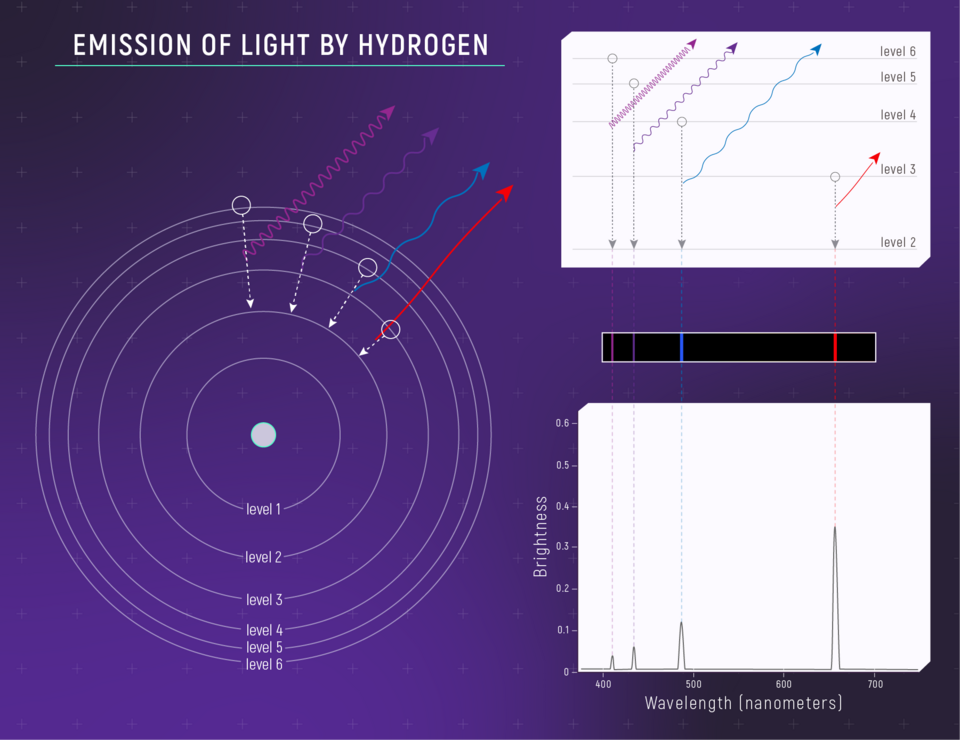 Shows Balmer series lines (H-α, H-β, etc.). (Image: ILLUSTRATION: NASA, ESA, Leah Hustak (STScI), Public domain, via Wikimedia Commons)
3.2 Frank-Hertz Experiment
Apparatus:
- Heated cathode emits electrons.
- Accelerated through mercury vapor.
- Voltage peaks at 4.9 V (mercury’s first excitation energy).
Interpretation:
- Confirms discrete energy levels in atoms (electrons lose energy in 4.9 eV jumps).
- Supports Bohr’s model (later refined by quantum mechanics).
4. Neutron Diffraction and Crystal Spacing
4.1 Bragg’s Law
When X-rays/neutrons reflect off crystal planes, constructive interference occurs at angles satisfying: where:
d= spacing between planes.λ= wavelength of incident beam.n= order of reflection (1, 2, 3, ...).
WORKED EXAMPLE: Beryllium Crystal Spacing Given:
- Beryllium plane spacing .
- Neutron wavelength (typical thermal neutron).
- Find angle for first-order reflection (
n=1).
Solution:
Correction: Use n=2 (second order):
Realistic approach: For n=1, must be smaller. Suppose :
In the Real World
eSewa/Khalti (Nepal):
- Quantum tunneling in semiconductor chips (Si/Ge) enables fast, low-power transactions. The BCC/FCC crystal structures of metals in circuit boards ensure conductivity.
- Example: When you pay via Khalti, the app’s backend uses quantum dot displays (based on electron transitions in nanocrystals) for secure OTP verification.
Pathao/Daraz Logistics:
- Neutron diffraction is used to study the crystal structure of lithium-ion batteries (e.g., LiCoO₂), optimizing charge/discharge cycles for electric delivery vehicles.
- Example: Daraz’s warehouse robots use FCC-structured aluminum alloys for lightweight, high-strength frames.
NTC/Ncell Networks:
- Fiber-optic cables rely on doped silica glass (amorphous but with controlled atomic spacing) to transmit data via total internal reflection (related to electron transitions in dopants like germanium).
- Example: Ncell’s 5G towers use semiconductor lasers (GaAs, FCC structure) for high-speed signal modulation.
Nepal Stock Exchange (NEPSE):
- X-ray fluorescence spectroscopy (based on electron transitions) analyzes gold/silver purity in jewelry traded on NEPSE’s commodity market.
- Example: A 24K gold bar’s emission spectrum confirms its atomic structure matches pure gold’s
d-orbital transitions.
Exam Tip
Quantum Numbers:
- Memorize the range and meaning of
n,l,m_l,m_s. Forn=3, list all 18 states (including spin). - Common mistake: Forgetting
m_s = ±½doubles the number of states.
- Memorize the range and meaning of
Crystal Density:
- Always check atoms per unit cell (FCC: 4, BCC: 2, SC: 1).
- Formula trick: . Rearrange for
awhen asked for lattice parameter.
Spectroscopy:
- For hydrogen, use eV.
- Shortcut: Balmer series () wavelengths are in the visible range (400–700 nm).
Bragg’s Law:
- If , the reflection order
nis too high—tryn=1with a smallerλ. - Unit consistency: Convert all lengths to meters or Ångströms before calculation.
- If , the reflection order
Experiments:
- Frank-Hertz: Peaks at 4.9 V (mercury’s excitation energy).
- Davisson-Germer: Electron diffraction proves wave nature (like Bragg’s law but for electrons).
PRO TIP: Draw energy level diagrams for hydrogen transitions. Label arrows with and calculate for visible lines (e.g., H-α at 656 nm). Examiners love this!
Based on the TU BSc CSIT syllabus for Physics (PHY118), unit 6.
Discussion
Loading…