PhysicsUnit 39 min read
Electric Fields & Potential: Forces, Work, Energy & Applications
Unit 3 of Physics covers electric fields (E), electric potential (V), potential difference, electric potential energy, and their applications in real-world systems like particle accelerators, capacitors, and electronic devices. Learn how to calculate forces, work, and energy in electric fields, and understand the relat
Core Concepts: Electric Fields and Potential
1. Electric Field (E)
The electric field at a point in space is defined as the force per unit positive charge experienced by a test charge placed at that point. Mathematically:
where:
- = Electric field (N/C)
- = Electrostatic force (N)
- = Test charge (C)
Key Properties of Electric Fields
- Direction: Electric field lines point away from positive charges and toward negative charges.
- Strength: The density of field lines represents the magnitude of the electric field.
- Superposition: The net electric field at a point is the vector sum of individual fields due to multiple charges.
Electric Field Due to a Point Charge
For a point charge , the electric field at a distance is given by:
where (Coulomb’s constant).
Electric Field Due to a Uniformly Charged Infinite Plane
For an infinite charged plane with surface charge density , the electric field is:
where is the permittivity of free space ().
Electric Field Between Two Parallel Plates (Capacitor)
For two parallel plates with charge densities and , the electric field between them is:
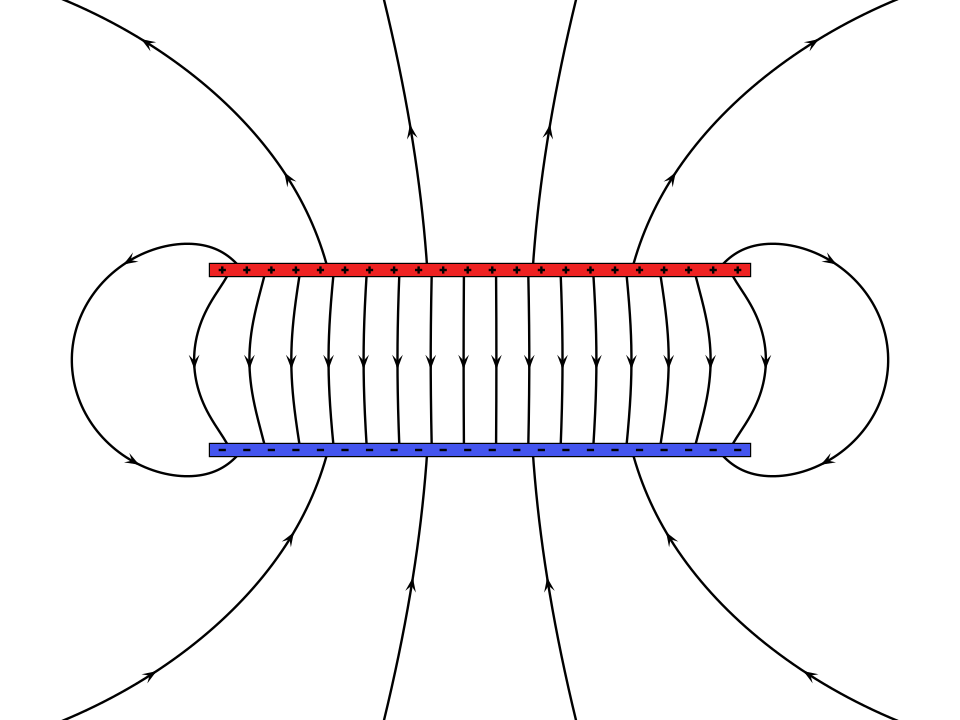 Shows uniform electric field between two charged plates (Image: Geek3, CC BY-SA 4.0, via Wikimedia Commons)
2. Electric Potential (V)
The electric potential at a point is the work done per unit charge in bringing a positive test charge from infinity to that point.
where:
- = Electric potential (V or J/C)
- = Work done (J)
- = Test charge (C)
Electric Potential Due to a Point Charge
For a point charge , the potential at a distance is:
Potential Difference (ΔV)
The potential difference between two points is the work done per unit charge in moving a charge from one point to another.
Relationship Between Electric Field and Potential
The electric field is the negative gradient of the electric potential:
For a uniform electric field:
3. Electric Potential Energy (U)
The electric potential energy of a charge in an electric field is the work done to bring it from infinity to that point.
Work Done in an Electric Field
The work done in moving a charge through a potential difference is:
In the Real World
Electric fields and potentials are fundamental to many technologies and everyday phenomena:
eSewa and Khalti (Digital Payments)
- Concept Used: Electric potential and current flow
- How? When you transfer money via eSewa or Khalti, the transaction is processed through servers that rely on voltage regulation (stable electric potential) to ensure data integrity. The capacitors in power supplies maintain a steady potential difference, preventing data loss during transactions.
Ncell and NTC (Telecommunication Networks)
- Concept Used: Electric fields in antennas and signal transmission
- How? Cell towers use electromagnetic waves (generated by oscillating electric fields) to transmit signals. The potential difference in antennas creates an oscillating electric field, which propagates as radio waves to your phone.
Daraz and Pathao (Logistics and Order Processing)
- Concept Used: Electric potential in microcontrollers and sensors
- How? Delivery tracking systems use GPS modules that rely on electric potential differences to process signals. The battery voltage (electric potential) powers the microcontroller, which calculates the shortest delivery route using algorithms similar to those in electric field optimization problems.
Worked Example: Proton Accelerated Through a Potential Difference
Problem Statement: A proton is accelerated through a potential difference of 200 V. It then enters a region with a magnetic field perpendicular to its motion. Find the force experienced by the proton.
Step 1: Find the Velocity of the Proton After Acceleration
Using the work-energy principle:
Given:
- (charge of proton)
- (mass of proton)
Step 2: Find the Magnetic Force on the Proton
The magnetic force on a moving charge is given by:
Since the magnetic field is perpendicular to the velocity (, ):
Direction: The force is perpendicular to both the velocity and the magnetic field (right-hand rule).
Comparison Table: Electric Field vs. Electric Potential
| Property | Electric Field (E) | Electric Potential (V) |
|---|---|---|
| Definition | Force per unit charge () | Work done per unit charge () |
| Unit | N/C or V/m | Volt (V) or J/C |
| Direction | Points away from +ve, toward -ve charges | Scalar quantity (no direction) |
| Relation to Force | ||
| Superposition | Vector sum of individual fields | Scalar sum of individual potentials |
| Zero Reference | No unique zero point | Zero at infinity (for point charges) |
| Work Done | (for uniform field) |
Applications of Electric Fields and Potential
Capacitors in Electronics
- Used in smartphones, laptops, and power supplies to store and release energy.
- IMAGE: parallel plate capacitor labelled diagram | Shows how charge separation creates a uniform electric field
Particle Accelerators (CERN, Medical Imaging)
- Concept: Electric potential difference accelerates charged particles (electrons, protons) to high speeds.
- Example: In CT scans, electrons are accelerated through a potential difference to generate X-rays.
Electrostatic Precipitators (Industrial Pollution Control)
- Concept: Electric fields remove particulate matter from exhaust gases in factories.
- How? A high-voltage electric field ionizes particles, which are then attracted to oppositely charged plates.
Touchscreens and Sensors
- Concept: Capacitive sensing relies on changes in electric potential when a finger touches the screen.
Mermaid Diagram: Electric Field Lines and Potential
graph TD
    A["Positive Charge (+Q)"] -->|"Electric Field Lines"| B["Away from +Q"]
    C["Negative Charge (-Q)"] -->|"Electric Field Lines"| D["Toward -Q"]
    E["Uniform Electric Field"] -->|"Between Plates"| F["Parallel Field Lines"]
    G["Potential (V)"] -->|"Decreases"| H["From + to -"]
    I["Work Done (W)"] -->|"qΔV"| J["Moves Charge"]
Exam Tip
Memorize Key Formulas:
- (Point charge field)
- (Point charge potential)
- (Field from potential)
- (Work done)
Direction Matters:
- Always specify the direction of electric fields (away from +ve, toward -ve).
- Use the right-hand rule for magnetic forces on moving charges.
Units and Signs:
- Electric field (E): N/C or V/m
- Potential (V): Volts (V)
- Work (W): Joules (J)
- Negative potential difference means the field does negative work (charge moves opposite to field).
Real-World Problems:
- In exam questions, relate electric potential to batteries, capacitors, and accelerators.
- Example: If a question asks about a proton moving in a potential difference, think of Ncell’s signal transmission or eSewa’s voltage regulation.
Graphical Representation:
- Electric field lines are continuous and never intersect.
- Equipotential lines are perpendicular to electric field lines.
Final Note: Master the relationship between E and V, and practice numerical problems involving work, energy, and force in electric fields. Use real-world analogies (like eSewa’s voltage stability) to remember concepts!
Based on the TU BSc CSIT syllabus for Physics (PHY118), unit 3.
Discussion
Loading…