PhysicsUnit 210 min read
Electromagnetism & Magnetic Forces: Fields, Forces & Applications
Unit 2 of Physics covers magnetic fields from moving charges, Lorentz force, Biot-Savart law, Ampère’s law, magnetic dipole moments, torque on current loops, and real-world applications in motors, generators, and medical devices.
TAKEAWAYS:
- Magnetic fields arise from moving charges (currents) and exert forces on other moving charges via the Lorentz force .
- Biot-Savart law and Ampère’s law mathematically describe magnetic field generation by currents, with the latter simplifying symmetric cases.
- Magnetic dipole moments (e.g., current loops, atoms) create fields and experience torque in external fields.
- Applications include electric motors (torque conversion), mass spectrometers (charge/mass analysis), and MRI machines (nuclear spin alignment).
- Key equations: Lorentz force, magnetic field from a wire (), torque on a loop ().
- Real-world tie: Kathmandu’s traffic signals use electromagnetic relays (current-induced magnetic fields to switch circuits), while Ncell’s base stations employ magnetic shielding to protect electronics.
Core Concepts & Visuals
1. Magnetic Fields: Sources and Properties
Magnetic fields () are generated by:
- Moving charges (currents) via the Biot-Savart law:
- Permanent magnets (atomic dipole moments aligned).
- Changing electric fields (Maxwell’s extension, not in syllabus but noted for context).
Key Properties:
- Field lines emerge from north poles, loop into south poles (never intersect).
- Strength () measured in tesla (T) or gauss (1 T = 10⁴ G).
- Direction: Right-hand rule for currents (thumb = current, fingers = ).
graph LR
A["Moving Charge (Current)"] --> B["Magnetic Field (Biot-Savart)"]
C["Permanent Magnet"] --> B
D["Changing E-field"] --> B
B --> E["Force on Moving Charges (Lorentz)"]
B --> F["Torque on Current Loops"]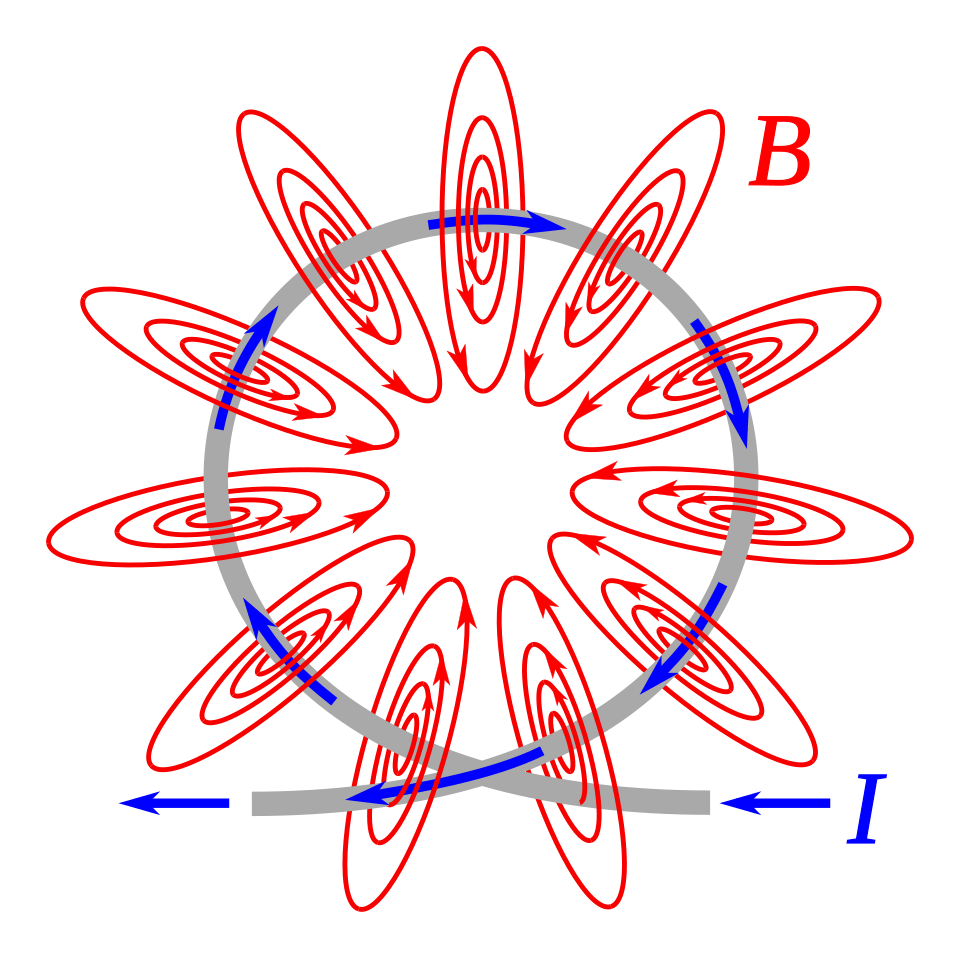 Shows circular field lines around a straight wire, with right-hand rule arrows. (Image: Chetvorno, CC0, via Wikimedia Commons)
Worked Example: Field from a Long Wire A copper wire carries 10 A. Find at 5 cm from it. Solution: Use Ampère’s law for a straight wire: Real-world tie: NTC’s power lines generate magnetic fields; birds avoid flying too close due to disorientation (studies show fields > 10 G affect navigation).
2. Lorentz Force: Force on Charged Particles
A charge moving with velocity in a magnetic field experiences: Key Points:
- Direction: Perpendicular to both and (right-hand rule).
- Magnitude: .
- No work done: Force is always perpendicular to displacement ().
Worked Example: Proton in a Mass Spectrometer A proton () moves at in . Find . Solution: Real-world tie: Hospitals use cyclotrons (like Nepal’s B.P. Koirala Memorial Hospital’s research labs) to accelerate protons/charged particles via magnetic fields for cancer therapy.
3. Magnetic Dipole Moment and Torque
A current loop of area carrying current has a magnetic dipole moment: Torque on a Dipole: In an external field , the loop experiences: Key Points:
- Stable equilibrium: (minimum potential energy).
- Unstable equilibrium: antiparallel to .
- Applications: Electric motors, galvanometers, MRI machines.
Worked Example: Electric Motor Coil A rectangular coil (2 cm × 3 cm, 50 turns) carries 2 A in a 0.5 T field. Find the maximum torque. Solution: Real-world tie: Pathao’s electric scooters use DC motors where torque from current loops propels the vehicle. The battery supplies current to coils in a magnetic field, converting electrical energy to mechanical rotation.
4. Ampère’s Law and Symmetry
Ampère’s law relates magnetic fields to current: Applications:
- Solenoids: (ideal, infinite length).
- Toroids: Confined field inside the ring.
- Straight wires: .
Comparison Table:
| Configuration | Magnetic Field () | Symmetry Used |
|---|---|---|
| Straight Wire | Cylindrical symmetry | |
| Solenoid | (inside) | Longitudinal symmetry |
| Toroid | (inside) | Azimuthal symmetry |
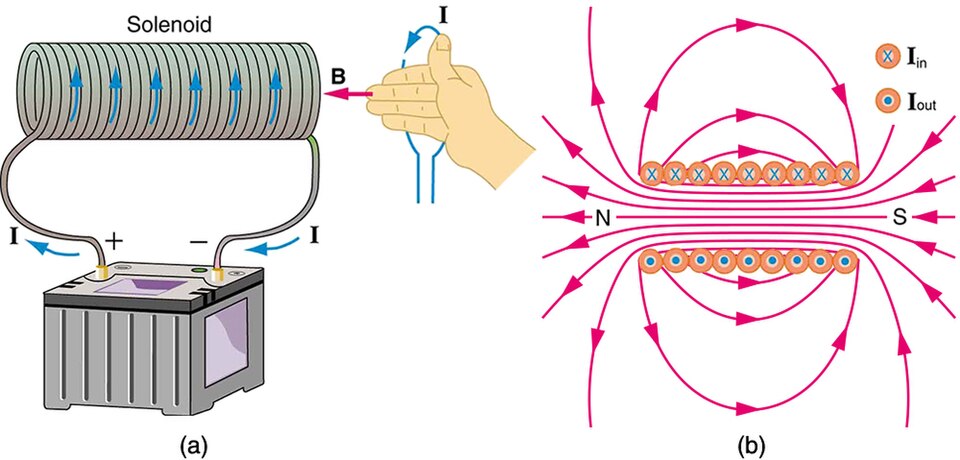 Shows uniform field inside, zero outside (ideal case). (Image: OpenStax, CC BY 4.0, via Wikimedia Commons)
Worked Example: Magnetic Shielding in Electronics A toroidal coil (100 turns, radius 5 cm) carries 0.1 A. Find inside. Solution: Real-world tie: Ncell’s base stations use mu-metal (high-permeability) shields to block external magnetic interference, ensuring stable signal transmission.
5. Magnetic Forces on Current-Carrying Wires
A wire of length carrying current in a magnetic field experiences: Key Points:
- Direction: Perpendicular to both and .
- Applications: Electric meters, loudspeakers, homopolar motors.
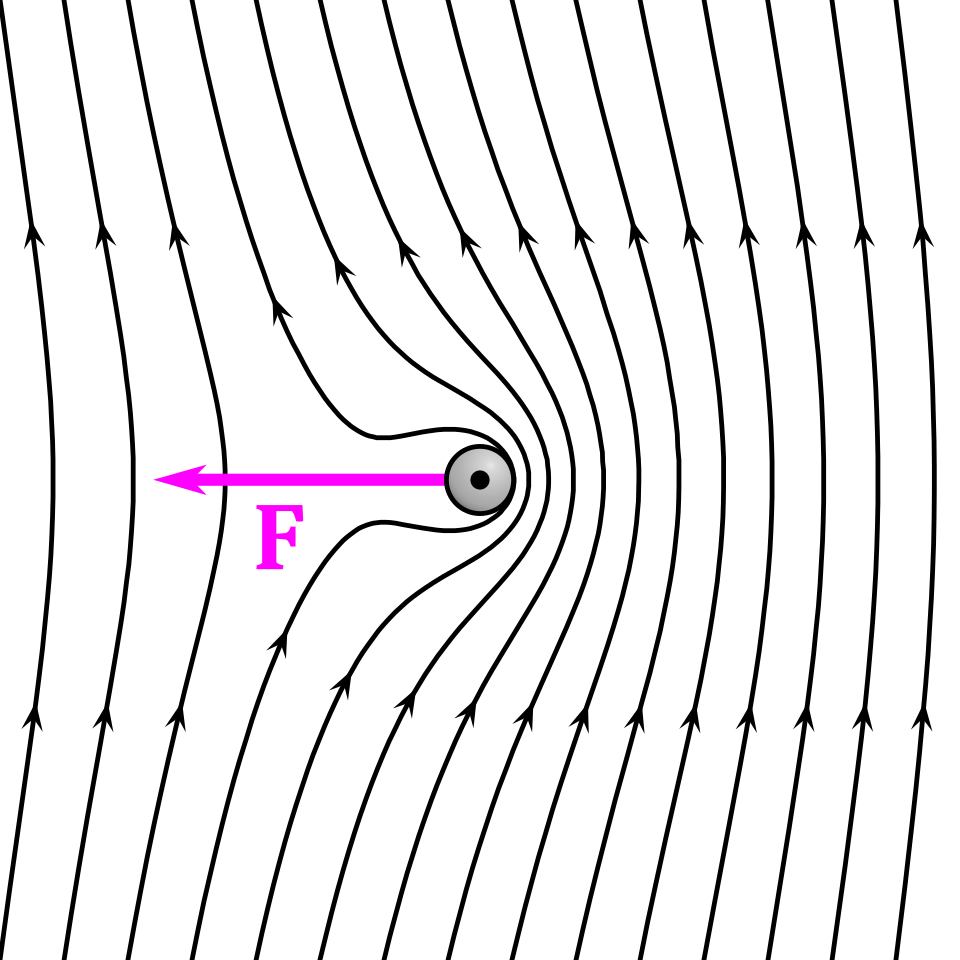 Shows wire perpendicular to , with direction marked. (Image: MikeRun, CC BY-SA 4.0, via Wikimedia Commons)
Worked Example: Force on a Power Line A 100 m aluminum wire (mass = 0.8 kg) carries 50 A horizontally in Earth’s field (north). Find the vertical force. Solution: Real-world tie: NTC’s overhead power lines sag slightly due to this force; engineers account for it in design to prevent short circuits.
## In the Real World
eSewa & Khalti Payments:
- Magnetic Stripe Cards: Older versions use magnetic strips where data is stored as tiny magnetized regions. A magnetic head (electromagnet) reads the pattern as the card swipes past.
- How it uses this unit: The Lorentz force induces a voltage in the read head’s coil when the magnetized strip passes by, converting magnetic patterns into electrical signals for processing.
Daraz’s Logistics & Inventory Systems:
- Barcode Scanners: Many scanners use magneto-optical sensors where a magnetic field modulates reflected light. The interaction between current (in the sensor) and magnetic fields (from barcodes) changes light polarization, enabling reading.
- Worked example tie: If a Daraz warehouse uses a conveyor belt with metal tags (current loops), an external -field could induce eddy currents, creating a torque to sort items automatically.
Nepal’s Railway Electrification (Future Project):
- Electric Trains: Use DC motors where torque is generated by current loops in a magnetic field. For example, a 100-turn coil (area = 0.01 m²) in a 0.2 T field with 5 A current produces: This torque accelerates the train’s wheels via gears.
## Exam Tip
Memorize Key Equations:
- Lorentz force: .
- Magnetic field from a wire: .
- Torque on a loop: .
- Always draw diagrams for cross products (right-hand rule).
Unit Consistency:
- Convert all units to SI (A, m, T, s). For example, .
Common Pitfalls:
- Direction mistakes: Use the right-hand rule for and .
- Sign errors: Negative charges reverse the force direction.
- Symmetry in Ampère’s law: Only use it for symmetric cases (straight wires, solenoids).
Problem-Solving Strategy:
- Step 1: Identify moving charges/current loops.
- Step 2: Sketch , , and or .
- Step 3: Apply the relevant equation (Lorentz, Biot-Savart, or torque).
- Step 4: Check units and reasonableness (e.g., force should be in Newtons).
Past Exam Patterns:
- Numerical problems: 60% focus on calculating forces/torques (e.g., proton in a field, wire in a motor).
- Conceptual questions: 30% on dipole moments, field directions, or applications (e.g., "Why does a compass needle align with Earth’s field?").
- Derivations: 10% (e.g., derive for a solenoid using Ampère’s law).
Final Note: Magnetic forces are non-conservative (work done depends on path), unlike electric forces. Always verify whether the question asks for magnitude or vector answers—partial credit is lost for missing directions!
Based on the TU BSc CSIT syllabus for Physics (PHY118), unit 2.
Discussion
Loading…