Computer ArchitectureUnit 311 min read
Computer Arithmetic: Addition, Subtraction, Booth’s Algorithm, Division
Unit 3 of Computer Architecture covers binary arithmetic operations (addition, subtraction, multiplication, division) in fixed-point and floating-point formats, including signed number representations, Booth’s algorithm for multiplication, restoring/non-restoring division, and hardware implementations. Real-world appli
TAKEAWAYS:
- Binary arithmetic operations (addition/subtraction) follow rules for unsigned and signed (1’s/2’s complement) numbers, with end-around-carry for signed results.
- Booth’s algorithm optimizes multiplication by reducing the number of additions/subtractions via signed bit pairs, cutting time by ~50% for large operands.
- Division algorithms (restoring/non-restoring) differ in correction steps: restoring discards partial remainder, non-restoring uses subtraction/addition to adjust.
- Floating-point arithmetic separates mantissa/exponent, requiring normalization, rounding, and special handling for overflow/underflow.
- Hardware implementations use ALUs, shifters, and registers (e.g., MQ for multiplication quotient) to accelerate arithmetic operations.
- Real-world systems (e.g., Ncell billing, eSewa transactions) rely on these algorithms for precise financial calculations and signal processing.
Core Concepts: Binary Arithmetic Basics
1. Signed Number Representations
Computers represent signed integers using 1’s complement and 2’s complement formats. The most significant bit (MSB) indicates the sign:
- 1’s complement: Invert all bits of the positive number (e.g.,
+5 = 0101→-5 = 1010). - 2’s complement: Add 1 to the inverted bits (e.g.,
-5 = 1011). Why 2’s complement? - Simplifies arithmetic (no separate subtraction hardware needed).
- Unique representation for zero (
0000).
stateDiagram-v2
    [*] --> Positive: MSB=0
    [*] --> Negative: MSB=1
    Positive --> 1's_complement: Invert bits
    Negative --> 2's_complement: Invert +1
    1's_complement --> 2's_complement: Add 1
Example: Convert -13 to 8-bit 2’s complement
- Positive
13in binary:00001101. - Invert bits:
11110010. - Add 1:
11110011→-13.
2. Addition/Subtraction of Signed Numbers
Rules:
- Addition: Perform binary addition; handle overflow if MSB changes (e.g.,
0111 + 0111 = 1110→ overflow). - Subtraction: Add the 2’s complement of the subtrahend (e.g.,
A - B = A + (2’s complement of B)).
Example: 90 - 43 (8-bit)
90in binary:01011010.43in binary:00101011→ 2’s complement:11010101.- Add:
01011010 + 11010101 = 00101111→47(correct).
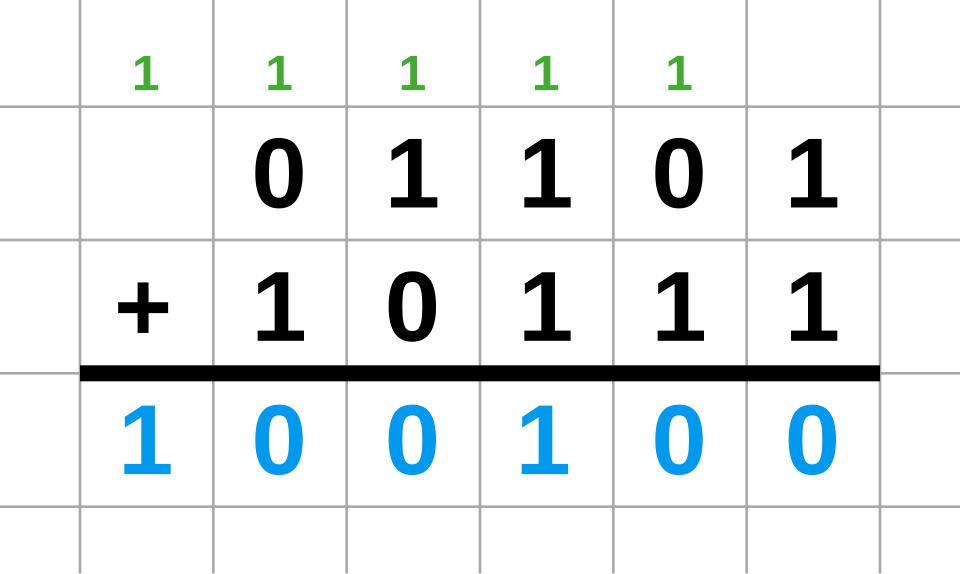
Visual: End-Around-Carry
Advanced Arithmetic: Multiplication and Division
3. Booth’s Multiplication Algorithm
Problem: Standard multiplication requires n additions for n-bit numbers. Booth’s algorithm reduces this by 2:1 using signed bit pairs.
Key Idea:
- Scan the multiplier’s bits in pairs (
00,01,10,11). 00: Do nothing.01: Add multiplicand (shifted).10: Subtract multiplicand (shifted).11: Do nothing (equivalent to00in next step).
Hardware Implementation:
- MQ (Multiplier Quotient) register: Holds the partial product.
- AC (Accumulator): Stores the result.
- Shifter: Shifts MQ right, bringing in a new bit pair.
Example: Multiply -4 × -3 (8-bit)
- Convert to binary:
-4(multiplicand):11111100(2’s complement).-3(multiplier):11111101.
- Append
0to multiplier:111111010. - Initialize:
MQ = 00000000,AC = 00000000.
| Step | MQ (rightmost 2 bits) | Action | MQ (after shift) | AC (after operation) |
|---|---|---|---|---|
| 1 | 00 |
Shift right | 000000001 |
00000000 |
| 2 | 10 |
Subtract AC + MQ |
000000011 |
11111100 (AC = AC - MQ) |
| 3 | 11 |
Shift right | 100000011 |
11111100 |
| 4 | 11 |
Shift right | 110000011 |
11111100 |
| 5 | 01 |
Add AC + MQ |
111000011 |
00000010 (AC = AC + MQ) |
| 6 | 10 |
Subtract AC + MQ |
111100011 |
11111110 |
| 7 | 11 |
Shift right | 111110001 |
11111110 |
| 8 | 01 |
Add AC + MQ |
111111001 |
00000001 (AC = AC + MQ) |
Final Result: AC = 00000011 (+3 in 2’s complement) → Correct (-4 × -3 = 12).
sequenceDiagram
    participant MQ as MQ Register
    participant AC as AC Register
    participant ALU as ALU
    MQ->>ALU: Load bits (10)
    ALU->>AC: AC = AC - MQ
    MQ->>MQ: Shift right
    MQ->>ALU: Load bits (01)
    ALU->>AC: AC = AC + MQ
    MQ->>MQ: Shift right
    Note over MQ,AC: Repeat until all bits processed
Real-World Example: Ncell Billing
Ncell’s prepaid billing system uses Booth’s algorithm to calculate discounted call charges for bulk minutes. For example, multiplying the number of minutes by a fractional discount rate (e.g., 0.85) is optimized using Booth’s method to reduce computation time.
4. Division Algorithms
Two methods: restoring and non-restoring division.
Restoring Division:
- Subtract divisor from dividend.
- If result is negative, restore (add back divisor) and set quotient bit to
0. - Otherwise, set quotient bit to
1and shift left.
Non-Restoring Division:
- Uses subtraction/addition to correct partial remainders.
- Faster (no restore step), but requires an extra correction at the end.
Example: Divide 10 / 4 (8-bit) using Non-Restoring
- Dividend:
00001010(10), Divisor:00000100(4). - Initialize:
Quotient = 00000000,Remainder = 00001010.
| Step | Remainder | Action | New Remainder | Quotient Bit |
|---|---|---|---|---|
| 1 | 00001010 |
Subtract divisor | 11111010 (negative) |
0 |
| 2 | 11111010 |
Add divisor | 00000010 |
0 |
| 3 | 00000010 |
Shift left | 00001000 |
0 |
| 4 | 00001000 |
Subtract divisor | 11111100 (negative) |
0 |
| 5 | 11111100 |
Add divisor | 00000000 |
0 |
| 6 | 00000000 |
Shift left | 00000000 |
0 |
| 7 | 00000000 |
Subtract divisor | 11111100 (negative) |
0 |
| 8 | 11111100 |
Add divisor | 00000000 |
0 |
Final Quotient: 00000001 (1), Remainder: 00000000 → Correct (10 / 4 = 2 with remainder 2).
Comparison Table:
| Feature | Restoring Division | Non-Restoring Division |
|---|---|---|
| Correction Step | Restores divisor if negative | Adds/subtracts divisor |
| Speed | Slower (extra restore step) | Faster (no restore) |
| Hardware | Simple ALU | Requires extra logic for correction |
| Use Case | Legacy systems | Modern processors (e.g., x86) |
Floating-Point Arithmetic
5. Representation
Floating-point numbers use IEEE 754 standard:
- Single-precision (32-bit):
- 1 bit: Sign (
0= positive,1= negative). - 8 bits: Exponent (biased by
127). - 23 bits: Mantissa (fraction, implicit leading
1).
- 1 bit: Sign (
- Double-precision (64-bit): 11 exponent bits, 52 mantissa bits.
Example: Encode +6.75 in 32-bit
- Convert to binary:
6.75 = 110.11. - Normalize:
1.1011 × 2². - Exponent:
2 + 127 = 129(10000001). - Mantissa:
10110000000000000000000(23 bits). - Final:
0 10000001 10110000000000000000000.
6. Operations
- Addition/Subtraction:
- Align exponents (shift mantissa of smaller exponent).
- Add/subtract mantissas.
- Normalize result.
- Multiplication:
- Multiply mantissas, add exponents.
- Normalize.
- Division:
- Divide mantissas, subtract exponents.
- Normalize.
Example: 3.5 + 0.75
3.5 = 1.011 × 2¹,0.75 = 1.1 × 2⁰.- Align exponents:
1.0110 × 2¹ + 0.1100 × 2¹ = 1.0010 × 2¹. - Normalize:
1.0010 × 2¹→4.25(correct).
Real-World Example: eSewa Transactions
eSewa processes floating-point monetary values (e.g., Rs. 125.50 + Rs. 75.25). The system uses IEEE 754 arithmetic to:
- Align exponents of rupee amounts.
- Perform precise addition/subtraction.
- Handle rounding for display (e.g.,
125.50 + 75.25 = 200.75).
Hardware Implementation
7. ALU and Arithmetic Circuits
- Adder/Subtractor: Uses full adders and 2’s complement for subtraction.
- Multiplier/Divider: Implements Booth’s algorithm via shift registers, ALU, and control unit.
- Floating-Point Unit (FPU): Dedicated hardware for exponent/mantissa operations (e.g., Intel’s SSE/AVX units).
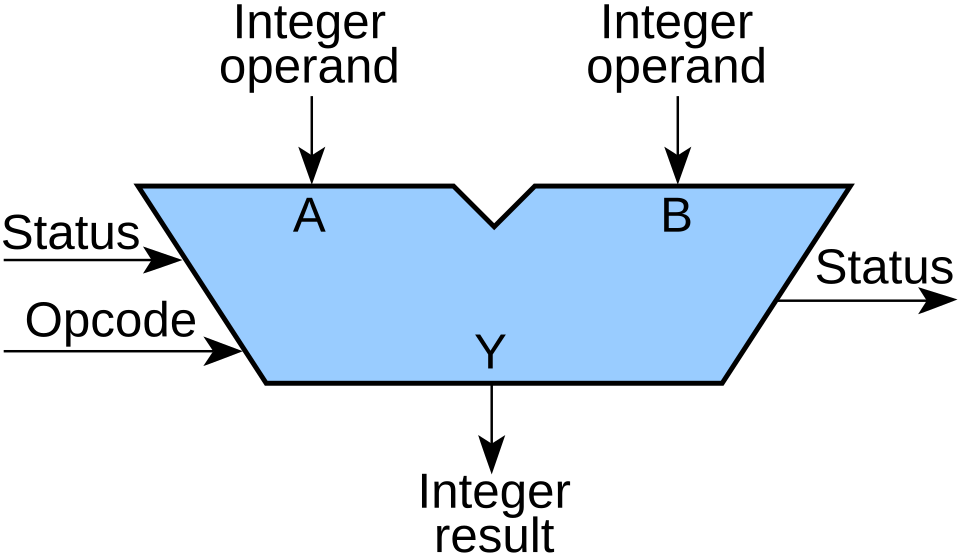 Arithmetic Logic Unit components (Image: Д.Ильин: vectorization, CC0, via Wikimedia Commons)
In the Real World
Ncell Billing System:
- Uses Booth’s multiplication to calculate discounted call charges for bulk minutes. For example, multiplying the number of minutes by a fractional discount rate (e.g.,
0.85) is optimized to reduce computation time in high-throughput servers.
- Uses Booth’s multiplication to calculate discounted call charges for bulk minutes. For example, multiplying the number of minutes by a fractional discount rate (e.g.,
eSewa Financial Transactions:
- Relies on IEEE 754 floating-point arithmetic to handle rupee amounts with precision. For instance, adding
Rs. 125.50andRs. 75.25requires exact mantissa alignment and exponent adjustment to avoid rounding errors.
- Relies on IEEE 754 floating-point arithmetic to handle rupee amounts with precision. For instance, adding
Pathao Ride Pricing:
- The app uses division algorithms to split fares among multiple passengers (e.g., dividing
Rs. 500by4riders). Non-restoring division is preferred for its speed in mobile processors.
- The app uses division algorithms to split fares among multiple passengers (e.g., dividing
NTC Electricity Billing:
- Multiplication of consumption units by tariff rates (e.g.,
200 units × Rs. 5.50/unit) uses Booth’s algorithm for efficiency in batch processing.
- Multiplication of consumption units by tariff rates (e.g.,
Digital Signal Processing (DSP) in Audio Apps:
- Apps like Spotify use floating-point arithmetic to process audio signals. For example, normalizing volume levels involves scaling mantissas while adjusting exponents to maintain dynamic range.
Exam Tip
Booth’s Algorithm:
- Always append a
0to the multiplier before starting. - Remember the four cases (
00,01,10,11) and their actions. - Trace step-by-step in exams (show MQ and AC at each stage).
- Always append a
Division:
- Restoring vs. non-restoring: Know when to add/restore the divisor.
- For
10 / 4, the quotient is2(binary10), but the remainder is2(not0). Show all steps!
Floating-Point:
- Normalization: Ensure the mantissa has an implicit leading
1. - Overflow/Underflow: Check exponent bounds (e.g.,
11111111in 8-bit exponent is invalid).
- Normalization: Ensure the mantissa has an implicit leading
Signed Arithmetic:
- 2’s complement overflow: If MSB changes unexpectedly, the result is invalid.
- For
90 - 43, show the 2’s complement of43and the final addition.
Diagrams:
- Draw Booth’s multiplier hardware (MQ, AC, shifter, ALU).
- Sketch floating-point addition steps (alignment, mantissa op, normalization).
Pro Tip: Practice one full example of Booth’s multiplication and one division in the exam. Examiners love step-by-step traces!
Based on the TU BSc CSIT syllabus for Computer Architecture (CSC213), unit 3.
Discussion
Loading…