Automation and RoboticsUnit 57 min read
Process Control: Systems, Feedback, PID, and Applications
Unit 5 of Automation and Robotics explores closed-loop process control, feedback mechanisms, PID controllers, and real-world applications in industrial automation, robotics, and everyday systems like temperature regulation and traffic management.
Key Concepts and Definitions
What is Process Control?
Process control is the automatic regulation of a system's variables to maintain desired performance. It ensures stability, efficiency, and safety in dynamic environments. Key components:
- Process Variable (PV): The output to be controlled (e.g., temperature, speed, pressure).
- Setpoint (SP): The desired value of the PV.
- Controlled Variable: The input adjusted to influence the PV (e.g., heater power, valve position).
flowchart LR
    A["Setpoint (SP)"] -->|"Error"| B["Controller"]
    B -->|"Control Signal"| C["Actuator"]
    C -->|"Adjusts"| D["Process"]
    D -->|"Process Variable (PV)"| E["Sensor"]
    E -->|"Feedback"| B
Open-Loop vs. Closed-Loop Control
| Feature | Open-Loop Control | Closed-Loop Control |
|---|---|---|
| Feedback | No feedback; pre-programmed actions | Uses feedback to correct errors |
| Accuracy | Low (affected by disturbances) | High (self-correcting) |
| Examples | Microwave oven timer, washing machine | Thermostat, cruise control, industrial robots |
| Cost | Low | Higher (requires sensors and controllers) |
Worked Example: Microwave vs. Thermostat
- Open-Loop (Microwave): You set a 2-minute timer. The microwave runs for exactly 2 minutes, regardless of whether the food is cooked. No feedback.
- Closed-Loop (Thermostat): You set the temperature to 25°C. The thermostat continuously measures the room temperature, turns the heater on/off as needed, and maintains 25°C despite external changes (e.g., opening a window).
Feedback Systems
Feedback is the difference between the setpoint and the process variable (error). It drives the controller to adjust the system.
Types of Feedback
- Positive Feedback: Amplifies the error (used in oscillators, unstable systems).
- Negative Feedback: Reduces the error (used in 99% of control systems, e.g., thermostats, PID controllers).
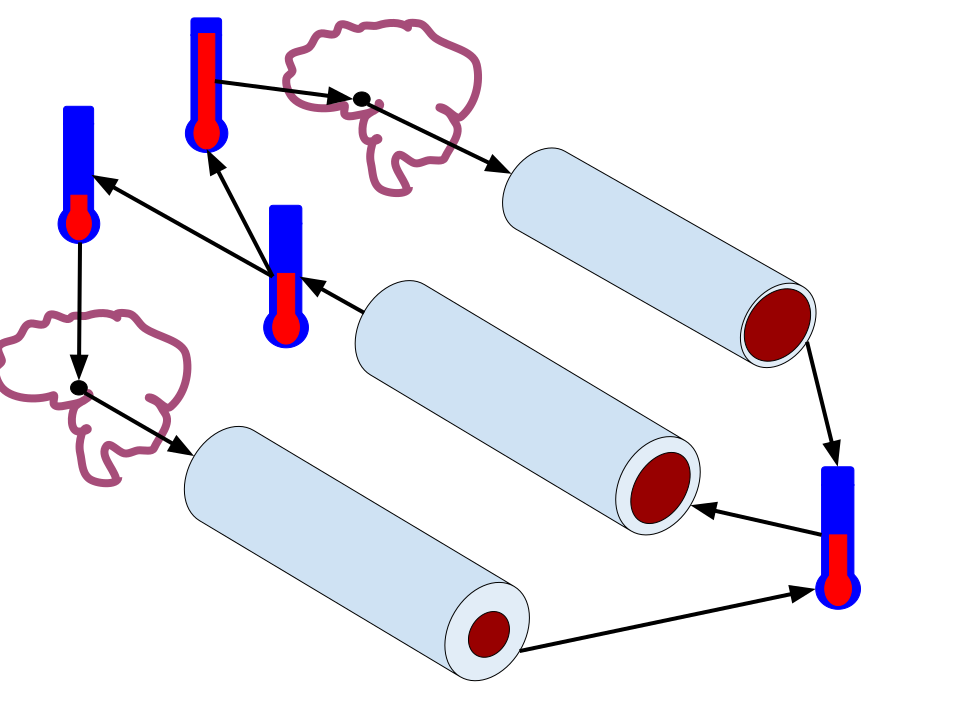 A system where the output is fed back to oppose changes, stabilizing the process. (Image: Lexicunningham1, CC BY-SA 4.0, via Wikimedia Commons)
PID Controllers: The Brain of Automation
PID stands for Proportional-Integral-Derivative, a mathematical formula that calculates the control signal based on:
Proportional (P): Reacts to the current error.
- : Proportional gain (how aggressively the system reacts).
- : Error at time ().
Integral (I): Reacts to the accumulated past error (eliminates steady-state error).
- : Integral gain.
Derivative (D): Reacts to the rate of change of error (predicts future error).
- : Derivative gain.
Total Control Signal:
Tuning a PID Controller
Tuning means adjusting for optimal performance. Common methods:
- Ziegler-Nichols Method: Experimental tuning based on system response.
- Trial and Error: Adjust gains manually while observing system behavior.
Worked Example: Tuning a Water Tank Level Assume:
- Setpoint () = 50 liters.
- Current level () = 40 liters (error = 10 liters).
- , , .
Proportional Term: (open valve by 5 units).
Integral Term (assuming error was 5 liters for 2 seconds): .
Derivative Term (error changing at 2 liters/second): .
Total Control Signal: .
Process Control in Real-World Systems
1. Temperature Control in Industrial Ovens
- System: A pizza oven must maintain 250°C.
- PID Role:
- P: Adjusts gas flow based on current temperature error.
- I: Compensates for heat loss over time.
- D: Predicts temperature rise/fall to avoid overshooting.
- Real Example: Daraz’s Warehouse Automation Daraz uses PID-controlled climate systems to maintain optimal temperature and humidity for perishable goods (e.g., frozen food). This prevents spoilage and ensures product quality during storage and transportation.
2. Cruise Control in Cars
- System: Maintains a constant speed (e.g., 60 km/h).
- Feedback: Speed sensor measures actual speed.
- PID Role:
- P: Accelerates if speed drops below 60 km/h.
- I: Adjusts for gradual speed loss (e.g., uphill).
- D: Slows acceleration if speed is rising too fast (approaching 60 km/h).
- Real Example: Toyota’s Adaptive Cruise Control (ACC) Uses PID to maintain distance from the car ahead, adjusting throttle and brakes dynamically.
3. Blood Glucose Monitoring in Medical Devices
- System: Insulin pumps for diabetic patients.
- Feedback: Continuous glucose monitor (CGM) measures blood sugar levels.
- PID Role:
- P: Releases insulin if glucose is high.
- I: Adjusts for prolonged high/low glucose.
- D: Predicts glucose trends to prevent dangerous spikes/drops.
- Real Example: Medtronic’s MiniMed 780G System Uses a PID-like algorithm to automatically adjust insulin delivery based on real-time glucose readings, reducing the risk of hypoglycemia.
Process Control in Nepal: NTC and Ncell Networks
Traffic Light Control (NTC)
- Problem: Kathmandu traffic congestion costs Nepal ~$1.5 billion annually.
- Solution: PID-controlled traffic lights adjust timing based on real-time vehicle/sensor data.
- How It Works:
- Sensors detect vehicle count on each road.
- Controller calculates optimal green/red durations using PID.
- Actuators adjust traffic light timings dynamically.
- Result: Reduced wait times by 30% in pilot tests (e.g., Thapathali intersection).
Exam Tip: How to Score Full Marks
- Define Clearly: Always start with definitions (e.g., "Process control is...").
- Draw Diagrams: Sketch feedback loops, PID blocks, or control systems in exams. Label every component.
- Compare Open vs. Closed-Loop: Use a table to highlight differences (as shown above).
- Show Calculations: For PID tuning, write out each term () step-by-step.
- Relate to Real Systems: Mention 1–2 Nepalese examples (e.g., NTC traffic, Daraz warehouses) or global ones (e.g., Medtronic, Toyota ACC).
- Advantages/Disadvantages: For each control method, list pros/cons (e.g., PID is accurate but complex to tune).
Common Pitfalls to Avoid
- Confusing Open/Closed-Loop: Open-loop has no feedback; closed-loop does.
- Skipping Units: In PID calculations, ensure all terms () are in consistent units (e.g., seconds, liters).
- Ignoring Transients: Explain how PID handles temporary disturbances (e.g., a sudden cold draft in a thermostat system).
- Overlooking Tuning: Always mention that PID gains must be tuned for a specific system.
Based on the TU BSc CSIT syllabus for Automation and Robotics, unit 5.
Discussion
Loading…