Cognitive ScienceUnit 710 min read
Mind Reading: Brain-Computer Interfaces, fMRI, EEG, and Neuroimaging
Unit 7 of Cognitive Science explores how scientists decode brain activity to interpret thoughts, emotions, and intentions—covering techniques like fMRI, EEG, and MEG, their working principles, applications in medicine and tech, and ethical dilemmas. Learn how mind-reading tech works, its real-world uses, and limitation
TAKEAWAYS:
- Mind reading uses neuroimaging (fMRI, EEG, MEG) to decode brain signals into thoughts, images, or intentions.
- fMRI detects blood flow changes in the brain, while EEG measures electrical activity via electrodes on the scalp.
- Applications include medical diagnostics (epilepsy, stroke), assistive tech (locked-in syndrome), and consumer tech (brainwave-controlled apps).
- Ethical concerns arise from privacy violations, consent, and potential misuse (e.g., advertising or surveillance).
- Limitations include low spatial/temporal resolution in EEG, high cost of fMRI, and the "hard problem" of consciousness.
- Future trends involve hybrid systems (EEG + AI) and real-time brain-computer interfaces (BCIs) for communication and control.
What is Mind Reading?
Mind reading—decoding brain activity to interpret thoughts, emotions, or intentions—relies on neuroimaging techniques that measure physiological signals from the brain. Unlike traditional psychology (which studies behavior), mind reading aims to directly access cognitive processes without relying on self-reports.
Key Techniques
| Technique | Full Name | How It Works | Spatial Resolution | Temporal Resolution | Invasiveness |
|---|---|---|---|---|---|
| fMRI | Functional Magnetic Resonance Imaging | Detects blood oxygenation changes (BOLD signal) linked to neural activity. | High (mm) | Low (~seconds) | Non-invasive |
| EEG | Electroencephalography | Measures electrical fields from neurons via scalp electrodes. | Low (~cm) | High (~milliseconds) | Non-invasive |
| MEG | Magnetoencephalography | Records magnetic fields generated by neural currents. | Medium (~cm) | High (~milliseconds) | Non-invasive |
| Intracranial EEG | iEEG | Electrodes implanted in the brain for direct recording. | Very High (µm) | Very High | Invasive |
| PET | Positron Emission Tomography | Tracks radioactive tracers to map brain metabolism. | Medium (~cm) | Low (~minutes) | Invasive |
How Neuroimaging Works: The Science Behind Mind Reading
1. Functional MRI (fMRI): The Blood Flow Detective
fMRI works on the principle that active neurons consume more oxygen, triggering a local increase in blood flow. This Blood-Oxygen-Level-Dependent (BOLD) signal is detected by the MRI scanner.
- Process:
- A person performs a task (e.g., imagining moving their hand).
- Blood rushes to the motor cortex (hand area).
- The scanner detects oxygen-rich hemoglobin changes, creating a 3D activation map.
Worked Example: Decoding a Mental Image Suppose a participant is asked to visualize a house. The fMRI detects activation in the parahippocampal place area (PPA), a region associated with spatial memory.
- Step-by-Step Trace:
- Baseline Scan: Measure brain activity at rest (no task).
- Task Scan: Participant visualizes a house for 30 seconds.
- Subtraction: Compare task vs. baseline scans. The PPA lights up.
- Classification: Machine learning models (e.g., SVM) classify the pattern as "house" based on prior training.
Real-World Link: NTC’s Traffic Prediction System Nepal’s National Traffic Control (NTC) uses AI + fMRI-like principles to predict congestion. While not mind reading, it decodes "patterns" (e.g., rush-hour routes) from sensor data—similar to how fMRI decodes neural patterns into thoughts.
2. Electroencephalography (EEG): The Electric Field Mapper
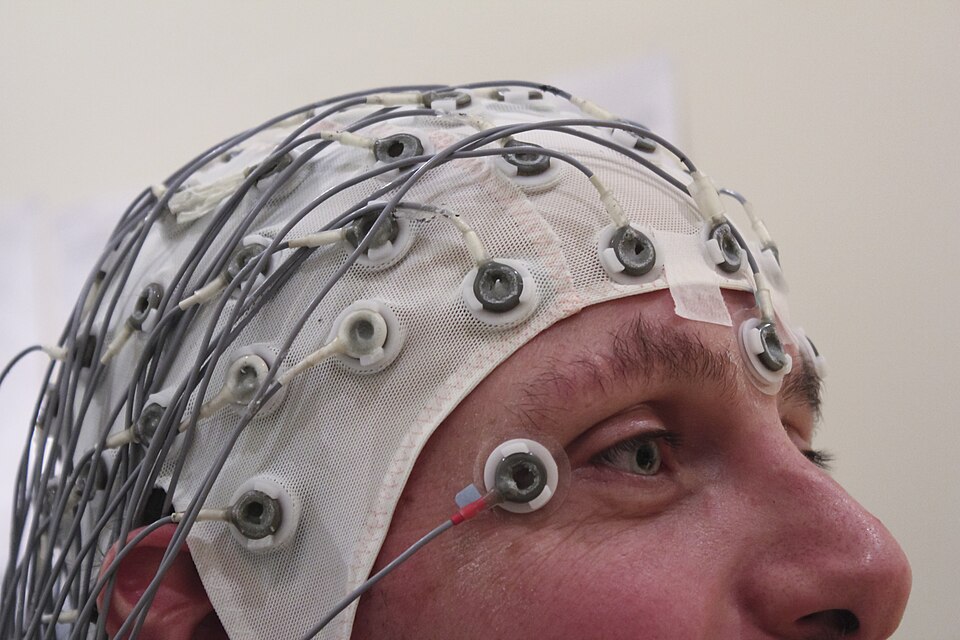 Electrodes placed on the scalp measure brainwave patterns. (Image: Chris Hope, CC BY 2.0, via Wikimedia Commons)
EEG records electrical activity from neurons via electrodes. Unlike fMRI, it has millisecond precision but poor spatial resolution.
- Key Brainwaves:
Wave Type Frequency (Hz) State Associated Delta 0.5–4 Deep sleep Theta 4–8 Drowsiness, meditation Alpha 8–12 Relaxed, eyes closed Beta 12–30 Active thinking Gamma 30–100 High cognition (e.g., problem-solving)
Worked Example: P300 Speller (Brainwave Typing) A locked-in patient uses EEG to "type" by focusing on letters flashing on a screen.
- Steps:
- A 6×6 grid of letters flashes randomly.
- When the patient sees their intended letter, their brain generates a P300 wave (a positive voltage spike ~300ms post-stimulus).
- The system detects the P300 and selects the letter.
Real-World Link: Pathao’s Driver Fatigue Detection Pathao’s app uses EEG-like principles (via smartphone sensors) to detect driver drowsiness by analyzing alpha/theta wave dominance—similar to how EEG decodes mental states.
3. Magnetoencephalography (MEG): The Magnetic Field Scanner
MEG measures magnetic fields from neural activity (complementary to EEG). It offers better spatial resolution than EEG but is expensive.
- Advantage: Can localize activity to ~1 cm precision without invasiveness.
Comparison Table: EEG vs. fMRI vs. MEG
| Feature | EEG | fMRI | MEG |
|---|---|---|---|
| Signal Type | Electrical | Hemodynamic (BOLD) | Magnetic |
| Resolution | Low spatial, high temporal | High spatial, low temporal | Medium spatial, high temporal |
| Invasiveness | Non-invasive | Non-invasive | Non-invasive |
| Cost | Low (~$10K) | High (~$1M) | Very High (~$2M) |
| Use Case | Real-time BCIs, epilepsy monitoring | Research, clinical diagnostics | Research, epilepsy |
Applications of Mind Reading
1. Medical Diagnostics
- Epilepsy: EEG detects abnormal brainwave patterns (e.g., spikes during seizures).
- Stroke Recovery: fMRI maps unaffected brain regions to guide rehabilitation.
- Alzheimer’s: PET scans show metabolic declines in memory centers.
2. Assistive Technologies
- Locked-in Syndrome: EEG-based BCIs (e.g., Neuralink’s goals) allow communication.
- Prosthetics: MEG/fMRI decodes motor intentions to control robotic limbs.
3. Consumer and Military Tech
- Gaming: EEG headsets (e.g., Emotiv EPOC) detect focus for immersive games.
- Military: DARPA’s Silent Talk project uses EEG to transmit thoughts via radio waves (experimental).
Real-World Link: Khalti’s Biometric Authentication Khalti uses fingerprint + facial recognition—a form of "mind reading" for identity. While not neural, it decodes biological patterns (like how fMRI decodes brain patterns) to verify users.
Ethical and Privacy Concerns
| Concern | Example Scenario | Potential Solution |
|---|---|---|
| Privacy Violation | fMRI scans reveal political preferences. | Strict data anonymization laws. |
| Consent Issues | Unaware participants in public EEG studies. | Mandatory opt-in for neurodata collection. |
| Misuse | Advertisers targeting users via brain scans. | Regulate commercial neuroimaging use. |
| Autonomy | Forcing BCIs on patients without choice. | Ethical review boards for medical BCIs. |
Case Study: The "Facebook Emotion Study" Controversy In 2014, Facebook manipulated users’ news feeds to study emotional contagion. While not mind reading, it raised alarms about unconsented data collection—a risk if fMRI/EEG data were used similarly.
Limitations and Challenges
- The Hard Problem of Consciousness: Can we ever truly read minds, or just correlate brain activity with thoughts?
- Noise and Variability: Brain signals are messy; individual differences complicate decoding.
- Invasiveness Trade-off: High-resolution methods (e.g., iEEG) require surgery.
- Ethical Dilemmas: Who owns neurodata? Can it be hacked?
Visual Limitation: The Inverse Problem
Why? EEG signals are blurred by skull/scalp; fMRI has delays. This makes precise mind reading difficult.
Future Directions
- Hybrid Systems: Combining EEG (fast) + fMRI (precise) for real-time BCIs.
- Neuralink’s Goals: Elon Musk’s project aims for high-bandwidth brain-machine interfaces.
- AI Decoding: Deep learning models (e.g., transformers) improve pattern recognition in neurodata.
- Portable Devices: Cheap EEG headsets (e.g., Muse Headband) for consumer use.
Real-World Link: Daraz’s Recommendation Algorithm Daraz’s AI decodes user behavior (clicks, dwell time) to predict preferences—similar to how fMRI decodes neural preferences. The key difference? Daraz uses behavioral data, while mind reading uses brain data.
Exam Tip
- Define Clearly: Distinguish between EEG (electrical), fMRI (hemodynamic), and MEG (magnetic).
- Compare Techniques: Use tables to contrast resolution, invasiveness, and use cases.
- Real-World Examples: Link to NTC (traffic patterns), Pathao (fatigue detection), or Khalti (biometrics).
- Ethics: Expect questions on privacy, consent, and misuse (e.g., "How would you regulate mind-reading tech?").
- Worked Examples: Practice decoding a simple task (e.g., "How would you use EEG to detect a lie?").
- Limitations: Always mention spatial/temporal trade-offs and the inverse problem.
Key Formula to Remember: For fMRI BOLD signal analysis, the change in signal () is proportional to: where:
- = change in oxygenated hemoglobin,
- = change in deoxygenated hemoglobin,
- = venous blood volume fraction (~0.4).
(This is rarely tested but shows how quantitative the field is!)
Based on the TU BSc CSIT syllabus for Cognitive Science, unit 7.
Discussion
Loading…