Computer Hardware DesignUnit 38 min read
Binary Arithmetic, Signed Numbers, ALU Design & Floating-Point
Unit 3 of Computer Hardware Design covers binary arithmetic operations (addition, subtraction, multiplication, division), signed number representations (1’s complement, 2’s complement, sign-magnitude), arithmetic logic units (ALU), and floating-point arithmetic. It explains how computers perform arithmetic at the hardw
TAKEAWAYS:
- Binary arithmetic follows fixed rules for addition, subtraction, multiplication, and division, with carry/borrow propagation and overflow detection.
- Signed numbers are represented in sign-magnitude, 1’s complement, and 2’s complement formats, with 2’s complement being the most efficient for hardware.
- The Arithmetic Logic Unit (ALU) performs arithmetic and logical operations, combining registers, decoders, and multiplexers.
- Floating-point arithmetic uses IEEE 754 standards for representing real numbers, with precision trade-offs between mantissa and exponent.
- Booth’s algorithm optimizes multiplication/division of signed numbers by reducing the number of operations.
- Overflow and underflow must be detected in both integer and floating-point arithmetic to ensure correct results.
1. Binary Arithmetic Operations
Computers perform arithmetic using binary digits (0 and 1). The four fundamental operations are:
- Addition: Follows the same rules as decimal addition but with carry propagation.
- Subtraction: Performed as addition of the 2’s complement of the subtrahend.
- Multiplication: Uses shift-and-add or Booth’s algorithm for efficiency.
- Division: Uses restoring division or non-restoring division for signed numbers.
1.1 Binary Addition and Subtraction
Binary addition is straightforward:
  1 0 1 1  (11)
+ 0 1 1 0  (6)
-----------
 1 0 0 0 1  (17)
Subtraction is done by adding the 2’s complement of the subtrahend:
  1 0 1 1  (11)
- 0 1 1 0  (6)
-----------
 1 0 1 1  + 2’s complement of 6 (1 0 0 1 + 1 = 1 0 1 0)
-----------
 0 0 0 1  (1)
Overflow occurs if the result exceeds the bit-width (e.g., adding two positive numbers yields a negative result).
1.2 Binary Multiplication (Shift-and-Add)
Multiplication is done by shifting and adding:
   1 0 1 0  (10)
×    1 1 0 1  (13)
-----------
   1 0 1 0    (shift 0)
+ 1 0 1 0     (shift 1)
+ 0 0 0 0     (shift 2)
+ 1 0 1 0     (shift 3)
-----------
1 1 0 0 1 1 0  (130)
Booth’s algorithm reduces the number of additions by encoding sequences of 1s and 0s.
1.3 Binary Division (Restoring Division)
Division uses subtraction and shifting:
Dividend: 1 1 0 1 0 1  (101)
Divisor:   1 0 1 0      (10)
Quotient:  1 0 1 1      (11)
Remainder: 0 0 1 1      (3)
Steps:
- Align divisor with dividend.
- Subtract divisor from dividend.
- Shift right and repeat until divisor fits no more.
2. Signed Number Representations
Computers represent signed numbers in three ways:
| Format | Positive Example | Negative Example | Key Feature |
|---|---|---|---|
| Sign-Magnitude | 0 1 0 1 (+5) |
1 1 0 1 (-5) |
Sign bit + magnitude |
| 1’s Complement | 0 1 0 1 (+5) |
1 0 1 0 (-5) |
Invert all bits |
| 2’s Complement | 0 1 0 1 (+5) |
1 0 1 1 (-5) |
Invert +1 |
2’s complement is preferred because:
- No separate sign bit (simpler hardware).
- Direct subtraction (adding negative is same as adding positive).
- Overflow detection is straightforward.
2.1 Conversion Between Formats
- Sign-Magnitude → 2’s Complement:
- If negative, invert bits and add 1.
- Example:
-5(1 0 1 0) →1 0 1 1(-5 in 2’s complement).
- 1’s Complement → 2’s Complement:
- Add 1 to the 1’s complement representation.
2.2 Overflow Detection in 2’s Complement
Overflow occurs if:
- Two positive numbers add to a negative result.
- Two negative numbers add to a positive result. Example:
  0 1 1 0  (+6)
+ 0 0 1 0  (+2)
-----------
 1 0 0 0  (-8) → Overflow!
3. Arithmetic Logic Unit (ALU)
The ALU performs arithmetic and logical operations. It consists of:
- Registers (to hold operands).
- Adders/Subtractors (for arithmetic).
- Multiplexers (to select operations).
- Control Unit (to manage operations).
3.1 ALU Block Diagram
flowchart LR
    A["Input A"] --> MUX1["Operation Selector"]
    B["Input B"] --> MUX2["Operation Selector"]
    MUX1 --> ADD["Adder"]
    MUX2 --> ADD
    ADD --> OUT["Result"]
    MUX1 --> SUB["Subtractor"]
    MUX2 --> SUB
    SUB --> OUT
    MUX1 --> AND["AND Gate"]
    MUX2 --> AND
    AND --> OUT
    MUX1 --> OR["OR Gate"]
    MUX2 --> OR
    OR --> OUT
Example ALU Operations:
| Operation | Control Signals | Output |
|---|---|---|
A + B |
0 0 |
A + B |
A - B |
0 1 |
A + (2’s comp of B) |
A AND B |
1 0 |
A ∧ B |
3.2 ALU for Signed Numbers
- Uses 2’s complement arithmetic.
- Detects overflow using carry-out signals.
- Example: Adding
-3and5in 4-bit 2’s complement:-3: 1 1 0 1 +5: 0 1 0 1 ----------- 0 0 1 0 (2) → Correct!
4. Floating-Point Arithmetic (IEEE 754 Standard)
Floating-point numbers represent real numbers in the form:
± (Mantissa) × 2^(Exponent)
IEEE 754 Single-Precision (32-bit):
| Bit Range | Field | Description |
|---|---|---|
| 0 | Sign | 0=+, 1=- |
| 1-8 | Exponent | Biased by 127 |
| 9-31 | Mantissa | Fraction (implicit leading 1) |
Example: 1.5 in IEEE 754:
- Binary:
1.1 - Normalized:
1.1 × 2^0 - Exponent:
0 + 127 = 127(01111111) - Mantissa:
10000000000000000000000(implicit 1) - Final:
0 01111111 10000000000000000000000
4.1 Floating-Point Operations
- Addition/Subtraction:
- Align exponents.
- Add/subtract mantissas.
- Normalize result.
- Multiplication/Division:
- Multiply/divide mantissas.
- Add/subtract exponents.
- Normalize.
Example: 1.5 + 0.5:
1.5: 1.1 × 2^0
0.5: 1.0 × 2^-1 → Align: 0.1 × 2^0
Sum: 1.1 + 0.1 = 10.0 × 2^0 → Normalize: 1.0 × 2^1 (2.0)
4.2 Floating-Point Overflow/Underflow
- Overflow: Exponent too large (e.g.,
1.0 × 2^128). - Underflow: Exponent too small (e.g.,
1.0 × 2^-127→ denormalized or zero).
5. Real-World Applications
In the Real World
eSewa (Nepal):
- Uses 2’s complement arithmetic for financial transactions (e.g., deducting
Rs. 50fromRs. 100). - Floating-point for displaying decimal amounts (e.g.,
Rs. 99.99).
- Uses 2’s complement arithmetic for financial transactions (e.g., deducting
Khalti (Digital Payments):
- ALU operations validate transactions (e.g., checking if
account_balance - transaction_amount ≥ 0). - Overflow detection prevents incorrect balances due to arithmetic errors.
- ALU operations validate transactions (e.g., checking if
Bank Loan Interest Calculation:
- Uses floating-point arithmetic to compute monthly installments (e.g.,
principal × (rate/12) × (1 + rate)^n / ((1 + rate)^n - 1)). - 2’s complement ensures correct subtraction of payments from loan amounts.
- Uses floating-point arithmetic to compute monthly installments (e.g.,
Ncell Billing System:
- Binary multiplication/division for calculating call durations and charges.
- Overflow checks prevent billing errors in large transactions.
YouTube (Video Buffering):
- Floating-point used in adaptive bitrate streaming to adjust video quality based on network speed.
- ALU operations optimize buffer management (e.g.,
buffer_size - downloaded_data).
Daraz Order Processing:
- Priority queues (implemented with ALU-controlled registers) manage order fulfillment.
- 2’s complement used in inventory subtraction (e.g.,
stock - sold_items).
Exam Tip
Binary Arithmetic:
- Always show carry/borrow propagation in addition/subtraction.
- For multiplication/division, explain shifts and partial results.
- Overflow detection is critical—practice with edge cases (e.g.,
MAX_INT + 1).
Signed Numbers:
- Memorize 2’s complement rules (invert +1).
- Compare sign-magnitude vs. 2’s complement in terms of hardware efficiency.
- Overflow examples are common—practice adding/subtracting large numbers.
ALU Design:
- Draw the block diagram and label components (adder, MUX, control signals).
- Explain how operations are selected (e.g.,
00for add,01for subtract). - Signed ALU must handle overflow—mention carry-out checks.
Floating-Point:
- Convert decimal to IEEE 754 (and vice versa) in exams.
- Explain alignment and normalization in addition/multiplication.
- Overflow/underflow definitions are key—know when they occur.
Worked Examples:
- Always trace steps (e.g., Booth’s algorithm, restoring division).
- Real-world ties (e.g., bank interest, eSewa transactions) can earn bonus marks.
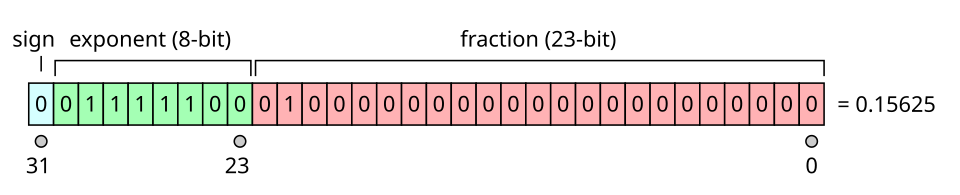 Bit layout for single-precision floating-point numbers. (Image: Codekaizen, CC BY 3.0, via Wikimedia Commons)
Based on the TU BSc CSIT syllabus for Computer Hardware Design, unit 3.
Discussion
Loading…